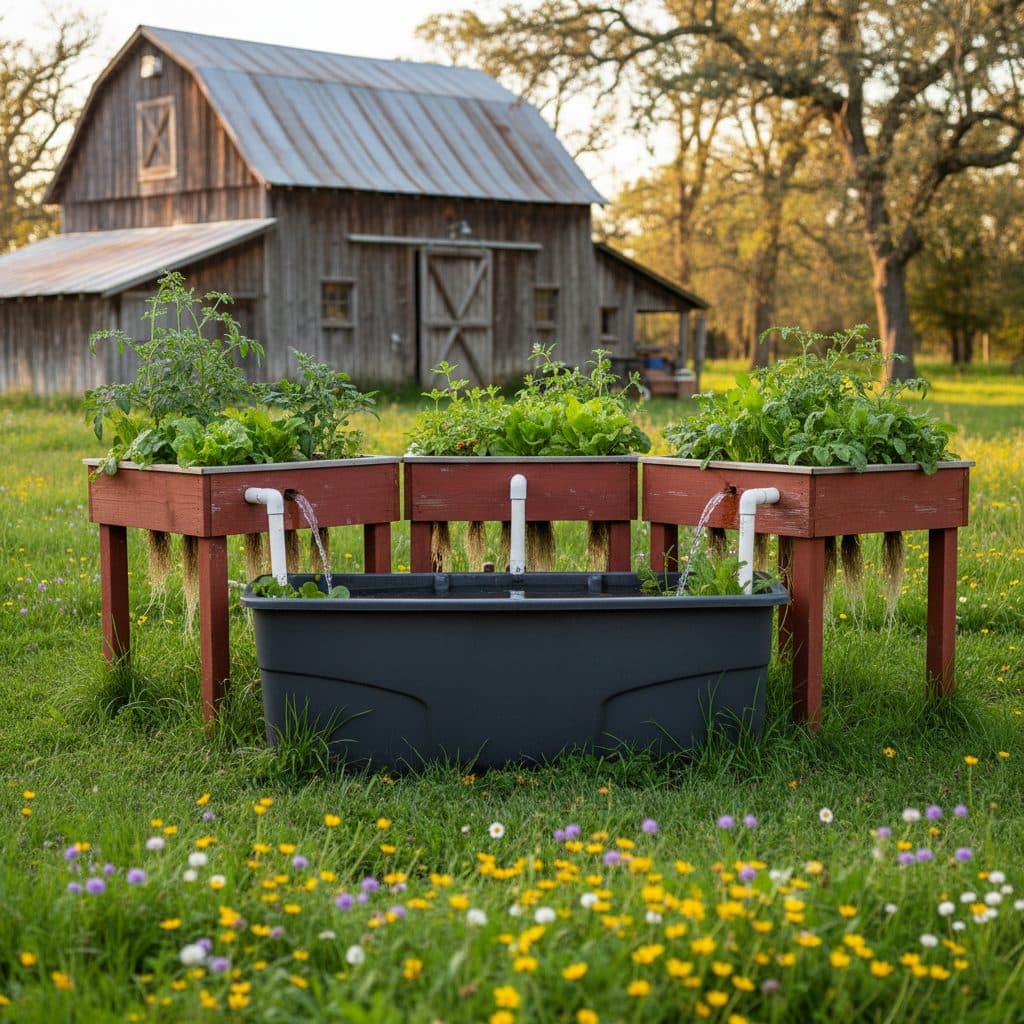
Key takeaways
- Stock tanks and IBCs offer cost-effective, durable, and high-volume solutions for aquaponics fish tanks, often costing 50% less than dedicated aquaculture tanks.
- Proper sizing is critical, with a general guideline of 1 lb of fish per 5-10 gallons of water for optimal health and system balance.
- Thorough cleaning, sealing, and plumbing are essential steps to ensure the safety and longevity of your converted tank, especially for food-grade systems.
- Effective filtration (mechanical and biological), aeration, and temperature control are non-negotiable for maintaining healthy fish and plant growth.
- Choosing the right fish species, like Tilapia or Trout, is vital for success, considering their growth rates and tolerance to varying water conditions.
- Regular water testing and maintenance are crucial for system stability, monitoring parameters like pH, ammonia, nitrite, and nitrate levels daily.
Quick answer: Stock tanks and IBCs can be converted into productive aquaponics systems by ensuring proper cleaning, sealing, plumbing, filtration, and temperature control. They offer a cost-effective and durable alternative to dedicated aquaculture tanks, often saving 50% or more on initial setup.
In the arid landscapes of Arizona, or the humid expanses of Florida, growers are constantly seeking resourceful ways to maximize their agricultural output. For those exploring aquaponics, the fish tank often represents a significant initial investment. However, many experienced US growers have discovered that readily available, robust containers like livestock stock tanks and Intermediate Bulk Containers (IBCs) offer a practical and economical alternative. These options can significantly reduce initial setup costs compared to purpose-built aquaculture tanks, making aquaponics more accessible.
Converting a stock tank or IBC into a functional fish tank for an aquaponics system requires careful planning and execution. From understanding the material properties to ensuring adequate water volume and filtration, each step is critical for the health of your fish and the productivity of your plants. This guide will walk you through the process, grounded in practical experience and numerical data, to help you build a resilient and productive aquaponics system right in your backyard or greenhouse.
Why stock tanks and IBCs are viable fish tank options
When considering the foundation of an aquaponics system, the fish tank is paramount. For many growers across the Midwest, from Ohio to Iowa, stock tanks and IBCs (Intermediate Bulk Containers) have emerged as highly practical choices. A standard 300-gallon stock tank, often found at farm supply stores for around $200-$400, provides a substantial water volume for a small to medium-sized system. IBCs, typically 275 or 330 gallons, can sometimes be sourced for even less, often between $50-$150 if cleaned and food-grade, representing a significant cost saving over dedicated aquaculture tanks which might run upwards of $1,000 for a similar capacity. These containers are designed for durability, often made from UV-stabilized polyethylene or polypropylene, standing up to outdoor conditions in USDA zones 4 through 9 for many years.
Durability and cost-effectiveness for growers
The inherent strength and weather resistance of these containers make them ideal for long-term use. A typical polyethylene stock tank can last 10-15 years, even when exposed to harsh sunlight and freezing temperatures in northern states like Minnesota. This longevity, combined with their lower purchase price, translates to a superior return on investment for growers. Furthermore, their large, open top design in the case of stock tanks, or the ability to easily cut an access port in an IBC, simplifies maintenance tasks like fish feeding, water testing, and tank cleaning. For more on setting up a complete system, see our guide on aquaponics systems explained: fish, plants, and the nitrogen loop.
- Cost savings: Often 50% to 80% cheaper than commercial aquaculture tanks.
- High volume: Typically 275-330 gallons for IBCs, 150-500 gallons for stock tanks.
- Durability: UV-stabilized plastics resist degradation for 10+ years.
- Availability: Widely available at farm supply stores and industrial suppliers.
- Ease of modification: Simple to drill for plumbing connections.
The robust construction of these tanks means they can withstand the weight of hundreds of gallons of water, approximately 8.34 pounds per gallon, without structural compromise. This is a critical factor for any water-holding vessel, especially when considering the dynamic environment of an aquaponics system. With proper support and placement on a level surface, these tanks offer a stable and secure habitat for fish. That stability also supports the plants that rely on the fish waste nutrients.
Sizing your fish tank for success
The size of your fish tank directly impacts the number of fish you can comfortably raise and, consequently, the amount of nutrients available for your plants. A common guideline for fish density in an aquaponics system is to manage stocking density carefully, though advanced systems can support higher densities with robust filtration. For a 300-gallon stock tank, this means you could potentially house 30-60 lbs of fish, such as Tilapia or Trout, which are popular choices for US growers due to their growth rate and adaptability. This calculation matters for maintaining a balanced ecosystem where fish waste is adequately processed by beneficial bacteria and absorbed by plants.
Calculating fish capacity and plant needs
When planning your system, consider the mature size of your chosen fish species. Tilapia, for example, can reach a market weight of 1-1.5 lbs in 6-9 months, meaning a 300-gallon tank could support 20-40 Tilapia to harvest size. Trout, preferring cooler waters (55-65°F), might grow to 1-2 lbs in 8-12 months. The ratio of fish tank volume to grow bed volume is also important, with many systems using a grow bed volume at least equal to the fish tank volume. For a 300-gallon fish tank, aim for 300-600 gallons of grow bed volume to ensure all fish waste nutrients are absorbed. This balance prevents nutrient buildup and maintains water quality for the fish. For more specific guidance on fish tank considerations, check out our article on turning a fish tank into an aquaponics garden.
- Fish density: Aim for 1 lb of fish per 5-10 gallons of water.
- Tank-to-grow bed ratio: Generally 1:1 or 1:2 (fish tank to grow bed volume).
- Species growth: Tilapia reach 1-1.5 lbs in 6-9 months; Trout 1-2 lbs in 8-12 months.
- Water volume: A 300-gallon tank can support 30-60 lbs of fish.
- Space considerations: Allow 2-3 feet around the tank for maintenance access.
Beyond fish density, consider the physical space required for your tank. A 300-gallon oval stock tank is typically about 8 feet long, 3 feet wide, and 2 feet deep. An IBC is roughly 4 feet long, 3 feet wide, and 4 feet tall. Ensure your chosen location, whether in a greenhouse in USDA zone 7 or an outdoor setup in southern California, can accommodate these dimensions, plus extra room for plumbing, pumps, and grow beds. Remember that a full 300-gallon tank weighs over 2,500 lbs, so a strong, level foundation is non-negotiable to prevent structural failure or uneven stress on the tank walls.
Preparing your chosen vessel for fish
Once you’ve selected your stock tank or IBC, the preparation phase is critical to ensure a safe and healthy environment for your fish. The first and most important step is thorough cleaning. Many IBCs, even if food-grade, may have contained various liquids, from food oils to chemicals. Always verify the previous contents of an IBC by checking the label or asking the supplier. If the IBC held anything other than potable water or food-grade liquids, it should not be used for aquaponics. Even food-grade IBCs need rigorous cleaning; a dilute bleach solution, followed by multiple thorough rinses and airing out, can be used to sterilize the interior. For stock tanks, a good scrub with a stiff brush and warm water, followed by a rinse, is usually sufficient.
Modifying and sealing for longevity
For IBCs, you’ll likely need to cut an access port into the top for feeding and maintenance. Use a jigsaw or reciprocating saw to create an opening of at least 2 feet by 2 feet, ensuring smooth edges to prevent injury. For both types of tanks, plumbing connections are essential. Drill holes for your water pump return line and, if using a siphon system, for your grow bed return. Use bulkheads designed for water tanks, ensuring a tight, leak-proof seal with silicone sealant. A 1-inch bulkhead is common for water returns, while a 1.5-inch or 2-inch bulkhead is often used for drain lines. Always test for leaks by filling the tank with water for 24-48 hours before adding fish. The USDA Natural Resources Conservation Service emphasizes proper water management in agricultural systems [6], which includes leak prevention.
- Source food-grade IBCs: Only use IBCs with known, safe previous contents.
- Thorough cleaning: Bleach solution (1:10) for IBCs, scrubbing for stock tanks.
- Cut access port: For IBCs, create a 2 ft x 2 ft minimum opening.
- Install bulkheads: Use appropriate sizes (e.g., 1 inch for returns, 2 inch for drains) with silicone sealant.
- Leak test: Fill tank for 24-48 hours to confirm no leaks before introducing fish.
After cleaning and modifications, consider painting the exterior of your tank, especially if it’s an IBC with a clear or translucent plastic bladder. Direct sunlight can promote excessive algae growth, which competes with your plants for nutrients and can fluctuate water pH. Painting the outside with a dark, non-toxic, exterior-grade paint will block light, helping to maintain stable water conditions. This step is particularly important in sunny regions like California or Texas, where intense UV exposure can also degrade plastics over time. A dark color will also help absorb solar heat, which can be beneficial in cooler climates for maintaining optimal fish temperatures, especially for species like Tilapia that thrive in 75-85°F water.
Essential equipment and setup for fish health
A successful aquaponics system relies heavily on maintaining optimal water quality for your fish. This necessitates several key pieces of equipment beyond just the tank. First, filtration is paramount. A combination of mechanical filtration (to remove solid waste) and biological filtration (to convert ammonia to nitrates) is essential. For a 300-gallon tank, a filter pump capable of turning over the tank’s volume at least once per hour (e.g., 300 GPH) is a good starting point. This pump will feed water to your grow beds, which often serve as the primary biological filter. Additionally, a separate mechanical filter, like a swirl filter or radial flow settler, can remove a significant portion of solid fish waste before it reaches the grow beds, preventing clogging and anaerobic zones.
Aeration, heating, and monitoring
Fish require dissolved oxygen to survive, typically needing 5-8 mg/L. An air pump with an air stone is crucial, especially in warmer water where oxygen solubility decreases. For a 300-gallon tank, an air pump rated for 100-200 gallons is usually sufficient, as the water returning from grow beds also adds oxygen. A heater may be necessary if you’re raising warm-water fish like Tilapia in cooler climates or during winter months in USDA zone 6. An appropriately sized submersible heater can maintain temperatures in a 300-gallon tank, though insulation around the tank can significantly reduce heating costs. Monitoring water parameters daily with a reliable test kit is non-negotiable; check pH, ammonia, nitrite, and nitrate. This vigilance ensures fish health and plant nutrient uptake.
- Filter pump: 300+ GPH for a 300-gallon tank, turning water over 1x per hour.
- Air pump & stone: Rated for 100-200 gallons to ensure 5-8 mg/L dissolved oxygen.
- Submersible heater: 300+ watts for maintaining temperatures for warm-water fish.
- Water test kit: Essential for daily monitoring of pH, ammonia, nitrite, and nitrate.
- Tank insulation: Rigid foam board can reduce heating costs by 30% in cooler climates.
Finally, consider the lighting for your plants. While the fish tank itself doesn’t require direct light, the grow beds connected to it certainly do. If your system is indoors, especially in a basement or garage, supplemental lighting is a must. A high-efficiency LED grow light, often found in conjunction with a reflective indoor grow tent, can provide the necessary spectrum and intensity for plant growth. Even in a greenhouse, winter months in northern states like Michigan might require additional lighting to maintain optimal plant production. Remember that healthy plants are just as vital as healthy fish for a balanced and productive aquaponics system, as they remove nitrates from the water, completing the nitrogen cycle.
Maintaining water quality and fish health
Consistent water quality is the cornerstone of any successful aquaponics system. Without it, both your fish and plants will suffer. Daily monitoring of key parameters is non-negotiable. You should be testing for pH, ammonia, nitrite, and nitrate. A pH range of 6.0-7.0 is generally ideal, as it suits most common aquaponics fish like Tilapia and provides good nutrient availability for plants. Ammonia and nitrite levels should always be at 0 parts per million (ppm); any detectable levels indicate a problem with your biological filtration, which could quickly become lethal to fish. Nitrate levels, on the other hand, should be present, ideally between 5-80 ppm, as these are the primary nutrients for your plants. If nitrates are consistently low, you may need more fish or to feed them a bit more; if too high, you might need more plant grow bed volume. This constant vigilance is critical for preventing issues like ‘fish tank granuloma,’ a bacterial infection that can affect fish and, rarely, humans [3].
Feeding, water changes, and disease prevention
Feeding your fish a high-quality, protein-rich diet (typically 32-40% protein for Tilapia) is essential for their growth and for providing nutrients to your plants. Feed only what the fish can consume in 5-10 minutes, two to three times a day, to avoid overfeeding and excess waste buildup. While a well-balanced aquaponics system requires fewer water changes than a traditional aquarium, occasional partial water changes (10-20% every 2-4 weeks) can help replenish trace minerals and dilute any accumulated undesirable compounds. Always use dechlorinated water for top-offs and changes, as chlorine is toxic to both fish and beneficial bacteria. In regions with hard water, like parts of Texas, monitoring mineral buildup is especially important.
- Daily water tests: Monitor pH (6.0-7.0), ammonia (0 ppm), nitrite (0 ppm), nitrate (5-80 ppm).
- High-quality feed: Use 32-40% protein feed, feeding 2-3 times daily what fish consume in 5-10 minutes.
- Partial water changes: 10-20% every 2-4 weeks with dechlorinated water.
- Disease prevention: Isolate new fish for 1-2 weeks before introducing them to the main tank.
- Temperature stability: Maintain consistent temperatures; Tilapia thrive at 75-85°F, Trout at 55-65°F.
Disease prevention is far easier than treatment in an aquaponics system. When introducing new fish, quarantine them in a separate tank for 1-2 weeks to observe for any signs of illness before adding them to your main system. Maintain stable water temperatures, as sudden fluctuations (more than 5°F in a day) can stress fish and make them more susceptible to disease. Ensure proper aeration at all times, as low oxygen levels are a common stressor. By adhering to these practices, you can create a robust and healthy environment that supports both thriving fish populations and productive plant growth, yielding fresh produce and protein year-round, even in challenging climates like the high desert of New Mexico.
Stock Tank vs. IBC for Aquaponics Fish Tanks
Feature | Stock Tank (e.g., 300 gal oval) | IBC (e.g., 275 gal caged) |
|---|---|---|
Typical Volume | 150-500 gallons | 275-330 gallons |
Cost (New/Used) | $200-$500 (new) | $50-$150 (used, food-grade) |
Material | Polyethylene, galvanized steel | HDPE plastic bladder in steel cage |
UV Resistance | Often UV-stabilized | Bladder needs painting to block light |
Shape/Footprint | Oval or round, lower height | Rectangular, taller, smaller footprint |
Ease of Access | Open top, easy access | Requires cutting a top opening (e.g., 2 ft x 2 ft) |
Structural Support | Self-supporting, needs level ground | Steel cage provides support |
Cost Savings: Converting a food-grade IBC can offer significant savings on initial tank costs compared to purchasing a new commercial aquaculture tank of similar volume.
Fish Density: For a balanced aquaponics system, aim for a fish density of 1 lb of fish per 5-10 gallons of water, allowing a 300-gallon tank to support 30-60 lbs of fish.
Water Turnover: Ensure your pump provides a flow rate capable of turning over the entire tank volume at least once per hour; for a 300-gallon tank, this means a minimum 300 GPH pump.
Frequently asked questions
What is the best fish-to-water ratio for an aquaponics system?
A common guideline for aquaponics is 1 lb of fish per 5-10 gallons of water. For beginners, starting with 1 lb per 10 gallons in a 300-gallon system, supporting 30 lbs of fish, provides a safer buffer against water quality issues.
How often should I clean my aquaponics fish tank?
In a well-balanced aquaponics system, the grow beds act as biological filters, reducing the need for frequent deep cleaning of the fish tank. You should perform a 10-20% partial water change every 2-4 weeks and remove any large solid waste accumulation from the bottom as needed, perhaps monthly.
Can I use any IBC for an aquaponics fish tank?
No, you should only use food-grade IBCs that previously contained potable water or food products. IBCs that held chemicals or petroleum products can leach harmful substances into your system, contaminating your fish and plants. Always verify the previous contents and clean thoroughly with a 1:10 bleach solution.
What water temperature is ideal for aquaponics fish?
The ideal water temperature depends on your chosen fish species. Tilapia thrive in warmer water, typically 75-85°F, while Trout prefer cooler temperatures between 55-65°F. Maintaining stable temperatures within the species’ optimal range, often with a 300-watt heater, is crucial for fish health and growth.
How much grow bed volume do I need for my fish tank?
A good starting point for the ratio of fish tank volume to grow bed volume is 1:1 or 1:2. For example, a 300-gallon fish tank would ideally be paired with 300-600 gallons of grow bed volume to effectively process fish waste and provide nutrients for plants.
What are the most important water parameters to monitor?
The most critical water parameters to monitor daily are pH (ideally 6.0-7.0), ammonia (should be 0 ppm), nitrite (should be 0 ppm), and nitrate (should be between 5-80 ppm). These readings directly indicate the health of your fish and the effectiveness of your biological filtration.
References
- Fish Tank (2009). Fish Tank.
- Beware the Fish Tank (2016). Beware the Fish Tank.
- Fish tank granuloma (2023). Fish tank granuloma.
- TANK SIZING AND OPTIMIZING LOOP PLACEMENT IN A BRANCHED WATER DISTRIBUTION SYSTEM (2023). TANK SIZING AND OPTIMIZING LOOP PLACEMENT IN A BRANCHED WATER DISTRIBUTION SYSTEM.
- Swimming in a Stock Tank (2023). Swimming in a Stock Tank.
- USDA Natural Resources Conservation Service (2024). USDA Natural Resources Conservation Service.