Key takeaways
- Identify major monsoon fungal diseases early: damping-off, powdery mildew, downy mildew, leaf spots, and collar rot.
- Elevate grow bags on pot stands and prune lower foliage to prevent water-splash fungal spore transmission.
- Apply biological control agents like Trichoderma viride and Pseudomonas fluorescens to root zones before rains start.
- Spray organic preventative bio-fungicides like diluted sour buttermilk (chaas) or cold-pressed neem oil emulsion.
- Remove and safely dispose of severely infected leaves immediately to prevent rapid airborne spore dispersal.
Quick answer: Managing fungus on plants in rainy season gardens requires improving air circulation, ensuring rapid container drainage, and applying preventative biological fungicides. Elevating pots off wet ground, pruning lower leaves to stop soil splash, and spraying organic solutions like sour buttermilk or Trichoderma viride controls powdery mildew, damping-off, and root rot naturally.
The arrival of the Indian monsoon (kharif season) brings welcome moisture and rapid plant growth, but the combination of sustained rainfall, high relative humidity (often exceeding 85% to 95%), and warm temperatures (25°C to 35°C) creates the perfect breeding ground for destructive plant pathogenic fungi.
Identifying and treating fungus on plants in rainy season is one of the most critical skills for kitchen and terrace gardeners. Within just 48 to 72 hours of persistent wet weather, fungal spores can germinate, penetrate leaf stomata or root tissues, and spread across an entire container garden, causing defoliation, stem collapse, and crop failure.
By understanding the symptoms of common monsoon fungal pathogens and implementing proactive cultural practices, biological inoculants, and organic home-made foliar sprays, you can protect your vegetables and ornamentals throughout the rainy season.
Common monsoon fungal diseases and identification
Accurate diagnosis is the first step in effective organic disease management:
- Damping-off (Pythium and Rhizoctonia species): Attacks newly germinated seedlings in nursery trays. Stems turn water-soaked, blacken at the soil line, and collapse overnight.
- Root rot and collar rot (Phytophthora and Fusarium species): Caused by waterlogged, anaerobic soil. Plants wilt during bright intervals despite wet soil; stems turn brown and mushy at the soil line, and the root system turns dark brown and rots away. Review revival steps in our root rot overwatering rescue guide.
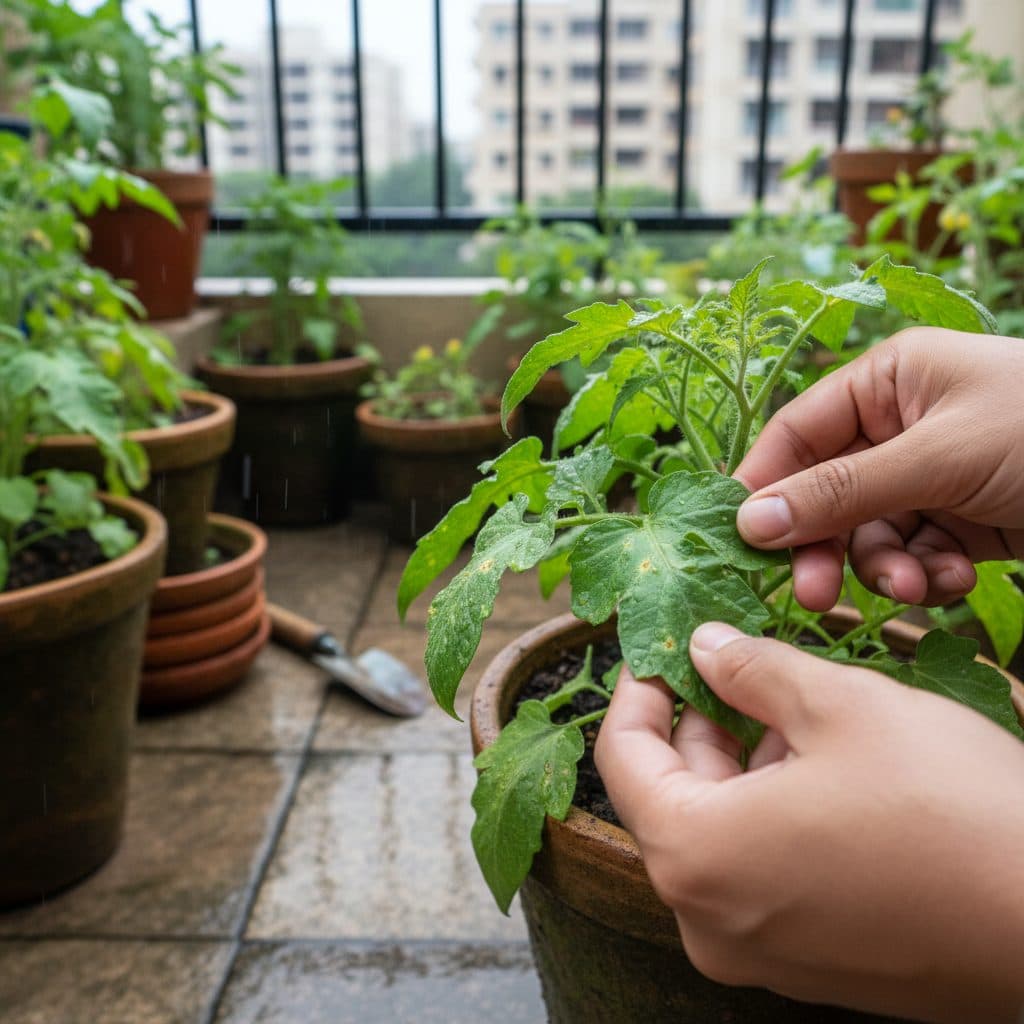
- Powdery mildew (Erysiphaceae family): Forms dusty, talcum-powder-like white patches on upper leaf surfaces, young stems, and flower buds of cucurbits (gourds, squashes), tomatoes, and ornamentals. Leaves turn yellow and curl.
- Downy mildew (Pseudoperonospora cubensis): Thrives in cool, rainy weather. Produces angular, yellow-to-brown patches on upper leaf surfaces bounded by leaf veins, with a purplish-grey downy mould on the corresponding leaf undersides.
- Anthracnose and leaf spots: Cercospora leaf spot: small spots with pale grey centres and dark brown margins. Colletotrichum anthracnose: sunken, water-soaked lesions on chilli and tomato fruit, often with concentric rings of dark spore masses. Concentric target rings on the leaves themselves indicate early blight (Alternaria solani).
Note that Pythium and Phytophthora are oomycetes (water moulds) rather than true fungi. Cultural control is the same (drainage and airflow), but many fungicides and home sprays have no effect on them.
For a structured diagnostic approach across diverse garden plants, refer to our comprehensive plant disease diagnosis flowchart.
Cultural controls to prevent fungal proliferation
Most fungal and oomycete pathogens need a film of moisture on the tissue for several hours to infect, so eliminating standing moisture is your primary defence. Powdery mildew is the exception — it germinates on dry leaves in humid, still air, so there the fix is spacing and airflow, not leaf-drying:
- Elevate all containers: Never let pots or grow bags sit flat on wet terrace concrete. Place containers on metal pot stands, terracotta tiles, or bricks so drainage water drains away instantly.
- Prune lower foliage (bottom clearance): Prune away all leaves growing within 10 cm to 15 cm of the soil surface. Heavy raindrops splashing on wet potting soil bounce fungal spores directly onto lower leaves; maintaining bottom clearance breaks this transmission cycle.
- Widen plant spacing: Increase spacing between grow bags by 20% to 30% during monsoon. Generous spacing allows breezes to circulate through the plant canopy, drying leaf surfaces rapidly after rain.
- Sterilise cutting tools: Disinfect secateurs and pruning shears with rubbing alcohol or a 10% bleach solution between cuts to avoid transferring fungal pathogens between plants. Review proper procedures in our guide on how to sterilise pruners and stop plant disease.
To integrate these physical steps with broader terrace rain management, see our complete guide on how to protect plants from heavy rain.
Biological control agents: Trichoderma and Pseudomonas
Beneficial microbial bio-fungicides offer highly effective, non-toxic protection by colonising plant tissues and parasitizing pathogenic fungi:
- Trichoderma viride and *Trichoderma harzianum: A beneficial soil fungus that aggressively outcompetes root-rot pathogens. Mix 5 g of *Trichoderma powder per litre of water and drench potting soil at the beginning of the monsoon season. It colonises the root surface and coils around pathogen hyphae, secreting chitinase enzymes that dissolve their cell walls.
- Pseudomonas fluorescens: A beneficial rhizobacterium that produces natural antibiotics and induces systemic resistance in plants. Apply as a soil drench (5 g/litre) or foliar spray (5 g/litre) every 14 days during the rainy season.
- Application tip: Always apply bio-fungicides in the late evening or on overcast days, as direct midday UV sunlight kills beneficial microorganisms. Never mix bio-fungicides with synthetic chemical fungicides.
Organic home-made sprays for monsoon fungus control
Several time-tested, non-toxic home preparations effectively suppress foliar mildews and leaf spots without harming beneficial pollinators:
- Fermented sour buttermilk (chaas) spray:
- How it works: Lactic acid bacteria (Lactobacillus) produce an acidic environment and antimicrobial peptides that inhibit fungal spore germination.
- Preparation: Mix 100 ml of well-fermented, sour buttermilk in 1 litre of water. Strain through a fine cloth and spray thoroughly over both sides of leaves every 7 to 10 days. Traditionally used against powdery mildew on gourds and roses. Treat it as a mild preventative and re-apply after rain; it will not control downy mildew.
- Cold-pressed neem oil emulsion:
- How it works: Neem oil acts against foliar mildews as an oil — it coats the leaf surface and physically disrupts spore germination. Its insecticidal compound azadirachtin acts on insects, not fungi, so treat neem as a mild suppressant, not a curative fungicide, and re-apply after rain.
- Preparation: Mix 5 ml of pure cold-pressed neem oil and 2 ml of mild organic liquid soap in 1 litre of warm water. Shake vigorously until fully emulsified and spray early in the morning.
- Baking soda (Sodium bicarbonate) spray:
- How it works: Bicarbonate ions disrupt fungal cell walls and collapse hyphae on contact. Use potassium bicarbonate in preference to sodium bicarbonate — repeated sodium applications build up in a small pot and burn leaves. Spot-test on a few leaves first.
- Preparation: Dissolve 5 g (1 teaspoon) of baking soda and 2 ml of liquid soap in 1 litre of water. Spray at the very first sign of powdery mildew spots.
Sanitation and safe plant disposal
When fungal disease advances beyond the control of preventative sprays, strict sanitation prevents the outbreak from spreading:
- Prompt leaf removal: Snip off infected leaves as soon as spots or mildew patches appear. Catch falling debris in a bucket—do not drop infected leaves onto the potting soil.
- Never compost diseased foliage: Domestic home compost bins rarely generate the sustained high temperatures (60°C+) required to kill fungal resting spores. Placing diseased leaves in your compost bin will contaminate your entire compost supply.
- Bag and discard: Seal heavily infected plant material in garbage bags and dispose of them in municipal waste bins.
- Discard or solarize contaminated soil: Discard the potting mix from a plant lost to collar rot. To reuse it, wait for a dry, hot spell: moisten the mix, seal it in clear polythene bags or under a sealed clear sheet in full sun for four to six weeks, then re-inoculate with Trichoderma before replanting. This cannot be done mid-monsoon.