Key takeaways
- Solar-powered exhaust fans can reduce greenhouse temperatures by 10-15°F, important for plant health in warmer USDA zones like 7-9.
- Proper sizing of both fans and solar panels is critical, often requiring 10-20 watts of solar power per 100 square feet of greenhouse space.
- Direct-drive DC fan systems are generally simpler and more efficient for off-grid applications compared to complex AC inverter setups.
- Strategic placement of intake vents low on one side and exhaust fans high on the opposite side ensures optimal airflow and efficient heat removal.
- Regular maintenance, including cleaning fan blades and solar panels, helps maintain system efficiency and extends the lifespan of components, typically 5-10 years for fans.
- Battery backup is often unnecessary for greenhouse cooling, as the greatest need for ventilation matches peak solar availability during the day.
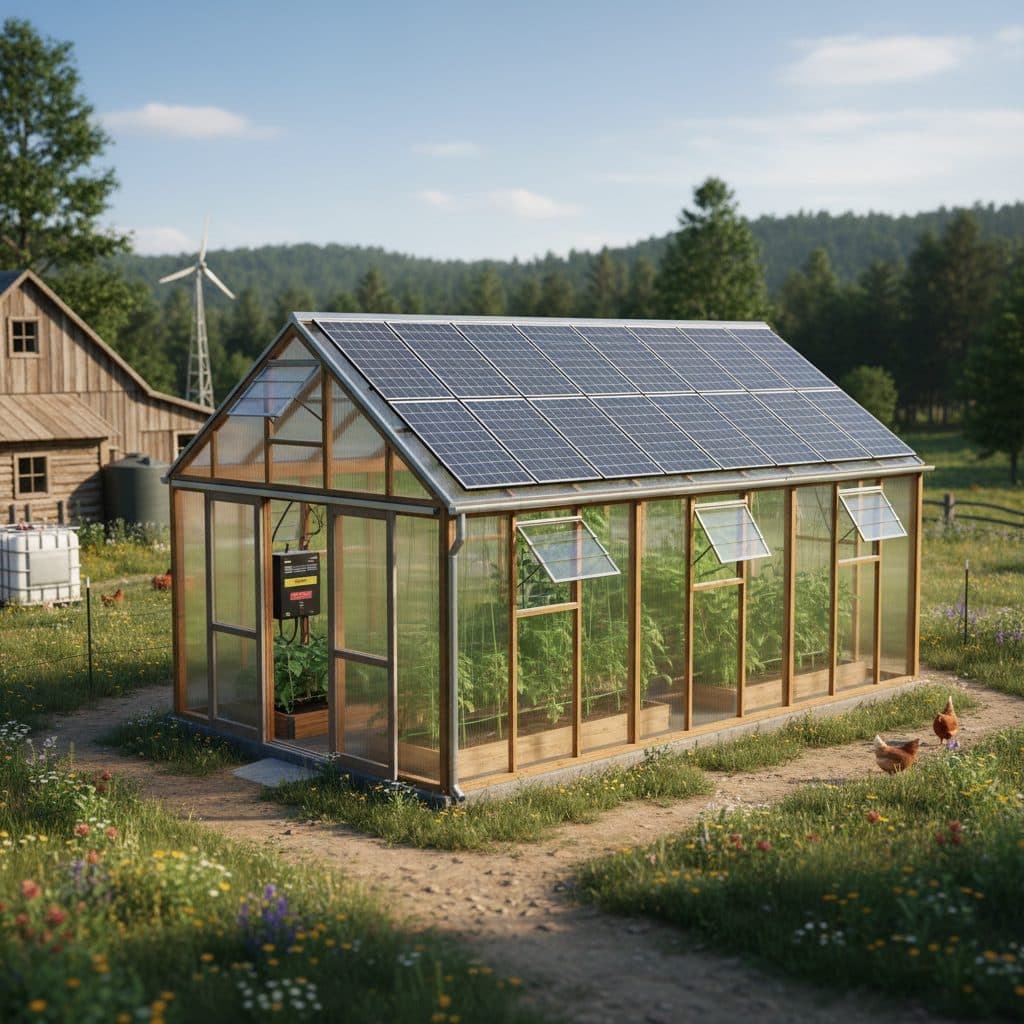
Quick answer: Solar-powered exhaust fans cool greenhouses by using photovoltaic panels to power DC fans, removing hot air and reducing internal temperatures by 10-15°F. This provides essential ventilation for plant health, especially in off-grid or warmer climates.
Growing food in a greenhouse offers many advantages, extending seasons and protecting plants from harsh weather. However, in regions like the American Southwest or even during hot summers in USDA zone 6, a greenhouse can quickly become an oven. Temperatures inside can easily climb significantly higher than ambient outdoor air, reaching 100°F or more on a 75°F day, which stresses most common garden crops like tomatoes and peppers.
For homesteaders operating off the grid, relying on conventional electric fans isn’t always an option without significant battery banks or generator use. This is where solar-powered exhaust fans offer a straightforward and effective solution. These systems use the sun’s energy to drive fans, providing essential ventilation precisely when it’s needed most, without drawing power from your main off-grid system or requiring grid connection. A 2023 study confirmed that these systems effectively reduce peak temperatures in enclosed spaces [1].
The problem of heat in a greenhouse
A greenhouse’s primary function is to trap solar radiation, creating a warmer environment for plant growth. This works well in cooler months or northern climates like USDA zone 4. However, as outdoor temperatures rise, especially above 75°F, this heat-trapping effect becomes a significant liability. Without adequate ventilation, internal temperatures can quickly soar, causing severe plant stress and even death. For instance, tomato plants begin to show stress symptoms around 85°F, and their fruit set can be negatively impacted above 90°F. Peppers and cucumbers also suffer significantly when temperatures consistently exceed 95°F for several hours.
Understanding plant heat stress
High temperatures accelerate plant respiration rates, leading to excessive water loss through transpiration. This can cause wilting, reduced photosynthesis, and poor fruit development. In extreme cases, temperatures above 100°F can cause irreversible damage to plant cells. A well-designed ventilation system, including exhaust fans, is important for maintaining optimal growing conditions, often aiming to keep internal temperatures within 5-10°F of the ideal range for specific crops. Even in a small 100 square foot greenhouse, stagnant hot air can quickly become a problem, necessitating active air movement to prevent these issues.
- wilting leaves and stems
- scorched leaf edges or tips
- reduced flowering or fruit set
- stunted growth and overall vigor
- increased susceptibility to pests and diseases
How solar-powered fans work for cooling
Solar-powered exhaust fans operate on a straightforward principle: photovoltaic (PV) panels convert sunlight directly into electricity, which then powers a direct current (DC) fan. This means the fan runs strongest when the sun is brightest and the greenhouse is hottest, providing ventilation precisely when it’s most needed. Unlike grid-tied systems that might require complex wiring or inverters, a direct-drive DC setup is relatively simple, making it ideal for off-grid homesteads in places like northern Arizona or rural Maine.
Direct current vs. alternating current systems
Most solar greenhouse fans are designed to run on direct current (DC) power, which is what solar panels produce. This eliminates the need for an inverter, which converts DC to alternating current (AC), reducing system complexity and potential points of failure. A 100-watt solar panel can typically power a fan moving 1,000 to 1,500 cubic feet per minute (CFM), which is sufficient for a 10×10 foot greenhouse. These fans often include a simple thermostat or switch, allowing for automated operation when temperatures exceed a set point, such as 80°F. For more details on panel selection, consider our guide on solar panels for off-grid living.
- solar photovoltaic panel
- DC exhaust fan (12V or 24V)
- mounting hardware for panel and fan
- wiring and connectors (often 10-14 gauge)
- optional thermostat or manual switch
Sizing your system: fans and panels
Determining the right size for your solar fan system matters for effective cooling. A common guideline for greenhouse ventilation is to achieve one to two complete air changes per minute. To calculate the required cubic feet per minute (CFM), multiply your greenhouse’s volume (length x width x height) by the desired air change rate (e.g., 1.5). For a 10-foot by 20-foot greenhouse with an 8-foot peak height, the volume is 1,600 cubic feet. At 1.5 air changes per minute, you’d need a fan system capable of moving 2,400 CFM. Many single solar fans move between 1,000 and 2,000 CFM, so you might need one or two fans for this size greenhouse.
Matching panel wattage to fan needs
Once you know your CFM requirements, you can select appropriate fans and then size your solar panels. A typical 12-volt DC fan moving 1,000 CFM might draw 20-30 watts of power. Therefore, a 50-watt solar panel would provide ample power for one such fan, accounting for some efficiency losses. For a larger system requiring 2,400 CFM, you might use two 1,200 CFM fans, each needing a 50-watt panel, totaling 100 watts of solar capacity. Remember that cooling is primarily needed during daylight hours, so battery backup is often unnecessary, simplifying the system and reducing costs. For more on solar components, refer to our guide on off-grid solar kits explained.
- greenhouse volume (length x width x height)
- desired air changes per minute (1-2 is common)
- fan CFM rating (cubic feet per minute)
- fan wattage and voltage (e.g., 12V, 25W)
- solar panel wattage (e.g., 50W, 100W)
Installation and placement for optimal airflow
Effective cooling isn’t just about having powerful fans; it’s also about strategic placement to ensure proper cross-ventilation. Exhaust fans should generally be placed high on one end wall or in the roof of the greenhouse, allowing hot air, which rises, to be efficiently drawn out. For a greenhouse in a region with prevailing westerly winds, placing the exhaust fan on the east side can help pull air across the structure. For example, in a 20-foot long greenhouse, placing the fan 18 feet from the intake on the opposite end maximizes air travel.
Intake vents and sealing
Corresponding intake vents should be located low on the opposite end or side of the greenhouse. These vents, often simple louvered openings, allow cooler, fresh air to be drawn in as hot air is expelled. The total area of your intake vents should be at least 1.5 times the area of your exhaust fan opening to ensure unrestricted airflow. For a 12-inch fan, which has an area of roughly 0.8 square feet, you’d want at least 1.2 square feet of intake vent area. It’s also important to seal any unintended gaps or cracks in the greenhouse structure, as these can create short-circuiting of airflow, reducing the fan’s efficiency. Consider adding a thermostatic control for automatic fan operation when temperatures exceed a set point, like 80°F. More on climate control can be found in our article on greenhouse climate control.
- mount exhaust fan high on one end or roof
- place intake vents low on the opposite end or side
- ensure intake vent area is 1.5x exhaust fan area
- seal all unintended gaps and cracks in the structure
- orient to prevailing winds for improved natural airflow
Maintenance and troubleshooting
While solar-powered exhaust fan systems are generally low-maintenance, a few routine tasks can ensure their longevity and optimal performance. The most common issue is dust accumulation on fan blades and solar panels. Dust on solar panels can reduce power output in arid regions like New Mexico. Cleaning panels with water and a soft brush every 3-6 months, or more frequently in dusty environments, will maintain peak efficiency. Fan blades should also be checked and wiped clean annually to prevent imbalances and reduce motor strain, extending the fan’s lifespan.
Checking wiring and connections
Periodically inspect all wiring connections for corrosion or loose terminals, especially at the solar panel and fan motor. Exposed wiring can degrade over time, particularly in humid greenhouse environments, potentially reducing voltage. Ensure all connections are secure and weatherproof. If a fan isn’t operating or is running slowly on a sunny day, check for shading on the solar panel, which can drastically cut power output. A single shaded cell on a panel can significantly reduce its overall output. Most solar panels are designed to last 20-25 years, while the DC fans typically have a lifespan of 5-10 years, depending on usage and environmental conditions. For broader off-grid system care, consider our resources on off-grid living.
- clean solar panels every 3-6 months
- wipe fan blades annually to remove dust
- inspect wiring for corrosion or loose connections
- check for any shading on the solar panel
- monitor fan operation during peak sun hours
Greenhouse Cooling Options Comparison
Feature | Solar DC Fan System | Grid-Tied AC Fan System | Passive Ventilation |
|---|---|---|---|
Power Source | Sunlight (DC) | Grid Electricity (AC) | Natural Airflow |
Operating Cost | Zero (after initial install) | Moderate (electricity bill) | Zero |
Installation Complexity | Low to Moderate (wiring, mounting) | Moderate (electrical hookup) | Very Low (opening vents) |
Cooling Effectiveness | Good (reduces temps by 10-15°F) | Excellent (precise control) | Limited (depends on wind, temp) |
Off-Grid Suitability | Excellent | Poor (requires inverter/generator) | Excellent |
Automation | Simple thermostat options | Advanced controls available | Manual or simple auto-vents |
Temperature Drop: Solar-powered exhaust fans can effectively lower internal greenhouse temperatures by 10-15°F on sunny days, critical for plant health in zones like USDA 8.
Sizing Rule: Aim for 1-2 air changes per minute in your greenhouse; a 10×10 ft greenhouse with 8 ft walls needs 800-1600 CFM, often requiring a 50-watt solar panel per 1000 CFM fan.
References
- Use of solar photovoltaic powered fans to reduce peak temperatures in outdoor cabinets (2023).
- Fluid-Thermal Characteristics of Solar-Exhaust Gas Powered Dryer: An Experimental Validation (2023).
- Novel Gas Turbine Exhaust Temperature Measurement System (2013).
- A case study for the effectiveness of solar-powered attic ventilation fans (2014).
- Abelmoschus esculentus (2019).
- USDA Natural Resources Conservation Service (2024).