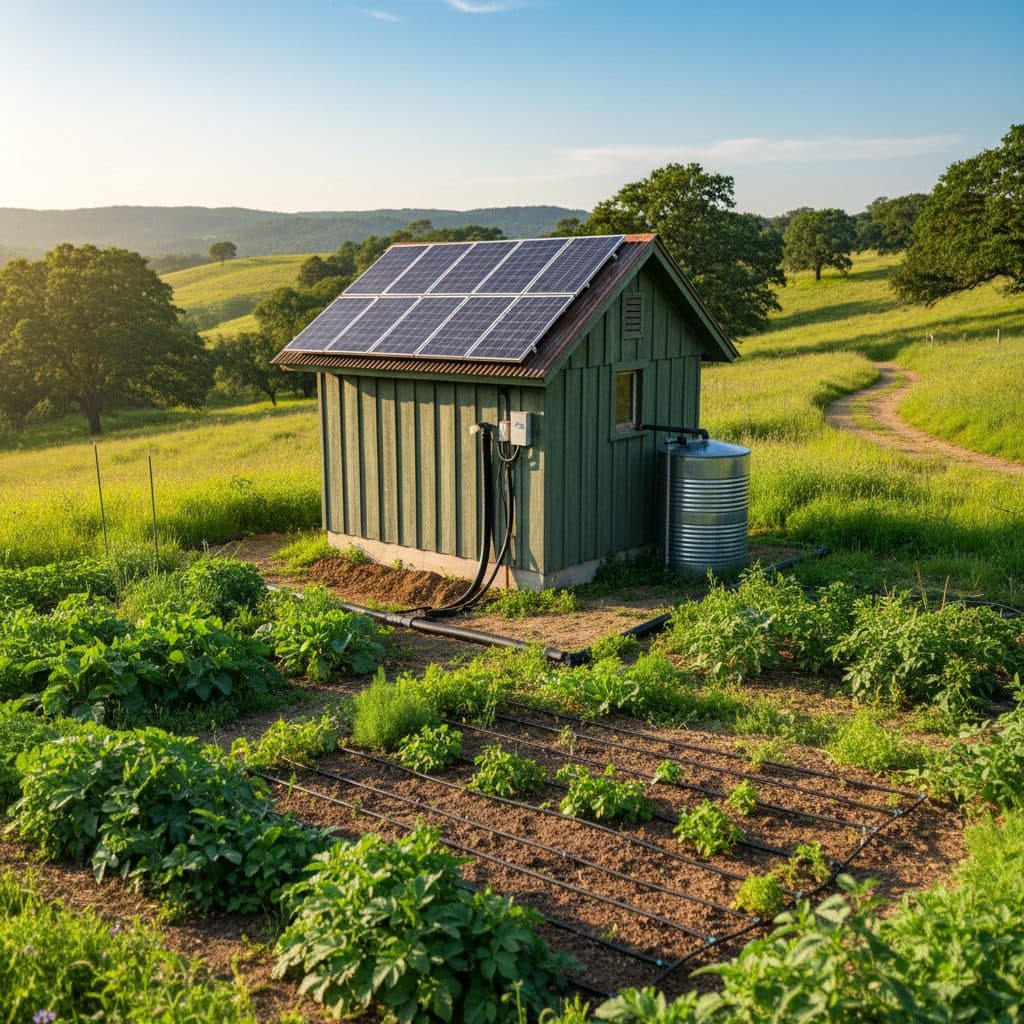
Key takeaways
- Solar water pumps offer reliable, independent water access for off-grid homesteads, reducing reliance on grid power or fossil fuels.
- Understanding your specific water needs, including daily volume (gallons per day) and vertical lift (feet), is critical for proper system sizing.
- Common solar pump types include submersible pumps for deep wells and surface pumps for shallow water sources or transfer tasks.
- A well-designed solar pumping system can operate for 20 years or more with minimal maintenance, providing long-term water security.
- Integrating solar pumps with storage tanks and efficient irrigation methods, like drip systems, maximizes water usage and system effectiveness.
- While initial costs can be higher, solar pumps eliminate ongoing fuel or electricity bills, leading to significant savings over a 10-year period.
Quick answer: Off-grid solar water pumps use photovoltaic (PV) technology to convert sunlight directly into electricity, powering wells and irrigation systems. This provides reliable, independent water access without grid power or fossil fuels, offering long-term water security for homesteads.
In the arid stretches of eastern Washington, where summer temperatures can hit 95°F for weeks on end, a reliable water source is essential for growing food and sustaining livestock, not merely convenient. For many off-grid homesteads across the US, from the humid subtropics of Florida to the high deserts of Arizona, traditional grid power for wells and irrigation pumps is simply not an option. Solar pumps provide an independent way to keep water flowing.
For over 40 years, solar energy has been used to power irrigation pumps, with early designs appearing as far back as 1976 and 1978, utilizing steam or thermal energy to lift water [3, 2]. Today’s photovoltaic (PV) solar pumps are far more efficient, converting sunlight directly into electricity to run a motor. This technology provides a practical path to water independence, allowing growers to manage their water resources without the constant hum of a generator or the monthly utility bill, often saving thousands of dollars over the system’s lifespan.
Why choose solar for your off-grid water needs?
The decision to go off-grid often stems from a desire for self-sufficiency and reduced reliance on external systems. For water, this means moving beyond municipal lines or grid-powered wells. Solar water pumps provide a direct, sustainable answer to this need, particularly for those in remote areas or where grid extension costs are prohibitive, often exceeding $20,000 per mile. One of the primary benefits is the elimination of ongoing fuel costs; once installed, the sun provides free energy for decades. A typical diesel pump might consume 2 gallons of fuel per hour, costing over $8 for a single hour of operation at current prices.
Beyond cost, solar pumps offer incredible reliability. With fewer moving parts than internal combustion engines, they require less maintenance, often needing only an annual check-up. This translates to more uptime and less worry, especially during critical irrigation periods in USDA zones 6 and 7, where summer droughts are increasingly common. Furthermore, integrating solar pumps into a broader off-grid system, perhaps alongside solar for tiny homes or solar livestock water heaters, creates a truly resilient homestead. This holistic approach to energy management ensures that essential services, like water, remain operational even when the grid is down or unavailable.
The independence of solar-powered water
The ability to pump water independently is a significant step towards full off-grid living. Imagine a homestead in rural Montana, far from power lines, where a solar pump draws 500 gallons of water daily from a 150-foot deep well for garden irrigation and livestock. This level of self-reliance is achievable and practical. The absence of fuel storage requirements and the minimal operational noise are also considerable advantages over gasoline or diesel alternatives. Many systems are designed to operate for 20 years or more, offering a long-term investment that pays dividends in water security and peace of mind. The initial investment, while potentially several thousand dollars, is often recouped within five to seven years through avoided fuel and utility expenses.
- Eliminates ongoing fuel or electricity bills, saving hundreds to thousands annually.
- Provides reliable water access for homesteads in remote locations, up to 100 miles from grid infrastructure.
- Reduces maintenance requirements compared to combustion engine pumps, with typical service intervals of one year.
- Contributes to overall homestead resilience, especially during power outages or natural disasters.
- gives a quiet operation, improving the peaceful environment of an off-grid property.
Understanding different types of solar water pumps
Choosing the right solar water pump depends heavily on your specific water source and application. There are two main categories: submersible pumps and surface pumps. Submersible pumps are designed to be placed directly into a well or borehole, often hundreds of feet deep, pushing water upwards. They are ideal for deep wells, typically those deeper than 20 feet, and can handle significant lifts, delivering consistent flow rates for residential use or significant irrigation in regions like the Central Valley of California.
Surface pumps, on the other hand, sit above the water source and pull water up. They are suitable for shallow wells (less than 20 feet deep), ponds, rivers, or for transferring water between tanks. These pumps are generally easier to install and maintain because they are accessible, but their suction lift is limited. For example, a surface pump might be used to draw water from a rainwater harvesting tank into a garden irrigation system in USDA zone 8. Each type has its niche, and understanding your water source’s characteristics is the first step.
Pump technologies and their applications
Within these categories, various technologies exist. Centrifugal pumps are common for high flow rates at lower pressures, suitable for flood irrigation or filling large tanks quickly, often delivering high flow rates. Diaphragm pumps and piston pumps are positive displacement pumps, meaning they deliver a fixed volume of water per stroke, making them efficient for high-pressure, lower-flow applications, like drip irrigation or supplying pressure tanks for domestic use. Early solar pumps often used more complex thermal systems, like the Rankine cycle, which were developed in the late 1970s to convert solar heat into mechanical work for pumping [4]. Modern PV systems are much simpler and more direct.
- Submersible pumps are best for deep wells, capable of lifting water from depths exceeding 200 feet.
- Surface pumps are suited for shallow water sources or transferring water, with a maximum suction lift of about 20 feet.
- Centrifugal pumps provide high flow rates for irrigation, often moving over 30 gallons per minute.
- Diaphragm and piston pumps are efficient for high-pressure, low-flow applications, ideal for drip systems.
- Brushless DC motors are preferred in modern solar pumps for their longevity and efficiency, often lasting 10 years longer than brushed motors.
Sizing your solar pump system for optimal performance
Properly sizing a solar water pump system ensures reliable operation. Sizing depends on the whole system, including the pump, solar array, and battery storage. The two primary factors are total dynamic head and required flow rate. Total dynamic head is the total vertical distance the water needs to be lifted plus any friction losses in the piping, measured in feet. For example, a well 100 feet deep with a 10-foot run to a tank might have a total dynamic head of 115 feet, accounting for pipe friction.
The required flow rate is how much water you need per day, typically measured in gallons per day (GPD) or gallons per minute (GPM). A small garden might need 50 GPD, while livestock and extensive irrigation in a USDA zone 9 homestead can demand 1,000 GPD or more. Once these figures are established, you can select a pump that meets these requirements. The solar panel array size will then be determined by the pump’s power consumption (watts) and the number of peak sun hours in your location, which can range from three hours in winter in the Pacific Northwest to six hours in summer in the Southwest.
Sizing the solar array and batteries
Most solar water pumps are DC-powered and can run directly from solar panels without an inverter, simplifying the system. However, for continuous operation during cloudy days or at night, battery storage is essential. A battery bank sized for two to three days of autonomy is common, providing a buffer against inclement weather. For instance, if your pump draws 200 watts for 5 hours a day, it consumes 1,000 watt-hours daily. A 12-volt battery bank providing 3,000 watt-hours (e.g., two 100 Ah 12V batteries in parallel) would offer three days of backup.
- Measure your total dynamic head, including vertical lift and pipe friction, to determine pump pressure requirements.
- Calculate your daily water needs in gallons per day for all uses, such as 200 gallons for a family of four.
- Select a pump with a flow rate and head capacity that exceeds your maximum daily requirements by at least 15%.
- Size the solar array to provide sufficient power to the pump during peak sun hours, often requiring 1.5 to 2 times the pump’s wattage.
- Consider a battery bank for nighttime or cloudy day operation, typically providing 2-3 days of backup power.
Installation, maintenance, and longevity of solar pumps
Installing a solar water pump system requires careful planning and attention to detail. For submersible pumps, proper well casing and depth are essential. The pump should be suspended at a depth that ensures it remains submerged even during periods of low water, typically at least 10 feet from the bottom of the well to avoid drawing sediment. Surface pumps are simpler to install, often mounted on a concrete pad near the water source, requiring protection from weather and direct sunlight. Wiring should be properly sized to minimize voltage drop, especially for long runs, which can lead to power loss.
Maintenance for solar pumps is generally minimal while aiding their long operational life. The solar panels themselves require occasional cleaning to remove dust, leaves, or snow, which can reduce efficiency if left unaddressed. The pump motor, especially if it’s a brushless DC type, is designed for years of service without internal maintenance. Check electrical connections annually for corrosion, particularly in humid climates like coastal Georgia, and inspect piping for leaks or damage. A well-maintained system can easily last 15 to 25 years, providing reliable water for decades, far outlasting many conventional pumps.
Maximizing system lifespan and efficiency
To maximize the lifespan of your solar pump system, consider oversizing your solar array slightly. This ensures the pump receives adequate power even on partially cloudy days or as panels naturally degrade over time. Using a pump controller is also highly recommended; these devices optimize power delivery from the panels to the pump, preventing dry-running and protecting the motor from over-voltage or under-voltage conditions. Many controllers also offer features like low-water cutoff and maximum power point tracking (MPPT), which can increase daily water output.
- Ensure proper well depth and casing for submersible pumps, keeping the pump at least 10 feet from the well bottom.
- Mount solar panels securely, facing true south in the Northern Hemisphere, at an angle equal to your latitude for year-round performance.
- Use appropriately sized wiring to prevent voltage drop, especially for runs longer than 50 feet, which can reduce power by 5%.
- Clean solar panels quarterly to maintain optimal efficiency, as dirt can decrease output by 10% or more.
- Inspect all electrical connections and plumbing annually for wear, corrosion, or leaks to prevent system failures.
Integrating solar pumps with irrigation and water storage
A solar water pump is only one component of an efficient off-grid water system. Integrating the pump with storage and irrigation methods maximizes water use and minimizes waste. Water storage tanks, whether above-ground or underground, act as a buffer, allowing the pump to operate during peak sun hours and store water for use at any time, including at night or on cloudy days. A 1,000-gallon storage tank can provide a full day’s water supply for a small homestead, reducing the need for expensive batteries to power the pump continuously.
For irrigation, gravity-fed systems from an elevated storage tank are highly efficient, requiring no additional energy once the water is pumped into the tank. Drip irrigation is another excellent choice, delivering water directly to plant roots, significantly reducing evaporation and overall water consumption compared to sprinklers. The USDA Natural Resources Conservation Service (NRCS) promotes efficient irrigation practices to conserve water, especially in drought-prone areas like California’s Central Valley [5]. Pairing a solar pump with a drip system and a well-placed storage tank can create a highly sustainable and productive garden or farm.
Efficient water use and smart irrigation
Consider using a timer system, powered by a small solar panel and battery, to automate your drip irrigation. This ensures plants receive water at optimal times, such as early morning, reducing water loss to evaporation by up to 20%. For larger fields, a solar pump can fill a holding pond from which a secondary, perhaps smaller, solar pump or a gravity system can distribute water. Rainwater harvesting can also supplement your well water, reducing the demand on your solar pump. The EPA’s Soak Up the Rain program outlines methods for capturing rainwater for irrigation, reducing reliance on pumped groundwater during rainy seasons [6].
- Install elevated storage tanks to enable gravity-fed irrigation, eliminating the need for a secondary pump for distribution.
- Implement drip irrigation systems to reduce water waste by 30-50% compared to traditional sprinklers.
- Size your storage tank to hold at least 1-3 days of your total water demand, for example, a 1,500-gallon tank for a 500 GPD system.
- Utilize timers for automated irrigation so water is applied during cooler parts of the day to minimize evaporation.
- Integrate rainwater harvesting to supplement your well, potentially reducing pump run-time by 25% during wet months.
Comparing off-grid water pumping solutions
Feature | Solar Pump System | Gasoline/Diesel Pump | Grid-Powered Pump |
|---|---|---|---|
Energy Source | Sunlight | Fossil Fuels (Gasoline/Diesel) | Utility Grid Electricity |
Operating Cost | Near zero (after installation) | High (fuel costs, maintenance) | Moderate (monthly utility bill) |
Installation Cost | Moderate to High ($2,000 – $10,000+) | Low to Moderate ($300 – $2,000) | Moderate (pump + trenching/wiring) |
Maintenance | Low (panel cleaning, annual checks) | High (oil changes, filter replacement, spark plugs) | Low (motor checks, occasional repairs) |
Noise Level | Silent | Very Loud (80-100 dB) | Quiet to Moderate (motor hum) |
Environmental Impact | Very Low (no emissions) | High (emissions, fuel spills) | Varies (depends on grid’s energy mix) |
Lifespan (years) | 15-25+ | 3-10 | 10-20 |
Independence | Complete off-grid autonomy | Requires fuel supply | Dependent on grid availability |
Water Demand: An average homestead in the US may require 150-300 gallons of water per day for domestic use, plus additional amounts for irrigation and livestock.
Solar Panel Efficiency: Modern solar panels typically convert 18-22% of sunlight into electricity, with a degradation rate of about 0.5% per year.
References
- Design of Solar Steam Irrigation Pump (2014).
- IRRIGATION LIFT PUMP UTILIZING SOLAR ENERGY AND BIOMASS AND SOLAR POWERED LIFT PUMP (1978).
- Solar water pump for lift irrigation (1976).
- Solar powered Rankine cycle irrigation pump. Final report (1979).
- USDA Natural Resources Conservation Service (2024).
- EPA — Soak Up the Rain (2024).