Key takeaways
- Echinacea thrives across USDA zones 4 to 9, preferring full sun and well-drained soil.
- All parts of the plant — roots, leaves, flowers — have medicinal value, particularly for immune system support.
- Planting echinacea supports local pollinator populations, drawing a wide range of native bees and butterflies.
- Proper harvesting techniques, especially for roots after three years, ensure plant longevity and potency of compounds.
- Prepare echinacea as tinctures, teas, or capsules for home apothecary use, often using a 1:5 herb-to-alcohol ratio for tinctures.
- Start seeds indoors 6 to 8 weeks before the last frost for best results in cooler climates, requiring a 30-day cold stratification period.
Quick answer: Growing echinacea in USDA zones 4-9 offers dual benefits by providing medicinal value for immune support and significantly boosting local pollinator populations. This resilient perennial thrives in full sun and well-drained soil, making it a valuable addition to a home garden.
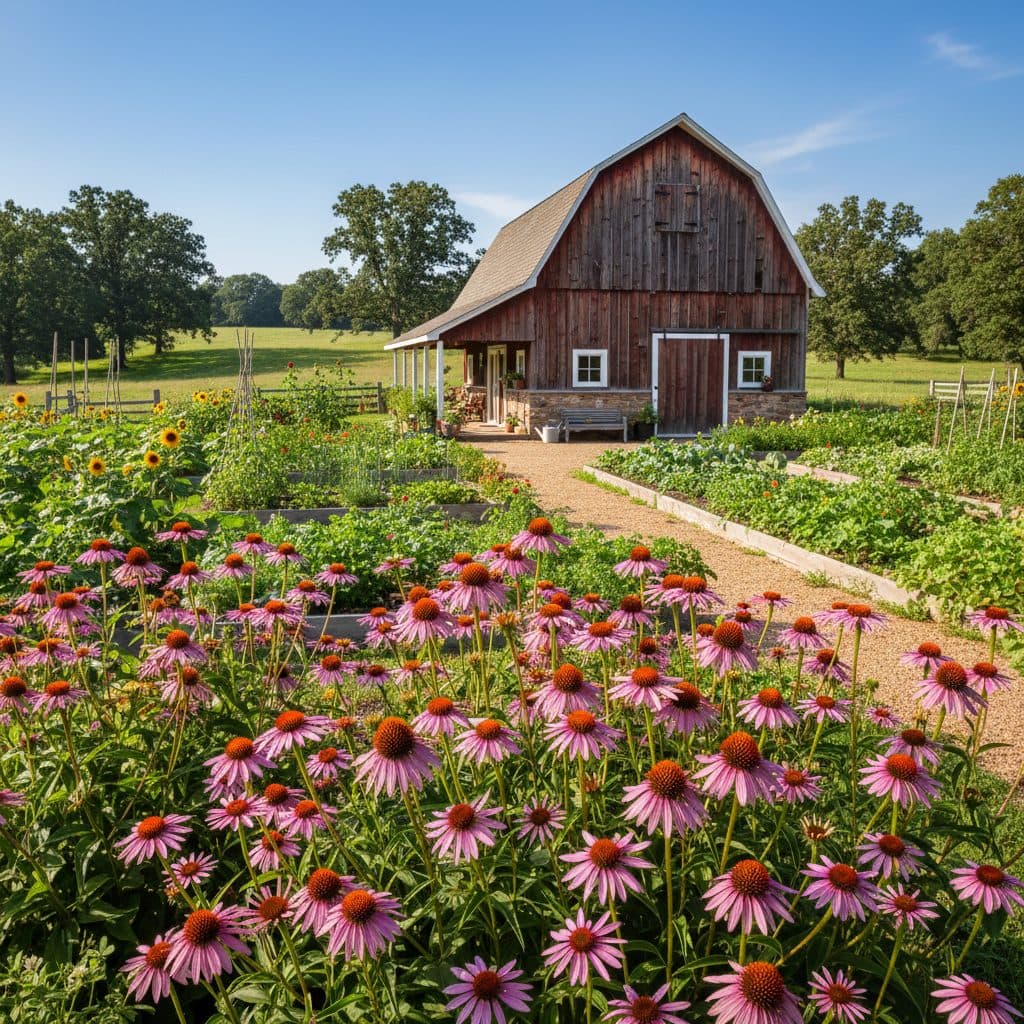
Across the United States, from the arid plains of Nebraska to the humid summers of Georgia, gardeners are discovering the dual benefits of growing echinacea, commonly known as purple coneflower. This resilient perennial, native to central and eastern North America, offers both significant medicinal properties and support for local pollinator populations [1]. With its striking purple petals and prominent central cone, Echinacea purpurea stands out in any garden, providing a consistent bloom from mid-summer into fall.
For those in USDA zones 4 through 9, integrating echinacea into a home garden is a straightforward process that yields substantial rewards. A well-established plant can reach heights of 2 to 5 feet, producing dozens of flowers that attract a diverse array of beneficial insects and birds [2]. Beyond its visual appeal, the roots, leaves, and flowers of echinacea have been utilized for centuries, with modern research into its effects on the immune system still ongoing and so far inconsistent.
Why grow echinacea in your garden?
Growing echinacea offers a compelling combination of practical benefits for both the gardener and the surrounding ecosystem. In regions like the Midwest, where native prairies once flourished, adding echinacea helps restore vital habitat for beneficial insects [6]. A single mature plant can produce hundreds of seeds, providing food for goldfinches and other birds late in the season, while its nectar draws a wide range of native bees and butterflies through a long midsummer bloom.
medicinal properties and immune support
The primary draw for many growers is echinacea’s well-documented medicinal value, particularly its role in immune system support [5]. Extracts from the plant, especially the roots, contain compounds like alkylamides, polysaccharides, and glycoproteins, which are believed to stimulate immune cell activity. Clinical trial results have been inconsistent, and systematic reviews have not established that echinacea reliably shortens the common cold.
- Supports the body’s natural defenses against seasonal ailments.
- Provides a sustainable source of herbal remedies for a home apothecary.
- Attracts a wide range of pollinator magnet species, including monarch butterflies and bumblebees.
- Supports garden biodiversity and a healthier local environment.
Choosing and planting your coneflowers
Successful echinacea cultivation begins with selecting the right species and preparing an optimal planting site. While several species exist, Echinacea purpurea is the most widely cultivated for both ornamental and medicinal purposes due to its adaptability across USDA zones 4 to 9 [2]. Other species like Echinacea angustifolia and Echinacea pallida are also valued, particularly for their root systems, but can be more challenging to establish in some home garden settings.
site selection and soil preparation
Echinacea thrives in full sun, meaning it needs at least 6 hours of direct sunlight per day to produce abundant blooms and potent medicinal compounds. The ideal soil is well-drained with a slightly acidic to neutral pH, ranging from 6.0 to 7.0. If your soil is heavy clay, amend it with 2 to 3 inches of organic matter, such as compost, to improve drainage. Before planting, consider using a 3-in-1 soil meter to accurately assess pH and moisture levels.
- Choose a location receiving 6+ hours of direct sunlight daily.
- Ensure soil is well-drained; avoid soggy conditions which can lead to root rot.
- Aim for a soil pH between 6.0 and 7.0 for optimal growth.
- Space plants 18 to 24 inches apart to allow for mature size and air circulation.
- Consider starting seeds indoors 6 to 8 weeks before the last frost, especially in cooler climates. Give the seed about 30 days of cold, moist stratification in the refrigerator first — sown straight from the packet, echinacea germinates slowly and unevenly.
Care and maintenance for steady growth
Once established, echinacea is a remarkably resilient plant, requiring minimal care to thrive across its wide range in the US. During its first growing season, consistent moisture is crucial, with young plants needing about 1 inch of water per week, either from rainfall or irrigation. Mature plants, however, are quite drought tolerant and generally only require supplemental watering during prolonged dry spells, which can extend for 2 to 3 weeks in summer.
feeding, pest control, and overwintering
Echinacea typically does not require heavy fertilization. An annual application of 1 to 2 inches of organic compost around the base of the plant in early spring provides sufficient nutrients for the entire growing season. While generally pest-resistant, keep an eye out for common garden pests like aphids, which might appear on new growth in early summer. A strong spray of water can dislodge these insects, or an insecticidal soap can be applied if colonies build up on new growth. Diseases like powdery mildew can occur in humid conditions; ensuring good air circulation by proper spacing helps prevent this.
- Water young plants consistently, about 1 inch per week, for the first year.
- Apply a 1-inch layer of compost each spring to enrich the soil.
- Monitor for pests like aphids; treat when colonies start building on new growth.
- Practice deadheading spent blooms to encourage more flowers and extend the blooming season by several weeks.
- Leave some seed heads on the plant in fall to provide food for birds and allow for self-seeding.
Harvesting and processing for home use
Harvesting echinacea for your home apothecary requires understanding which parts of the plant to collect and when to maximize their medicinal potency. While all parts — roots, leaves, and flowers — contain beneficial compounds, the roots are generally considered the most potent [5]. For root harvesting, it is best to wait until the plant is at least three years old, allowing it to establish a robust root system and accumulate sufficient active constituents. This ensures a sustainable harvest and maintains plant vigor.
collecting roots, leaves, and flowers
The ideal time for root harvesting is in the fall after the first hard frost, when the plant’s energy has retreated underground, or in early spring before new growth begins. Carefully dig around the plant, lifting the entire root ball with a garden fork, then gently shake off excess soil. For leaves and flowers, harvest them when the plant is in full bloom during summer. Collect leaves in the morning after dew has dried, and pick flower heads when they are fully open, typically from July to September. You can find more general guidance on starting a herb garden at agripure.org/articles/starting-a-herb-garden.
- Harvest roots from plants that are at least three years old for maximum potency.
- Collect roots in late fall or early spring, washing them thoroughly before drying.
- Gather flower heads when fully open, typically from July through September.
- Pick healthy leaf collection in the morning after dew has evaporated.
- Dry plant material in a well-ventilated area at temperatures below 100°F (38°C) to preserve active compounds.
Making the most of your echinacea in the home apothecary
Once you’ve successfully harvested and dried your echinacea, the next step is transforming it into usable forms for your home apothecary. The most common and effective preparations include tinctures, teas, and poultices, each offering a distinct way to utilize the plant’s beneficial properties. Proper preparation ensures the extraction of active compounds and extends the shelf life of your herbal remedies, often for up to 2 to 3 years when stored correctly.
common preparations and usage
An alcohol tincture is a highly concentrated liquid extract, made by soaking dried echinacea in high-proof alcohol (typically 80-proof or higher) for several weeks. A common ratio is 1 part dried herb to 5 parts alcohol by weight (1:5), yielding a potent extract. For a simple herbal tea, steep 1 to 2 teaspoons of dried echinacea leaves or flowers in 8 ounces of hot water for 10 to 15 minutes. For root tea, a decoction is more effective: simmer 1 teaspoon of chopped dried root in 8 ounces of water for 15 to 20 minutes. Echinacea is in the Asteraceae family, so people allergic to ragweed, daisies, marigolds or chrysanthemums can react to it — including, rarely, serious reactions. It is also generally avoided by people with autoimmune conditions or taking immunosuppressant medication. Always consult a healthcare professional before starting any new herbal regimen, especially if you are pregnant, nursing, or taking medications.
- Create a potent alcohol tincture using a 1:5 herb-to-alcohol ratio for long-lasting immune support.
- Brew herbal tea from dried leaves and flowers for a soothing, mild daily tonic.
- Prepare a decoction from dried roots to extract deeper medicinal compounds.
- Make a poultice from fresh or rehydrated leaves for external application on minor skin irritations.
- Store dried herbs in airtight containers away from direct sunlight for up to 12 months.
Comparison of Common Echinacea Species for Cultivation
Species | Native Range | Key Characteristics | Medicinal Focus |
|---|---|---|---|
<i>Echinacea purpurea</i> | Eastern & Central US | Most common; 3-5 ft tall; purple-pink petals; adaptable to USDA zones 4-9. | General immune support; all plant parts used. |
<i>Echinacea angustifolia</i> | Central US Plains | Narrower leaves; 1-2 ft tall; often more potent roots; prefers drier conditions. | Strong immune stimulant; roots primarily used. |
<i>Echinacea pallida</i> | Central & Southeastern US | Pale pink, drooping petals; 2-3 ft tall; deep taproot; prefers well-drained, sandy soils. | Immune support, particularly for lymphatic system; roots mainly used. |
Pollinator Magnet: Echinacea’s long summer bloom makes it a dependable nectar and pollen source for native bees and butterflies, and its seed heads feed goldfinches into winter.
Root Potency: For maximum medicinal potency, it is recommended to harvest echinacea roots from plants that are at least three years old, allowing for greater accumulation of active compounds.
Frequently asked questions
What USDA zones are suitable for growing echinacea?
Echinacea is a hardy perennial that thrives across a wide range of climates, specifically in USDA zones 4 through 9. This means it can tolerate winter temperatures as low as -30°F (-34°C) in zone 4 and withstand the heat of zone 9 summers.
How much sunlight does echinacea need?
For optimal growth and abundant flowering, echinacea requires full sun exposure, which translates to at least 6 hours of direct sunlight per day. In hotter climates, such as USDA zone 9, some afternoon shade can be beneficial to prevent scorching.
When is the best time to plant echinacea?
The best time to plant echinacea is in spring after the last danger of frost has passed, typically when soil temperatures reach 60°F (15°C) or higher. Seeds can be started indoors 6 to 8 weeks before this period for an earlier bloom in the first year.
Can echinacea be grown in containers?
Yes, echinacea can be successfully grown in containers, provided they are at least 12 to 18 inches in diameter and depth to accommodate the plant’s root system. Ensure the container has good drainage holes and use a well-draining potting mix.
How often should I water established echinacea plants?
Established echinacea plants are quite drought tolerant and generally require minimal watering. During dry periods, water deeply once every 2 to 3 weeks, providing about 1 inch of water, rather than frequent shallow watering.
How long does it take for echinacea to flower from seed?
When grown from seed, echinacea typically takes one to two years to produce its first flowers. If seeds are started indoors and transplanted, you might see a few blooms in the first year, but a more robust display usually occurs in the second year of growth.
References
- Echinacea (American Coneflower, Purple Coneflower (2011). Echinacea (American Coneflower, Purple Coneflower.
- Echinacea purpurea (purple coneflower) (2019). Echinacea purpurea (purple coneflower).
- Echinacea Species (Narrow-Leafed Purple Coneflower) (2013). Echinacea Species (Narrow-Leafed Purple Coneflower).
- Echinacea Species (Narrow-Leafed Purple Coneflower) (2020). Echinacea Species (Narrow-Leafed Purple Coneflower).
- ECHINACEA (Purple coneflower) (2023). ECHINACEA (Purple coneflower).
- USDA Natural Resources Conservation Service (2024). USDA Natural Resources Conservation Service.