Key takeaways
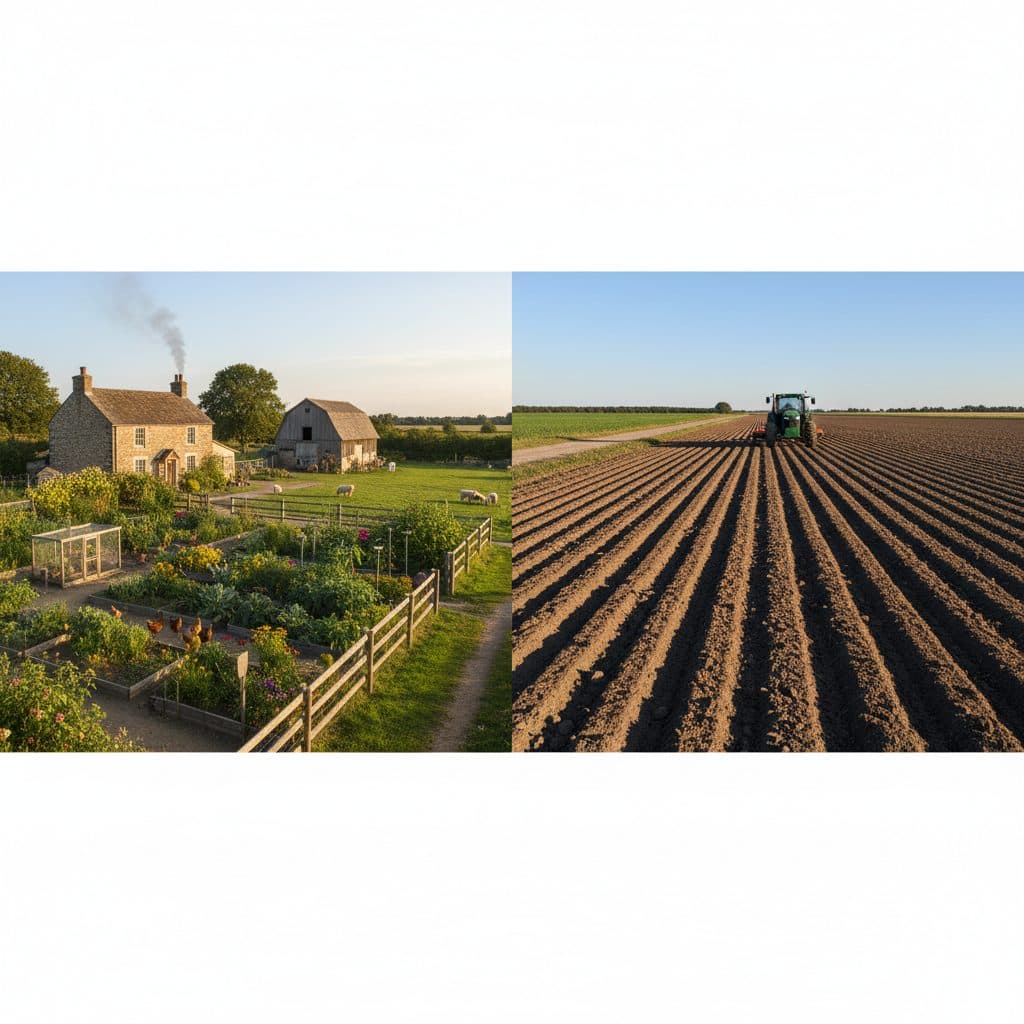
- The primary distinction between homesteading and farming lies in their central objective: self-reliance versus commercial revenue.
- Homesteaders prioritize closed-loop resilience, polyculture diversity, and direct household subsistence.
- Commercial farmers focus on enterprise profitability, production efficiency, monoculture or specialized crops, and wholesale markets.
- Land requirements for homesteading can be as small as a suburban quarter-acre, whereas commercial farming generally requires larger acreage.
- Legal, tax, and zoning classifications distinguish residential homestead properties from commercial agricultural operations.
Quick answer: The fundamental difference between homesteading and farming is the primary objective. Homesteading focuses on household self-sufficiency, closed-loop resilience, and producing food and resources for direct family consumption. Farming is a commercial business enterprise focused on maximizing production efficiency, yield, and financial profit by selling agricultural goods in the marketplace.
The modern surge of interest in rural living and food security has brought two traditional terms to the forefront: homesteading and farming. While both lifestyles involve working the soil, raising livestock, and spending long hours outdoors, they operate under entirely different economic, ecological, and philosophical frameworks. Exploring homesteading vs farming helps aspiring land stewards choose the right path for their lifestyle, financial goals, and acreage.
Confusing the two concepts often leads to costly miscalculations. An aspiring homesteader who designs their land like a commercial farm may find themselves overwhelmed by commercial equipment debt and market volatility. Conversely, a farmer who attempts to run a business using diversified, labor-intensive subsistence methods may struggle to achieve commercial profitability.
Defining the core objectives: subsistence vs commerce
The overarching philosophy of each model shapes every daily operational decision on the land.
+---------------------+-----------------------+---------------------------------------+
| Comparison Factor   | Homesteading          | Commercial Farming                    |
+---------------------+-----------------------+---------------------------------------+
| Primary Objective   | Household self-reliance| Financial profit and market revenue   |
| System Design       | Polyculture / Diverse | Specialized / Scaled enterprise       |
| Primary Consumer    | The family / household| Wholesale buyers, retail customers    |
| Economic Model      | Expense reduction     | Gross revenue and profit margins      |
| Labor Model         | Family & sweat equity | Mechanized, contracted, or crew labor |
| Success Metric      | Independence & quality| Return on investment and net income   |
+---------------------+-----------------------+---------------------------------------+
The homesteading philosophy
Homesteading is fundamentally about producing what you consume and consuming what you produce. The homesteader measures success by the degree to which their household reduces its reliance on external industrial systems—grocery stores, utility grids, and commercial supply chains. Financial sustainability comes primarily from cutting living expenses rather than generating taxable revenue.
To explore foundational homestead structures and definitions, consult what is homesteading.
The farming business model
Farming is an agricultural enterprise. Whether operating a 500-acre grain farm, a 20-acre commercial orchard, or a 2-acre market garden, a farmer is a business owner. Capital is invested in land, machinery, and seed with the explicit expectation of generating a positive return on investment. Success is measured on financial balance sheets, crop yield per acre, and profit margins.
System design: polyculture diversity vs specialized efficiency
The practical day-to-day operations on a homestead look radically different from those on a working farm.
Homestead polyculture
Because a homestead aims to feed a family throughout the entire year, diversity is paramount:
- A kitchen garden with 30 different vegetable and herb varieties.
- A small home orchard with apples, pears, and berries ripening from June to October.
- A mixed flock of laying hens for daily breakfast eggs and pest control.
- Two dairy goats or a family milk cow providing daily dairy, cheese, and butter.
- A root cellar packed with canned preserves, winter squashes, and fermented kraut.
This polyculture mimics natural ecosystems. If a summer drought damages the tomato crop, the winter squashes and berry bushes compensate. No single crop failure threatens household survival.
For livestock integration on homestead layouts, explore the best animals for homesteading.
Farm specialization and economy of scale
In contrast, commercial farming relies on specialization and economies of scale to compete in the market:
- A commercial market gardener might focus on just five high-margin, fast-turning crops: salad greens, heirloom tomatoes, garlic, microgreens, and carrots.
- Specialized machinery (walk-behind two-wheel tractors, mechanical seeders, commercial bubbler wash stations) is purchased specifically to streamline these few crops.
- Planting 5,000 row feet of a single lettuce variety reduces labor per head, enabling the farmer to sell to restaurants and wholesale distributors at competitive prices.
Land requirements and acreage scale
How much land is required depends on which path you pursue.
+---------------------+-----------------------+---------------------------------------------------------------------------------------+
| Scale Category      | Typical Acreage       | Feasible Production                                                                   |
+---------------------+-----------------------+---------------------------------------------------------------------------------------+
| Urban Homestead     | 0.1 to 0.25 Acres     | Vegetables, herbs, quail, micro-greens                                                |
| Suburban Homestead  | 0.5 to 1.5 Acres      | Large garden, chickens, fruit trees                                                   |
| Rural Homestead     | 2 to 10 Acres         | Most household produce, poultry and eggs; meat/dairy and woodlot need the upper end   |
| Small Market Farm   | 2 to 15 Acres         | Intensive vegetables, pastured poultry                                                |
| Broadacre Farm      | 50 to 500+ Acres      | Livestock cow-calf, grain, hay, timber                                                |
+---------------------+-----------------------+---------------------------------------------------------------------------------------+
A family can run a highly productive homestead on a modest parcel of land. With intensive raised beds and vertical gardening, a quarter-acre lot can supply a substantial portion of a household's fresh produce and poultry. For land acquisition strategies, review land for homesteading and techniques for homesteading on an acre.
Conversely, commercial farming generally requires sufficient acreage to justify capital investments in tractors, irrigation infrastructure, processing sheds, and commercial vehicles.
Legal, tax, and zoning distinctions
Operating a homestead versus a farm carries distinct legal and regulatory ramifications in the United States:
- Zoning regulations: Homesteads in residential or suburban zones are subject to municipal bylaws governing outbuilding setbacks, livestock head counts, and rooster bans. Commercial farms in agricultural zones enjoy broader protections under state Right-to-Farm acts.
- Tax classifications: Many states offer agricultural property tax assessment exemptions ("greenbelt" or Present-Use Value programs) for commercial farms that meet minimum annual gross income thresholds. In the states that offer them, residential homestead exemptions can reduce the assessed value of an owner-occupied primary residence and, in some states, shield some of its equity from creditors. What is on offer varies widely by state.
- Regulatory oversight: Selling milk, meat, or preserved foods to the public is regulated, and the rules vary sharply by state and by product. Many states allow shelf-stable canned goods from a home kitchen under cottage food laws, meat sold within a state may come from a state-inspected plant as well as a federally inspected one, and small poultry producers have federal exemptions. Raw milk sales are the most tightly restricted of all. Check your own state's rules before selling anything.
Time allocation and labor dynamics
The daily schedule on a homestead revolves around seasonal household needs: morning animal chores, afternoon weeding and planting, and evening food preservation such as water-bath canning or lacto-fermentation. The labor is varied, physical, and directly connected to family nourishment.
On a commercial farm, daily time is driven by market deadlines, harvest quotas, cold-chain logistics, invoicing, and customer deliveries. Peak harvest days demand 12 to 14 hours of continuous specialized field work to fulfill restaurant and market orders before produce loses field crispness.
The hybrid model: homesteading with a cash crop
Many modern land stewards successfully merge both concepts into a hybrid model: the homestead with a commercial enterprise.
In this structure, the family maintains a diverse subsistence homestead for their own nutritional independence while operating one or two focused agricultural cash enterprises—such as pastured egg production, cut flowers, gourmet garlic, or nursery stock—to pay property taxes and fund capital improvements.
By clearly understanding the structural differences between homesteading and farming, you can align your land design with your true personal goals, creating a resilient, rewarding lifestyle.