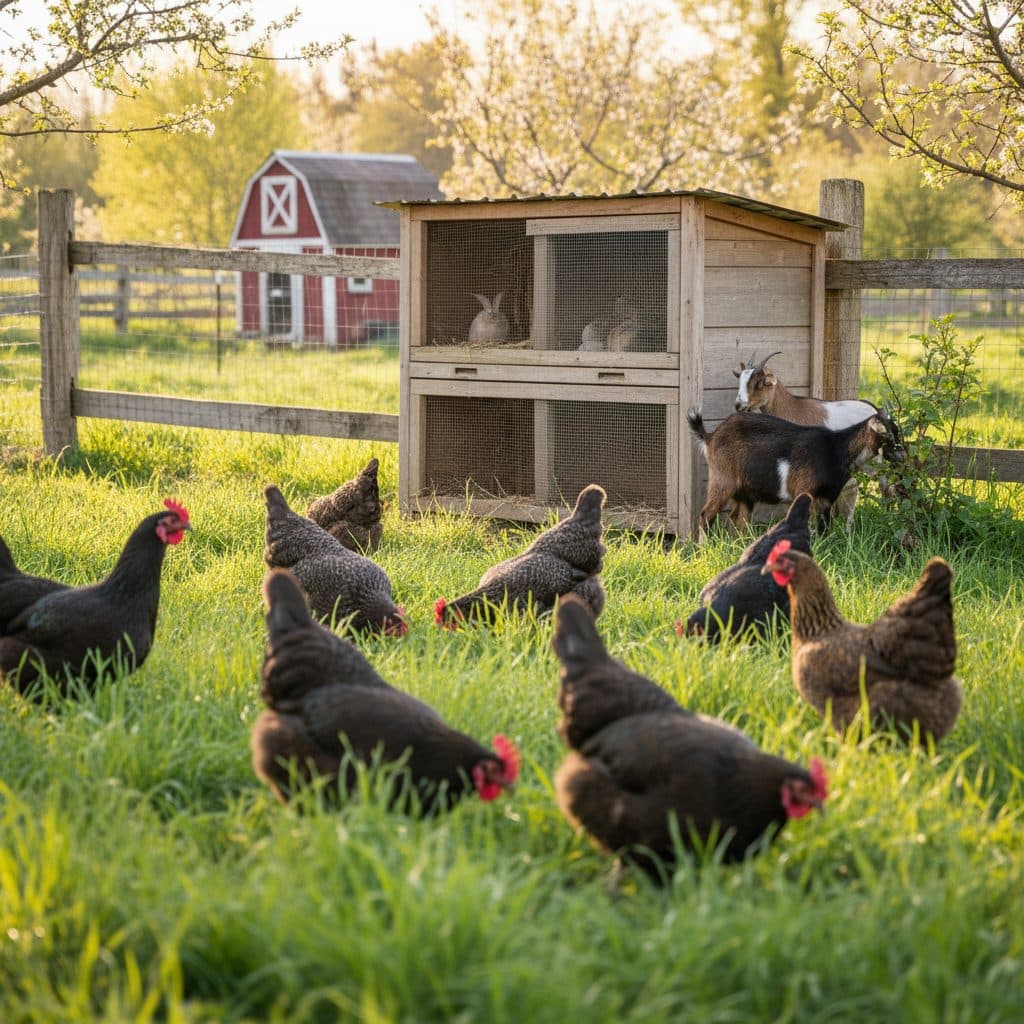
Key takeaways
- Starting with small, manageable livestock prevents beginner overwhelm and runaway feed expenses.
- Chickens are the most common starter animal, providing daily eggs, pest management, and nitrogen-rich manure.
- Meat rabbits convert feed to meat efficiently for their size, need very little space, and produce cold manure usable directly on garden beds.
- Ducks excel in wet climates, forage voraciously for garden slugs, and several duck breeds, notably Khaki Campbells and Welsh Harlequins, often keep laying better than hens through the short days, though they still slow during moult.
- Dairy goats require secure predator-proof fencing and daily milking routines but provide fresh milk on smaller acreage.
Quick answer: The best animals for homesteading ranked for beginners are laying chickens, meat rabbits, ducks, and coturnix quail, followed by dairy goats and hair sheep for larger properties. Starting with small livestock minimizes startup infrastructure costs and daily feed expenses while providing immediate protein, pest control, and garden fertility.
Adding livestock turns a vegetable garden into a diversified homestead system. Animals convert pasture grass, kitchen scraps, and forage into eggs, meat, and manure for garden beds. However, choosing the best animals for homesteading requires matching your acreage, daily time budget, and fencing infrastructure with the right species.
Bringing large, demanding livestock onto a new homestead before infrastructure is ready is one of the most common beginner pitfalls. By starting with smaller, docile species that provide high utility with modest feed demands, you build confidence and husbandry skills before expanding into larger ruminants.
Beginner livestock ranking matrix
Evaluating livestock species across space, feed costs, daily labor, and multi-purpose utility provides a clear roadmap for gradual homestead expansion.
+---------------------+-----------------------+-----------------------+-----------------------+
| Animal Category     | Minimum Space Required| Primary Outputs       | Beginner Rank         |
+---------------------+-----------------------+-----------------------+-----------------------+
| Laying Chickens     | 4 sq ft coop / 10 run | Fresh eggs, pest care | Tier 1 (Essential)    |
| Meat Rabbits        | 30 x 36 inch hutch    | Lean meat, cold manure| Tier 1 (Quiet / Easy) |
| Ducks               | 4 sq ft coop / 15 run | Rich eggs, slug patrol| Tier 2 (Wet Climates) |
| Coturnix Quail      | 1 sq ft per bird      | Fast eggs & meat      | Tier 2 (Small Space)  |
| Dairy Goats         | 250 sq ft per goat    | Fresh milk, brush care| Tier 3 (Intermediate) |
| Hair Sheep          | 0.5 to 1 acre / pair  | Grass-fed meat, weed  | Tier 3 (Pasture-Ready)|
+---------------------+-----------------------+-----------------------+-----------------------+
To explore foundational self-reliance principles, review our guide on what is homesteading.
Tier 1: essential homestead starter animals
1. Laying chickens (Gallus gallus domesticus)
No animal matches the versatility, ease of management, and immediate return of a small flock of laying hens. A flock of four to six heritage breed hens (such as Australorps, Rhode Island Reds, or Plymouth Rocks) supplies a family with two to three dozen fresh eggs weekly.
- Multipurpose utility: Beyond eggs, chickens scratch and till garden soil, devour garden pests (ticks, beetles, grasshoppers), and process kitchen scraps into high-nitrogen manure.
- Housing and containment: A secure, predator-proof coop with nest boxes, roosting bars, and hardware cloth fencing keeps birds safe from raccoons, foxes, and hawks.
- Management overview: Check out our detailed guide on raising chickens for eggs.
2. Meat rabbits (Oryctolagus cuniculus)
Meat rabbits (such as New Zealand White, Californian, or Standard Chinchilla) are arguably the most productive, quiet, and space-efficient livestock for urban and rural homesteads alike.
- Rapid reproduction: A breeding trio of one buck and two does can produce roughly 40 to 50 fryers a year, which dresses out at somewhere around 100 to 150 pounds of lean white meat depending on breed and processing weight.
- Cold manure advantage: Unlike poultry or horse manure, rabbit manure is a "cold" fertilizer that contains balanced nitrogen and phosphorus without burning plants. It can be applied directly to garden beds without prior composting.
- Low space footprint: Rabbits thrive in off-ground wire hutches or colony setups, making them ideal for small backyards with strict zoning rules. Learn the details in raising meat rabbits.
Tier 2: specialized and small-space poultry
3. Ducks (Anas platyrhynchos domesticus)
Ducks, particularly hardy heritage breeds like Khaki Campbells, Silver Appleyards, and Welsh Harlequins, make practical homestead poultry.
+-----------------------------------------------------------------------------------+
|  [Duck vs Chicken Homestead Strengths]                                            |
|                                                                                   |
|  - Ducks: Cold/damp hardy, gentle on plant roots, ferocious slug eaters           |
|  - Chickens: Scratch & till soil, eat kitchen scraps cleanly, easy dry bedding    |
+-----------------------------------------------------------------------------------+
Ducks produce larger, richer eggs than chickens. Several duck breeds, notably Khaki Campbells and Welsh Harlequins, often keep laying better than hens through the short days, though they still slow during moult. Furthermore, ducks forage gently around garden vegetables without scratching up delicate root systems, which helps control garden slugs and snails. Compare these two poultry species in depth in raising ducks vs chickens.
4. Coturnix quail (Coturnix japonica)
For homesteaders with tight urban spaces or strict HOA regulations prohibiting chickens, Coturnix quail are a practical alternative.
- Rapid maturity: Quail mature and begin laying speckled eggs in just six to eight weeks from hatching.
- Quiet and compact: Males do not crow loudly like roosters, and birds can be housed comfortably in stacked indoor or balcony cages.
Tier 3: small ruminants and pasture livestock
5. Dairy goats (Capra hircus)
For households seeking home dairy independence, miniature dairy goat breeds like Nigerian Dwarfs or full-sized Nubians and Saanens provide fresh milk, yogurt, and cheese on a fraction of the feed required by a dairy cow.
- Space and browse: Two Nigerian Dwarf does can be comfortably maintained on a half-acre lot. Goats are natural browsers, preferring woody brambles, poison ivy, and brush over pure grass.
- Infrastructure demands: Goats are notorious escape artists and require sturdy 4-foot woven wire fencing with electric wire reinforcement. They also require a strict twice-daily milking routine when in milk. For husbandry protocols, read raising dairy goats.
6. Hair sheep (Katahdin, Dorper, St. Croix)
Unlike traditional wool sheep that require annual shearing and tail docking, hair sheep shed their winter coats naturally like deer. They thrive on marginal grass pastures, convert forage efficiently into mild-flavored meat, and maintain pastures with docile temperaments.
Feed budgeting and predator security
Managing livestock successfully requires disciplined planning around daily feed costs and predator pressure:
- Feed budgeting: Feed costs are the largest ongoing operational expense for any homestead animal. Free-ranging poultry in portable tractors, planting fodder crops (mangel beets, comfrey, sunflowers) and fermenting whole grain feeds all cut how much bagged feed you buy, though how much you save depends on your forage and flock size.
- Predator-proof hardware: Standard chicken wire only keeps birds in; it stops almost no determined predators. Always use 1/2-inch galvanized hardware cloth buried 6 to 12 inches into the ground around coop perimeters to prevent digging predators like foxes, coyotes, and neighborhood dogs.
Step-by-step livestock integration roadmap
To avoid burnout, follow a phased introduction schedule:
- Year 1: Start with four to six laying chickens. Build secure predator-proof housing and establish daily feeding and watering routines.
- Year 2: Introduce meat rabbits or a small flock of ducks to expand protein production and diversify garden pest control.
- Year 3: Once fencing, rotational grazing paddocks, and shelter infrastructure are fully established, consider adding a pair of dairy goats or hair sheep.
Scaling livestock gradually gives you time to build infrastructure and manage feed costs without taking on too much at once.