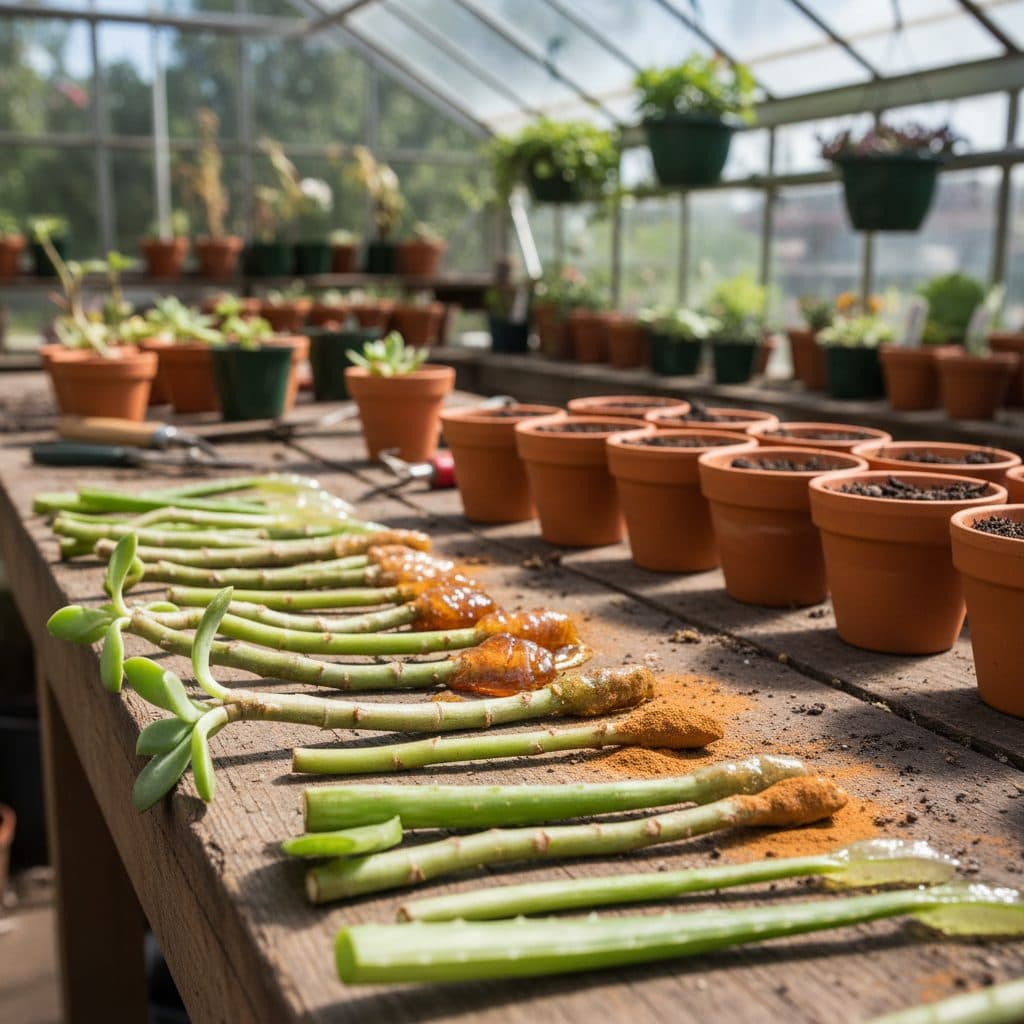
Key takeaways
- Honey offers antiseptic properties that may reduce fungal issues in cuttings, though the effect has not been measured in propagation trials.
- Aloe vera gel contains plant hormones and enzymes that may support root development in softwood cuttings.
- Cinnamon acts primarily as an antifungal agent, protecting cuttings from damping-off disease in humid conditions.
- Commercial rooting hormones, like IBA and NAA, typically provide more consistent and stronger rooting success, often exceeding 75% for difficult-to-root species.
- For best DIY results, select healthy cuttings 4-6 inches long and maintain consistent moisture and warmth around 70°F.
- Sterile media and proper humidity matter more to the outcome than any of these aids.
Quick answer: Honey and cinnamon primarily act as antifungal agents, protecting cuttings from disease. Aloe vera gel contains natural plant hormones that can stimulate root development, offering a natural alternative to commercial rooting hormones for US growers.
In the humid climate of USDA zone 8b, where growers propagate everything from camellias to figs, the quest for effective plant rooting methods is ongoing. Many experienced gardeners, particularly those focused on sustainable practices, often look beyond commercial rooting hormones to more natural alternatives. These DIY options, including common kitchen staples like honey, aloe vera, and cinnamon, promise to aid in the delicate process of turning a simple cutting into a healthy new plant, at a fraction of the cost of a commercial product.
Examining the scientific evidence behind these remedies shows what they actually do for home growers across US regions, from the arid southwest to the temperate northeast, and which are worth the effort.
Understanding plant propagation and the appeal of DIY methods
Plant propagation from cuttings is a time-honored technique, allowing gardeners to multiply favorite plants like roses, hydrangeas, or even herbs from a single stem. This process typically involves taking a section of a parent plant, often 4-6 inches in length, and encouraging it to develop new roots. Success rates can vary widely, from 20% for challenging woody plants to over 90% for easy-to-root annuals, depending on the species and environmental conditions. Many growers seek methods that are effective and suit a preference for minimal chemical use, leading them to try natural alternatives.
The basics of successful cutting propagation
For cuttings to root successfully, they need a few basic conditions: a sterile growing medium, consistent moisture, adequate warmth, and sometimes rooting hormones. Commercial rooting hormones, containing synthetic auxins like indole-3-butyric acid (IBA) or naphthaleneacetic acid (NAA), are widely available and generally effective, often boosting rooting percentages by 30-50% for many species. However, the allure of using readily available, inexpensive kitchen ingredients has led many home growers in regions like the Pacific Northwest to experiment with honey, aloe vera, and cinnamon. These DIY approaches cost very little for small-scale propagation projects.
- Cost savings: Utilizing materials already in your pantry keeps propagation costs close to zero.
- Accessibility: Ingredients like honey and cinnamon are found in nearly every US household.
- Perceived safety: Many growers prefer natural substances for food-producing plants or starting a herb garden.
- Environmental considerations: Reducing reliance on synthetic chemicals is a priority for some gardeners.
Honey as a rooting aid: antiseptic properties and limited hormonal effects
Honey has been used for centuries in various applications, including wound care, due to its natural antiseptic properties. When applied to plant cuttings, raw honey, especially varieties like Manuka or local wildflower honey from states like California, can act as a natural antibacterial and antifungal agent. This protective layer can help prevent common issues like damping-off disease, which can devastate young cuttings, particularly in high-humidity environments. Honey’s antibacterial and antifungal activity is well documented in wound dressings; whether that carries over to a plant cutting in a propagation tray has not been tested in a comparable way.
Understanding honey’s role in rooting
While honey is excellent for protecting cuttings from pathogens, it is important to note that it does not contain significant amounts of plant hormones that directly stimulate root growth. Its primary benefit is creating a more sterile environment for the cutting to focus its energy on rooting instead of fighting disease. For growers in the Midwest, where humidity fluctuates, this protective barrier can be especially helpful. Use the thinnest possible film on the cut surface — a thick coat seals the stem and blocks water uptake, and undiluted sugar in a warm, closed dome can feed the very molds it is meant to deter. Learning about beekeeping for beginners can also provide insight into the quality of honey available.
- Antiseptic barrier: Honey’s natural sugars and enzymes inhibit bacterial and fungal growth.
- Wound healing: It helps seal the cut end, preventing moisture loss and pathogen entry.
- Non-toxic: A safe option for edible plants and home gardens.
- Readily available: Most households have honey, making it a convenient choice.
Aloe vera: a natural rooting hormone alternative with plant growth compounds
Beyond its use for sunburns, aloe vera (Aloe barbadensis) gel contains compounds that can benefit plant propagation. Research indicates that aloe vera gel includes auxins and gibberellins, natural plant hormones that stimulate cell division and root development. It also contains salicylic acid, a plant defense compound that can improve a cutting’s resilience against stress. For growers in the desert southwest, where aloe vera thrives, fresh gel is easy to come by, though its effect on rooting has not been measured in any consistent way.
Applying fresh aloe vera gel to cuttings
To use aloe vera, cut a fresh leaf from a mature plant (ideally one at least two years old) and extract the clear, viscous gel. This gel can then be applied directly to the cut end of a stem, coating about one inch of the base. For best results, use the gel immediately after extraction, as its active compounds can degrade over time. Growers in Florida have reported success using aloe gel for propagating hibiscus and bougainvillea cuttings, often seeing root development within three to four weeks when temperatures are consistently above 70°F. More information on this plant can be found at aloe barbadensis.
- Natural auxins: Contains compounds that promote root formation.
- Antimicrobial properties: Helps protect cuttings from disease.
- Nutrient content: Provides trace elements beneficial for plant growth.
- Easy to harvest: Fresh gel is simple to obtain from a home plant.
Cinnamon: primarily an antifungal agent for cutting protection
Cinnamon, particularly Ceylon or Cassia varieties, is a common spice with potent antifungal and antibacterial properties. While it does not contain plant hormones that directly stimulate root growth, its primary benefit in propagation is protecting cuttings from fungal diseases like powdery mildew or botrytis, which can quickly rot the cut end. This is especially helpful in propagation setups with high humidity, such as a 24-cell seedling propagation tray with dome. Applying cinnamon can reduce fungal rot on susceptible cuttings, though the size of the effect has not been measured.
How to use cinnamon powder for cuttings
To use cinnamon as a rooting aid, moisten the cut end of the cutting and dip it into ground cinnamon powder until the bottom 1/2 inch is coated. The fine powder forms a protective barrier. This method is used for softwood or semi-hardwood cuttings prone to rot, such as coleus or geraniums. Gardeners in the humid southeastern US often use cinnamon to reduce cutting loss from disease. Controlled trials of cinnamon on cuttings are scarce; the practice is popular but largely untested.
- Antifungal properties: Prevents common fungal diseases like damping-off.
- Antibacterial action: Helps deter bacterial infections at the wound site.
- Natural and safe: A non-toxic option for protecting cuttings.
- Easy application: Simply dip the moistened cutting into the powder.
DIY solutions versus commercial rooting hormones: efficacy and consistency
When comparing DIY rooting aids to commercial rooting hormones, the primary difference lies in their consistency and potency. Commercial products, typically containing synthetic auxins like IBA (indole-3-butyric acid) or NAA (naphthaleneacetic acid), are formulated to deliver precise concentrations of growth-stimulating compounds. These hormones directly trigger cell division and root initiation, often leading to faster, stronger, and more uniform rooting across a batch of cuttings. For difficult-to-root species, such as certain conifers or mature hardwoods, commercial hormones improve the odds substantially, though results from mature wood stay poor even with them.
When to choose commercial options for higher success rates
While honey, aloe vera, and cinnamon offer useful benefits (primarily protection against disease and some hormonal support from aloe), they generally do not match the consistent rooting power of synthetic auxins. For large-scale propagation, or when propagating rare or challenging plant material, commercial rooting hormone is often justified by higher success rates, sometimes doubling the yield of viable plants. For seed starting for beginners, the choice might depend on the specific plant and desired outcome.
- Potency: Commercial hormones contain concentrated auxins for direct root stimulation.
- Consistency: Provide reliable results across different plant species and conditions.
- Speed: Often lead to faster root development, reducing propagation time by a week or more.
- Difficult species: Essential for rooting plants that are challenging to propagate naturally.
Best practices for successful DIY propagation with natural aids
Regardless of the rooting aid you choose, several practices help maximize success rates. Starting with healthy, disease-free parent plants matters most; select cuttings from vigorous growth that is not flowering, ideally from the current season’s growth. For most herbaceous and softwood cuttings, a length of 4-6 inches is optimal to leave enough nodes for root development and leaf surface for photosynthesis. Clean tools and fresh, sterile media prevent a large share of early cutting failures, a step new propagators often skip.
Creating the ideal environment for root development
Once cuttings are prepared and treated with your chosen DIY aid, providing the right environment is essential. Use a well-draining, sterile propagation mix; a 50:50 blend of peat moss and perlite works well for many species, including those in USDA zone 7. Maintain consistent moisture without waterlogging, and aim for ambient temperatures between 65-75°F. High humidity, often achieved with a clear plastic dome or humidity tent, is necessary to prevent dehydration, as cuttings lack roots to absorb water. For example, maintaining 80-90% humidity markedly improves rooting success compared to open-air propagation.
- Sterile environment: Use clean tools and fresh, sterile potting mix to prevent disease.
- Optimal cutting selection: Choose healthy, non-flowering stems 4-6 inches long.
- Consistent moisture: Keep the rooting medium moist but not soggy, avoiding daily watering.
- High humidity: Cover cuttings with a dome or plastic bag to maintain 80-90% humidity.
- Warm temperatures: Ideal rooting temperatures are typically 65-75°F.
Integrating DIY aids into your propagation strategy for diverse plants
For many home growers, integrating DIY rooting aids into their propagation strategy offers a balanced approach, combining the benefits of natural protection with the satisfaction of using readily available resources. While commercial hormones generally offer superior, more reliable results for challenging species, natural aids can be highly effective for easy-to-root plants like basil, mint, or coleus. Tomato suckers, for instance, root readily in plain water; no aid of any kind is needed, so a treatment that appears to work on them has not really been tested. The practical approach is to understand the specific strengths of each DIY aid and match them to your propagation goals.
Experimentation and observation for optimized results
Successful propagation often involves a degree of experimentation. Try propagating a batch of cuttings using only honey, another with aloe vera, and a control group with no aid, observing the differences in rooting percentage and speed. Documenting your results (for example, noting a 10% increase in rooted cuttings with aloe vera for specific rose varieties) can help refine your techniques over time. For plants that are moderately difficult to root, some growers combine cinnamon for protection with aloe for its growth compounds, though nothing has been tested to show the combination beats either one alone. Many plants take 4-8 weeks to develop sufficient roots.
- Target easy-to-root plants: DIY aids are most effective for species that naturally root well.
- Combine for synergy: Use cinnamon for protection and aloe for hormonal support.
- Experiment and track: Keep records of different methods and their success rates.
- Consider plant type: Match the aid to the specific needs of herbaceous, softwood, or semi-hardwood cuttings.
Comparison of DIY and Commercial Rooting Aids
Aid Type | Primary Benefit | Rooting Hormone Content | Typical Success Rate (Easy-to-root) | Cost per Application (Approx.) |
|---|---|---|---|---|
Honey | Antiseptic, antifungal | None significant | 40-60% | $0.01 – $0.05 |
Aloe Vera | Natural auxins, antimicrobial | Low to moderate | 50-70% | $0.00 (if homegrown) |
Cinnamon | Antifungal, antibacterial | None | Not a rooting aid (protective only) | $0.01 – $0.03 |
Commercial Hormone | Direct root stimulation | High (synthetic IBA/NAA) | 75-95% | $0.05 – $0.20 |
Fungal Protection: Cinnamon powder can help limit fungal rot in cuttings, especially in high-humidity propagation setups.
Aloe Root Boost: Fresh aloe vera gel contains natural plant hormones, which is the basis for its use as a rooting aid.
Frequently asked questions
Can I combine honey, aloe vera, and cinnamon for better results?
While there’s limited scientific research on combining all three, some growers report success. You could apply aloe vera gel for hormonal support, then dust with cinnamon for antifungal protection. Honey might be used separately to reduce bacterial issues. Experiment with small batches, perhaps 5-10 cuttings per combination, to observe specific plant responses.
Are these DIY methods effective for all types of plant cuttings?
No, their effectiveness varies significantly by plant type. DIY aids are generally most effective for easy-to-root herbaceous or softwood cuttings, such as coleus or basil, where success rates might be 50-70%. For genuinely difficult woody material, commercial rooting hormones give better odds than DIY aids, but some species barely root from cuttings at all. Oak is one of them: grow it from acorns or graft it instead.
How long do cuttings treated with DIY aids take to root?
The rooting time depends on the plant species, environmental conditions, and the specific aid used. Generally, cuttings treated with DIY aids may take 3-8 weeks to root, which can be 1-2 weeks longer than those treated with commercial hormones. For example, mint cuttings might root in 2-3 weeks, while a rosemary cutting could take 6-8 weeks.
What is the most important factor for successful rooting with DIY aids?
Maintaining consistent environmental conditions is the most important factor. This includes providing high humidity (around 80-90%), stable temperatures (65-75°F), and a sterile, well-draining rooting medium. Even with the best DIY aid, poor environmental conditions can lead to a less than 20% success rate.
Can I use store-bought aloe vera juice or powdered cinnamon?
For aloe vera, fresh gel directly from the plant (Aloe barbadensis) is recommended, as processed juices may lack the active compounds. For cinnamon, common ground cinnamon from your spice rack is generally suitable, but ensure it’s pure cinnamon without added sugars or other ingredients.