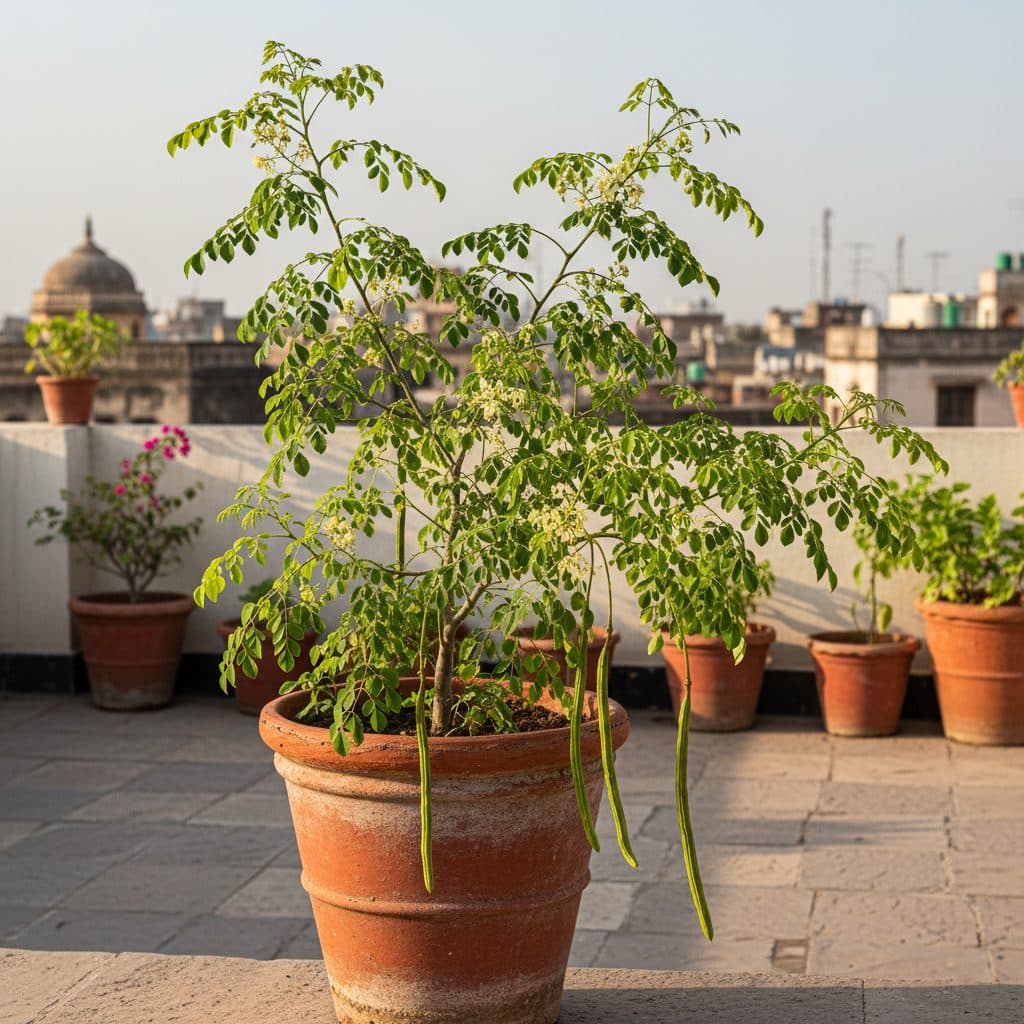
Key takeaways
- Grow drumstick trees from seed or hardwood cuttings taken from mature branches at least a year old in full sun with at least six to eight hours of direct light daily.
- Use large containers of at least 50 to 100 litres with multiple drainage holes, filled with a well-draining sandy loam mix.
- Pinch out the central terminal shoot when the tree reaches 1 metre in height to induce lateral branching for heavy pod production.
- Avoid overwatering; drumstick trees have fleshy tuberous roots that rot quickly in waterlogged soil, especially during the monsoon.
- Feed every two months with well-rotted cow dung manure, vermicompost, and wood ash to support continuous flowering and pod set.
- Harvest pods while they are still tender and snap cleanly when bent, about finger thickness, before the ribs harden and the seeds swell.
Quick answer: To grow a drumstick tree in India, plant seeds or 1-metre stem cuttings in a sunny location with well-drained sandy loam soil or a 50-litre container. Prune the main stem at 1 metre height to encourage bushy lateral branching, water sparingly to prevent root rot, and harvest fresh leaves and tender pods within six to eight months.
The drumstick tree (Moringa oleifera), known variously across India as sahjan, munakkaya, murungai, or shevga, is one of the most versatile and resilient perennial trees grown in home gardens and urban terrace vegetable garden spaces. Revered for its tender pods and highly nutritious edible leaves, moringa is a fast-growing species that thrives in warm tropical and subtropical conditions.
Whether you plant a specimen in your ground garden or cultivate a dwarf variety in a large container on your rooftop, moringa requires minimal intervention once established. By understanding its drainage requirements and mastering regular structural pruning, you can maintain a compact, productive drumstick tree that yields fresh greens and pods for years.
Selecting propagation methods: seeds versus stem cuttings
Drumstick trees can be propagated with equal ease from seeds or mature stem cuttings. Each method offers distinct advantages depending on your starting material and container size.
+-------------------------------------------------------------+
|                DRUMSTICK PROPAGATION PATHWAYS               |
|                                                             |
|   FROM SEED:                                                |
|   - Deep central taproot development                        |
|   - Heavy fruiting within 6-8 months (Annual cultivars)     |
|   - Ideal for ground planting & large deep containers       |
|                                                             |
|   FROM STEM CUTTING:                                        |
|   - Fast clonal reproduction; identical to parent tree      |
|   - Uses 1-metre mature hardwood limb (wrist thickness)     |
|   - Produces shallow, spreading root system                 |
+-------------------------------------------------------------+
Propagating from seed:
Seeds germinate quickly when fresh. Popular high-yielding annual cultivars like 'PKM-1', 'PKM-2', and 'Odc-3' are specifically bred for compact growth, heavy early flowering, and tender pod production within six to eight months from seed.
- Soak winged moringa seeds in clean water for 24 hours.
- Sow two seeds 2 cm deep in a 5-litre nursery bag or directly into your final growing container.
- Keep the mix warm (25°C to 35°C) and moderately damp. Germination occurs within 7 to 12 days.
Propagating from stem cuttings:
Stem cuttings bypass early seedling stages and replicate the characteristics of a proven parent tree.
- Select hardwood cuttings taken from mature branches at least a year old that are 1 metre long and 5 cm to 8 cm in diameter (best taken in the dry season, before the new flush).
- Make a clean, angled cut at the base and let the cutting dry in the shade for two to three days to form a callus over the cut surface.
- Plant the bottom 30 cm of the cutting into loose, sandy soil and water lightly once. Fresh green shoots emerge along the stem within two to three weeks.
For wider climate context, see our detailed guide on can you grow moringa by zone.
Soil preparation and container requirements
Moringa tolerates poor, sandy soils but cannot survive saturated, anaerobic conditions. The tree possesses a fleshy, tuberous root system that rots rapidly if water pools around the root zone.
Container specifications for terrace growing:
To cultivate drumstick trees on rooftops or paved areas:
- Container Volume: Choose a sturdy 50 to 100-litre container, half-cut plastic drum, or 60 cm x 60 cm heavy-duty fabric grow bag.
- Drainage: Drill 6 to 8 drainage holes (1.5 cm diameter) across the base and bottom perimeter. Cover the holes with broken terracotta shards or gravel to prevent soil blockage.
Potting mix formulation:
- 40% Coarse Sand or Perlite: Ensures rapid drainage and prevents compaction.
- 30% Well-Drained Red Soil or Garden Loam: Provides physical anchor density.
- 30% Mature Vermicompost or Decomposed Cow Dung: Delivers sustained organic nutrients.
- Additions: Blend in 100 grams of neem cake powder to deter soil-borne pests.
To explore landscape planting arrangements, review our guide on swale berm planting with nitrogen fixers and fruit trees.
The critical rule: pruning for height and branching
Left unpruned, a drumstick tree grows as a single, tall, leggy pole reaching 4 to 6 metres within its first year. The flowers and pods form at the very top of the canopy, making harvesting impossible from the ground or terrace.
+-------------------------------------------------------------+
|               DRUMSTICK CANOPY PRUNING PHASES               |
|                                                             |
|   Phase 1: Terminal Pinch at 1 Metre                        |
|   - Snip central leader when stem reaches 100 cm height     |
|   - Forces 3-4 vigorous primary lateral branches            |
|                                                             |
|   Phase 2: Secondary Pinch at 45 cm Length                  |
|   - Pinch each lateral branch tip after 45 cm extension     |
|   - Creates a compact, bushy, multi-branched umbrella       |
|                                                             |
|   Phase 3: Annual Post-Monsoon Heading Back                 |
|   - Cut all main branches back to 1 metre every winter      |
+-------------------------------------------------------------+
Pruning schedule:
- First Pinch (1 metre height): When the main seedling stem reaches 100 cm, cut off the top 10 cm of the central leader using clean pruning shears. This breaks apical dominance and forces the trunk to produce 3 to 5 strong side branches.
- Second Pinch (Branching): When these lateral branches grow to 45 cm in length, pinch out their growing tips. This induces tertiary branching, creating a dense, productive canopy at comfortable harvesting height.
- Annual Rejuvenation: At the end of the primary fruiting cycle (post-monsoon in South India), cut the tree back to 1 to 1.5 metres above ground. Note that moringa is damaged at or near 0°C. On the northern plains, move container trees against a wall or under cover for the coldest weeks, and delay hard pruning until the frost risk has passed — a tree cut back just before a frost may not recover.
For comparisons with other rapid-growth canopy options, explore our overview of fast growing shade trees.
Watering and nutrient management
Drumstick trees are drought-tolerant once established, but regular irrigation supports steady leaf production and heavy pod set.
- Watering guidelines: Water deeply when the top 5 cm of soil feels completely dry. During peak summer heat (40°C+), container-grown trees require daily watering. During the monsoon, suspend watering entirely and ensure rainwater drains away freely from pots.
- Fertiliser regimen: Moringa does not require heavy synthetic fertilisers, which cause excessive foliage growth at the expense of flowering. Apply:
- 2 kg of well-rotted cow dung manure or vermicompost every two months.
- 100 grams of wood ash for potassium, plus 100 grams of bone meal for phosphorus, twice a year before flowering.
During intense heatwaves, explore protective shelter strategies in our guide on shade netting for fruit trees.
Flowering cycle and pod development
Drumstick trees typically flower twice a year in sub-tropical climates (spring and post-monsoon), or continuously throughout the year in warm, frost-free southern Indian states.
- Flowering habits: Small, fragrant, creamy-white flowers appear in large hanging panicles. Honeybees and butterflies are primary pollinators.
- Blossom drop prevention: High atmospheric temperatures combined with dry roots cause blossom drop. Maintain steady root moisture during flowering without waterlogging the container. Avoid high-nitrogen fertilisers while flowers are open.
Managing common pests and diseases
Moringa is naturally pest-resilient, but a few seasonal insects require attention in urban gardens:
- Hairy Caterpillars (Eupterote mollifera): Feed on the leaves at night and gather in dense masses on the trunk and in shade during the day — which is when you can collect them.
- Control: Wear gloves, long sleeves and eye protection — the hairs cause severe skin irritation, and never handle them bare-handed or brush them off in a way that sends hairs into the air. Manually scrape egg masses or caterpillars off the trunk into a bucket of soapy water. Spray neem oil (5 ml/litre) on young foliage.
- Moringa Pod Fly (Gitona distigma): Small flies lay eggs inside tender pods, causing internal rotting, oozing gum, and premature pod splitting.
- Control: Harvest mature pods promptly. Collect and destroy any infested pods. Spray neem seed kernel extract (NSKE 5%) around flower clusters.
- Aphids and Whiteflies: Attack tender growing shoot tips during dry summer spells.
- Control: Wash infested shoot tips with a steady jet of water or spray with organic soap solution.
Harvesting drumstick pods and moringa leaves
Harvesting your drumstick tree regularly keeps the plant productive and prevents stems from becoming overgrown.
- Edible leaves: Pick tender leaf clusters continuously by snapping small side stems. Avoid stripping whole branches bare; leave sufficient foliage to fuel photosynthesis.
- Drumstick pods: Harvest pods while they are slender, tender, and snap easily when bent. Over-mature pods develop hard, woody ribs and fibrous seeds that are unpalatable.
- Harvest technique: Use sharp shears to cut the pod stem cleanly from the branch rather than pulling, which can tear bark from the tree.
With proper pruning, full sunlight, and excellent soil drainage, a single drumstick tree will provide an abundance of fresh, nutritious produce for your kitchen year after year.