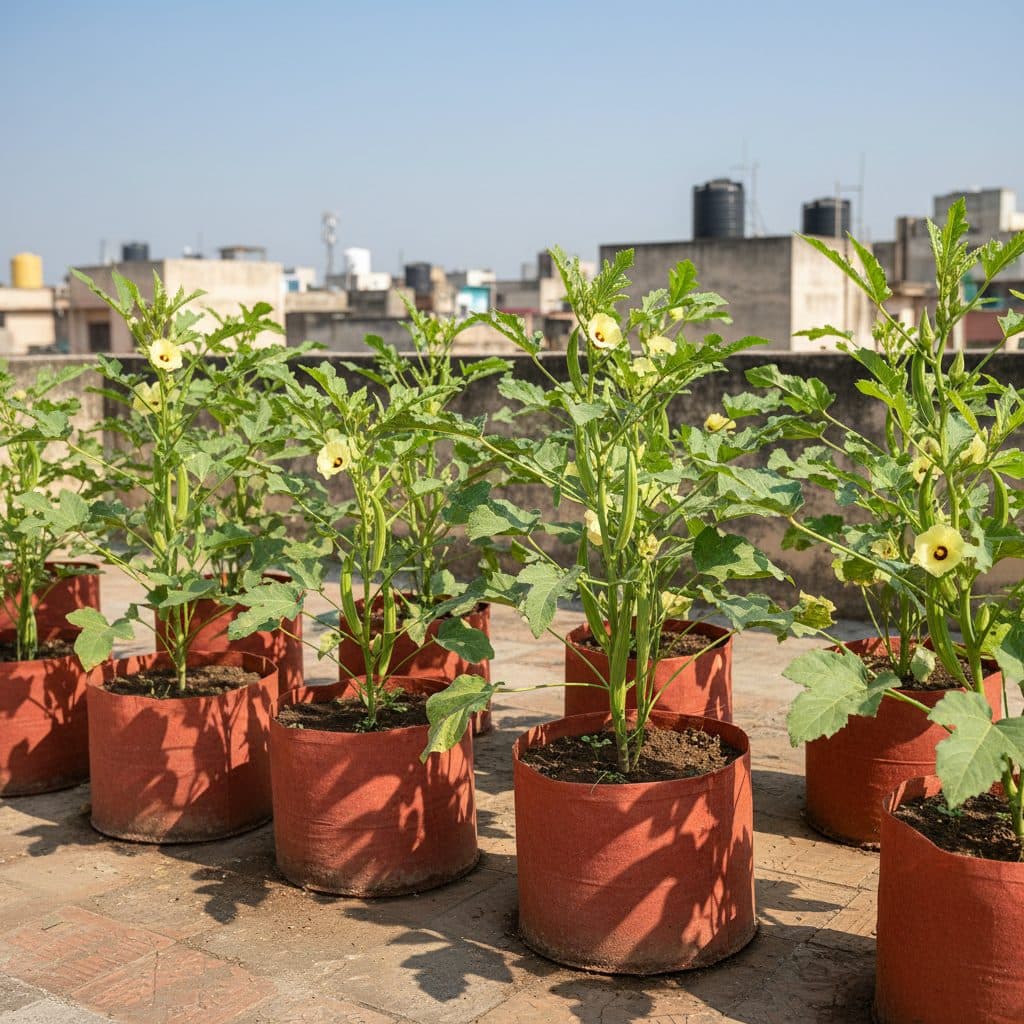
Key takeaways
- Select deep pots or HDPE grow bags measuring at least 30 cm to 35 cm in depth and diameter.
- Mix 40% garden soil, 30% cocopeat, and 30% vermicompost for aeration and moisture retention.
- Sow during the zaid (February to March) and kharif (June to July) seasons across Indian plains.
- Position containers where plants receive at least 6 to 8 hours of direct, unfiltered sunlight daily.
- Elevate grow bags on clay bricks or pot stands to safeguard roof waterproofing and promote drainage.
- Harvest tender green pods every two to three days to stimulate continuous blossom and pod production.
Quick answer: For great results when learning how to grow lady finger in pots in India, use 30 cm to 35 cm deep grow bags filled with a mix of 40% garden soil, 30% cocopeat, and 30% vermicompost. Sow seeds in February–March (summer crop) or June–July (monsoon crop), provide full sunlight, and harvest pods every other day while young and crisp.
Lady finger, widely known across India as bhindi or okra (Abelmoschus esculentus), is one of the most productive and rewarding vegetables you can cultivate in a home terrace garden or balcony. A beloved staple in Indian kitchens, home-grown bhindi delivers a sweet tenderness and crisp texture that shop-bought pods simply cannot match.
Because bhindi is naturally heat-loving and vigorous, it thrives under the bright sunshine of Indian summers and monsoons. However, learning how to grow lady finger in pots successfully requires understanding the constraints of container gardening. Restricted root volumes, extreme rooftop heat reaching 40°C, and heavy monsoon downpours require specific potting mixes, proper container drainage, and attentive feeding.
Choose a properly sized grow bag, blend a light, nutrient-rich potting mix, and manage pests organically, and your rooftop terrace can yield fresh, tender lady fingers through the warm months.
+--------------------------------------------------------------------------+
|                  BHINDI CONTAINER SOWING CALENDAR (INDIA)                |
+-------------------+-----------------------------+------------------------+
| Cropping Season   | Sowing Window               | Harvesting Period      |
+-------------------+-----------------------------+------------------------+
| Zaid (Summer)     | Mid-February to March       | April to June          |
| Kharif (Monsoon)  | June to July (Onset of rain)| August to October      |
| Year-Round (South)| August to October (Warm)    | November to January    |
+-------------------+-----------------------------+------------------------+
Sowing seasons for lady finger across Indian regions
Bhindi requires warm soil and ambient temperatures between 22°C and 35°C for rapid seed germination and steady flowering. Across the Indian subcontinent, sowing is traditionally divided into two major agricultural seasons:
- Zaid / Summer Crop (February to March): Sown as soon as winter chills subside in the northern and central plains. Plants grow rapidly in spring sunshine and yield heavily through peak summer, provided watering is maintained.
- Kharif / Monsoon Crop (June to July): Sown with the arrival of the monsoon rains. This is the main national cropping season, producing vigorous plants and prolific yields through early autumn.
In southern and coastal regions (such as Tamil Nadu, Kerala, Karnataka, and coastal Maharashtra), where winter temperatures remain mild and frost is absent, bhindi can be sown practically year-round. In northern hill regions, sowing should be restricted to the warm window between April and June.
To explore other quick crops suited to Indian home setups, see our guide on fast-growing-vegetables-in-india.
Container selection and roof protection
Container size matters for bhindi. Okra produces a substantial central taproot that requires ample vertical depth to anchor the plant and access nutrients.
Container specifications:
- Minimum dimensions: Choose round pots or HDPE fabric grow bags that are at least 30 cm deep and 30 cm to 35 cm in diameter (roughly a 15-litre to 20-litre volume).
- Rectangular grow bags: If using long rectangular terrace grow bags (e.g., 90 cm x 30 cm x 30 cm), space individual bhindi plants 25 cm to 30 cm apart.
- Drainage holes: Ensure plastic or terracotta containers have multiple unobstructed drainage holes at the base.
+--------------------------------------------------------------------------+
|                  TERRACE GROW BAG ELEVATION SETUP                        |
+--------------------------------------------------------------------------+
|  [ Bhindi Foliage in Full Sun (6-8 hours direct light) ]                 |
|  [ Porous HDPE Fabric Grow Bag (Allows root pruning & aeration) ]        |
|  [ Free-Draining Soil Mix (40% Soil, 30% Cocopeat, 30% Vermicompost) ]  |
|  [ Terracotta Bricks / Pot Stand (5 cm clearance above roof slab) ]      |
|  [ Terrace Concrete Floor (Waterproof coating protected) ]               |
+--------------------------------------------------------------------------+
Terrace roof care: Always place grow bags and pots on clay bricks, plastic drain cells, or raised metal pot stands. Elevating containers creates a 5 cm air gap that prevents water from pooling beneath the pot, protecting your roof's waterproofing membrane from dampness and allowing air to prune bottom roots naturally.
Formulating the ideal potting mix
Standard heavy garden soil quickly compacts inside containers, turning rock-hard in summer and waterlogged during monsoon deluges. A loose, well-aerated, moisture-retentive potting mix is essential.
Recommended pot mix ratio by volume:
- 40% Good Quality Garden Soil / Red Soil: Provides mineral body and base anchorage.
- 30% Washed Cocopeat: Retains essential moisture in terrace heat while keeping the mix light.
- 30% Well-Aged Vermicompost or Cow Dung Manure (Gobar Khad): Supplies slow-release nitrogen and active microbial life.
- Additions per pot: Mix in two tablespoons of neem cake powder (neem khali) and one tablespoon of bone meal or steamed rock phosphate. Neem cake acts as a natural soil bio-fertiliser while deterring soil-dwelling root grubs and nematodes.
For pairing bhindi with other container staples in your kitchen garden, explore our instructions on how-to-grow-turmeric-at-home.
Sowing seeds and seedling management
Bhindi seeds feature a hard, tough outer seed coat. Soaking seeds in a bowl of warm water or diluted seaweed solution for 8 to 12 hours before sowing softens the outer hull and dramatically speeds up germination.
Sowing steps:
- Fill your container, leaving a 3 cm rim at the top for watering and future top-dressing.
- Press two seeds into the center of the pot at a depth of 1.5 cm to 2 cm.
- Water gently with a rose can until moisture begins to drain from the base.
- Place the container in a warm, bright position. Seedlings will emerge within 4 to 7 days.
- Once the seedlings develop two sets of true leaves, snip the weaker seedling at soil level, retaining only the strongest single plant per container.
Terrace care: watering, heat protection, and nutrition
Caring for potted bhindi on an exposed Indian rooftop requires managing rapid water loss during dry summer heatwaves and heavy monsoonal moisture.
- Watering rhythm: During hot summer months (April to June), terrace containers dry out rapidly. Water deeply twice daily—once in the early morning and once in the late afternoon. During the monsoon, check moisture levels daily and only water when the top 2 cm of soil feels dry. To master summer moisture management, read our advice on container-crop-water-needs-summer.
- Summer shade net: When peak summer temperatures cross 38°C to 40°C, erect a 50% green shade net above your terrace garden. The net filters harsh UV rays, lowers ambient leaf temperature, and prevents flower drop. For additional cooling methods, explore container-gardens-summer-survival.
- Organic feeding: Bhindi is a continuous producer that requires regular nutrition:
- Every 15 days: Top-dress each pot with two handfuls of rich vermicompost.
- Every 10 days: Apply a diluted liquid organic fertiliser, such as jeevamrut, seaweed extract, or fermented mustard cake liquid (sarson khali), to encourage strong blossoming.
Managing pests and viral diseases organically
Indian terrace gardens face several common insect pests that target bhindi plants:
- Aphids and Jassids (Leafhoppers): Small green or brown insects suck sap from leaf undersides, causing leaf curling and yellow margins. Spray the undersides of leaves with cold-pressed neem oil (5 ml neem oil plus 2 ml liquid soap per 1 litre of water) every 7 to 10 days in the evening.
- Shoot and Fruit Borer: Caterpillars bore into tender growing shoot tips and developing pods. Inspect plants weekly, prune off wilted shoot tips immediately, and handpick any visible caterpillars.
- Yellow Vein Mosaic Virus (YVMV): Transmitted by tiny whiteflies, this virus turns leaf veins bright yellow, severely stunting fruit production. Prevent infections by choosing YVMV-resistant varieties (such as Arka Anamika, Kashi Kranti (VRO-6), Parbhani Kranti, or Arka Abhay) and controlling whitefly populations using yellow sticky traps and regular neem sprays. Older varieties such as Pusa Sawani are no longer resistant (the resistance broke down long ago), so avoid them if YVMV is a problem in your area.
If you are expanding your container fruit and vegetable collection, consult our comprehensive guide on how-to-grow-pomegranate-in-pot.
Harvesting for continuous production
Bhindi plants begin flowering 40 to 50 days after sowing. The creamy yellow blossoms open in the morning and naturally drop their petals by evening, revealing a miniature green pod at the base.
Harvesting rules:
- Harvest pods 4 to 6 days after flowering, when they reach 8 cm to 12 cm in length.
- Test tenderness: gently bend the pointed tip of the pod with your thumb. If the tip snaps crisply, the pod is tender. If it bends without snapping, it has turned fibrous and woody.
- Use a sharp pair of pruning snips or a harvesting knife to cut the stem just above the pod cap. Avoid pulling or twisting pods, which tears the main stalk.
- Harvest regularly every two days. Leaving oversized pods on the plant signals the plant to stop producing new flowers and divert energy into seed maturation.