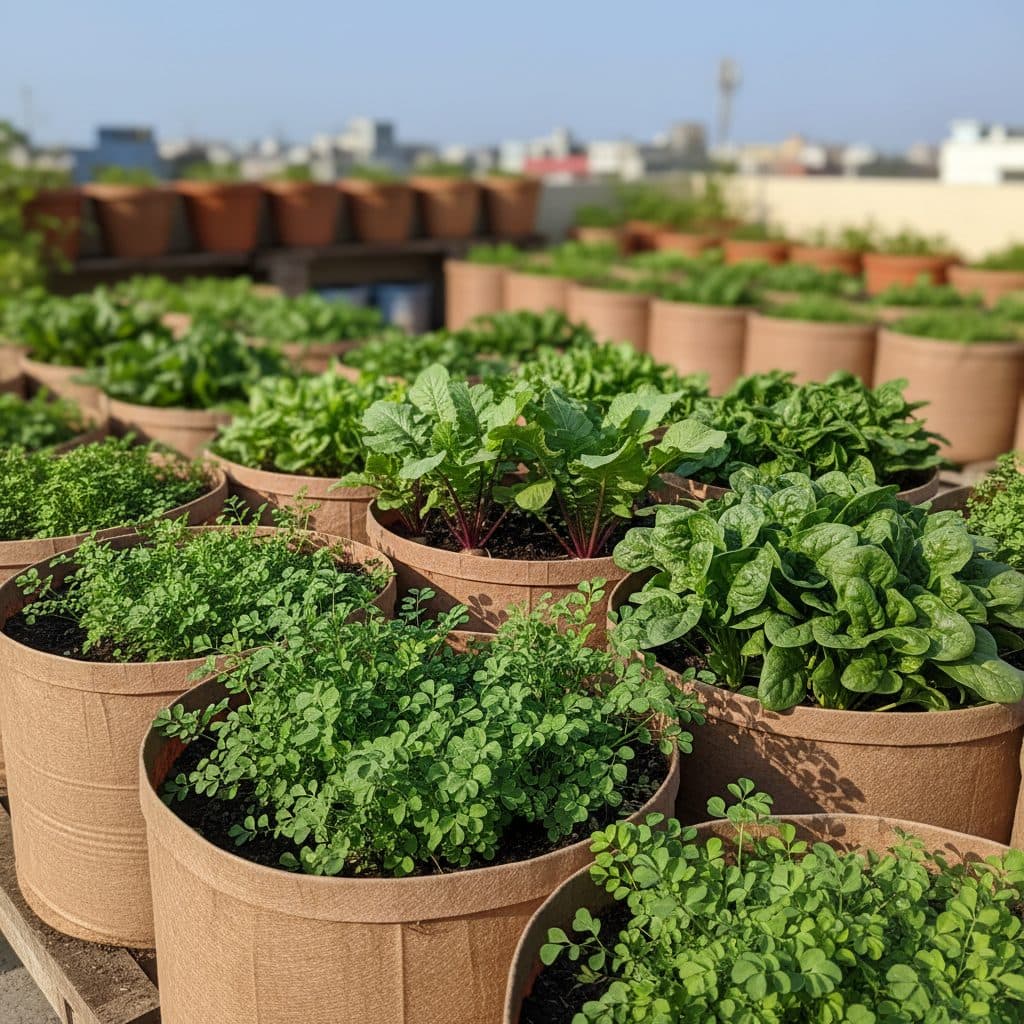
Key takeaways
- Sow methi (fenugreek) for tender leafy greens ready to harvest in 20 to 25 days.
- Direct sow rapid-maturing table radishes (mooli) for crisp root harvests in 25 to 30 days.
- Choose wide, shallow grow bags measuring 15 cm to 20 cm in depth for leafy greens (20 cm minimum for round table radishes, 30 cm or more for long mooli types).
- Stagger seed sowing every 10 to 14 days to establish a continuous supply of kitchen greens.
- Use light, moisture-retentive potting mixes containing 40% cocopeat and 40% vermicompost.
- Harvest leafy vegetables using the cut-and-come-again method to encourage multiple regrowth flushes.
Quick answer: The fastest growing vegetables in India for terrace gardens and balconies include methi (fenugreek, 20–25 days), red amaranth (chaulai, 25–30 days), radishes (mooli, 25–35 days), palak (spinach, 30–35 days), and coriander (dhania, 30–40 days). Leafy greens thrive in 15 cm to 20 cm deep grow bags; use 20 cm minimum for round table radishes, and 30 cm or more for long mooli types.
For city dwellers, apartment renters, and home gardeners across India, the desire for quick, chemical-free homegrown produce often meets the challenge of limited space and busy schedules. Waiting several months for fruiting crops like eggplants, pomegranates, or winter squash can test beginner patience.
Fortunately, a remarkable range of traditional Indian leafy greens and quick root vegetables yield abundant, nutrient-dense harvests in as little as three to five weeks. Learning which fast growing vegetables in India suit your terrace or balcony allows you to turn small containers into productive kitchen gardens with rapid turnarounds.
By selecting fast-growing species tailored to Indian seasonal temperatures, utilizing shallow fabric grow bags, and practicing succession sowing, you can harvest crisp, organic greens for your daily dal, parathas, and sabzis throughout the year.
+--------------------------------------------------------------------------+
|                  FASTEST GROWING CROPS IN INDIA (CONTAINERS)             |
+-------------------+-----------------------------+------------------------+
| Vegetable Crop    | Days to First Harvest       | Primary Season         |
+-------------------+-----------------------------+------------------------+
| Methi (Fenugreek) | 20 to 25 Days               | Rabi (Oct-Feb); Mar-Apr|
|                   |                             | in shade only          |
| Chaulai (Amaranth)| 25 to 30 Days               | Zaid & Kharif (Summer) |
| Mooli (Radish)    | 25 to 35 Days               | Rabi & Autumn (Sep-Feb)|
| Sarson (Mustard)  | 25 to 30 Days               | Rabi (Winter)          |
| Palak (Spinach)   | 30 to 35 Days               | Rabi & Mild Summer     |
| Dhania (Coriander)| 30 to 40 Days               | Rabi & Post-Monsoon    |
+-------------------+-----------------------------+------------------------+
Top 6 rapid-harvest vegetables for Indian homes
1. Methi (fenugreek), 20 to 25 days
Methi is the undisputed champion of the Indian kitchen garden. Unprocessed culinary seeds from your spice box germinate within 48 to 72 hours in warm soil.
- Sowing method: Broadcast seeds densely over the soil surface and cover with a 1 cm layer of vermicompost.
- Harvesting: Snip tender shoots 5 cm above soil level when plants reach 10 cm to 15 cm in height. Leaving the root crowns intact allows the plant to produce a second flush of greens within 10 days.
2. Chaulai / Thotakura (green and red amaranth), 25 to 30 days
Amaranth is nature's answer to intense Indian summer heat. While cold-season greens struggle when temperatures cross 35°C, chaulai thrives in hot, humid weather.
- Sowing method: Mix tiny seeds with dry sand for even distribution, sprinkling lightly over moist potting mix.
- Harvesting: Harvest tender leaves and succulent young shoots continuously as a cut-and-come-again crop.
3. Mooli / Radish (roots and greens), 25 to 35 days
Quick European table radishes such as 'Cherry Belle', or the oblong 'French Breakfast', mature in 25 to 30 days in a 20 cm deep container. For a full-size mooli such as Pusa Chetki — a long white type suited to summer sowing — allow 40 to 45 days and a container at least 30 cm deep.
- Sowing method: Sow seeds 1.5 cm deep and 7 cm apart in containers at least 20 cm deep.
- Bonus harvest: Radish thinnings and young leaves are edible and peppery, ready for stir-fries within 15 to 20 days.
4. Palak (Indian spinach), 30 to 35 days
Desi palak produces broad, tender, succulent leaves packed with iron and dietary fibre.
- Sowing method: Sow seeds 1.5 cm deep in rows 10 cm apart.
- Harvesting: Harvest outer leaves individually once they reach hand-length, leaving the central growing heart to generate new foliage over 4 to 5 successive flushes.
5. Sarson / mustard greens, 25 to 30 days
Mustard greens add a sharp, spicy bite to winter salads and traditional sarson ka saag.
- Sowing method: Scatter yellow or black mustard seeds thinly in wide trays.
- Harvesting: Cut tender baby leaves at 25 days for salads, or let plants grow to 35 days for cooking.
6. Dhania (coriander), 30 to 40 days
Fresh, fragrant coriander is essential in Indian cooking.
- Sowing method: Gently crush whole coriander seeds into two halves using a rolling pin before soaking them in water for 12 hours. Sow in partial shade.
- Harvesting: Trim outer stems as needed once plants reach 15 cm in height.
For longer-term vegetable projects, combine quick greens with fruiting staples detailed in our guide on how-to-grow-lady-finger-in-pots.
+--------------------------------------------------------------------------+
|                  POTTING PROFILE FOR RAPID LEAFY GREENS                  |
+--------------------------------------------------------------------------+
|  [ Broadcast Seeds covered with 1 cm Fine Vermicompost ]                 |
|  [ 40% Washed Cocopeat (Retains Moisture in Shallow Trays) ]             |
|  [ 40% Sifted Vermicompost (Rapidly Available Nitrogen & Microbes) ]     |
|  [ 20% Fine Garden Soil (Mineral Body) + 1 Tbsp Neem Cake Powder ]       |
|  [ 15-20 cm Deep Rectangular HDPE Grow Bag with Drainage Holes ]         |
+--------------------------------------------------------------------------+
Container selection and potting mix for quick crops
Because fast-maturing leafy greens and small table radishes have shallow, fibrous root systems, they do not require massive, heavy pots.
Container specifications:
- Container depth: 15 cm to 20 cm is ideal for leafy greens; use 20 cm minimum for round table radishes and 30 cm or more for long mooli types.
- Surface area: Maximize surface area using wide rectangular HDPE fabric grow bags (e.g., 60 cm x 30 cm x 15 cm), shallow terracotta troughs, or recycled fruit crates lined with permeable weed fabric.
- Drainage: Ensure containers have multiple base holes. Elevate trays on bricks to prevent water pooling on your terrace roof.
Potting mix formulation:
Shallow containers dry out quickly in Indian sunshine. Formulate a light, spongy medium that holds moisture without waterlogging:
- 40% Washed Cocopeat: Holds moisture and prevents compaction.
- 40% Sifted Vermicompost: Supplies readily available nitrogen and beneficial bacteria that drive fast leaf expansion.
- 20% Fine Garden Soil: Provides mineral anchorage.
- Additions: Blend in one tablespoon of neem cake per tray as a slow-release nitrogen source with useful activity against soil nematodes. To avoid damping-off, sow thinly, use a free-draining mix and never leave the tray standing wet.
For deeper root vegetables that require specialized container depth, check our detailed instructions on growing-carrots-root-vegetables-containers.
Succession sowing: ensuring a year-round harvest
The secret to a constant supply of fresh kitchen greens is succession sowing. If you sow an entire packet of methi seeds at once, you will have a mountain of greens at day 25 and nothing left on day 35.
Succession routine:
- Divide your growing space into three or four separate shallow trays.
- Sow Tray 1 on Day 1.
- Sow Tray 2 on Day 10.
- Sow Tray 3 on Day 20.
- By the time you harvest Tray 1 on Day 25, Tray 2 is halfway grown, and Tray 3 has just emerged.
- Re-fertilise and replant Tray 1 immediately after harvest.
+--------------------------------------------------------------------------+
|                  TERRACE SUCCESSION SOWING CYCLE                         |
+--------------------------------------------------------------------------+
|  [ Week 1: Sow Tray A (Methi / Palak) ]                                  |
|  [ Week 2: Sow Tray B (Radish / Amaranth) ]                              |
|  [ Week 3: Sow Tray C (Coriander / Sarson) ]                             |
|  [ Week 4: Harvest Tray A -> Re-seed Tray A ]                            |
+--------------------------------------------------------------------------+
Terrace management: watering and shade
Managing quick-growing greens on Indian rooftops requires careful temperature and moisture control:
- Watering technique: Never blast delicate leafy seedlings with a harsh hose stream, which knocks plants flat and exposes roots. Use a handheld pressure mister or a watering can fitted with an ultra-fine rose head.
- Moisture consistency: Leafy greens must never dry out completely. A single afternoon of severe drought will check growth and force crops like coriander and spinach to bolt prematurely to seed. For managing moisture in terrace heat, consult container-crop-water-needs-summer.
- Summer shade: During peak summer (April to June), place quick greens in morning-sun positions or beneath a 50% green shade net. Morning sun (7:00 AM to 11:00 AM) provides ample energy for photosynthesis while avoiding scorching afternoon heat.
To integrate slow-maturing root and fruit crops alongside fast greens, explore our companion guides on how-to-grow-turmeric-at-home and how-to-grow-pomegranate-in-pot.