Key takeaways
- Container crops typically require 20% to 50% more water than in-ground plants due to faster evaporation and heat absorption.
- Tomatoes in 15-gallon containers in USDA zone 9 can demand up to 2.5 gallons of water per day during peak summer.
- Ollas can reduce water consumption by 50% to 70% for container plants, especially in arid regions like the Southwest.
- Wicking beds provide consistent moisture, often cutting watering frequency by 75% compared to top-down methods.
- Rainwater harvesting can supply up to 600 gallons of water from a 1,000 square foot roof with one inch of rain.
- Monitoring soil moisture with a meter is more effective than a schedule, aiming for 60% to 80% moisture for most crops.
Quick answer: In hot climates like Arizona, a single tomato plant in a 15-gallon container can require over two gallons of water daily when temperatures exceed 100°F. Smart irrigation methods like ollas and wicking beds can significantly reduce this water consumption.
In the scorching summer heat of places like Phoenix, Arizona, where temperatures routinely exceed 100°F for weeks, a single tomato plant in a 15-gallon container can easily demand over two gallons of water every day. This isn’t an exaggeration; it’s a reality for growers striving to keep their plants productive under intense sun. Container gardening, while offering flexibility for small spaces and poor soil, introduces unique challenges, primarily around consistent moisture management. Unlike their in-ground counterparts, container plants have limited soil volume, which heats up faster and dries out much more quickly, often requiring daily—sometimes twice daily—watering during peak summer months, especially in USDA zones 8 and above.
Understanding these specific water requirements helps prevent both under-watering stress and over-watering root rot. Fortunately, various strategies can significantly reduce the daily chore and conserve precious water resources. From ancient techniques like ollas to more modern wicking beds and larger-scale rainwater harvesting systems, growers across the US, from humid Florida to the dry plains of Kansas, are adopting smarter irrigation methods. These approaches lead to healthier plants and more sustainable growing practices, often cutting water use by 30% to 70% compared to traditional top-down watering.
understanding container crop water needs
Determining how much water a container crop actually needs involves several factors, not just the plant type. The size and material of your container play a significant role; a 5-gallon plastic pot will dry out much faster than a 20-gallon ceramic one, especially when temperatures climb above 90°F. Evaporation from the soil surface and transpiration through the plant’s leaves are the primary ways water is lost. In direct sun, a black plastic pot can heat up to 120°F, causing water to evaporate 30% faster than from a lighter-colored container. The type of growing medium also matters; a well-draining mix might need more frequent watering than one with higher water retention, though both matter for root health. For instance, in USDA zone 7b, a pepper plant in a 10-gallon container might need 0.75 gallons of water daily when temperatures average 85°F.
Container plants, by their nature, are more susceptible to drying out than plants in the ground. Their limited soil volume and exposure to air on all sides mean they can lose moisture 20% to 50% faster than their in-ground counterparts, according to the USDA Natural Resources Conservation Service [1]. This accelerated drying is particularly pronounced in windy conditions, which can increase evaporation rates by another 15% to 25%. Understanding these dynamics helps growers anticipate needs rather than react to wilting plants. A consistent watering schedule might seem helpful, but it often leads to either over-watering or under-watering, as environmental conditions fluctuate daily. Instead, a more responsive approach is generally better for plant vitality.
assessing soil moisture
The most reliable way to gauge water needs is to check the soil moisture directly. For smaller containers, you can lift the pot; if it feels light, it likely needs water. For larger containers, stick your finger about two inches into the soil. If it feels dry at that depth, it’s time to water. Soil moisture meters, available for under 20 dollars, offer a more precise reading, helping maintain an ideal moisture level between 60% and 80% for most vegetables, as suggested by Sustainable Agriculture Research & Education [3]. Ensuring proper drainage is also critical; a container should have at least one 0.5-inch to 1-inch drainage hole to prevent waterlogging, which can lead to root rot. Overwatering can be just as detrimental as under-watering, suffocating roots and hindering nutrient uptake. For example, a basil plant in a 1-gallon pot in humid Florida might only need water every other day if the soil moisture consistently reads above 70%.
- terra cotta pots: porous, dry quickly, good for succulents.
- plastic pots: retain moisture well, lighter weight, less expensive.
- fabric grow bags: excellent aeration, prevent root circling, dry faster.
- glazed ceramic pots: retain moisture, heavy, decorative.
- wood planters: good insulation, moderate moisture retention, can be bulky.
specific water requirements for common container crops
Different container crops have vastly different water appetites, especially during the summer. Thirsty plants like tomatoes, cucumbers, and squash are heavy drinkers, particularly when they are fruiting. A mature tomato plant in a 15-gallon container in a hot climate like USDA zone 9 can easily consume 1.5 to 2.5 gallons of water per day, especially if temperatures consistently hit 95°F. Peppers, while also needing consistent moisture, are slightly less demanding, typically requiring 0.5 to 1 gallon daily in a 10-gallon pot. Herbs like rosemary, thyme, and oregano, which are often drought-tolerant in the ground, still need regular watering in containers, perhaps 0.25 to 0.5 gallons every other day in a 2-gallon pot, but they are more forgiving of brief dry spells.
Understanding these general categories helps, but observing individual plants is key. For example, a large zucchini plant in a 20-gallon fabric grow bag in the humid Midwest might need 2 gallons of water daily during its peak production, while a smaller bush bean plant in a 5-gallon pot might only need 0.75 gallons. The ATTRA / NCAT Sustainable Agriculture program provides detailed guidelines for many common vegetables, emphasizing that consistent moisture is more important than sheer volume for many fruiting crops [4]. Inconsistent watering can lead to issues like blossom end rot in tomatoes, even if the total water volume is adequate over a week. For instance, a bell pepper plant in a 7-gallon container in southern California might perform best with 0.75 gallons of water delivered in two smaller applications daily during a heatwave.
tailoring water for plant stages
A plant’s water needs change dramatically throughout its life cycle. Seedlings and young plants generally require less water than mature, fruiting plants, but their small root systems mean they dry out quickly. Overwatering young plants can be particularly damaging, leading to damping-off disease. As plants grow and begin to flower and set fruit, their water demands peak. For example, a tomato plant’s water usage can increase by 30% to 40% from its vegetative stage to its fruiting stage. During dormancy or in cooler weather, water needs drop significantly, sometimes by 50% or more. Monitoring these stages and adjusting watering accordingly can save water and improve yields. For example, a strawberry plant in a 1-gallon hanging basket might need 0.25 gallons daily during fruiting but only 0.1 gallons every two days during cooler, non-fruiting periods in USDA zone 6. You can efficiently deliver this water with a quality expandable hose and nozzle.
- tomatoes: 1.5-2.5 gallons/day in 15-gallon pots during fruiting.
- cucumbers: 1.5-2 gallons/day in 10-gallon pots during peak growth.
- zucchini: 2-2.5 gallons/day in 20-gallon pots when producing.
- peppers: 0.5-1 gallon/day in 7-gallon pots during summer.
- strawberries: 0.25-0.5 gallons/day in 1-gallon pots during fruiting.
passive irrigation strategies for containers
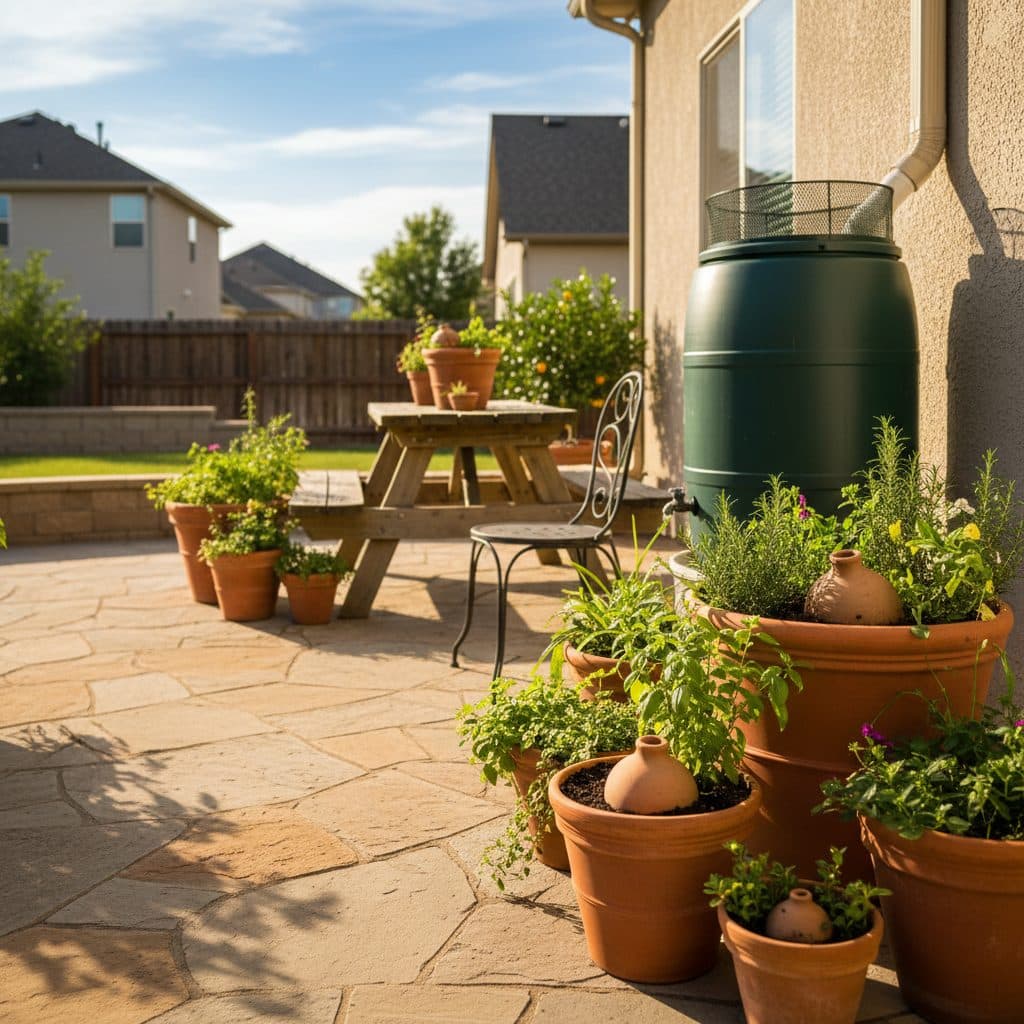
Passive irrigation methods offer a significant advantage for container growers, reducing labor and conserving water. Ollas, an ancient technique, involve burying unglazed clay pots with narrow necks into the soil among plants. These porous vessels slowly release water into the surrounding soil as the plant roots draw moisture, creating a consistent, localized water source. This method can reduce water consumption by 50% to 70% compared to surface watering, especially in arid regions like the Southwest, as documented by Sustainable Agriculture Research & Education [3]. A single 1-gallon olla can effectively irrigate a 12-inch to 18-inch radius for several days, depending on the plant’s needs and climate. They are particularly useful for larger containers (10 gallons or more) and for plants that prefer consistent moisture without soggy roots, such as tomatoes and peppers.
The efficiency of ollas comes from direct root-zone delivery, minimizing evaporation from the soil surface. This means less water is lost to the air, and more is available to the plant. Filling an olla once every two to five days, depending on conditions, can replace daily watering for many container setups. For instance, a grower in USDA zone 8 with three 15-gallon containers might only need to fill three 1-gallon ollas every three days, saving considerable time and effort. The initial investment for ollas is modest, often less than 15 dollars per olla, and they can last for many seasons if properly cared for. Their effectiveness is particularly noticeable during prolonged heatwaves, maintaining soil moisture levels around 70% even when air temperatures reach 98°F.
wicking beds for steady hydration
Wicking beds are another highly effective passive irrigation system for containers. These beds feature a water reservoir at the bottom, separated from the growing medium by a permeable layer. Water is drawn up into the soil by capillary action (wicking), providing a steady supply of moisture to the plant roots from below. This method can reduce watering frequency by as much as 75% compared to top-down watering, according to ATTRA / NCAT Sustainable Agriculture [4]. A typical wicking bed for a container garden might have a 4-inch to 6-inch deep reservoir, which can hold enough water to last a week or more for many plants. This consistent moisture supply promotes strong root development and reduces plant stress, leading to healthier growth and often higher yields. For example, a 30-gallon wicking bed could hold 5-8 gallons of water, sustaining a large squash plant for five to seven days in 90°F weather.
- ollas: unglazed clay pots buried in soil, release water slowly.
- wicking beds: bottom reservoir feeds water up through capillary action.
- self-watering planters: integrated reservoir and wicking system.
- capillary mats: absorbent material under pots draws water from a tray.
- bottle irrigation: inverted plastic bottles with small holes, simple drip.
water harvesting and earthworks for container gardens
While ollas and wicking beds address individual container needs, integrating broader water harvesting strategies can provide a sustainable water source for an entire container garden. Rainwater harvesting, for instance, involves collecting rainfall from rooftops and storing it in barrels or cisterns. A 1,000 square foot roof can yield approximately 600 gallons of water from just one inch of rainfall, a substantial amount for irrigating numerous containers, as highlighted by the EPA’s Soak Up the Rain initiative [2]. A standard 50-gallon rain barrel connected to a downspout can quickly fill during a single rain event, providing chlorine-free water that many plants prefer. This collected water can then be used to fill ollas, top off wicking bed reservoirs, or simply hand-water containers, significantly reducing reliance on municipal water supplies. In regions like the Pacific Northwest, where rainfall is abundant, this can be a primary water source for months.
Setting up a rainwater harvesting system can be as simple as placing a 50-gallon barrel under a downspout, or as complex as a multi-barrel system with pumps and filters. The initial cost for a basic rain barrel setup is often less than 100 dollars. Using rainwater for container gardens conserves water and gives plants soft water free of salts and chemicals, which can build up in container soil over time. For example, a small 200 square foot patio roof could collect 120 gallons from a one-inch rain, enough to water ten 15-gallon tomato plants for nearly a week in 90°F weather. Consider exploring rainwater harvesting methods to supply your container garden.
integrating earthworks for larger scale
For growers with larger container gardens or those looking to integrate their container areas into a more comprehensive water management plan, passive irrigation earthworks can be highly beneficial. Swales, berms, and rain gardens are designed to slow, spread, and sink water into the landscape, reducing runoff and increasing soil moisture in surrounding areas. A swale, which is a shallow ditch dug along a contour line, can capture and hold rainwater, allowing it to slowly infiltrate the ground. This can reduce stormwater runoff by 30% to 50%, according to the USDA Natural Resources Conservation Service [1], benefiting nearby container plants by increasing ambient humidity and providing a localized water table. For example, a 6-inch deep swale placed uphill from a container garden could direct excess rainwater to a permeable area, preventing erosion and recharging groundwater.
These earthworks can create microclimates that support container plants, even if the containers aren’t directly in the earthwork itself. A rain garden, for instance, is a depressed area planted with water-tolerant vegetation that absorbs runoff from impervious surfaces like driveways or patios. While primarily for in-ground plants, the increased soil moisture and cooler temperatures within a rain garden can benefit nearby container plants, reducing their overall water stress. Implementing these larger-scale strategies, perhaps with the help of solar water pumps for moving collected water, can create a more resilient and less water-intensive growing environment, especially in regions experiencing prolonged droughts or water restrictions. A typical rain garden designed for a 500 square foot impervious surface can absorb 150-200 gallons of water during a one-inch rain event, preventing it from overwhelming storm drains.
- swales: contour ditches that capture and infiltrate runoff.
- berms: raised mounds of earth that direct water flow.
- rain gardens: depressed planting areas that absorb stormwater.
- check dams: small barriers in swales to slow water and encourage infiltration.
- keyline design: system of earthworks to manage water across a landscape.
Comparing common container irrigation methods
Method | Water Efficiency | Maintenance | Initial Cost |
|---|---|---|---|
top-down watering (hose/can) | Moderate (30-50% loss to evaporation) | High (daily in summer) | Low (under $50) |
ollas | High (50-70% water savings) | Moderate (fill every 2-5 days) | Moderate ($10-25 per olla) |
wicking beds | Very High (75% less watering frequency) | Low (fill reservoir weekly) | Moderate to High ($50-200 per bed) |
drip system | High (10-20% loss to evaporation) | Low (automated) | Moderate ($50-150 for small system) |
olla water savings: Ollas can reduce container plant water use by 50% to 70% in hot climates like USDA zone 9, maintaining consistent soil moisture around 70%.
rainwater potential: A 1,000 square foot roof can yield approximately 600 gallons of water from just one inch of rainfall, ideal for container gardens.
Frequently asked questions
How often should I water my container plants in summer?
In peak summer, many container plants in USDA zones 7-10 require watering once or even twice daily, especially if temperatures consistently exceed 90°F. Checking soil moisture two inches deep is more reliable than a strict schedule.
What is the best container size for water retention?
Larger containers, such as 15-gallon or 20-gallon pots, retain moisture significantly longer than smaller 5-gallon pots, potentially reducing watering frequency by up to 50% in hot weather.
Can I use tap water for my container plants?
Yes, tap water is generally fine, but rainwater collected in a 50-gallon barrel is often preferred as it lacks chlorine and other additives that can accumulate in container soil over time.
Do all container crops need the same amount of water?
No, water needs vary widely; a thirsty tomato plant might need 2 gallons daily, while a rosemary plant could thrive on 0.5 gallons every other day in similar 90°F conditions. Always tailor to the specific plant and its growth stage.
How can I tell if my container plant is overwatered?
Signs of overwatering include yellowing leaves, stunted growth, and a persistently soggy soil surface, often indicating more than 80% soil moisture and potentially leading to root rot. Ensure containers have adequate drainage holes (at least 0.5 inch).
Are self-watering containers truly effective?
Self-watering containers, including wicking beds, can be highly effective, reducing watering frequency by up to 75% and maintaining consistent soil moisture around 70%. They are particularly useful for busy growers or during vacations.
References
- USDA Natural Resources Conservation Service (2024). USDA Natural Resources Conservation Service.
- EPA — Soak Up the Rain (2024). EPA — Soak Up the Rain.
- SARE — Sustainable Agriculture Research & Education (2023). SARE — Sustainable Agriculture Research & Education.
- ATTRA / NCAT Sustainable Agriculture (2023). ATTRA / NCAT Sustainable Agriculture.
- USDA National Agroforestry Center (2023). USDA National Agroforestry Center.