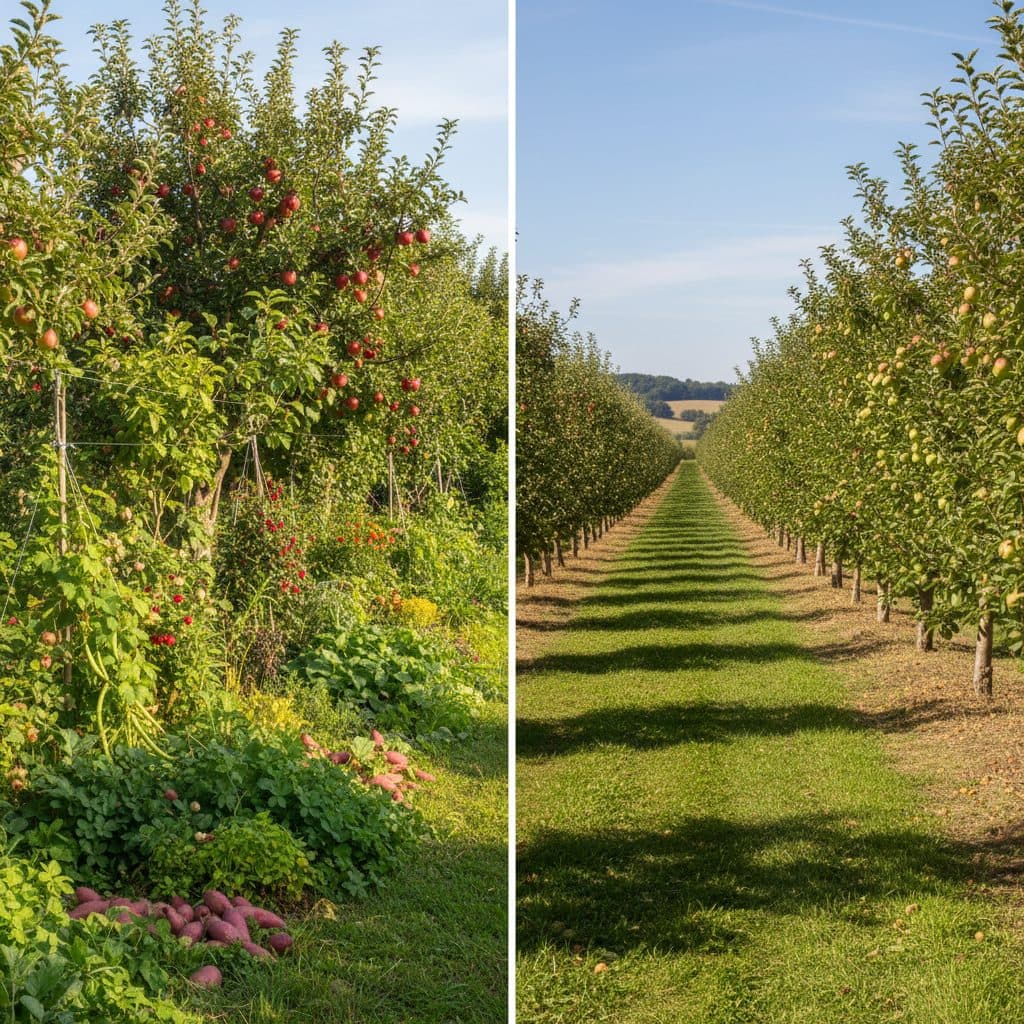
Key takeaways
- Orchards focus on linear, single-canopy monocultures designed for high single-crop yield, tractor access, and streamlined bulk harvesting.
- Food forests (forest gardens) mimic natural woodland ecosystems across seven vertical layers, integrating fruit, nuts, berries, perennial vegetables, and nitrogen-fixing support species.
- Traditional orchards require continuous external inputs, including mechanical mowing, synthetic or organic fertilizers, pest spraying, and intensive pruning.
- Food forests generate their own biological fertility through deep-rooted biomass plants (often called dynamic accumulators), chop-and-drop mulching, and pest-balancing predator habitats.
- Orchards produce higher commercial volume per hectare of a single target fruit, while food forests yield continuous, diversified harvests over an extended annual window.
- Harvesting a food forest requires hand labour and selective foraging, making it ideal for homestead self-reliance and community agriculture rather than mechanized wholesale markets.
Quick answer: In comparing a food forest vs orchard, an orchard prioritises streamlined single-crop production in neat rows with high external inputs and machinery access, whereas a food forest creates a self-sustaining seven-layer polyculture that yields diverse fruits, nuts, herbs, and perennial greens with minimal inputs once established.
When planning perennial fruit and nut production, landholders face a fundamental design choice: should you plant a conventional linear orchard or design an ecological food forest? Both approaches establish woody perennial crops that produce food for decades, but they operate on completely opposite ecological philosophies and management models.
The debate of food forest vs orchard centres on your goals for labor, harvest efficiency, ecological resilience, and yield diversity. While an orchard treats trees as isolated agricultural units in rows of mown grass, a food forest designs an integrated ecosystem where every plant supports the health and productivity of the whole community.
Whether you are designing a quarter-acre homestead garden, converting an existing monoculture tree block, or planning broadscale agroforestry, this guide compares structural layers, inputs, yields, and management demands.
+-------------------------------------------------------------+
|              ORCHARD VS FOOD FOREST COMPARISON              |
|                                                             |
|   FEATURE           CONVENTIONAL ORCHARD  FOOD FOREST       |
|   -------           --------------------  -----------       |
|   Structure         Linear single-tier    7 vertical layers |
|   Diversity         1 to 3 fruit species  Many species      |
|                                           across layers     |
|   Understory        Mown grass or bare    Edible perennials |
|   Fertility Source  Imported fertilizer   In-situ biomass   |
|   Pest Management   Regular spraying      Predator balance  |
|   Harvest Method    Mechanized / Bulk     Continuous hand   |
|   Best For          Commercial wholesale  Homesteads / Food |
+-------------------------------------------------------------+
What are the structural differences between orchards and food forests?
The physical layout and canopy architecture are the most obvious visual distinction between the two systems:
+-------------------------------------------------------------+
|                 SYSTEM ARCHITECTURE SCHEMATIC               |
|                                                             |
|   CONVENTIONAL ORCHARD                                      |
|   [ Tree ]      [ Tree ]      [ Tree ]   (Single Height)    |
|      |             |             |                          |
|   =====================================  (Mown Grass Sward) |
|                                                             |
|   SEVEN-LAYER FOOD FOREST                                   |
|   [ Canopy (Nut) ]                                          |
|         \       [ Sub-Canopy (Apple/Pear) ]                 |
|          \            \       [ Shrub (Berry) ]             |
|           \            \            \       [ Herbaceous ]  |
|   ========================================================= |
|   [ Ground Cover ]  [ Rhizosphere (Roots) ]  [ Vines Up ]   |
+-------------------------------------------------------------+
1. Conventional orchard design
- Monoculture rows: Fruit trees are planted in straight, equidistant lines with wide, mown turfgrass alleys (3 to 6 metres / 10 to 20 feet wide) between rows to accommodate tractors, sprayers, and transport trailers.
- Single canopy stratum: Trees are pruned to uniform heights and shapes (such as central leaders or open vases) using standard rootstocks to ensure uniform ripening. For dwarfing rootstock mechanics, see our guide on dwarf fruit trees.
- Suppressed understory: The soil directly beneath the tree canopy is typically kept bare with herbicides, cultivation, or plastic mulches to prevent turfgrass from competing with tree roots for nitrogen and moisture.
2. The seven-layer food forest model
A food forest replicates the multi-tiered structural complexity of a young natural woodland:
- Canopy Layer: Tall overstory trees (chestnuts, walnuts, large pecan, oak).
- Sub-Canopy / Understory: Standard and semi-dwarf fruit trees (apples, pears, plums, peaches, loquats).
- Shrub Layer: Berry bushes and woody shrubs (currants, gooseberries, haskaps, hazels).
- Herbaceous Layer: Perennial greens, culinary herbs, and mineral miners. Compare essential species in our breakdown of comfrey vs borage.
- Rhizosphere / Root Layer: Shallow and deep edible roots and tubers (sunchokes, horseradish, perennial alliums). Site the running species (sunchoke, horseradish, sea buckthorn) where you can contain them, and check your local invasive-species list before planting them outside their native range.
- Ground Cover Layer: Low creeping plants that protect topsoil, conserve moisture, and suppress grass (wild strawberries, prostrate rosemary, creeping thyme).
- Vertical / Vine Layer: Climbing perennial vines trained up tree trunks (grapes, kiwiberries, passion fruit, climbing beans).
For foundational principles on forest garden design, read our overview on what is a food forest.
How do inputs, fertility, and maintenance compare?
The long-term labor and resource profile shifts dramatically between these two models:
+-------------------------------------------------------------+
|                 LABOR & INPUT PROFILES OVER TIME            |
|                                                             |
|   STAGE             ORCHARD               FOOD FOREST       |
|   -----             -------               -----------       |
|   Years 1 - 3       Moderate prep; tree   High initial labor|
|   (Establishment)   planting & staking    Dense multi-layer |
|                                                             |
|   Years 4 - 10+     High ongoing labor;   Low external input|
|   (Maturity)        Mowing, spray, prune  Chop-and-drop cut |
|                     High annual inputs    Self-mulching     |
+-------------------------------------------------------------+
Fertility and soil management
- Orchards: Rely on external nutrient inputs. Grass alleyways actively compete with fruit tree feeder roots for soil nitrogen, requiring annual applications of compost, organic blood and bone, or synthetic nitrogen fertilizers.
- Food forests: Generate internal fertility. Dedicated nitrogen-fixing support trees and shrubs (such as alder, or, in the tropics, Gliricidia sepium or a locally recommended native legume; check your declared-weed list first, as Leucaena leucocephala is a declared weed in many tropical jurisdictions) are interplanted among fruit trees. Nitrogen fixers and deep-rooted biomass plants (often called dynamic accumulators) are pruned regularly ("chop-and-drop"), depositing biomass that decomposes into nutrient-rich soil humus.
Pest and disease management
- Orchards: Monocultures are vulnerable to pest outbreaks. If an insect pest (like codling moth) or fungal pathogen (like apple scab) enters the orchard, it can spread rapidly from tree to adjacent tree, requiring protective organic or synthetic spray schedules.
- Food forests: High biological diversity disrupts pest movement through visual confusion and aromatic masking. Dense floral understories provide continuous nectar and habitat for beneficial predatory wasps, hoverflies, ladybirds, and spiders, which makes it harder for any single pest to sweep the whole planting, though it does not guarantee that a given crop escapes damage in a bad year.
How do yields, harvest logistics, and economics differ?
Understanding yield characteristics prevents unrealistic expectations:
+-------------------------------------------------------------+
|                 YIELD & ECONOMIC COMPARISON                 |
|                                                             |
|   CRITERION         CONVENTIONAL ORCHARD  FOOD FOREST       |
|   ---------         --------------------  -----------       |
|   Single-Crop Yield Very High per acre    Moderate          |
|   Total Bio-Yield   Concentrated in 1 crop Spread across many|
|                                           crops rather than |
|                                           concentrated in 1 |
|   Harvest Window    Concentrated (2-3 wks)Continuous (9 mos)|
|   Harvest Method    Ladders / Shakers     Hand foraging     |
|   Commercial Fit    Wholesale packaging   Direct / Homestead|
+-------------------------------------------------------------+
1. Yield density vs yield diversity
- If your goal is producing uniform, commercial-grade 'Honeycrisp' apples at wholesale volume (40 tonnes or more per hectare), an orchard is superior. Every tree receives identical solar access, chemical thinning is straightforward, and ladders or picking platforms move unimpeded down straight alleys.
- If your goal is year-round household nutrition, a food forest is superior. A 0.25-hectare food forest yields fresh harvests spanning early spring asparagus, summer berries, autumn tree fruits, winter nuts, perennial root tubers, medicinal herbs, and edible mushrooms across nine to ten months of the year. For cold-climate perennial vegetable integration, explore perennial vegetables for Canada.
2. Harvest mechanics
- Orchard harvesting is efficient: pickers move linearly down unobstructed rows with harvest crates and trailers.
- Food forest harvesting is complex and non-mechanized: picking requires navigating through dense multi-tiered plantings, hand-selecting ripening berries beneath tree branches, and digging root crops by hand.
How do regional climates shape food forest and orchard design?
Designing perennial fruit systems requires adapting species choices to regional climatic zones:
In cool temperate climates:
Canopy density must be managed carefully to ensure sufficient solar radiation reaches the lower herbaceous and berry shrub layers. Standard fruit trees (apples, European pears, plums) are spaced generously, and equator-facing solar clearings are maintained to maximize light capture during short high-latitude summers.
In subtropical and tropical climates:
Intense year-round solar radiation and rapid biomass growth allow extremely dense multi-tiered canopies. Fast-growing nitrogen-fixing legumes are pruned aggressively throughout the monsoon season to fuel hungry understory crops like bananas, papayas, ginger, and turmeric.