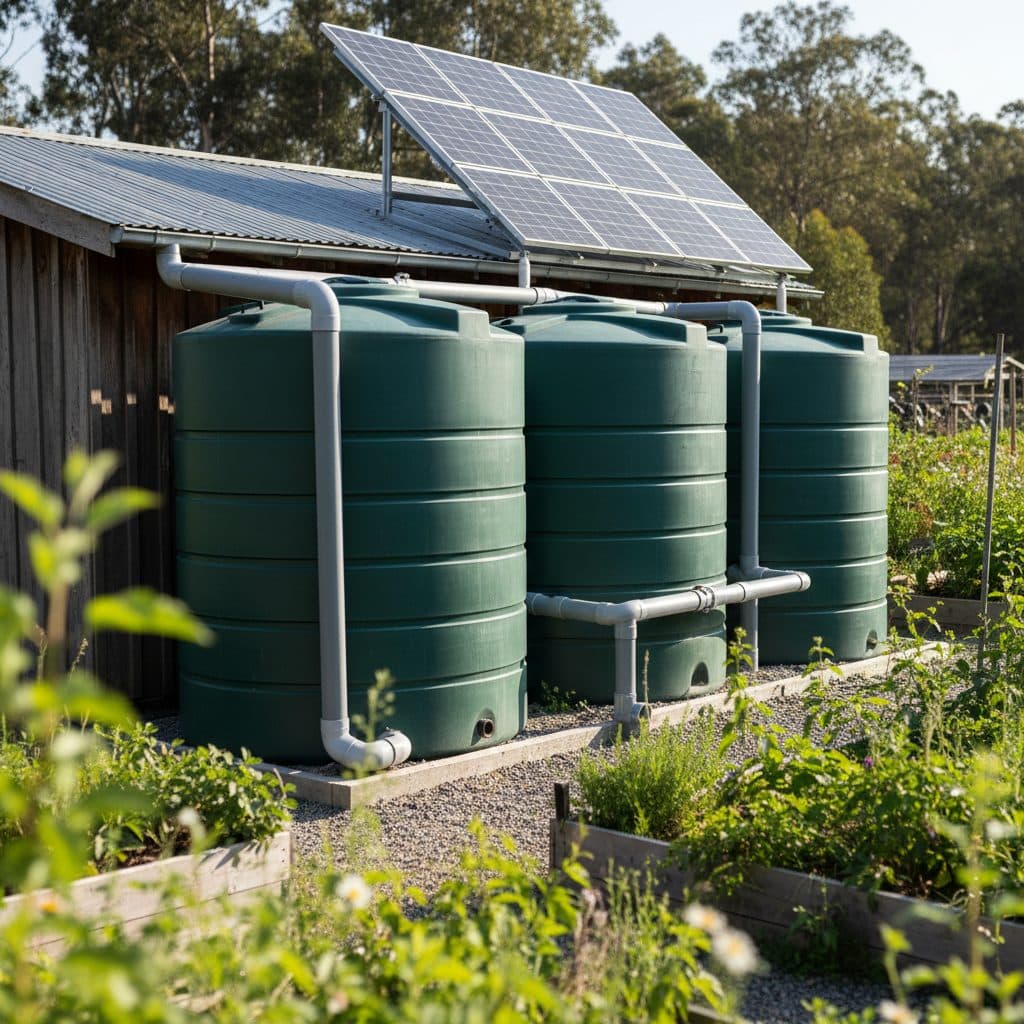
Key takeaways
- Secure multiple, redundant water sources on your homestead by combining roof rainwater catchment, deep wells, or natural springs.
- Metal standing-seam roofs provide the cleanest surface for potable rainwater harvesting, avoiding chemical leaching from asphalt shingles.
- Calculate gravity-fed water pressure accurately: every 2.31 feet of vertical elevation gain produces exactly 1 PSI (pound per square inch) of static pressure.
- Size bulk water storage tanks to provide at least 60 to 90 days of reserve household and livestock consumption for dry seasons.
- Treat harvested water through a staged filtration train: sediment pre-filters (50 to 5 microns), activated carbon blocks (1 micron), and ultraviolet (UV) disinfection.
- Protect distribution lines from sub-zero winter temperatures by burying PEX piping below your regional frost line and insulating above-ground pump manifolds.
Quick answer: Reliable off-grid water systems combine roof rainwater harvesting, a solar-powered well pump, or a developed spring with large dark poly storage cisterns (1,500 to 5,000 gallons / 5,600 to 19,000 litres). Distribute water using gravity elevation or a 12V/24V on-demand diaphragm pump, and purify potable water through staged sediment, carbon block, and UV filters.
Securing an independent, dependable water supply is the most fundamental infrastructure requirement for any off-grid homestead, cabin, or rural property. Without utility grid power or municipal water mains, you must design, build, and maintain your own catchment, storage, pressurization, and filtration systems.
Designing effective off grid water systems requires matching your environmental resources (such as local rainfall patterns, water table depths, and property topography) with realistic household, garden, and livestock consumption rates.
Whether you are developing a remote desert homestead in the Southwest, setting up a forested retreat in the Pacific Northwest, or retrofitting a rural farmstead, this guide outlines water sourcing, storage sizing, pumping options, and freeze-proof distribution.
+-------------------------------------------------------------+
|              OFF-GRID WATER INFRASTRUCTURE FLOW             |
|                                                             |
|   [ SOURCE ]       Rain Catchment / Solar Well / Spring     |
|       |                                                     |
|       v                                                     |
|   [ STORAGE ]      Cistern / Poly Tanks / High Reservoir    |
|       |                                                     |
|       v                                                     |
|   [ DELIVERY ]     Gravity Head (1 PSI per 2.31 ft) OR      |
|                    12V/24V DC Pressure Pump + Bladder Tank  |
|       |                                                     |
|       v                                                     |
|   [ TREATMENT ]    Sediment (5u) -> Carbon (1u) -> UV Lamp  |
+-------------------------------------------------------------+
How do you select and size your off-grid water source?
Most resilient homesteads integrate at least one primary water source and one backup source to weather seasonal droughts and mechanical pump failures.
+-------------------------------------------------------------+
|              PRIMARY WATER SOURCE COMPARISON                |
|                                                             |
|   SOURCE            UPFRONT COST    RELIABILITY  MAINTENANCE|
|   ------            ------------    -----------  -----------|
|   Roof Rainwater    Moderate        Seasonal     Gutter/flus|
|   Deep Well         High ($10k+)    Continuous   Solar pump |
|   Developed Spring  Low to Moderate Continuous   Silt box   |
|   Hauled Bulk Water Low upfront     Dependent    Truck/trailer|
+-------------------------------------------------------------+
1. Roof rainwater harvesting
Harvesting rain from roofs provides clean, naturally soft water with zero mineral hardness:
- Roof material: Use metal standing-seam or corrugated steel roofing coated in food-grade finishes. Avoid asphalt shingles, which shed petroleum hydrocarbons and toxic granules.
- Harvesting formula: 1 inch (2.5 cm) of rain on 1,000 square feet (93 m²) of roof area yields approximately 600 gallons (2,270 litres) of water.
- First-flush diversion: Install a first-flush diverter pipe to discard the initial 1 to 2 gallons per 100 square feet of roof, washing away airborne dust, bird droppings, and pollen before water enters storage tanks.
2. Deep drilled wells with solar pumps
Where ground aquifers exist, a drilled well paired with a direct-drive DC submersible pump (such as a 24V or 48V helical rotor pump) can lift water hundreds of feet directly into storage tanks using dedicated solar panels without needing large battery banks.
3. Developed natural springs and ram pumps
A modest spring flowing at just 1 to 2 gallons per minute yields 1,440 to 2,880 gallons every 24 hours, easily supplying a homestead if adequate storage is built. Where topography allows, hydraulic ram pumps deliver roughly 10% to 20% of drive flow to an elevation 5 to 10 times the drive head height, running continuously without electricity.
For state-specific water rights and rainwater legalities, consult our regional analyses on homesteading in Oregon and off-grid living in New Mexico.
How do you calculate storage capacity and tank placement?
Water storage buffers the disparity between intermittent rainfall or solar pumping hours and daily consumption.
+-------------------------------------------------------------+
|                 DAILY HOMESTEAD WATER CONSUMPTION           |
|                                                             |
|   USE CATEGORY             AVERAGE DAILY REQUIREMENT        |
|   ------------             -------------------------        |
|   Conservative Human Use   15 to 25 gallons (55-95 L) / pers|
|   Standard Flush Toilet    15 to 30 gallons (55-115 L) / day|
|   Dairy Cow (Lactating)    30 to 50 gallons (115-190 L)/head|
|   Horse / Dry Cattle       10 to 15 gallons (38-57 L) / head|
|   Flock of 10 Chickens     1 gallon (3.8 L) / day           |
|   Market Garden (1,000 sq) 50 to 100 gallons (190-380 L)/day|
+-------------------------------------------------------------+
Cistern types and placement
- Food-grade polyethylene tanks: UV-stabilized, opaque dark green or black poly tanks prevent sunlight penetration, completely eliminating algae blooms.
- Underground concrete cisterns: Ideal for cold northern climates, providing natural freeze protection and keeping water chilled at ground temperature (50°F to 55°F / 10°C to 13°C) year-round.
- Sizing benchmark: Size total storage capacity for at least a 60 to 90 day drought reserve. A two-person homestead with garden beds should maintain a minimum of 2,500 to 5,000 gallons (9,500 to 19,000 litres) in storage.
For integrating landscape water retention earthworks around storage sites, explore swales, berms, and French drains for water management.
How do you pressurize off-grid water: gravity vs DC pumps?
Delivering water to household fixtures and garden drip lines requires sufficient dynamic pressure:
+-------------------------------------------------------------+
|                 PRESSURIZATION COMPARISON                   |
|                                                             |
|   METHOD            PRESSURE HEAD        ENERGY REQUIRED    |
|   ------            -------------        ---------------    |
|   Pure Gravity      1 PSI per 2.31 ft    Zero electricity   |
|   12V/24V DC Pump   30 to 50 PSI (std)   Low battery draw   |
|   AC Pressure Pump  40 to 60 PSI (high)  High inverter load |
+-------------------------------------------------------------+
1. The physics of gravity-fed pressure
Gravity creates reliable, passive pressure without mechanical wear or electrical power:
- The formula: Vertical drop (head height) generates pressure at the rate of 0.433 PSI per vertical foot, which equals 1 PSI for every 2.31 feet (0.7 metres) of elevation.
- Practical requirements: To achieve standard household water pressure of 30 PSI, storage tanks must sit on a hillside at least 70 feet (21 metres) higher than the house fixtures.
+-------------------------------------------------------------+
|                 GRAVITY HEAD PRESSURE DIAGRAM               |
|                                                             |
|   [ Storage Cistern ] (Elevation: +70 ft / +21 m)           |
|          \                                                  |
|           \  (Buried 1.25" Supply Pipe)                     |
|            \                                                |
|             \                                               |
|              -----> [ Homestead Fixtures ] (Output: 30 PSI) |
+-------------------------------------------------------------+
2. On-demand 12V or 24V diaphragm pumps
If your property is flat, install an on-demand 12-volt or 24-volt DC diaphragm pump (such as a 3.0 to 5.0 GPM Shurflo or Seaflo unit) paired with a pre-pressurized accumulator bladder tank. Note that a 20-gallon pressure tank operating at 40/60 PSI yields only 5 to 6 gallons of actual water drawdown before the pump triggers; size the tank so the pump runs for at least 60 seconds per cycle, preventing rapid cycling every time a faucet is cracked.
To pair irrigation pressure with commercial vegetable plots, see how to start a market garden.
How do you filter and purify raw water for potable use?
Raw water from roofs, ponds, or shallow wells must be treated to eliminate biological pathogens, sediment, and chemical contaminants.
+-------------------------------------------------------------+
|                 THREE-STAGE POTABLE FILTRATION TRAIN        |
|                                                             |
|   [ Raw Supply ]                                            |
|         |                                                   |
|         v                                                   |
|   [ Stage 1: 50-Micron Washable Spin-Down Sediment Filter ] |
|         |                                                   |
|         v                                                   |
|   [ Stage 2: 5-Micron Melt-Blown Polypropylene Cartridge ]  |
|         |                                                   |
|         v                                                   |
|   [ Stage 3: 1-Micron Solid Extruded Carbon Block Cartridge]|
|         |                                                   |
|         v                                                   |
|   [ Stage 4: 12V / 24V Class A Ultraviolet (UV) Chamber ]   |
|         |                                                   |
|         v                                                   |
|   [ Potable Kitchen Fixture: Pathogen-Free Water ]          |
+-------------------------------------------------------------+- Sediment pre-filtration: A reusable 50-micron spin-down filter traps coarse sand, rust, and silt. This is followed by a 5-micron spun polypropylene cartridge filter to capture fine particles and protect downstream carbon filters from clogging.
- Activated carbon block (1 micron): Adsorbs organic chemicals, chlorine, heavy metals, pesticides, and unpleasant odors or tastes, while physically straining out protozoan cysts like Giardia and Cryptosporidium.
- Ultraviolet (UV) sterilization: Water passes through a stainless steel chamber containing an intense UV-C germicidal lamp. UV light scrambles the DNA of bacteria, viruses, and cysts, rendering them sterile and harmless without adding chemical chlorine to your drinking water.
- Biological slow sand filtration: Properly managed slow sand biological filters remove bacteria, protozoa (Giardia, Cryptosporidium), and turbidity without chemicals or power, but they do NOT remove chemical contaminants, heavy metals, or dissolved nitrates and require a continuous water flow to keep the biological schmutzdecke layer alive.
How do you prevent winter freezing in off-grid systems?
A single freeze event can rupture pipes, shatter pump heads, and destroy thousands of dollars in water infrastructure.
- Burying supply lines: Dig trenches for PEX or high-density polyethylene (HDPE) water lines well below the local frost line (typically 24 to 48 inches / 60 to 120 cm deep in midwestern and northern states).
- Insulated pump sheds: House all above-ground pumps, pressure switches, and filter housings inside a tightly insulated pump box or small outbuilding. In sub-zero regions, add passive thermal mass (such as two 55-gallon drums of water) or a thermostatically controlled 12V heating cable.
- Drain-back valves: Install manual frost-free yard hydrants or automatic drain-back valves at all exterior standpipes to allow standing water in vertical risers to drain below the frost line when shut off.
For state-specific winter infrastructure planning, see our guide on homesteading in Missouri.