Key takeaways
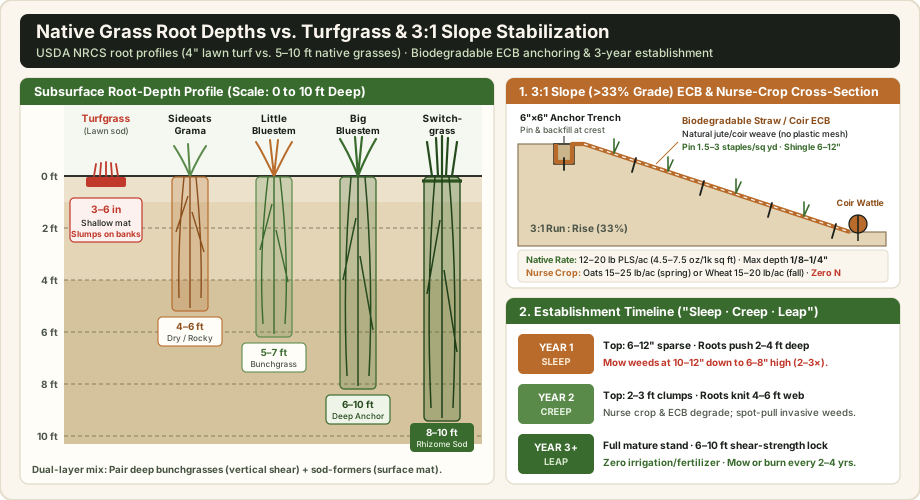
- Turfgrass roots stall at 3–6 in and shear off wet slopes; native grasses anchor 5–10 ft deep (Switchgrass 8–10 ft, Big Bluestem 6–10 ft, Little Bluestem 5–7 ft, Sideoats Grama 4–6 ft, Purple Needlegrass 6–15+ ft).
- Combine two root habits on every slope: deep bunchgrasses lock vertical shear planes while rhizomatous sod-formers knit horizontal mats that stop surface rills.
- Select species by rainfall and soil drainage across 6 US ecoregions (Northeast/Mid-Atlantic, Southeast/Piedmont, Midwest Tallgrass, Great Plains, Mountain West, and PNW/California)—cold hardiness alone misleads.
- Order and calibrate by Pure Live Seed (PLS): apply 12–20 lb PLS/acre (4.5–7.5 oz PLS/1,000 sq ft) no deeper than 1/8–1/4 in into a firm, weed-free, unfertilized seedbed.
- Bridge slow Year-1 root growth ('sleep, creep, leap') with a low-rate nurse crop (spring oats 15–25 lb/ac or fall winter wheat 15–20 lb/ac) and natural-weave biodegradable straw or coir blankets on >3:1 slopes.
- High-mow Year-1 weeds to 6–8 in whenever they reach 10–12 in (2–3 cuts) so sunlight reaches native crowns without clipping young grass growing points.
Quick answer: Native perennial grasses stop slope washouts because fibrous roots anchor 5–10 ft deep (versus 3–6 in for lawn turfgrass) while opening vertical pores that absorb heavy rain. Match mixes to US ecoregion, rainfall, and soil moisture, pairing deep bunchgrasses (Little Bluestem, Big Bluestem, Purple Needlegrass) with rhizomatous sod-formers (Switchgrass, Western Wheatgrass, Creeping Wildrye). Sow 12–20 lb PLS/acre 1/8–1/4 in deep with a low-rate annual nurse crop (oats or wheat), anchor biodegradable straw or coir blankets on slopes >3:1, skip nitrogen fertilizer, and high-mow Year-1 weeds to 6–8 in.
Why native grasses outperform turfgrass on eroding slopes and banks
During a heavy cloudburst on a hillside, roadside cut, or creek bank, lawn sod fails along a shallow mechanical seam. Kentucky bluegrass, perennial ryegrass, and shallow turf fescues pack nearly all their roots into the top 3 to 6 inches. When storm water saturates that thin mat over slick clay or loose fill, the whole turf layer shears loose and slides downhill—or sheets runoff across its tight surface until rills tear into gullies.
Native perennial grasses reinforce slopes across three zones simultaneously. Upright stems and standing thatch absorb raindrop kinetic energy before aggregates shatter; dense crowns and spreading rhizomes slow overland sheet flow; and deep fibrous roots documented by the USDA Natural Resources Conservation Service (NRCS) Plant Materials Program descend 5 to 10 feet into subsoil, stitching topsoil to stable substrate while decayed root channels drain storm water vertically underground.
Combine bunchgrasses and rhizomatous sod-formers
Monocultures leave weak spots. Native bunchgrasses—Little Bluestem (Schizachyrium scoparium), Big Bluestem (Andropogon gerardii), Idaho Fescue (Festuca idahoensis), and Purple Needlegrass (Nassella pulchra)—anchor deep vertical shear planes and leave permeable pockets between clumps, yet fast-moving water can scour bare gaps between isolated bunches. Blending roughly 60–70% deep bunchgrasses with 30–40% rhizomatous or stoloniferous sod-formers—Switchgrass (Panicum virgatum), Prairie Cordgrass (Spartina pectinata), Western Wheatgrass (Pascopyrum smithii), Creeping Wildrye (Elymus triticoides), or buffalograss (Bouteloua dactyloides)—seals surface rills while anchoring subsoil.
Avoid invasive legacy erosion grasses: Past highway programs widely seeded exotic Kentucky 31 tall fescue, Old World bluestems (Bothriochloa spp.), reed canarygrass, crown vetch, and sericea lespedeza. Missouri Department of Conservation records confirm these exotics escape banks, smother native wildlife habitat, and form shallow monocultures. Verify regional native status on every seed tag.
Best native grasses for erosion control across 6 US ecoregions
Picking slope grasses strictly by USDA hardiness zone causes costly washouts: Zone 7 spans wet Georgia clay (52 inches annual rain) and semi-arid New Mexico mesas (11 inches). Match species to **ecoregion, annual precipitation, sun exposure, and soil texture** first, sourcing local ecotype seed harvested within 150 to 250 miles and similar elevation.
Eastern and Midwestern US ecoregions (Regions 1–3)
Across the humid East and tallgrass Midwest (28 to 65 inches rain), warm-season C4 natives carry peak summer root stability while cool-season native wildryes (Elymus virginicus, E. canadensis) germinate rapidly in spring and autumn to hold disturbed banks.
Eastern & Midwestern Native Erosion-Control Grasses (Regions 1–3)
US Ecoregion & Rainfall | Top Native Species (Botanical) | Habit & Season | Verified Root Depth | Best Slope / Bank Role |
|---|---|---|---|---|
1. Northeast & Mid-Atlantic (35–50 in; Zones 3–7) | Switchgrass (Panicum virgatum), Little Bluestem (Schizachyrium scoparium), Big Bluestem (Andropogon gerardii), Virginia Wildrye (Elymus virginicus), River Oats (Chasmanthium latifolium) | Rhizome sod (Switchgrass, River Oats) + C4/C3 bunch | Switchgrass 8–10 ft; Big Bluestem 6–10 ft; Little Bluestem 5–7 ft; Wildrye/River Oats 2–4 ft | Dry cuts (Little Bluestem), clay swales (Switchgrass), shaded damp banks (Wildrye, River Oats) |
2. Southeast & Piedmont (45–65 in; Zones 7–9) | Eastern Gamagrass (Tripsacum dactyloides), Alamo Switchgrass (Panicum virgatum), Big Bluestem (Andropogon gerardii), Indiangrass (Sorghastrum nutans), Splitbeard Bluestem (A. ternarius), Pink Muhly (Muhlenbergia capillaris) | Stout rhizomes (Gamagrass, Switchgrass) + C4 bunch | Switchgrass 8–10 ft; Gamagrass & Big Bluestem 6–10 ft; Indiangrass 5–8 ft; Muhly 2–3 ft | Wet ditches & creek toes (Gamagrass, Switchgrass); red-clay or sandy cuts (Splitbeard, Muhly) |
3. Midwest Tallgrass (28–42 in; Zones 3–6) | Big Bluestem (Andropogon gerardii), Switchgrass (Panicum virgatum), Indiangrass (Sorghastrum nutans), Little Bluestem (Schizachyrium scoparium), Canada Wildrye (Elymus canadensis), Prairie Cordgrass (Spartina pectinata) | Heavy rhizome sod (Switchgrass, Cordgrass) + C4 bunch + C3 Wildrye nurse | Switchgrass 8–10 ft; Big Bluestem & Cordgrass 6–10 ft; Indiangrass 5–8 ft; Little Bluestem 5–7 ft | Grassed waterways & wet banks (Cordgrass, Switchgrass); farm embankments (Bluestem/Wildrye mix) |
On wooded banks receiving fewer than 5 hours of sun, sun-loving bluestems thin out quickly. Anchor shaded Eastern banks with cool-season Virginia Wildrye (Elymus virginicus) and rhizomatous River Oats (Chasmanthium latifolium, a perennial woodland native unrelated to annual cereal oats), paired with native sedges and woody live stakes covered in our riparian buffer design guide and slope embankment tree and shrub guide.
Western US ecoregions (Regions 4–6)
West of the 98th meridian, low rainfall (8 to 25 inches), alkaline or rocky subsoils, high evaporation, and winter-wet/summer-dry coastal storms demand deep drought-adapted bunchgrasses and tough cool-season wheatgrasses that keep living roots intact through dry summers.
Western US Native Erosion-Control Grasses (Regions 4–6)
US Ecoregion & Rainfall | Top Native Species (Botanical) | Habit & Season | Verified Root Depth | Best Slope / Bank Role |
|---|---|---|---|---|
4. Great Plains Semi-Arid (12–25 in; Zones 3–8) | Sideoats Grama (Bouteloua curtipendula), Western Wheatgrass (Pascopyrum smithii), Blue Grama (Bouteloua gracilis), Buffalograss (Bouteloua dactyloides), Little Bluestem (Schizachyrium scoparium) | Sod-formers (Western Wheatgrass C3, Buffalograss C4) + bunch/short-rhizome | Little Bluestem 5–7 ft; Sideoats Grama, Western Wheatgrass & Buffalograss 4–6 ft; Blue Grama 3–5 ft | Stony banks (Sideoats), alkaline clay cuts (Western Wheatgrass), low dry hills (Buffalograss/Blue Grama) |
5. Mountain West / Intermountain (8–20 in; Zones 3–7) | Bluebunch Wheatgrass (Pseudoroegneria spicata), Idaho Fescue (Festuca idahoensis), Thickspike Wheatgrass (Elymus lanceolatus), Basin Wildrye (Leymus cinereus), Indian Ricegrass (Achnatherum hymenoides), Mountain Brome (Bromus marginatus) | Rhizome sod (Thickspike) + C3 dryland bunchgrasses | Basin Wildrye 5–8 ft; Bluebunch 4–6 ft; Idaho Fescue & Thickspike 3–5 ft; Ricegrass 3–4 ft | Rocky slopes (Bluebunch, Idaho Fescue), sandy fill (Thickspike), gullies (Basin Wildrye), post-fire (Brome) |
6. Pacific Northwest & California (14–60 in winter-wet; Zones 6–10) | Purple Needlegrass (Nassella pulchra), Blue Wildrye (Elymus glaucus), Roemer's Fescue (Festuca roemeri), California Fescue (Festuca californica), Creeping Wildrye (Elymus triticoides), Deergrass (Muhlenbergia rigens) | Rhizome sod (Creeping Wildrye) + C3/coastal bunch | Purple Needlegrass 6–15+ ft; Creeping Wildrye 4–6 ft; Deergrass 4–5 ft; Blue Wildrye & Fescues 2–5 ft | Dry CA clay hills (Purple Needlegrass), fast PNW/CA pioneer (Blue Wildrye), wet bioswales (Creeping Wildrye, Deergrass) |
California and Pacific Northwest sites follow a winter-rain schedule: sow cool-season Nassella pulchra, Elymus glaucus, and native Festuca in late autumn right before winter rains so roots anchor deep before summer drought shuts growth down. For salt-spray bluffs, add coastal species from our salt-tolerant grasses for dunes and slopes guide; on dense clay subsoils, consult plants for clay soil.
Why 90% of DIY slope seedings fail: the 'sleep, creep, leap' protocol
Species selection is only 30% of slope stabilization; surviving Year 1 is the other 70%. Native perennials follow "sleep, creep, leap": Year 1 (Sleep) puts 70–80% of growth into 2–4 ft pioneer roots while top growth stays 6–12 in; Year 2 (Creep) expands crowns and pushes roots 4–6 ft; Year 3 (Leap) closes the canopy and locks the slope 6–10 ft deep.
Broadcasting bare seed onto a steep bank, fertilizing with nitrogen, and skipping weed mowing ends in washouts or weed thickets. Follow five field-tested engineering steps instead.
1. Divert upslope water, clear weeds, and skip nitrogen fertilizer
Intercept concentrated gutter or driveway runoff above the crest first with a diversion berm, piped outlet, or contour swale draining to a rain garden. Kill existing turf and aggressive weeds before seeding without deep plowing that drags buried weed seeds upward; on smaller slopes, Xerces Society organic site-prep favors black silage tarp occultation (step-by-step protocol) or shallow stale-seedbed passes.
Never fertilize native seedings with nitrogen: Use a Cooperative Extension soil test only to catch extreme pH (<5.2 or >8.5). Synthetic nitrogen fertilizer feeds fast annual weeds (crabgrass, foxtail, cheatgrass) that surge to 3 feet tall and shade out slow Year-1 native grass seedlings.
2. Meter by Pure Live Seed (PLS) at 1/8–1/4 inch max depth
Fluffy native seeds (bluestems, Indiangrass, gramas) hold chaff and empty hulls alongside living embryos. Always calibrate by Pure Live Seed (PLS): `PLS % = (% Purity × % Germination) ÷ 100`. If a tag reads 85% purity and 80% germination (68% PLS), applying 15 lb PLS/acre requires `15 ÷ 0.68 = 22.1 lb bulk seed/acre`.
- Exact seeding rates: Drill 12 to 20 lb PLS/acre (4.5 to 7.5 oz PLS per 1,000 sq ft). Bump rates by 25% to 50% (`18–25 lb PLS/acre`, or `6.5–9 oz PLS/1,000 sq ft`) when hand-broadcasting rough slopes.
- Firm seedbed & 1/8–1/4 inch depth: Native seeds carry tiny food reserves; burying them past 1/2 inch kills emergence. Pack the graded bank until a boot leaves at most a 1/4-inch track. Mix fluffy seed 1:3 with damp sawdust, vermiculite, or coarse sand for even two-pass broadcasting, then press into the top 1/8 to 1/4 inch with a lawn roller or light upside-down leaf rake.
- Seeding windows: Sow warm-season natives in late spring past 60°F soil—or as a dormant late-fall/winter seeding below 40°F so natural cold stratification breaks dormancy in spring. Sow cool-season western/northern natives in early spring or late autumn ahead of rains.
3. Pair slow natives with a low-rate annual nurse crop
A fast-germinating annual nurse crop emerges in 7 to 14 days to cushion raindrops while perennial roots dig in, then dies cleanly before Year 2. Keep rates light so the nurse crop never shades out native crowns.
Annual Nurse Crops for Native Grass Slope Seedings
Seeding Season / Site | Recommended Nurse Crop | Seeding Rate | Field Role & Caution |
|---|---|---|---|
Spring (All US Regions) | Spring Oats (Avena sativa) | 15–25 lb/ac (0.5–0.9 lb/1k sq ft) | Emerges in 7–10 days, buffers spring storms, and dies cleanly without reseeding. |
Fall / Dormant Seeding | Winter Wheat (Triticum aestivum) or Spring Oats | 15–20 lb/ac (0.5–0.7 lb/1k sq ft) | High-mow wheat at 6–8 in before heading; fall oats in Zones 3–6 winter-kill into mulch. |
Dryland / Alkaline West | Sterile Triticale or Spring Barley | 15–20 lb/ac (0.5–0.7 lb/1k sq ft) | Fast cover on 10–16 in rainfall banks and saline-sodic soils. |
Native Fast-Pioneer Add-In | Virginia, Canada, or Blue Wildrye (Elymus spp.) | 2–4 lb PLS/ac (1–1.5 oz/1k sq ft) | Cool-season native bunchgrasses delivering rapid Year-1 hold alongside slow bluestems. |
Avoid: Annual Ryegrass | Annual Ryegrass (Lolium multiflorum) | 0 lb (never >5 lb/ac) | Heavy mats and allelopathy smother slow native emergence. |
4. Anchor biodegradable erosion control blankets (ECBs) on >3:1 slopes
A 3:1 slope runs 3 feet horizontally per 1 foot of vertical drop (33% grade, or 18.4°). Gentler 4:1 slopes hold well with crimped weed-free straw (70–90 lb/1,000 sq ft) plus oats; on slopes 3:1 or steeper, loose straw washes straight downhill and requires an anchored biodegradable erosion control blanket (ECB).
- Match longevity to grade: Choose 100% straw (12 months) on 3:1 banks, 70% straw / 30% coconut (18–24 months) on steep 2:1 slopes or dry western cuts, and 100% woven coconut coir (24–36 months) on active creek banks or stormwater channels.
- Specify natural jute or coir leno-weave netting: Avoid cheap welded polypropylene 'photodegradable' plastic mesh—under grass shade it persists for years, trapping snakes, frogs, and nesting birds while tangling trimmers.
- MPCA / DOT installation specs: Dig a 6-inch deep by 6-inch wide anchor trench across the slope crest, tuck and pin the leading edge every 12 inches with 6- to 8-inch U-staples (or wooden stakes), backfill, and tamp tight. Unroll down-slope parallel to flow without stretching taut over hollows, overlap side edges 4 to 6 inches, shingle upper roll ends over lower rolls 6 to 12 inches, and pin at 1.5 to 3 staples per square yard.
- Steep 2:1 banks (>50% grade): Pair woven coir matting with live native grass plugs slit-planted on 12- to 18-inch staggered centers plus staked contour coir/straw wattles every 15 to 20 feet down-slope. Add woody slope stabilizers from our ground cover for slopes guide.
5. Year-1 high mowing (6–8 inches) and long-term care
Annual weeds always outrun Year-1 native seedlings. Follow USDA NRCS Practice 327 Year-1 high mowing: whenever annual weeds hit 10–12 inches, cut at 6–8 inches high (2–3 passes in Year 1) to clip weed seed heads and reopen sunlight while protecting short 3–5 in native growing points. Never wait past 18 inches or heavy clippings will smother sprouts. In Year 2, spot-pull perennial invasives (Canada thistle, sweetclover, knapweed). From Year 3 onward, established slopes require zero irrigation or fertilizer—just a late-winter dormant mow (4–6 in before nesting) or permitted burn every 2–4 years to keep woody brush out.
Seed vs. live plugs: matching format to slope and budget
Choose direct seeding, live landscape plugs, or a hybrid install based on slope angle and washout risk:
Direct Native Seeding vs. Deep-Cell Native Plugs
Site Factor | Direct Native Seeding (+ Nurse Crop + ECB) | Deep-Cell Native Plugs (2×5 in Plugs) |
|---|---|---|
Best Area & Grade | Slopes >1,000 sq ft to multi-acre banks; flat to 3:1 (with ECB) | Small home slopes (<1,500 sq ft), steep 2:1 cuts, active creek toes |
Material Cost | $0.15–$0.45 / sq ft (seed + oats + biodegradable ECB & pins) | $1.50–$3.50 / sq ft planted 12–18 in on center |
Time to Deep Root Lock | 2–3 growing seasons ('sleep, creep, leap') | 1–2 growing seasons (arrives with 4–5 in root column) |
Year-1 Washout Risk | High without firm seedbed, ECB, and 6–8 in mowing | Low when slit-planted through coir mat; easier spot-weeding |
A hybrid install delivers the best return on residential hills: seed your regional native mix plus oats underneath biodegradable coir matting, then slit-plant deep plugs of Switchgrass, Eastern Gamagrass, or Creeping Wildrye across the bottom 4 feet of the slope toe where runoff velocity peaks.