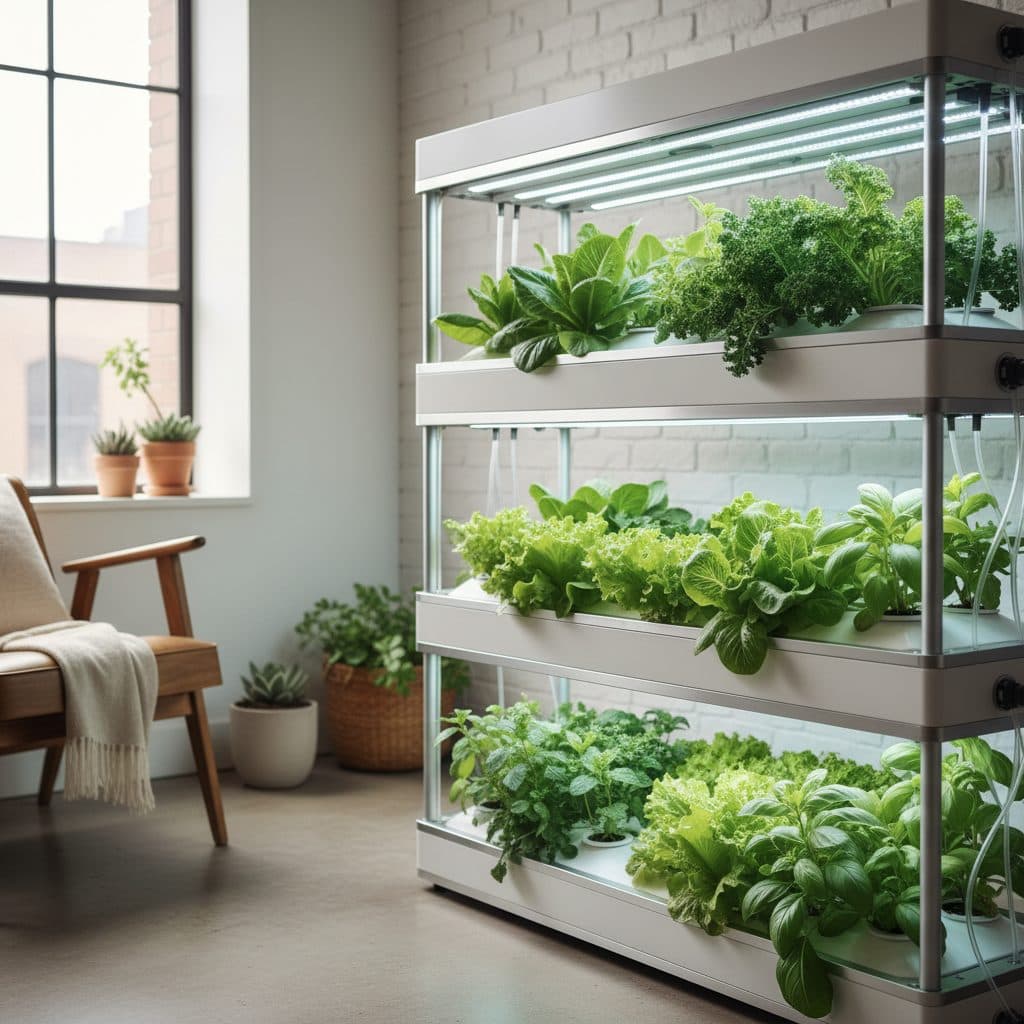
Key takeaways
- Small spaces, even 8 square feet, can yield significant fresh produce with proper indoor setup.
- Hydroponic and aquaponic systems offer efficient water and nutrient use, reducing environmental impact.
- Consistent harvesting of outer leaves and staggered planting ensure a continuous supply of greens for weeks.
- Careful selection of LED lights, balanced nutrients, and appropriate plant varieties matters most.
- Monitoring key parameters like pH and EC is essential for maintaining optimal plant health and maximizing yields.
Quick answer: You can harvest fresh greens year-round in a small apartment using indoor hydroponic or aquaponic systems. These methods efficiently grow plants in nutrient-rich water, allowing for continuous harvests even in limited spaces.
In many US cities, like New York City, where apartment living is common, space for gardening can be a significant challenge. However, even in a small apartment, perhaps one with only 400 square feet, it is entirely possible to cultivate a continuous supply of fresh salad greens indoors. This approach offers a consistent harvest, providing fresh produce daily or weekly, right from your living space.
Setting up a dedicated indoor salad system can reduce grocery trips and ensure a steady supply of nutrient-rich vegetables. With careful planning, a system occupying just 8 square feet of floor space can produce a significant amount of leafy greens for a small family.
Why grow salad indoors?
For many US households, especially those in urban centers like Chicago, Illinois, or Portland, Oregon, fresh, locally grown produce can be expensive or hard to find consistently. An indoor salad system provides a reliable source of greens, regardless of the outdoor climate or season. This method allows you to grow varieties that might not thrive in your local USDA zone, such as tender butterhead lettuce in USDA zone 5 winters. Furthermore, soilless cultivation systems, like hydroponics, can significantly impact the post-harvest quality of salad greens, as demonstrated with wild rocket salad in a 2019 study [4].
Beyond convenience, indoor growing offers substantial benefits in resource efficiency. Hydroponic systems, for instance, can use significantly less water than traditional soil-based agriculture, making them a water-wise choice for any home. This efficiency is particularly important in regions facing water scarcity, like parts of California. A well-designed system also minimizes nutrient waste, as the water and nutrients are recirculated, often achieving high nutrient utilization. This precision feeding leads to faster growth rates and higher yields compared to conventional gardening.
Consistent supply and environmental control
One of the primary advantages is the ability to maintain a continuous harvest. By staggering plantings and harvesting mature outer leaves instead of the entire plant, you can ensure a steady supply. Consistent harvesting of mature leaves, rather than entire plants, can extend the productive life of many salad greens for weeks. This strategy works well for plants like romaine lettuce or Swiss chard. You also gain complete control over the growing environment, from light cycles to nutrient delivery, which helps in mitigating pests and diseases without chemical treatments. For example, maintaining an ambient temperature between 65°F and 75°F is ideal for most indoor salad crops, promoting vigorous growth.
- Reduced grocery costs by growing your own produce.
- Year-round access to fresh, healthy greens.
- Significant water savings compared to soil.
- Control over growing conditions, minimizing pests and diseases.
- Ability to grow specific varieties not available locally.
Choosing your system: hydroponics or aquaponics?
When considering an indoor salad system for a small apartment, the primary choices for soilless cultivation are hydroponics and aquaponics. Both offer efficient ways to grow plants without soil, but they operate on different principles. Hydroponics involves growing plants in nutrient-rich water solutions, directly delivering essential minerals to the roots. This method is generally simpler to set up and maintain for beginners, requiring fewer components and less initial investment, often starting at a relatively low cost for a basic kit.
Aquaponics, on the other hand, integrates aquaculture (raising fish) with hydroponics. In this symbiotic system, fish waste provides nutrients for the plants, and the plants, in turn, filter the water for the fish. This creates a balanced ecosystem that can be highly productive and sustainable over time. However, aquaponics systems are more complex to establish and require careful monitoring of water parameters for both fish and plants, including ammonia, nitrites, and nitrates. For a deeper dive into these systems, you can read our article on aquaponics systems explained.
System selection for apartment living
For a small apartment in, say, Seattle, Washington, where space and noise might be concerns, a hydroponic system is often the more practical choice. Deep Water Culture (DWC) or Nutrient Film Technique (NFT) systems are popular for leafy greens. DWC systems are simple, using a reservoir of nutrient solution where plant roots are submerged, often with an air stone for oxygenation. NFT systems involve a thin film of nutrient solution flowing over the roots, providing excellent aeration. Both can be compact, fitting into spaces as small as 2 ft by 2 ft. Aquaponics, while rewarding, typically demands more space and a greater commitment to livestock care, making it less suitable for very small living areas.
- Deep Water Culture (DWC) for simplicity and robust growth.
- Nutrient Film Technique (NFT) for efficient water and nutrient delivery.
- Wick systems for passive, low-maintenance growing.
- Drip systems for precise nutrient application to individual plants.
Essential components for a small system
Regardless of whether you choose hydroponics or aquaponics, several key components are necessary for a successful indoor salad system. The most critical is lighting. Plants need specific light spectrums for photosynthesis, and standard household lights are insufficient. LED grow lights are highly efficient, consuming significantly less energy than traditional HPS or MH lights, making them a wise long-term investment for a system running 12-16 hours daily. Look for full-spectrum LEDs or those with a higher blue light component for leafy greens,
Next, you’ll need a grow tent or reflective enclosure. This helps contain light, maintain humidity, and reflect light back onto the plants, maximizing efficiency. A reflective indoor grow tent, like those found at agripure.org/shop/beylsion-grow-tent, can significantly improve light distribution, often increasing light intensity on plant surfaces. These tents also help manage temperature and humidity, which helps prevent common issues like powdery mildew in humid environments.
Nutrient solutions and growing media
For hydroponic systems, a balanced nutrient solution is vital. These come in liquid or powder form and are specifically formulated for plant growth. The optimal pH for most leafy greens in hydroponics ranges from 5.5 to 6.5, which can be monitored with a simple pH meter, For aquaponics, fish food provides the nutrients, which are then processed by beneficial bacteria. Inert growing media like rockwool, coco coir, or clay pebbles provide support for the plants. These media do not contribute nutrients themselves but offer a stable structure for root development. A 50-liter bag of coco coir, for example, is often affordable and can last for several planting cycles.
- Full-spectrum LED grow lights for optimal plant growth.
- A reflective grow tent or enclosure to maximize light efficiency.
- Hydroponic nutrient solution or fish food for aquaponics.
- Inert growing media such as rockwool or coco coir.
- A small water pump and air pump with air stone for water circulation and oxygenation.
Planting and continuous harvest strategies
The key to a continuous supply of fresh salad greens is a staggered planting schedule and proper harvesting techniques. Instead of planting all your seeds at once, sow a small batch every one to two weeks. For example, if you have a 12-plant system, plant three new seedlings every week. This ensures that as some plants mature and are harvested, younger plants are ready to take their place. This method is particularly effective for fast-growing crops like lettuce, which can reach harvestable size in 30-45 days. You can find more detailed guidance on specific crops in our article, how to grow lettuce: continuous salad from spring to frost.
When it comes to harvesting, avoid pulling the entire plant unless it’s reached the end of its productive life. For most leafy greens, a cut-and-come-again method is best. Harvest the outer, mature leaves, leaving the inner leaves to continue growing. This allows the plant to regenerate and produce more leaves over several weeks. Consistent harvesting of mature leaves, rather than entire plants, can extend the productive life of many salad greens for weeks [5]. For example, a single romaine lettuce plant can provide harvests for several weeks using this technique.
Suitable crops for continuous harvest
Not all plants are equally suited for continuous harvest in a small indoor system. Focus on leafy greens that respond well to the cut-and-come-again method. Excellent choices include various types of lettuce (romaine, butterhead, loose-leaf), spinach, arugula, kale, and Swiss chard. Herbs like basil, cilantro, and mint also thrive in these conditions and can be harvested continuously. Avoid crops that require significant space or have a single harvest point, such as large head cabbages or root vegetables, which are better suited for larger outdoor gardens or specific indoor setups. A small hand trowel, like the lightweight garden hand trowel, can be useful for transplanting seedlings.
- Loose-leaf lettuce varieties for rapid regrowth.
- Spinach and arugula for quick, consistent harvests.
- Kale and Swiss chard for nutrient-dense, larger leaves.
- Basil and mint for fresh herbs alongside your greens.
Hydroponics vs. Aquaponics for Apartment Systems
Feature | Hydroponics | Aquaponics |
|---|---|---|
Complexity | Lower, easier for beginners | Higher, requires fish care and water chemistry knowledge |
Initial Cost | Lower | Higher |
Space Requirement | Can be very compact, 2 ft x 2 ft | Generally requires more space for fish tank and grow beds |
Nutrient Source | Synthetic nutrient solutions | Fish waste, creating a natural cycle |
Maintenance | Regular pH/EC checks, nutrient refills | Regular water quality tests (ammonia, nitrite, nitrate), fish feeding, pH checks |
Sustainability | High water efficiency | Highly sustainable, closed-loop system, but more energy for pumps/aeration |
Yield Consistency | High, precise nutrient control | High, once system is balanced, but can be sensitive to fluctuations |
Pest Management | Easier to control, sterile environment | More complex due to fish, requires organic pest control methods |
Water Savings: Hydroponic systems can reduce water consumption by up to 90% compared to traditional soil gardening, making them highly efficient [6].
Yield Potential: A compact 2 ft by 4 ft indoor system can consistently produce a steady supply of fresh salad greens weekly for a small family.
Browse indoor growing solutions
Frequently asked questions
How much space do I need for a continuous indoor salad system?
You can start a productive system in as little as 2 square feet of floor space, such as a 2 ft by 1 ft shelf or a small grow tent. A system measuring 2 ft by 4 ft can comfortably produce a steady supply of greens per week for a family of two to four.
What are the best plants for continuous harvest in an apartment?
Loose-leaf lettuces, spinach, arugula, kale, and Swiss chard are excellent choices due to their rapid growth and suitability for cut-and-come-again harvesting. Herbs like basil and mint also thrive and can be harvested consistently for an extended period.
How often do I need to add nutrients to a hydroponic system?
For most leafy greens, you should check your nutrient solution’s pH and EC (electrical conductivity) every few days. A full nutrient change is typically recommended on a regular basis to ensure optimal plant health and prevent nutrient imbalances, especially in smaller systems.
Can I use tap water for my indoor salad system?
Yes, tap water can often be used, but it’s important to test it for chlorine/chloramine and hardness. If your tap water is very hard or contains high levels of chlorine, filtering it or letting it sit for 24 hours can improve plant health. The ideal pH range for most greens is generally between 5.5 and 6.5.
What is the typical energy consumption for an indoor grow light?
A modern LED grow light for a small 2 ft by 4 ft system consumes a moderate amount of power. Running this for 14 hours a day would use approximately 0.7 to 2.1 kilowatt-hours (kWh) daily, which translates to a variable monthly cost depending on local electricity rates.
References
- Frequency Modulated Continuous Wave Radar System at ISM Band for Short Range Indoor Positioning (2023). Frequency Modulated Continuous Wave Radar System at ISM Band for Short Range Indoor Positioning.
- An Iot-Based Continuous Monitoring System for Indoor Radon Measurements (2024). An Iot-Based Continuous Monitoring System for Indoor Radon Measurements.
- An indoor localization algorithm in a small-cell LED-based lighting system (2012). An indoor localization algorithm in a small-cell LED-based lighting system.
- Post-harvest performance of ready-to-eat wild rocket salad as affected by growing period, soilless cultivation system and genotype (2019). Post-harvest performance of ready-to-eat wild rocket salad as affected by growing period, soilless cultivation system and genotype.
- (199) Effect of Harvest Maturity on Quality of Pear Salad (2006). (199) Effect of Harvest Maturity on Quality of Pear Salad.
- USDA Natural Resources Conservation Service (2024). USDA Natural Resources Conservation Service.