Key takeaways
- Invasive jumping worms (Amynthas species) strip forest and garden topsoil of organic matter, leaving loose, granular castings resembling coffee grounds.
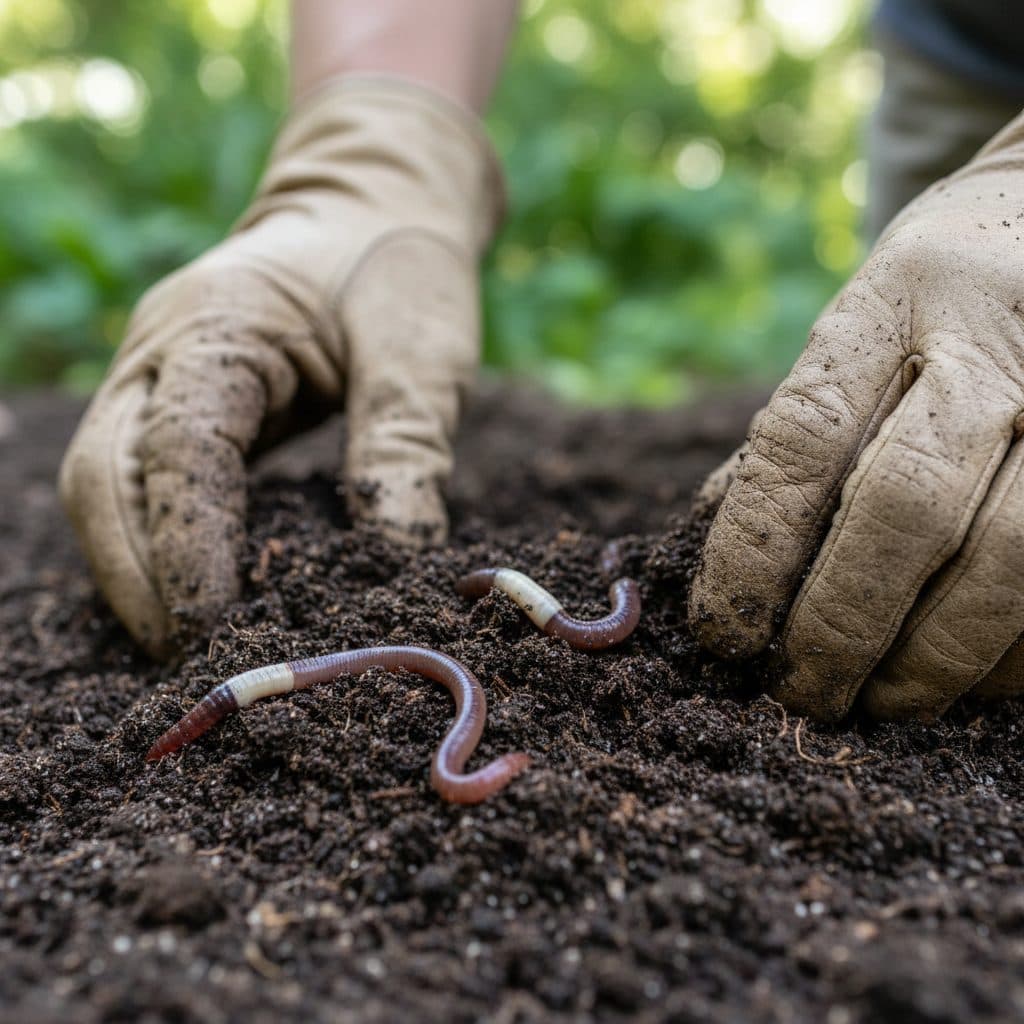
- Identify jumping worms by their smooth, milky-white clitellum that completely encircles the body flush with the skin near segment 14.
- Distinguish them from European earthworms by their vigorous, thrashing snake-like movement and ability to shed their tails when disturbed.
- No chemical pesticides are currently registered to eradicate jumping worms without harming beneficial soil organisms.
- Prevent introduction by solarizing bulk mulch and compost so internal core temperatures reach at least 130°F (55°C) for three consecutive days to kill dormant cocoons.
- Bare-root nursery stock and wash footwear treads and vehicle tires before moving between garden sites to prevent spreading microscopic cocoons.
Quick answer: Invasive jumping worms (primarily Amynthas agrestis, Amynthas tokioensis, and Metaphire hilgendorfi) are identified by their thrashing snake-like movement, smooth milky-white clitellum flush with the body, and loose coffee-ground soil castings. Manage them by solarizing compost to reach core temperatures of at least 130°F (55°C) to kill cocoons, bare-rooting nursery plants, and avoiding unverified bulk mulch.
Invasive jumping worms (Amynthas agrestis, Amynthas tokioensis, and Metaphire hilgendorfi) (also known colloquially as Asian jumping worms, crazy worms, snake worms, or Alabama jumpers) have emerged as one of the most concerning soil threats across North American gardens, landscapes, and native forests.
Unlike beneficial European earthworms (Lumbricus terrestris) that burrow deeply and slowly incorporate organic matter into the mineral subsoil, jumping worms reside in the top few inches of soil. They voraciously consume leaf litter and organic mulch, transforming fertile topsoil into loose, dry, highly erodible granules resembling coarse coffee grounds. Understanding how to identify these invaders and implement containment strategies is critical for protecting garden soil and native woodland ecosystems.
How to identify jumping worms versus European earthworms
Accurate identification prevents confusing invasive jumping worms with naturalized nightcrawlers and red wigglers.
+-------------------------------------------------------------+
|              EARTHWORM VS JUMPING WORM IDENTIFICATION       |
|                                                             |
|   EUROPEAN NIGHTCRAWLER           ASIAN JUMPING WORM        |
|   (Lumbricus terrestris)          (Amynthas agrestis)       |
|                                                             |
|   - Clitellum: Raised, pinkish,   - Clitellum: Smooth,      |
|     saddle-like (does not encircle  milky-white or grey,     |
|     the body completely)            completely encircles    |
|   - Segment: Position 32-37         the body flush with skin|
|   - Movement: Slow, gentle,       - Segment: Position 14-16 |
|     stretches longitudinally      - Movement: Violent thrash|
|   - Texture: Moist, slimy           snake-like, sheds tail  |
+-------------------------------------------------------------+
+-------------------------------------------------------------+
| ANATOMICAL CLITELLUM COMPARISON |
| |
| European Nightcrawler: |
| Head ===[ Segments 1-31 ]===( RAISED SADDLE )===[ Tail ] |
| |
| Invasive Jumping Worm: |
| Head ===[ Seg 1-13 ]===[ FLUSH WHITE BAND ]===[ Tail ] |
| (Complete 360° Ring) |
+-------------------------------------------------------------+Key diagnostic identifiers:
- The Clitellum (Collar): The band is smooth, cloudy white to light grey, completely flush with the surrounding body (not swollen or raised), and wraps 360 degrees around the body. It is positioned near segment 14, much closer to the head than on nightcrawlers.
- Behavior and movement: When touched, jumping worms thrash violently from side to side, slithering across the ground like a snake. When stressed, they can shed the end of their tail (autotomy) as a defense mechanism.
- Skin appearance: The body is smooth, iridescent bronze or metallic grey-brown, and feels firmer and less slimy than common nightcrawlers.
For comparisons with domestic composting worms, explore our guide on feeding composting worms and composting worms climate choice.
Soil damage: the coffee ground symptom
The most visible indicator of a jumping worm infestation is the altered texture of the soil surface.
+-------------------------------------------------------------+
|                 JUMPING WORM SOIL DEGRADATION               |
|                                                             |
|   HEALTHY TOPSOIL PROFILE         JUMPING WORM DAMAGED SOIL |
|   - Intact leaf litter layer      - Zero surface leaf litter|
|   - Spongy organic humus layer    - Coarse "coffee ground"  |
|   - Fine root network intact        loose granular castings |
|   - Strong moisture retention     - Rapid drying & erosion  |
+-------------------------------------------------------------+- Destruction of the organic layer: Jumping worms consume organic leaf mulch, compost, and root duff at an accelerated rate, stripping soil bare within weeks.
- Granular castings: Their excretions form coarse, round, loose pellets that do not bind together. The soil feels spongy, light, and granular, resembling spent coffee grounds or taco meat.
- Nutrient leaching and root desiccation: The loose soil structure cannot hold moisture or nutrients. Rain washes vital minerals away, and shallow plant roots become exposed to air pockets, leading to root drying, nutrient deficiency, and plant decline.
- Mycorrhizal disruption: By stripping the organic horizon, jumping worms destroy the delicate network of beneficial fungi that sustain forest trees and perennial crops.
For guidelines on maintaining soil balance, see our foundational overview of organic gardening soil.
Life cycle and the microscopic cocoon threat
Understanding the seasonal life cycle of jumping worms explains why infestations often seem to appear out of nowhere in mid-summer.
+-------------------------------------------------------------+
|                 JUMPING WORM ANNUAL LIFECYCLE               |
|                                                             |
|   SPRING (March - May):                                     |
|   - Adults die over winter; tiny cocoons hatch in topsoil   |
|   - Juvenile worms are minuscule and difficult to spot      |
|                                                             |
|   SUMMER (June - August):                                   |
|   - Rapid feeding and growth; clitellum develops            |
|   - Peak soil damage; adults reproduce parthenogenetically  |
|                                                             |
|   AUTUMN (September - November):                            |
|   - Adults produce hundreds of tiny mustard-seed cocoons    |
|   - Hard frosts kill all adult worms; cocoons overwinter    |
+-------------------------------------------------------------+
Cocoons hatch in spring (as early as March in the South, April to May in northern states). Jumping worms are parthenogenetic; a single worm can produce viable cocoons without mating. Each adult deposits hundreds of microscopic, mustard-seed-sized cocoons into the soil before dying with the first hard autumn frost. These cocoons easily survive sub-zero winter temperatures, insulated inside mulch or soil particles.
Prevention and containment strategies
Because there are currently no registered chemical nematicides or pesticides that selectively kill jumping worms without devastating native soil life, prevention and physical containment are the primary lines of defense.
1. Heat treatment and solarization
Jumping worm adults and cocoons are susceptible to heat. Research confirms that while cocoons succumb to 104°F (40°C) in sustained laboratory conditions, reliable field solarisation requires maintaining core temperatures of at least 130°F to 140°F (55°C to 60°C) for a minimum of three consecutive days to ensure complete lethality throughout bulk piles.
- Solarizing bulk materials: If purchasing bulk compost or woodchips, spread the material onto a concrete driveway or tarp, moisten lightly, and seal tightly beneath clear polyethylene plastic under full summer sun for three to five days before using it in garden beds.
- Commercial compost: Ensure purchased compost comes from reputable suppliers who practice certified thermophilic composting (reaching sustained temperatures of 131°F to 160°F).
2. Bare-rooting nursery transplants
Cocoons are frequently transported in the potted soil of nursery plants, shared perennials, and landscape stock.
- When bringing new plants into your garden, wash all nursery potting soil from the roots over a bucket of water.
- Inspect the root mass for juvenile worms or granular castings.
- Discard the wash water into municipal wastewater or let it solarize in a sealed bucket; never pour untreated nursery soil onto garden beds.
- Replant the bare-root perennial directly into your garden soil.
3. Equipment sanitation and boot washing
Scrape mud and organic debris from boot treads, shovel blades, wheelbarrow tires, and mower decks before moving between properties or natural woodlands to avoid spreading cocoons.
Managing existing garden infestations
If jumping worms are already present on your property, focus on reducing population numbers and supporting plant health:
- Hand-collecting and disposal: In late spring and summer, hand-pick adult worms from beneath mulch layers. Drop them into a sealed plastic bag or bucket of soapy water, leave in the sun to ensure mortality, and discard in the household trash.
- Mustard pour (Monitoring tool): Mix 1/3 cup of dry yellow mustard powder into 1 gallon of water and pour slowly over a 1-square-foot patch of soil. Use the mustard pour for detection and monitoring rather than eradication — it brings active worms to the surface in that spot for inspection, but does not kill buried cocoons.
- Tea seed meal: Saponin-based fertilizers (such as tea seed meal) have been tested in university trials to expel worms. Note that tea seed meal is not EPA-registered as a pesticide (it is sold as a fertilizer), is restricted or banned for worm control in some states, and the runoff is toxic to aquatic organisms — never use it near waterways or storm drains.
- Topdress with organic compost: Replace depleted organic matter by topdressing beds with fine, finished, heat-treated compost rather than thick layers of coarse woodchips, which provide jumping worms with their preferred food source.
By practicing strict hygiene with incoming mulch, bare-rooting new plants, and solarizing questionable materials, gardeners can prevent the spread of invasive jumping worms and safeguard long-term soil structure.