Key takeaways
- Mycorrhizal fungi form a mutualistic symbiosis with plant roots, trading absorbed water and minerals for plant-derived carbon sugars.
- Arbuscular mycorrhizal fungi (AMF) colonize over 80% of terrestrial plants, including most garden vegetables, fruit trees, and cover crops.
- Certain plant families, notably Brassicaceae (cabbage, kale, radishes) and Amaranthaceae (spinach, beets, chard, formerly chenopods), do not form mycorrhizal partnerships.
- Apply inoculants directly into the planting hole or root ball so spores touch living root tissue; surface broadcasting is ineffective unless the inoculant is formulated for root drenching and washed down to root depth.
- High levels of plant-available (soluble) phosphorus suppress mycorrhizal colonization, whereas slow-release insoluble forms (like rock phosphate) do not inhibit AMF to the same degree.
- Frequent rotary tilling physically shreds delicate fungal hyphae networks, collapsing biological soil structure.
Quick answer: Mycorrhizal fungi are beneficial soil organisms that form a symbiotic partnership with plant roots, extending the root system's reach to absorb water, phosphorus, and micronutrients in exchange for plant sugars. They are naturally present in healthy organic soils, but inoculants help when planting in sterile mixes or damaged subsoils.
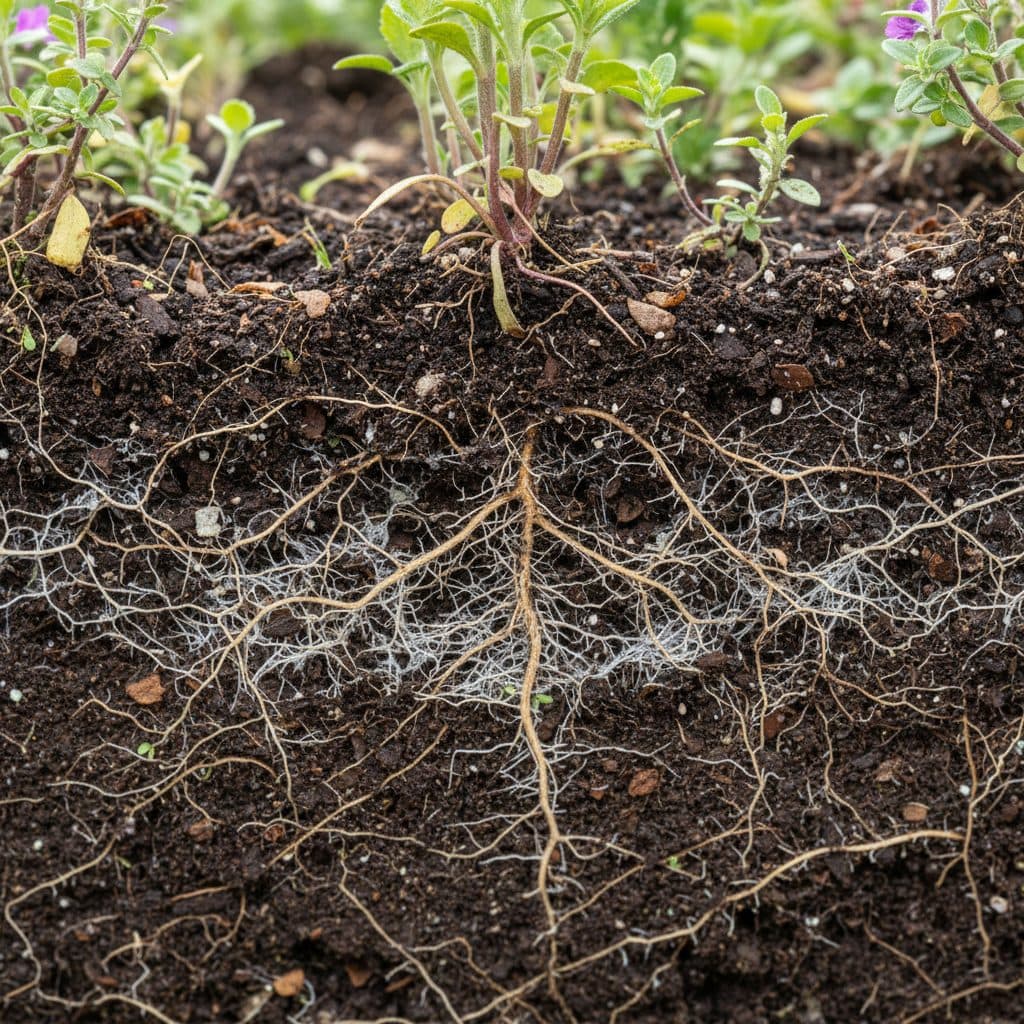
Beneath the surface of healthy garden beds lies a complex biological network that drives plant nutrition and soil structure. Central to this underground ecosystem are mycorrhizal fungi—specialized soil organisms that have co-evolved with land plants for over 400 million years.
Rather than acting as independent organisms, mycorrhizal fungi integrate directly into plant root structures, effectively extending the plant's root surface area by hundreds of times. Understanding how this fungal symbiosis functions allows gardeners to make informed decisions about soil cultivation, fertilization, and the practical value of commercial inoculants.
How mycorrhizal symbiosis works: the nutrient exchange
The word "mycorrhiza" originates from the Greek words for fungus (mykes) and root (rhiza). The relationship is a mutualistic symbiosis in which both partners gain essential survival benefits.
+-------------------------------------------------------------+
|              THE MYCORRHIZAL NUTRIENT EXCHANGE              |
|                                                             |
|              [ Plant Photosynthesis in Leaves ]             |
|                              |                              |
|                 ( Carbon / Sugars 10-20% )                  |
|                              v                              |
|   ===================== Root Zone =======================   |
|                              ^                              |
|           ( Phosphorus, Zinc, Copper, Water )               |
|                              |                              |
|        [ Extensive Fungal Hyphal Network in Soil ]          |
+-------------------------------------------------------------+- Plant contribution: Through photosynthesis, the host plant converts sunlight into carbon sugars and lipids. It directs 10% to 20% of these energy-rich carbohydrates down through its roots to feed the mycorrhizal fungus.
- Fungal contribution: In return, the fungus produces microscopic filaments called hyphae that are significantly finer than the smallest plant root hairs. These hyphae penetrate tiny soil micropores, solubilizing and transporting locked-up phosphorus, zinc, copper, nitrogen, and moisture back to the host plant.
- Glomalin production: As mycorrhizal hyphae grow and turnover, they exude a durable glycoprotein called glomalin. Glomalin-related soil proteins contribute significantly to stable soil carbon and aggregate stability, though exact percentages vary widely across soil types, acting as biological glue that binds mineral particles into stable soil aggregates.
Types of mycorrhizae: endo versus ecto
Mycorrhizal fungi fall into two primary ecological categories based on how their hyphae interact with root cell walls.
+-------------------------------------------------------------+
|               ENDOMYCORRHIZAE VS ECTOMYCORRHIZAE            |
|                                                             |
|   ENDOMYCORRHIZAE (AMF):          ECTOMYCORRHIZAE:          |
|   - Hyphae penetrate cortical     - Hyphae form dense outer |
|     root cell walls               sheath (Hartig net)       |
|   - Form branched arbuscules      - Do not penetrate cells  |
|   - Partners with 80%+ plants     - Partners with trees     |
|   - Vegetables, fruits, grasses   - Oaks, pines, birches    |
+-------------------------------------------------------------+
1. Endomycorrhizae (Arbuscular Mycorrhizal Fungi / AMF)
The most relevant group for home gardeners and homesteaders. AMF species (predominantly in the phylum Glomeromycota, such as Glomus intraradices and Glomus mosseae) penetrate the cell walls of the root cortex, forming tree-like structures called arbuscules within plant cells where direct nutrient transfer occurs.
- Associated Plants: Over 80% of plant families, including all nightshades (tomatoes, peppers), cucurbits (squash, melons), legumes (beans, peas), alliums (onions, garlic), fruit trees (apples, peaches, citrus), berries, and grasses.
2. Ectomycorrhizae
These fungi form an external mantle around the outside of roots and develop an intercellular lattice known as a Hartig net between epidermal cells, but do not penetrate cell walls.
- Associated Plants: Primarily woody forest trees including pines, spruces, oaks, beeches, birches, and willows. Many produce visible above-ground gourmet mushrooms (such as chanterelles and boletes).
Plants that do not form mycorrhizal associations
While the vast majority of garden plants welcome fungal partnerships, a few important botanical families are strictly non-mycorrhizal.
Botanical Family | Common Garden Vegetables | Fungal Interaction | Garden Management Insight |
|---|---|---|---|
Brassicaceae | Cabbage, kale, broccoli, cauliflower, radish, mustard, turnip | Non-host (Secretes glucosinolates) | Inoculants will not colonize; do not apply |
Amaranthaceae | Spinach, Swiss chard, beets, quinoa, amaranth (formerly chenopods) | Non-host (Root exudates block hyphae) | Grow without fungal dependency |
Polygonaceae | Rhubarb, buckwheat, sorrel | Non-host (Varies by species) | Buckwheat acts as a non-host cover crop |
Caryophyllaceae | Carnations, chickweed, campions | Non-host | Common weed competitors |
Applying commercial mycorrhizal inoculants to brassicas or spinach is an ineffective use of resources, as their root systems actively reject fungal colonization.
For biological disease control alternatives, explore our guide on biofungicides for soil and roots.
Are commercial mycorrhizal inoculants worth it?
The commercial gardening market features numerous mycorrhizal powders, granular amendments, and liquid root dips. Whether buying these products is necessary depends entirely on your existing soil condition.
+-------------------------------------------------------------+
|               WHEN TO USE COMMERCIAL INOCULANTS             |
|                                                             |
|   BENEFICIAL & WORTH IT:          UNNECESSARY / LOW VALUE:  |
|   - Sterile potting mixes         - Established organic beds|
|   - New construction subsoils     - No-dig compost gardens  |
|   - Strip-mined / degraded lots   - Beds with high P inputs |
|   - Bare-root fruit tree planting - Brassica / spinach beds |
+-------------------------------------------------------------+- When inoculants are valuable:
- Starting seeds in sterile, peat-based or cocopeat-based potting mixes that contain zero native biology.
- Planting into heavily disturbed, graded subsoils around newly constructed homes where topsoil was scraped away.
- Transplanting bare-root fruit trees or shrubs into unfamiliar ground.
- When inoculants are unnecessary:
- Established garden beds managed with organic compost, continuous mulching, and minimal tillage. These soils already harbor billions of viable native fungal spores and active hyphal fragments.
For soil amendment fundamentals, review biochar inoculation and soil fertility.
How to apply mycorrhizal inoculants effectively
If using a commercial inoculant on transplants or seeds, proper placement is essential for successful colonization:
- Direct root contact: Mycorrhizal spores must come into direct physical contact with active live root tissue. AMF spores need chemical signals (strigolactones) from live host roots to sustain growth after germination; spores that germinate in bare soil without a host root exhaust their energy and die. Dusting dry powder directly onto the root ball during transplanting or coating damp seeds before sowing is far more effective than broadcasting granules across bare soil.
- Water in immediately: Keep inoculated roots moist during planting so spores can hydrate and adhere to root hairs.
- Check product viability: Ensure the inoculant contains live propagules (measured as spores or propagules per gram) and check the manufacturer's expiration date, as fungal spores degrade under prolonged heat and humidity.
Garden practices that harm or preserve mycorrhizal fungi
Certain common gardening habits inadvertently destroy the fungal networks that sustain healthy plants.
+-------------------------------------------------------------+
|               MYCORRHIZAL THREATS VS PRESERVATION           |
|                                                             |
|   DESTRUCTIVE PRACTICES:          PROTECTIVE PRACTICES:     |
|   - Heavy rotary tilling          - No-dig / Broadforking   |
|   - High synthetic phosphorus     - Moderate organic compost|
|   - Prolonged bare fallow         - Continuous living roots |
|   - Broad-spectrum fungicides     - Coarse organic mulches  |
+-------------------------------------------------------------+- Excessive tillage: Rotary tillers physically tear and pulverize fungal hyphal networks. Transitioning to no-dig methods or using a broadfork to gently aerate soil preserves the continuous underground fungal web.
- High-phosphorus synthetic fertilizers: High levels of plant-available (soluble) phosphorus in the soil solution signal the host plant to suppress fungal colonization, whereas slow-release insoluble phosphorus forms (such as rock phosphate) do not inhibit AMF to the same degree. When soil is flooded with high concentrations of water-soluble phosphorus, the plant easily absorbs what it needs without fungal assistance, turning down root exudates.
- Bare fallow ground: Mycorrhizal fungi are obligate symbionts; they cannot survive indefinitely without a living host plant. Keeping ground planted with cover crops ensures living roots feed the fungal community year-round.
- Systemic fungicides: Broad-spectrum soil drenches kill beneficial mycorrhizal fungi alongside target pathogens. For foliar disease management, see copper and biofungicide sprays explained.
Minimizing tillage, avoiding synthetic phosphorus over-application, and maintaining living roots in the soil help mycorrhizal networks recover, supporting drought resilience and nutrient density.