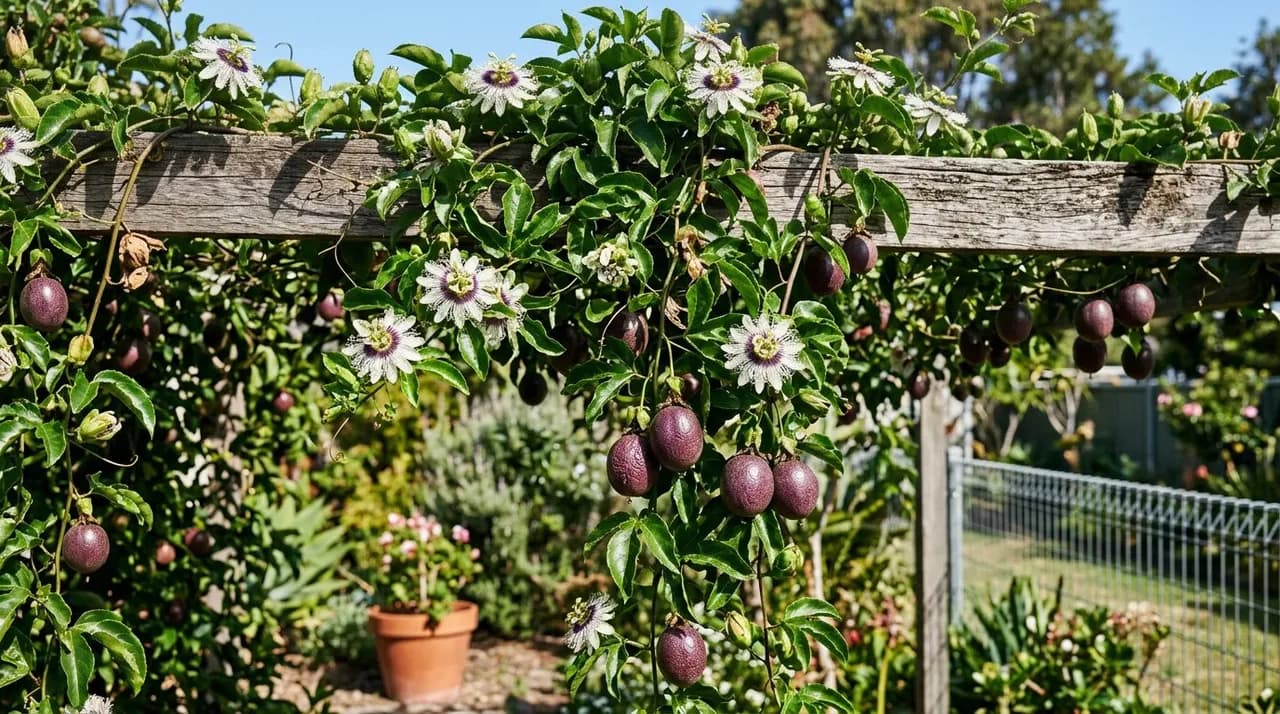
Key takeaways
- Passionfruit vines require full sun (at least 6 hours daily) and warm temperatures during the spring flowering window to set fruit.
- Excess nitrogen fertiliser promotes dense green foliage at the expense of blossom formation and fruit development.
- Poor pollination caused by a lack of bees or cold, rainy spring weather causes unfertilised flowers to shrivel and drop off within a day or two.
- Vigorous rootstock suckers emerging below the graft union rob the productive vine of energy and produce non-fruiting growth.
- Inconsistent watering during fruit swell leads to premature fruit drop, shrivelling, and hollow passionfruit shells.
Quick answer: A passionfruit vine fails to set fruit primarily due to lack of pollinating insects, excessive nitrogen fertilisation, severe moisture stress, or rogue rootstock suckers taking over the graft. Restoring heavy yields requires hand pollination, switching to potassium-rich organic fertilisers, consistent deep watering, and pruning out any five-lobed rootstock growth.
Few garden disappointments rival the frustration of watching a vigorous Passiflora edulis vine smother your fence with lush green foliage while producing zero edible fruit. Across Australian backyards, passionfruit not fruiting remains one of the most frequently asked horticultural troubleshooting questions. Gardeners from subtropical Queensland down to cool temperate Victoria often find their vines covered in buds that drop prematurely, or worse, vines that refuse to flower altogether.
Passionfruit vines are hungry, thirsty, sun-loving climbers native to subtropical South America (southern Brazil, Paraguay, and northern Argentina). Under ideal Australian conditions (warm sunshine, nutrient-rich soil, and abundant insect activity), a healthy vine can yield hundreds of sweet, aromatic fruit each season. However, because passionfruit flowers are complex and open for only a single day, any disruption in nutrition, moisture, or pollinator presence disrupts the delicate fruit-setting mechanism.
Diagnosing why your vine is struggling requires checking four key areas: the botanical identity of the climbing stems, the nutrient balance in the soil, the pollination dynamics during the spring flowering flush, and the consistency of root-zone moisture. Understanding how passionfruit vines interact with your broader veggie patch ideas allows you to implement targeted cultural adjustments that restore heavy cropping.
1. Eliminate rogue grafted rootstock suckers
Most commercial passionfruit vines sold in Australian retail nurseries are grafted. A fruiting scion (Passiflora edulis, such as the popular 'Nellie Kelly' black or panama varieties) is joined onto a tough, disease-resistant blue passionflower rootstock (Passiflora caerulea or wild species). This rootstock provides resistance against soil-borne fusarium wilt and nematodes.
However, if the root system experiences stress, physical damage from a whipper snipper, or planting too deeply, the rootstock frequently sends up aggressive vertical shoots directly from below the graft union.
How to identify rootstock suckers
- Leaf structure: Examine the leaves carefully. Productive Passiflora edulis varieties produce large, glossy leaves with three distinct lobes. Rootstock growth typically has smaller, duller leaves with five distinct lobes or slender, deeply divided fingers.
- Flower appearance: Rootstock blooms are often pale blue or greenish-white with thin filaments, whereas black passionfruit blossoms have prominent purple and white crowns with stout central reproductive organs.
- Growth habit: Suckers grow with extreme vigour, quickly overrunning the grafted fruiting canopy and starving it of sunlight and sap flow.
If you discover five-lobed shoots emerging from the ground or below the swollen graft scar on the lower stem, trace them back to their origin and prune them flush with the main trunk using sharp, sanitised secateurs. If the entire fruiting scion has died and only rootstock remains, the vine will never produce quality edible fruit and should be replaced.
2. Correct excessive nitrogen and feed for flowers
Passionfruit vines are rapid growers that absorb substantial quantities of nutrients. However, feeding your vine with high-nitrogen lawn fertilisers, fresh poultry manure, or uncomposted animal waste stimulates rampant vegetative growth while suppressing flowering hormones.
When a vine receives too much nitrogen, it directs all its metabolic energy into producing long, thick runner canes and massive dark green leaves. The plant simply sees no evolutionary need to reproduce through seed and fruit.
Implementing a balanced feeding schedule
- Early spring (September): Apply a balanced organic fertiliser containing potassium, phosphorus, and trace elements, such as sulfate of potash blended with well-aged compost or certified organic pelletised fruit fertiliser.
- Midsummer (January): Top-dress with a modest application of rock minerals and blood and bone, avoiding synthetic high-nitrogen chemical spikes.
- Potassium boost: If your vine looks healthy and green but produces few flower buds, apply liquid potassium (potash) around the drip line every two to three weeks through spring. Potassium stimulates flower bud differentiation and strengthens cell walls.
For detailed guidelines on soil moisture diagnostics that support proper nutrient absorption, consult our yellowing leaves watering flowchart.
3. Overcome poor pollination with hand pollination
Passionfruit flowers are anatomical marvels, but their physical structure makes wind pollination impossible. The heavy, sticky pollen grains must be transferred from the downward-facing anthers to the upright, receptive female stigmas by large insects, predominantly European honeybees, native carpenter bees (Xylocopa), and blue banded bees.
Each individual passionfruit flower opens for a single day, usually beginning in the morning and closing permanently by dusk; if unpollinated, the flower stem yellows and the blossom shrivels and falls within 24 to 48 hours.
Reasons pollination fails
- Inclement spring weather: Cool temperatures (below 15°C), heavy rain, or high winds prevent bees from flying and wash away pollen grains.
- Lack of nearby floral resources: An absence of companion blooms in the surrounding garden means resident pollinators may not visit the vine regularly.
- Self-incompatibility: While common purple passionfruit is self-fertile, certain red and yellow tropical varieties (including some Panama selections) require cross-pollination from a genetically distinct seedling vine to set fruit.
Step-by-step hand pollination
To guarantee a harvest during cool or bee-sparse springs, pollinate the blossoms manually:
- Walk along the trellis between 9:00 AM and 11:00 AM on a warm, clear morning.
- Locate open flowers with pollen-coated anthers (the five yellow pads facing downwards).
- Use a clean, soft artist brush, a cotton bud, or your bare fingertip to gently collect golden pollen from the anthers.
- Dab the pollen directly onto the upper surfaces of the three curved female stigmas located at the top centre of the flower.
- Repeat across multiple flowers on the vine to maximize genetic transfer and fruit set.
To draw native pollinators into your fruit growing zones permanently, plant targeted flowering companions by reviewing plants for pollinators and our guide on pollinator companion flowers for fruit set.
4. Manage watering and eliminate hydrophobic soil
A passionfruit root system is fibrous and shallow, concentrated primarily in the top 30 cm of soil across a wide radius. This root architecture makes the vine exceptionally vulnerable to drying out during hot Australian summers.
Moisture stress at any stage of reproductive growth triggers defensive survival responses:
- During budding: The vine aborts small immature flower buds before they open.
- During flowering: Flowers fail to produce nectar, deterring bees, and drop unfertilised.
- During fruit development: Immature green fruit shrivel, turn yellow, and drop to the ground prematurely, or develop thick, woody rinds with empty seed cavities.
Overcoming water-repellent sand
In many coastal and inland regions of Australia (notably the sandy coastal plains of Western Australia and South Australia), prolonged summer heat causes soil particles to become coated in waxy organic residues. Water pools on the surface or channels straight past dry roots. If water runs off your garden beds rather than soaking in, treat the root zone immediately following our guide on hydrophobic soil.
Apply a 7 cm to 10 cm layer of coarse organic mulch (such as chunky bark, straw, or sugarcane mulch) from the main stem out to 1.5 metres past the drip line, keeping the mulch 10 cm clear of the trunk itself to prevent collar rot. Water deeply two to three times per week during peak summer rather than giving daily shallow sprinkles.
5. Pruning timing and trellis management
Passionfruit vines produce flowers and fruit exclusively on newly developed lateral growth produced during the current season. An overgrown, tangled vine full of dead interior wood shading its own outer canopy will steadily decline in fruit productivity.
Seasonal pruning rules by climate
- Temperate and Mediterranean regions (Melbourne, Adelaide, Perth, inland NSW): Prune in early spring (September or early October) once the danger of severe frost has passed and new green growth buds begin to swell. Pruning in late autumn or winter leaves tender cut stems vulnerable to frost damage and fungal dieback.
- Subtropical and tropical regions (Brisbane, coastal NSW, Northern Australia): Prune in late winter (August) or immediately following the final autumn harvest flush.
Pruning technique
Cut back lateral canes by roughly one-third, removing thin, spindly shoots and entirely cutting away dead, diseased, or tangled wood. Ensure good air circulation and light penetration through the centre of the vine. Always leave two to three healthy nodes on main horizontal framework branches so vigorous new fruiting laterals can emerge.
6. Climate and sun exposure requirements
Passionfruit vines demand a minimum of 6 to 8 hours of unfiltered sunlight daily to accumulate the thermal energy necessary for abundant blossom initiation.
- Sun exposure: Planting against a south-facing wall or beneath dense overhanging gum trees limits light levels, resulting in leafy growth with very few flowers. Always select a north-facing fence, east-west trellis, or freestanding pergola in full sun.
- Frost sensitivity: Mature black passionfruit vines tolerate light, brief frosts down to -1°C or -2°C, but hard frosts will kill active growing tips and destroy embryonic spring flower buds. In frost-prone inland valleys, plant vines in sheltered thermal microclimates against brick walls, or cover young plants with protective fleece during winter nights.
Verifying the graft union, balancing soil nutrients with organic potash, maintaining consistent soil moisture under thick mulch, and hand pollinating help turn a barren passionfruit climber into a productive vine that yields reliable crops.