Key takeaways
- The Kratky method is a passive hydroponic system ideal for leafy greens and herbs, requiring no pumps or electricity.
- Scaling from a single jar to a multi-plant tote involves increasing nutrient reservoir volume and plant capacity.
- A 27-gallon tote can support six to eight mature lettuce plants, offering significant yield increases over individual jars.
- Proper spacing, light, and nutrient management matter for successful larger-scale Kratky systems.
- Regular monitoring of nutrient levels and pH is necessary, especially as plants mature and consume more solution.
- Consider grow tents or controlled indoor environments for consistent year-round production in regions like USDA zone 5.
Quick answer: To scale Kratky hydroponics, transition from single jars to larger containers like a 27-gallon tote, increasing nutrient reservoir volume and plant capacity. This passive method supports multiple leafy greens without pumps or electricity.
Across different regions of the US, from the humid summers of North Carolina to the drier air of Colorado, the Kratky method has proven itself as a remarkably straightforward way to grow leafy greens. It’s a passive hydroponic technique that doesn’t require pumps, air stones, or electricity, making it accessible for nearly anyone with a container and some plant starts. For many growers, the journey begins with a single mason jar on a windowsill, yielding one head of lettuce or a small bunch of basil.
However, once you’ve seen the success of that first jar, the natural next step is to wonder how to produce more. This article focuses on how to scale that simple, successful method from a single jar to a larger Kratky tote system, capable of supporting multiple plants and significantly boosting your home harvest. We’ll explore the practical steps and considerations for moving to a 27-gallon tote, allowing you to grow enough greens for a small family without a complex setup.
Understanding the single-jar Kratky method
The core principle of the Kratky method is elegantly simple: a plant’s roots are suspended in a nutrient solution, with an air gap maintained between the liquid and the top of the container. As the plant consumes water and nutrients, the solution level drops, naturally increasing the air gap and exposing more roots to oxygen. This passive process eliminates the need for pumps, making it a favorite for beginners and those looking for low-maintenance systems. A typical single-jar setup might use a 32-ounce (one-quart) mason jar, supporting one small plant like a head of butter lettuce or a basil plant for its entire growth cycle, which can be as short as 30 days for some varieties.
The basics of a passive system
For a single plant, a one-quart jar is often sufficient, but larger plants or longer growth cycles might benefit from a half-gallon or even one-gallon container. The success hinges on the initial nutrient solution concentration and the plant’s ability to develop both submerged and air-exposed roots. A good quality hydroponic nutrient solution, mixed according to the manufacturer’s directions for leafy greens, usually around 800-1200 parts per million (ppm) for lettuce, works well. The plant’s roots will grow into the solution, while the stem and crown remain above the water line, ideally supported by a 2-inch net pot. This initial setup is straightforward, often taking less than ten minutes to assemble once you have your seedling ready.
- Net pot size: Typically 2 or 3 inches for single plants.
- Container volume: One quart to one gallon per plant.
- Nutrient solution: Mixed at 800-1200 ppm for lettuce.
- Growth cycle: As short as 30-45 days for quick-growing varieties.
- Light requirements: 14-16 hours of light per day for optimal growth.
Planning for a multi-plant Kratky tote system
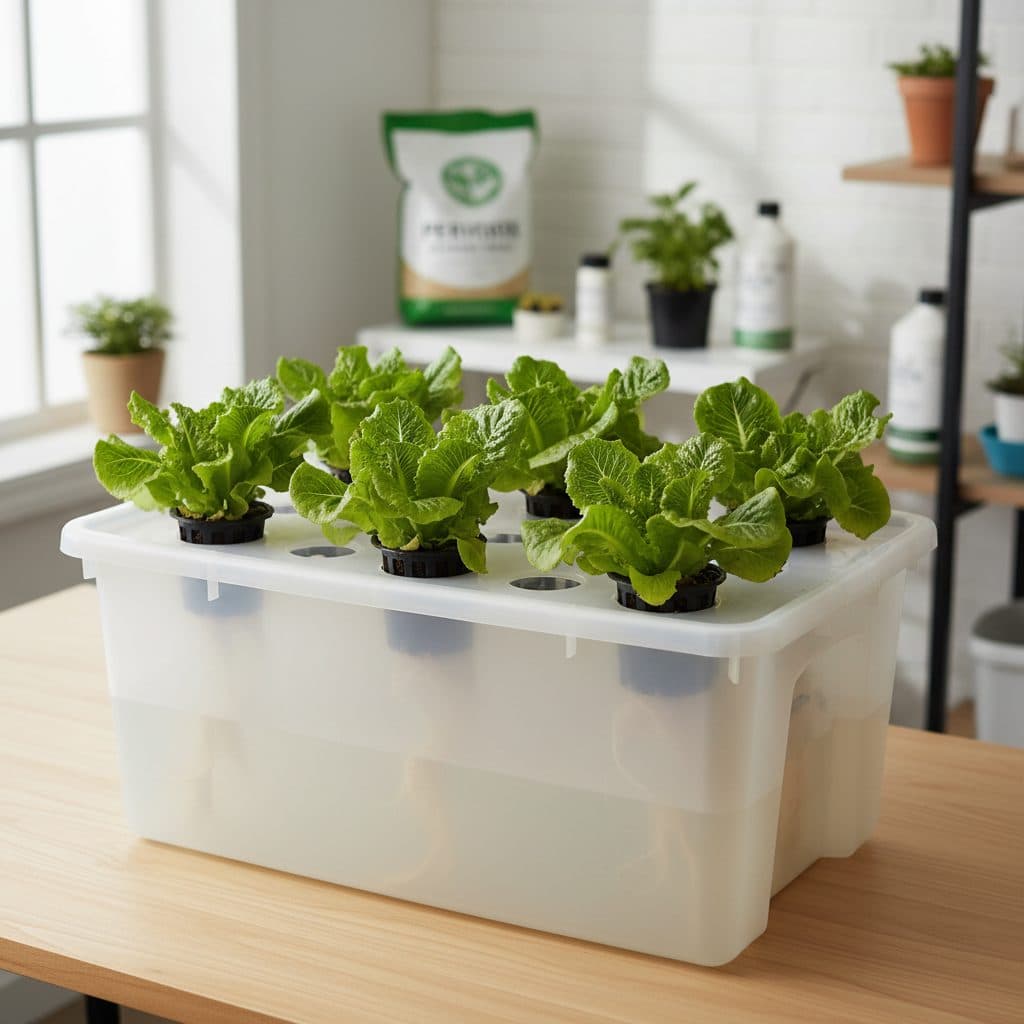
Moving from one jar to a tote introduces efficiencies and challenges. A larger reservoir means more stable nutrient levels and less frequent refilling, but it also requires careful planning for plant spacing and light distribution. For a 27-gallon storage tote, which is a common and affordable option, you can typically accommodate six to eight mature leafy green plants, such as various types of lettuce or Swiss chard. This capacity represents a significant increase in yield, potentially providing enough fresh greens for a family of four for several weeks.
Choosing the right tote and net pots
When selecting a tote, choose one made of food-grade plastic that is opaque to block light, preventing algae growth in the nutrient solution. A 27-gallon tote, measuring approximately 24 in long by 18 in wide by 16 in deep, provides sufficient volume for six to eight plants. You’ll need to drill holes in the lid for your net pots. For larger plants like lettuce, 3-inch net pots are a good choice, spaced about 8-10 inches apart on center. This spacing ensures adequate air circulation and light penetration for each plant, which helps prevent disease and supports healthy growth. Crowded plants shade each other and trap humid air around the leaves, so give each one its full spacing. For indoor setups, consider a reflective indoor grow tent to maximize light efficiency.
- Tote size: 27 gallons is a practical starting point.
- Material: Opaque, food-grade plastic is essential.
- Net pot size: 3 inches for most leafy greens.
- Spacing: 8-10 inches on center for optimal growth.
- Capacity: Six to eight plants per 27-gallon tote.
Building and setting up your Kratky tote system
Once you have your tote and net pots, the construction process is straightforward. The most critical step is drilling the holes in the lid. A 3-inch hole saw, typically found at hardware stores for around $15-$25, will make quick work of this. Measure and mark your desired spacing, aiming for 8-10 inches between the centers of each hole to give plants ample room. For a 27-gallon tote, create two rows of three or four holes, offset slightly for better light distribution. After drilling, smooth any rough edges around the holes to prevent damage to plant stems.
Filling and initial plant placement
With the lid prepared, fill the tote with your mixed hydroponic nutrient solution. For a 27-gallon tote, you’ll likely need about 20-25 gallons of solution initially, leaving a 2-3 inch air gap from the top of the tote. This initial air gap supplies oxygen to the young roots. Place your seedlings, ideally started in rockwool cubes or coco coir, into the net pots. Ensure the bottom of the net pot and the roots extend into the nutrient solution. For optimal growth, maintain a solution temperature between 65-75°F (18-24°C). If you’re considering a larger, more permanent setup, exploring four-season greenhouse design could offer year-round growing potential.
- Drill size: Use a 3-inch hole saw for net pots.
- Hole spacing: 8-10 inches on center.
- Initial fill volume: 20-25 gallons for a 27-gallon tote.
- Initial air gap: 2-3 inches from the top of the tote.
- Solution temperature: Maintain 65-75°F (18-24°C).
Managing and maintaining a larger Kratky system
Unlike recirculating systems, the Kratky method is a ‘set it and forget it’ approach for the nutrient solution, meaning you don’t typically top off the reservoir with fresh solution once it’s set. The plants consume the water and nutrients, and the solution level drops. This is by design, as it creates the necessary air gap for oxygen exchange. However, monitoring is still important. Check your plants daily for signs of stress or nutrient deficiencies, especially in the first two weeks. For systems with more than five plants, a pH meter and a TDS (Total Dissolved Solids) meter are valuable tools, costing around $20-$30 each, to ensure optimal conditions. The ideal pH for most leafy greens is between 5.5 and 6.5.
Troubleshooting and extending your system
If you notice yellowing leaves, it might indicate a nutrient deficiency, while brown, slimy roots could point to a lack of oxygen or root rot, often caused by too little air gap or too high water temperatures (above 75°F). For continuous harvest, consider staggering your plantings, starting new seedlings every two to three weeks. This ensures a steady supply of fresh greens rather than a single large harvest. If you find yourself consistently needing more produce, you might even consider integrating your hydroponic system with a fish tank to create an aquaponics garden, adding a protein source to your sustainable food production. That adds real complexity, including a pump, fish husbandry and water chemistry, in exchange for a wider range of output.
- pH range: Maintain 5.5-6.5 for leafy greens.
- TDS range: 800-1200 ppm for lettuce.
- Monitoring frequency: Daily visual checks, weekly pH/TDS checks.
- Staggered planting: Start new seedlings every 2-3 weeks for continuous harvest.
- Common issues: Nutrient deficiency (yellowing), root rot (brown, slimy roots).
Kratky System Comparison: Single Jar vs. 27-Gallon Tote
Feature | Single Jar (1 Quart) | 27-Gallon Tote |
|---|---|---|
Plant Capacity | One plant | Six to eight plants |
Nutrient Volume | 0.25 gallons | 20-25 gallons |
Refill Frequency | One time fill per cycle | One time fill per cycle |
Space Requirement | 6 in x 6 in | 24 in x 18 in |
Typical Yield | One head of lettuce | Six to eight heads of lettuce |
Monitoring Needs | Minimal visual checks | pH/TDS recommended |
Yield Increase: Scaling from a single 1-quart jar to a 27-gallon tote takes you from one head of lettuce per cycle to six or eight.
Cost-Effective Start: A complete 27-gallon Kratky tote system, excluding grow lights, can be built for under $50, making it an affordable entry into larger-scale hydroponics.
Frequently asked questions
How many plants can a 27-gallon Kratky tote support?
A 27-gallon Kratky tote can typically support six to eight mature leafy green plants, such as lettuce or basil. This capacity is based on providing each plant with adequate space, usually 8-10 inches on center, and sufficient nutrient solution for its full growth cycle.
Do I need to change the nutrient solution in a Kratky tote?
No, in a true Kratky system, you do not change or top off the nutrient solution. The initial fill of 20-25 gallons is designed to last the entire growth cycle of the plants, allowing the solution level to drop and create the necessary air gap for root oxygenation.
What is the ideal pH range for Kratky hydroponics?
For most leafy greens grown in a Kratky system, the ideal pH range for the nutrient solution is between 5.5 and 6.5. Regularly checking the pH with an inexpensive meter, especially once a week, helps ensure optimal nutrient uptake by the plants.
What kind of light do I need for a Kratky tote system?
For indoor Kratky tote systems, you’ll need a suitable grow light that can provide 14-16 hours of light per day. Full-spectrum LED grow lights are efficient and effective, and should be positioned 12-24 inches above the plant canopy.
Can I grow fruiting plants like tomatoes in a Kratky tote?
While possible, fruiting plants like tomatoes are generally not ideal for the traditional Kratky method due to their longer growth cycles and higher nutrient demands. They often require larger, more stable nutrient reservoirs and may benefit from recirculating systems, which provide continuous nutrient replenishment and aeration.
How much space does a 27-gallon Kratky tote require?
A typical 27-gallon tote measures approximately 24 inches long by 18 inches wide by 16 inches deep. When considering space, also account for the grow light fixture above and easy access around the tote for maintenance, requiring an area of about 2 ft by 3 ft.