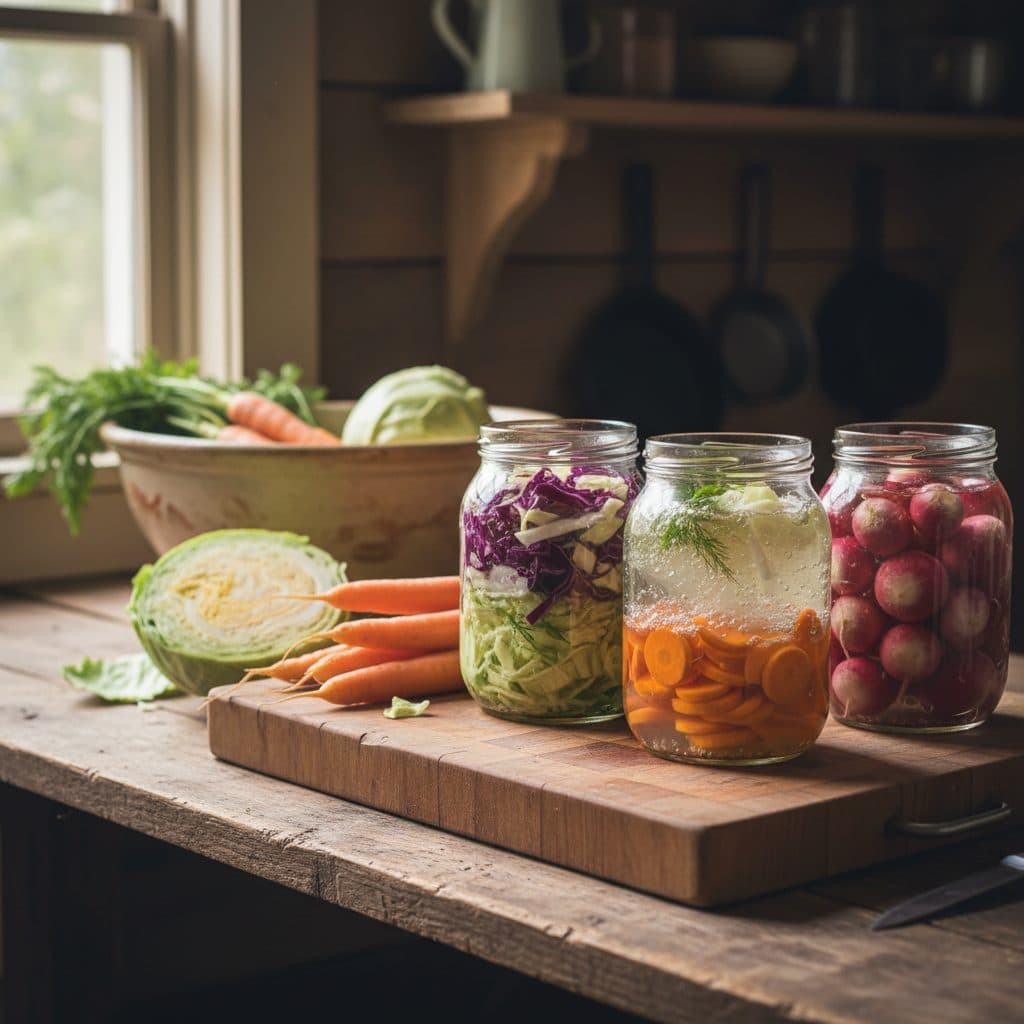
Key takeaways
- Lacto-fermentation relies on a 2-3% salt concentration to inhibit spoilage microbes while allowing beneficial lactic acid bacteria to thrive.
- Accurate salt measurement, whether by weight or volume, is critical for consistent and safe fermentation results.
- Temperature plays a significant role; ideal fermentation temperatures are typically between 65 and 75°F (18 and 24°C).
- Brine percentage calculation ensures proper salt-to-water ratio, which is essential for vegetable preservation and flavor development.
- Proper sanitation of equipment and quality produce are foundational to successful and safe lacto-fermentation.
- Fermented foods offer extended shelf life, often lasting for several months in a cool, dark storage area or refrigerator.
Quick answer: Lacto-fermentation relies on a 2-3% salt concentration to inhibit spoilage microbes and allow beneficial lactic acid bacteria to thrive. This precise brine percentage ensures safe, flavorful, and long-lasting preserves.
For growers in USDA zone 6, where winters bring hard freezes and summers offer abundant harvests, preserving food is a practical necessity. We’ve learned that understanding the science behind food preservation methods like lacto-fermentation is key to making the most of our produce. This method, which has been used for thousands of years, allows us to store vegetables for many months, extending their availability well beyond the growing season.
Lacto-fermentation is a straightforward process that uses salt to create an environment where beneficial bacteria, primarily Lactobacillus species, can convert sugars in vegetables into lactic acid. This acid acts as a natural preservative, inhibiting the growth of harmful microorganisms and giving fermented foods their characteristic tangy flavor. Getting the salt ratio right, typically a 2-3% brine, is the most critical step for both safety and taste.
The science of lacto-fermentation: how salt works
Lacto-fermentation is a natural preservation method that harnesses microscopic allies to transform fresh produce into shelf-stable, flavorful food. The process begins when vegetables are submerged in a saline solution, or brine, which creates an anaerobic environment. This salty condition draws out sugars and water from the vegetables, forming a nutrient-rich liquid that feeds naturally occurring lactic acid bacteria (LAB) present on the produce surface. These bacteria, such as Lactobacillus plantarum, thrive in the absence of oxygen and in the presence of salt, while most spoilage organisms are inhibited by these conditions [3].
understanding the microbial dance
The salt concentration controls this microbial process. A brine that is too weak, say below 1.5%, might allow undesirable molds and yeasts to flourish, leading to spoilage. Conversely, a brine that is too strong, perhaps above 5%, can inhibit the beneficial LAB, preventing the fermentation process from starting or slowing it down significantly. The sweet spot for most vegetable fermentations, including sauerkraut and kimchi, is typically a 2-3% salt concentration by weight. This range provides the ideal conditions for LAB to convert carbohydrates into lactic acid, acetic acid, and carbon dioxide, lowering the pH below 4.6 (the threshold under which Clostridium botulinum cannot grow), usually within the first several days. This acidic environment is what preserves the food, often for 6 to 12 months when stored in a refrigerator at or below 40°F (4°C); warmer storage keeps fermentation slowly ticking over and the vegetables soften long before that.
- Inhibits spoilage: Salt prevents the growth of pathogenic bacteria and molds.
- Draws out moisture: Osmosis pulls water and sugars from vegetables, forming brine.
- Favors lactobacillus: Creates an ideal environment for beneficial bacteria to thrive.
- Develops flavor: Contributes to the complex, tangy taste of fermented foods.
- Maintains texture: Helps vegetables retain a desirable crunch during fermentation.
Calculating salt ratios: weight vs. volume
Precision in salt measurement is paramount for successful lacto-fermentation. While some recipes might offer volume measurements, weighing your salt provides the most accurate and consistent results, especially when dealing with different types of salt that have varying densities. For example, one cup of fine sea salt can weigh significantly more than one cup of coarse kosher salt. A digital kitchen scale, accurate to 0.1 gram, is a valuable tool in any fermenter’s kitchen, ensuring your brine falls within the crucial 2-3% range [5].
the 2-3% golden rule
To calculate salt by weight, you’ll need the total weight of your vegetables and water combined. For example, if you have 2 pounds (about 907 grams) of cabbage and 4 cups (about 946 grams) of water, your total weight is approximately 1853 grams. To achieve a 2% brine, you would multiply 1853 grams by 0.02, which equals 37.06 grams of salt. For a 3% brine, you’d need 55.59 grams of salt. This method is reliable for any quantity of produce, from a small jar of fermented carrots to a 5-gallon crock of sauerkraut. Use non-iodized salt, such as canning salt or sea salt: iodized salt and the anti-caking agents packed with it can darken vegetables and cloud the brine.
- Digital scale: Essential for accurate salt measurements by weight.
- Non-iodized salt: Use canning or sea salt to avoid fermentation inhibition.
- Total weight: Sum of vegetables and water for precise calculation.
- 2-3% range: Optimal for inhibiting spoilage and promoting LAB.
- Consistency: Weighing ensures repeatable results across batches.
Brine percentages: a no-fail formula for vegetables
Once you understand the salt-to-total-weight calculation, applying it to various vegetables becomes a straightforward process. For whole vegetables or those packed tightly, like cucumbers for pickles, a separate brine solution is often prepared and poured over the produce. For shredded vegetables, such as cabbage for sauerkraut, the salt is typically mixed directly with the vegetables, and the natural juices form the brine. Regardless of the method, the goal remains a final salt concentration of 2-3% of the total weight of the fermentable material [5].
applying the formula to different ferments
Consider a batch of fermented green beans. If you have 1.5 pounds (about 680 grams) of beans and need 3 cups (about 709 grams) of water to cover them, your total weight is 1389 grams. For a 2.5% brine, you would add 34.7 grams of salt. This consistent approach minimizes the risk of failure, which often stems from incorrect salt levels. In regions like the humid Southeast, where ambient temperatures can be consistently above 80°F (27°C) for extended periods, a slightly higher salt percentage, perhaps 3%, can help slow down fermentation, preventing mushy results. Conversely, in cooler climates, a 2% brine might be sufficient. For more details on preserving a variety of produce, you might find our guide on fermenting and pickling vegetables useful.
- Shredded vegetables: Salt mixed directly, juices form brine.
- Whole vegetables: Pre-mixed brine poured over produce.
- Temperature adjustment: Higher salt for warmer climates, lower for cooler.
- Consistent results: Precise calculation ensures reliable outcomes.
- Avoid spoilage: Correct brine percentage prevents unwanted microbial growth.
Essential tools and conditions for success
Beyond salt ratios, several other factors contribute to a successful lacto-fermentation. Sanitation is non-negotiable; all jars, crocks, weights, and utensils should be thoroughly cleaned and sanitized. While not strictly necessary to sterilize, ensuring they are free of food residues and rinsed well is important. Using filtered, non-chlorinated water is also recommended, as chlorine can inhibit the beneficial bacteria you’re trying to cultivate. Municipal tap water is chlorinated, and heavily chlorinated water can slow the start of a ferment.
temperature, time, and observation
Temperature strongly affects the rate and outcome of fermentation. Most lacto-ferments do best at ambient temperatures between 65 and 75°F (18 and 24°C). At lower temperatures, fermentation slows significantly, potentially taking weeks longer. At higher temperatures, above 80°F (27°C), fermentation can proceed too quickly, leading to mushy vegetables or off-flavors. Fermentation time varies depending on the vegetable, temperature, and desired sourness, typically ranging from 5 days to 3 weeks. Regular observation for signs of activity, like bubbles, and tasting are key indicators. Airlocks or fermentation weights are useful for keeping vegetables submerged and maintaining an anaerobic environment. For long-term storage, once fermentation is complete, move your jars to a cool basement or refrigerator, where they can last for 6 months or more, similar to root cellaring principles.
- Sanitation: Clean all equipment thoroughly to prevent contamination.
- Filtered water: Avoid chlorinated water to protect beneficial bacteria.
- Temperature control: Maintain 65-75°F (18-24°C) for optimal activity.
- Anaerobic environment: Use airlocks or weights to keep oxygen out.
- Observation: Monitor for bubbles and taste for desired sourness.
Troubleshooting common fermentation issues
Even with careful planning, sometimes a ferment doesn’t go exactly as expected. One common issue is mold growth, which often appears as fuzzy, colored patches on the surface of the brine or vegetables. This usually indicates exposure to oxygen or insufficient salt, allowing undesirable aerobic organisms to thrive. If you see mold, especially black, pink, or green varieties, it’s generally best to discard the batch to ensure safety, as some molds can produce toxins. However, a thin white film, called kahm yeast, is usually harmless and can be skimmed off, though it can impart an off-flavor if left unchecked.
preventing and addressing problems
Another frequent concern is a lack of activity—no bubbles or souring after several days. This could be due to several factors: too little salt, too low a temperature (below 60°F or 15°C), or chlorinated water. If your ferment isn’t bubbling after 3-4 days at 70°F (21°C), check your salt calculations and consider moving it to a warmer spot. If it still shows no bubbling and no sour smell after about a week, discard it rather than tasting it - a batch that never acidified was never preserved. If you suspect chlorinated water, let tap water sit out for 24 hours before use, or use filtered water. Mushy vegetables are often a sign of too high a fermentation temperature (above 80°F or 27°C) or too long a fermentation time, breaking down pectin too quickly. For future batches, a slightly higher salt percentage, up to 3%, can help maintain crispness, particularly for vegetables like green beans or carrots. Remember, consistent success comes from understanding these variables and adjusting your process accordingly, much like how a gardener learns to adapt to local soil conditions across USDA zones.
- Mold: Discard if fuzzy, colored; indicates oxygen exposure or low salt.
- Kahm yeast: White film, harmless but can affect flavor; skim off.
- No activity: Check salt, temperature, and water for chlorine.
- Mushy vegetables: Often due to high temperature or prolonged fermentation.
- Off-flavors: Can result from high temperatures or improper sanitation.
Common Salt Types for Fermentation
Salt Type | Characteristics | Use in Fermentation |
|---|---|---|
Fine Sea Salt | Small crystals, dissolves quickly, contains trace minerals. | Excellent for brines and dry-salting, easy to measure by weight. |
Coarse Sea Salt | Larger crystals, dissolves slower, good for texture. | Good for brines, but measure by weight for accuracy due to crystal size variability. |
Kosher Salt (Diamond Crystal) | Flaky crystals, low density, no iodine or anti-caking agents. | Popular for fermentation, but weight is crucial due to low density (1 cup ≈ 5 oz). |
Kosher Salt (Morton’s) | Denser crystals than Diamond Crystal, no iodine or anti-caking agents. | Reliable, but still requires weighing for precise 2-3% brine. |
Pickling/Canning Salt | Fine granules, no iodine or anti-caking agents, dissolves easily. | Ideal for fermentation due to purity and consistent density, often recommended. |
Optimal Salt Range: Most lacto-ferments require a 2-3% salt concentration by weight for optimal safety and flavor development, inhibiting spoilage while promoting beneficial bacteria.
Temperature Control: Maintaining fermentation temperatures between 65 and 75°F (18 and 24°C) is crucial; temperatures above 80°F (27°C) can lead to mushy results or off-flavors.
Water Quality: Filtered or off-gassed water is the safer choice, since chlorinated tap water can slow the start of a ferment.
Frequently asked questions
What is the ideal salt percentage for lacto-fermentation?
The ideal salt percentage for most lacto-fermentations is between 2% and 3% of the total weight of the vegetables and water combined. This range effectively inhibits spoilage organisms while allowing beneficial lactic acid bacteria to thrive and produce lactic acid.
Can I use iodized salt for fermentation?
It is generally recommended to avoid iodized salt for fermentation. Iodine can inhibit the growth of beneficial lactic acid bacteria, potentially leading to failed ferments or off-flavors. Stick to non-iodized options like canning salt, sea salt, or kosher salt.
How long does lacto-fermentation typically take?
The duration of lacto-fermentation varies depending on the vegetable, temperature, and desired sourness, but typically ranges from 5 days to 3 weeks. At 70°F (21°C), many ferments are ready in about 7 to 14 days.
What should I do if mold appears on my ferment?
If you observe fuzzy, colored mold (e.g., black, pink, green) on your ferment, it’s generally safest to discard the entire batch. This usually indicates oxygen exposure or insufficient salt. A thin white film, called kahm yeast, is usually harmless and can be skimmed off.
Why is temperature important in fermentation?
Temperature significantly impacts fermentation speed and outcome. Ideal temperatures are 65-75°F (18-24°C). Temperatures below 60°F (15°C) slow fermentation, while those above 80°F (27°C) can cause mushy vegetables and off-flavors due to rapid bacterial growth.
How can I ensure my vegetables stay submerged in the brine?
To ensure vegetables remain submerged, use fermentation weights, such as glass weights specifically designed for jars, or a clean, smaller jar filled with water. Keeping vegetables below the brine prevents exposure to oxygen, which can lead to mold growth and spoilage.
References
- Fermentation and Wine Composition (2018). Fermentation and Wine Composition.
- The Nutritional and Safety Challenges Associated with Lupin Lacto-Fermentation (2016). The Nutritional and Safety Challenges Associated with Lupin Lacto-Fermentation.
- BASICS OF FERMENTATION (2025). BASICS OF FERMENTATION.
- The effect of Piper betle leaves on lacto-fermentation of idli batter, characterization and applicability of potent isolates in soymilk fermentation (2015). The effect of Piper betle leaves on lacto-fermentation of idli batter, characterization and applicability of potent isolates in soymilk fermentation.
- The Basics of Fermentation (2025). The Basics of Fermentation.
- USDA Natural Resources Conservation Service (2024). USDA Natural Resources Conservation Service.