Key takeaways
- NFT systems use a shallow stream of nutrient-rich water to feed plants, offering efficient water and nutrient delivery.
- Balcony NFT setups can significantly increase plant density and yield compared to traditional container gardening.
- Strawberries (e.g., ‘Seascape’, ‘Albion’), leafy greens like lettuce, and herbs such as basil and cilantro are well-suited for NFT systems due to their shallow root systems. Keep mint in a channel of its own if you grow it at all — its running roots will fill an NFT channel and block flow to everything downstream of it.
- Proper system design, including a slight slope of 1:30 to 1:40, ensures even nutrient distribution and prevents root rot.
- Regular monitoring of pH (5.5-6.5) and Electrical Conductivity (EC) of the nutrient solution is essential for plant health and productivity.
- Consider the structural capacity of your balcony for the weight of the system, which can be 50-100 pounds when full.
Quick answer: Growing strawberries and herbs on a balcony using Nutrient Film Technique (NFT) hydroponics can significantly boost yields compared to traditional container gardening. This method uses a shallow stream of nutrient-rich water, allowing for higher plant density and efficient resource use in small spaces.
In many US cities, like those with compact living spaces in USDA zone 8 on the Pacific Northwest coast, gardening space can be a real challenge. Traditional soil beds are often out of the question, leaving many aspiring growers to rely on a few pots on a balcony or patio. However, there is a way to significantly boost your yield of fresh produce, even in a limited footprint: Nutrient Film Technique, or NFT, scaled for a balcony. This approach can transform a small outdoor area into a productive growing station, and can noticeably increase harvestable produce compared to conventional container methods.
NFT is a hydroponic method where a thin film of nutrient-rich water flows over the roots of plants, providing them with everything they need without soil. For balcony growers, this means less mess, efficient water use, and often faster growth. Imagine harvesting fresh strawberries and aromatic herbs just steps from your kitchen, even if your entire growing area is a 3-foot by 10-foot balcony. This guide will walk you through setting up an NFT system that works for your outdoor space, focusing on practical steps and real-world results.
Understanding NFT for small spaces
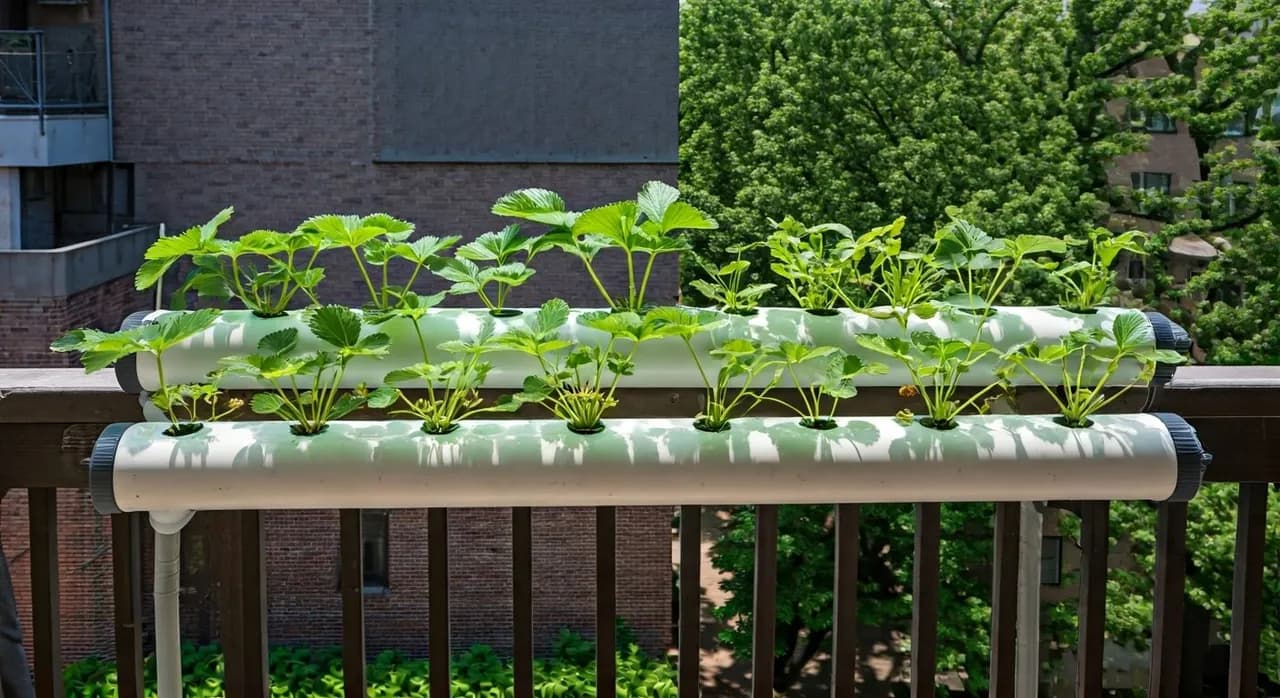
Nutrient Film Technique (NFT) is a hydroponic system that delivers a continuous, shallow stream of nutrient-rich water to plant roots. Unlike deep water culture, the roots are not fully submerged; a thin film of water flows past them, ensuring they get both water and oxygen. This method works well for plants with shallow root systems — strawberries, leafy greens, and most herbs — which makes it suited to a balcony or patio rail. A typical NFT channel might be 4 inches wide and 2 inches deep, allowing for efficient use of vertical space.
the benefits of NFT on a balcony
Setting up an NFT system on a balcony offers several distinct advantages over traditional container gardening. First, it allows for a much higher plant density per square foot, which can meaningfully raise yield for crops like strawberries. Second, water consumption is significantly reduced, often by 70% to 90% compared to soil gardening, because the system is closed-loop and recirculates water. Third, there’s no soil involved, which means less mess, fewer soil-borne pests, and a cleaner growing environment on your patio. A well-designed system can support eight to ten strawberry plants in a 4-foot channel.
- Efficient water use, reducing consumption by up to 90%
- Higher plant density and increased yields per square foot
- Reduced pest and disease issues common in soil
- Cleaner gardening experience with no soil mess
- Faster growth rates for many plant varieties
Designing your balcony NFT system
When planning your balcony NFT system, the first consideration is the available space and sunlight. Most balconies, especially those in urban areas like New York City (USDA zone 7a), receive direct sunlight for only four to six hours a day, which is sufficient for many herbs and strawberries. You’ll need a solid wall or a floor-standing frame to carry the system. Do not hang it on the balcony railing: guardrails are engineered to resist an outward push from a person, not to carry a sustained hanging load, and many leases, condo bylaws and local codes prohibit anything mounted on or overhanging a rail. Check your building’s rules before you build, and mount everything so nothing can fall to the ground below. A typical NFT setup includes a reservoir for the nutrient solution, a submersible pump, PVC or food-grade plastic channels, and a return pipe. Because this is a mains-powered pump sitting in water outdoors, run it from a GFCI-protected outdoor outlet, use an outdoor-rated cord, and leave a drip loop so rain cannot track down the cable into the plug. The entire system, when full of water and plants, can easily weigh 50 to 100 pounds — a 10-gallon reservoir alone is over 80 pounds of water — so confirm your balcony can carry the load before you build.
selecting components and layout
For channels, 3-inch or 4-inch square or rectangular PVC pipes are common, often with 2-inch net pots spaced 6 to 8 inches apart for plants. The channels need to be angled slightly, with a slope of 1:30 to 1:40 (a one-inch drop for every 30 to 40 inches of length) to ensure the nutrient film flows properly and doesn’t pool, which could lead to root rot. A 5-gallon to 10-gallon reservoir is usually sufficient for a small system with ten to twenty plants, requiring a pump that can circulate 100 to 200 gallons per hour. You can find suitable reflective grow tents for indoor setups, but for balconies, durable outdoor materials are key. Consider a reflective indoor grow tent for starting seedlings before moving them outdoors.
- Solid wall mount or a floor-standing frame — not the balcony railing
- Food-grade PVC or plastic channels, 3-4 inches wide
- Submersible pump rated for 100-200 GPH
- 5-10 gallon reservoir for nutrient solution
- Net pots, 2-3 inches in diameter
Choosing the right plants and nutrients
Not all plants thrive in NFT systems, but many popular balcony crops are excellent candidates. For strawberries, day-neutral varieties like ‘Seascape’ or ‘Albion’ are ideal because they produce fruit continuously throughout the growing season, often yielding 0.5 to 1 pound per plant. Strawberry flowers still need pollinating to set well-shaped fruit, so if your balcony is sheltered, screened, or covered with plastic, brush each open flower with a soft artist’s brush every couple of days — unpollinated flowers give small, misshapen berries or none at all. These varieties perform well in USDA zones 4 through 9. For leafy greens and herbs, types like basil, cilantro and lettuce are perfect for NFT due to their shallow root systems and rapid growth. Mint will grow too, but give it a channel of its own — its running roots pack an NFT channel and dam the film for everything downstream. These can mature in as little as 30 days from seed. Starting a herb garden with NFT can be much faster than traditional methods.
nutrient solution and maintenance
The success of any hydroponic system hinges on the nutrient solution. You’ll need a high-quality, balanced hydroponic fertilizer designed for fruiting plants like strawberries, typically with an NPK ratio around 5-10-15 during flowering. For leafy herbs, a more balanced NPK like 8-8-8 is suitable. The pH of the solution is critical and should be maintained between 5.5 and 6.5 for optimal nutrient uptake; check it daily with a pH meter and adjust as needed with pH up or pH down solutions. The Electrical Conductivity (EC) should also be monitored to ensure proper nutrient concentration, typically between 1.2 and 2.0 mS/cm for strawberries and 1.0 to 1.6 mS/cm for herbs. Replace the entire nutrient solution every one to two weeks to prevent nutrient imbalances and pathogen buildup.
- Day-neutral strawberry varieties (‘Seascape’, ‘Albion’)
- Leafy herbs (basil, mint, lettuce, cilantro)
- High-quality hydroponic nutrient solution (e.g., 5-10-15 NPK for strawberries)
- pH meter and pH adjustment solutions
- EC meter for monitoring nutrient strength
Installation and ongoing care
Once you have all your components, assembly is straightforward. Securely mount your NFT channels to a solid wall or a dedicated floor-standing frame — not the railing — ensuring the proper slope of one inch per 30-40 inches of length. Connect the pump in the reservoir to the highest point of your channel system, and ensure all channels drain back into the reservoir. Fill the reservoir with water and add your hydroponic nutrients according to the manufacturer’s instructions, typically starting with a half-strength solution for young plants. Test the pH and EC immediately, adjusting as necessary. For a 10-plant system, this initial setup might take three to four hours.
monitoring and troubleshooting common issues
Regular monitoring is the key to a successful NFT system. Check the nutrient solution levels daily, as plants will consume water, especially on hot days in regions like Phoenix, Arizona (USDA zone 9b), where evaporation rates are high. Replenish with fresh water, then check and adjust pH and EC every two to three days. Look for signs of nutrient deficiencies (yellowing leaves) or excesses (burnt leaf tips). Algae growth can be an issue in uncovered reservoirs or channels; ensure all parts of the system are light-proof to prevent this. If you notice slow growth or wilting, check the pump for clogs or failures, as consistent flow is vital. A small system can consume 1-2 gallons of water per day during peak growing periods.
- Securely mount channels with a 1:30 to 1:40 slope
- Connect pump and ensure proper water circulation
- Fill reservoir with nutrient solution and test pH/EC
- Monitor water levels daily and replenish as needed
- Check pH and EC every two to three days
Maximizing your balcony harvest
To get the most out of your balcony NFT system, consider plant spacing and light exposure. For strawberries, allow 6 to 8 inches between plants to ensure good air circulation and light penetration, which improves fruit quality and reduces gray mold in humid weather. Rotate your channels periodically if some areas of your balcony receive more sun than others, especially in east-facing balconies in regions like the Midwest (USDA zones 5-6) where morning sun is dominant. Pruning older leaves from strawberry plants can encourage new growth and larger fruit. For herbs, regular harvesting of outer leaves will promote bushier growth and extend the harvest period for weeks.
extending your growing season
While an outdoor balcony NFT system is limited by local climate, you can extend your growing season. In USDA zone 7, for example, you might get six to eight months of outdoor growing. For cooler seasons, a clear plastic cover or mini greenhouse over your NFT channels will hold a little daytime warmth. It will not save the crop from a real freeze: an NFT channel holds only a film of water, so the root zone has almost no thermal mass, and plastic resting against foliage makes frost damage worse rather than better. Drain the system and move it indoors before a hard freeze — water left in the pump and plumbing will split them. This can extend your harvest by several weeks in spring and fall. For year-round production, especially for herbs, you might bring a small NFT unit indoors under grow lights, or even convert a fish tank into an aquaponics garden which is a similar soilless method. Dehydrating excess herbs is also an effective way to preserve your harvest for months.
- Space strawberry plants 6-8 inches apart for optimal growth
- Rotate channels for even light exposure
- Prune older strawberry leaves to encourage new growth
- Harvest herbs regularly to promote bushiness
- Use clear plastic covers to extend the outdoor season
NFT vs. traditional container gardening for balconies
Feature | NFT System | Traditional Containers |
|---|---|---|
Water Use Efficiency | 70-90% less water | High evaporation, frequent watering needed |
Yield Potential | Higher per square foot, thanks to tighter plant spacing | Limited by container size and plant density |
Mess & Pests | No soil, fewer soil-borne pests | Soil can be messy, common soil pests |
Growth Rate | Often faster due to direct nutrient access | Slower, dependent on soil quality and watering |
Nutrient Control | Precise control over nutrient delivery | Nutrient availability varies, less control |
Setup Complexity | Higher initial setup time and cost | Simple, low initial cost |
Balcony Weight Limit: a full NFT system with channels, water, plants and reservoir is heavy — water alone weighs about 8.3 pounds per gallon — so confirm your balcony can carry the load before you build.
Strawberry Yields: Day-neutral strawberry varieties like ‘Seascape’ can yield 0.5 to 1 pound of fruit per plant in an NFT system over a season [1].
Frequently asked questions
What kind of strawberries grow best in an NFT system on a balcony?
Day-neutral strawberry varieties like ‘Seascape’ or ‘Albion’ are excellent choices for NFT systems because they produce fruit continuously throughout the growing season. These varieties can yield 0.5 to 1 pound of fruit per plant in a well-maintained system.
How often do I need to change the nutrient solution in an NFT system?
It’s best practice to replace the entire nutrient solution every one to two weeks. This prevents nutrient imbalances and the buildup of pathogens, ensuring your plants receive optimal nutrition and remain healthy. Daily top-offs with fresh water are also necessary.
Can NFT systems be used in cold climates like USDA zone 4?
While outdoor NFT systems are limited by frost, you can extend the growing season in USDA zone 4 by using clear plastic covers or bringing smaller units indoors under grow lights. Without protection, the outdoor season in zone 4 is short, and a light cover adds only a few weeks at each end. For anything longer, move the unit indoors under lights.
What is the ideal slope for NFT channels?
The ideal slope for NFT channels is typically between 1:30 and 1:40. This means for every 30 to 40 inches of channel length, there should be a one-inch drop. This slight incline ensures a thin film of nutrient solution flows consistently over the roots without pooling.
How much sunlight do strawberries and herbs need in an NFT system?
Strawberries and most herbs thrive with at least four to six hours of direct sunlight per day. Balconies receiving morning sun or dappled afternoon light can still be productive, but more light generally leads to higher yields, and larger fruit.
Is a balcony NFT system heavy?
Yes. Channels full of water, plus the reservoir, add up quickly — water alone weighs about 8.3 pounds per gallon, so a 10-gallon reservoir is over 80 pounds before you count the frame, the channels or the plants. Assess your balcony’s structural capacity before installation, mount the system on a solid wall or a floor-standing frame rather than the railing, and check your building’s rules first.
References
- STRAWBERRIES AS BALCONY FRUIT (2014). STRAWBERRIES AS BALCONY FRUIT.
- USDA Natural Resources Conservation Service (2024). USDA Natural Resources Conservation Service.