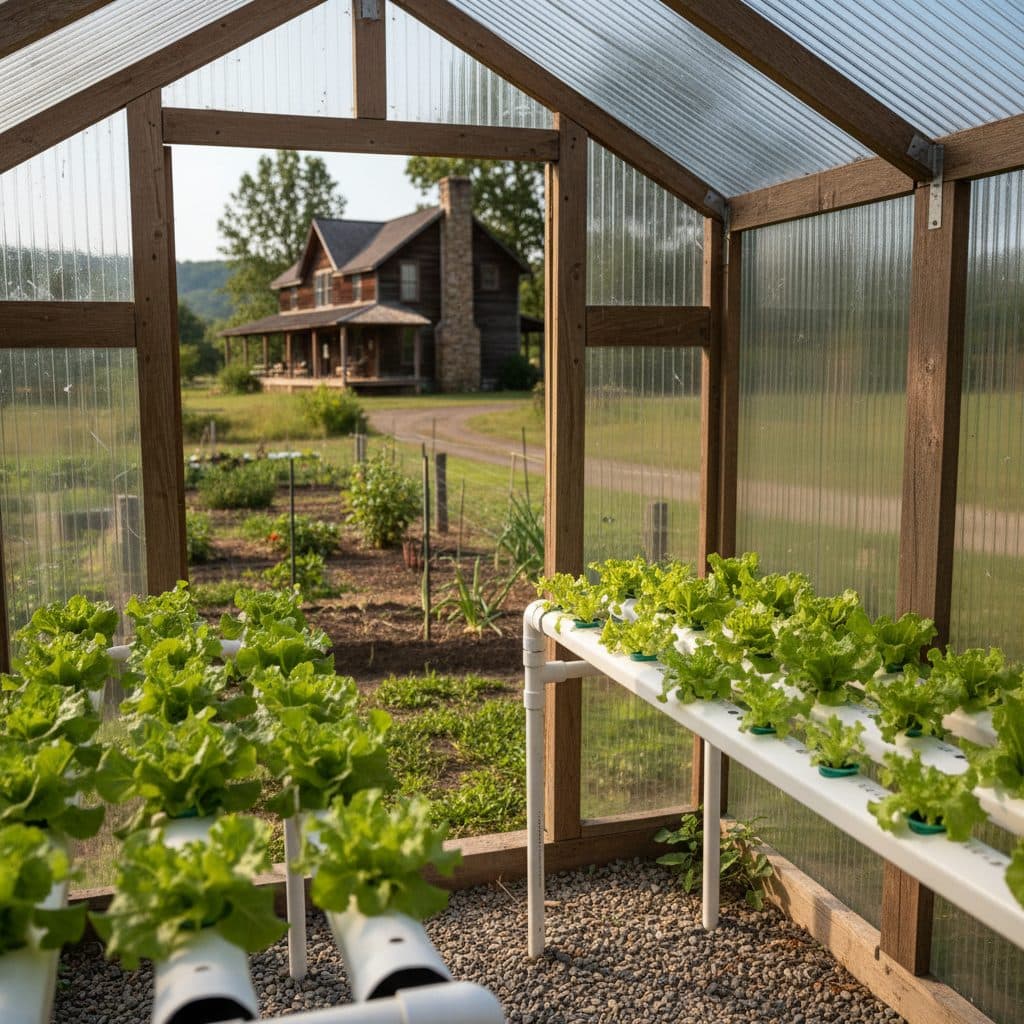
Key takeaways
- NFT systems deliver nutrients via a genuinely thin film, no more than about 1/8 inch (3 mm) deep.
- Optimal flow rates for NFT are often between 0.25 and 0.5 gallons per minute per channel.
- Channel slope should be 1:30 to 1:40, ensuring even nutrient distribution and drainage.
- Maintaining proper nutrient film depth prevents root rot and ensures adequate oxygenation.
- Regular monitoring of pH, EC, and water temperature is crucial for plant health.
- NFT is well-suited for leafy greens and herbs, offering high yields in compact spaces.
Quick answer: NFT hydroponics works by delivering a constant, shallow stream of nutrient-rich water (a thin film) over plant roots in growing channels. This method ensures roots receive consistent nutrition and adequate oxygen, promoting optimal growth without soil.
In the arid regions of the American Southwest, like Arizona or Nevada, where water conservation is a top priority, hydroponic systems offer a compelling alternative to traditional soil-based farming. Nutrient Film Technique, or NFT, is one such method that has gained traction among growers looking to maximize efficiency and yield. This system, first developed in the 1960s, relies on a constant, shallow stream of nutrient-rich water flowing over plant roots, providing them with everything they need to thrive without soil.
Understanding the core principles of NFT (particularly the thin-film concept and ideal flow rates) is essential for success. Many growers in USDA zone 7 and above find NFT particularly effective for producing leafy greens and herbs, often yielding more produce per square foot than conventional methods. Getting these foundational elements right gives your plants consistent nutrition and adequate oxygen, which heads off common issues like root rot and nutrient deficiencies.
The thin-film principle explained
The core idea behind Nutrient Film Technique is right there in the name: a thin film of nutrient solution. This isn’t a deep reservoir where roots are submerged; instead, it’s a genuinely thin stream, no more than about 1/8 inch (3 mm) deep, that flows over the bottom of a growing channel. This design ensures that the upper portion of the plant’s root mass remains exposed to air, allowing for crucial oxygen uptake. Without this exposure, roots can suffocate, leading to plant stress and eventual failure, a problem often seen in poorly managed deep water culture systems. For example, a commercial NFT setup in California might use channels 4 inches wide and 2 inches deep, with the nutrient solution only a few millimeters deep across the channel floor. This specific depth is critical for maintaining root health and preventing anaerobic conditions, which can breed harmful pathogens.
The constant movement of this nutrient film, often recirculated from a central reservoir, delivers a steady supply of water, oxygen, and dissolved minerals directly to the root zone. This efficient delivery means plants don’t expend energy searching for nutrients, so they can focus on vegetative growth or fruit production. NFT lettuce typically finishes faster than the same variety grown in soil, because the roots never have to search for water or nutrients. Main components include:
- A nutrient reservoir holding 10 to 50 gallons of solution.
- A submersible pump rated for 200 to 500 gallons per hour.
- Growing channels, usually 4 to 6 inches wide.
- A return pipe system for recirculation.
- Net pots, typically 2 to 3 inches in diameter.
Achieving the ideal flow rate
The flow rate of your nutrient solution is just as important as its depth. Too fast, and the film might not adequately coat the roots, leading to dry spots and nutrient deficiencies. Too slow, and the water can stagnate, reducing oxygen levels and potentially causing root rot. The sweet spot for most NFT systems, especially for leafy greens like lettuce or basil, is typically between 0.25 and 0.5 gallons per minute (GPM) per channel. For a system with six channels, this means a total flow of 1.5 to 3 GPM from the pump. This rate ensures a consistent, even film across the entire length of the channel, which can be up to 10 feet long in many home setups.
Gentle slope
To achieve this, the slope of your growing channels is critical. A gentle slope, usually 1:30 to 1:40 (meaning a one-inch drop for every 30 to 40 inches of channel length), is generally recommended. This slight incline allows gravity to do its work, ensuring the solution flows smoothly without pooling. For example, a 10-foot channel would need a drop of 3 to 4 inches from one end to the other. Many growers use simple spirit levels or even smartphone apps to verify their slope. Proper flow and slope contribute to maximum nutrient uptake and prevent waterlogging, which suffocates roots. Consider using a reflective indoor grow tent to maintain stable temperatures, which also impacts flow and evaporation.
- Measure pump output with a flow meter or bucket test.
- Adjust channel slope to 1:30 or 1:40 for gravity flow.
- Monitor root health for signs of drying or waterlogging.
- Consider plant size; larger plants may need slightly higher flow.
- Check for blockages in channels regularly, and confirm daily that the pump is actually running, since so little water sits in the channels that roots can dry out within hours if flow stops.
Nutrient solution management
Beyond the physical setup, the nutrient solution itself is the lifeblood of your NFT system. Maintaining the correct pH and Electrical Conductivity (EC) is paramount for plant health and nutrient availability. Most hydroponic crops, including common NFT plants like lettuce, spinach, and strawberries, thrive in a pH range of 5.5 to 6.5. Outside this range, essential nutrients can become locked out, even if they are present in the solution. For instance, iron availability drops sharply above pH 7.0, leading to chlorosis, a yellowing of leaves. Regular pH testing, at least once every two days, is a standard practice for many commercial growers in states like Ohio and Michigan, where indoor farming is expanding.
What to watch for
EC measures the total dissolved solids, indicating the concentration of nutrients. A typical EC range for leafy greens is 1.2 to 1.8 mS/cm (millisiemens per centimeter). Fruiting plants like tomatoes or peppers might require a higher EC, perhaps 2.0 to 3.0 mS/cm, but these are less common in traditional NFT setups due to their larger root systems. You’ll need to replenish the reservoir with fresh nutrient solution every one to two weeks, and top it off with plain water daily to compensate for evaporation and plant uptake. This constant management ensures consistent nutrient delivery and prevents nutrient lockout. For more complex systems, consider how turning a fish tank into an aquaponics garden integrates nutrient cycling.
- Test pH daily or every other day, aiming for 5.5 to 6.5.
- Monitor EC two to three times per week, adjusting as needed.
- Replenish reservoir with fresh solution every 7 to 14 days.
- Top off daily with plain water to maintain volume.
- Keep water temperature between 65°F and 75°F for optimal oxygen levels.
Common challenges and solutions
Even with careful planning, NFT systems can present challenges. Root rot is perhaps the most common issue, often caused by insufficient oxygen due to an overly deep nutrient film or stagnant water. If you see roots turning brown or developing a slimy texture, it’s a clear sign of trouble. Adjusting the flow rate to the recommended 0.25 to 0.5 GPM per channel and ensuring the channel slope is between 1:30 and 1:40 can often resolve this. For severe cases, a complete system flush and the addition of beneficial microbes can help. In commercial operations in California’s Central Valley, where NFT is used for strawberry production, root rot can take out a substantial share of the crop if not addressed quickly.
Getting it right
Another frequent problem is nutrient deficiency or toxicity, usually indicated by discolored leaves or stunted growth. This points to issues with pH or EC. Always calibrate your meters regularly (at least once a month) to ensure accurate readings. If your pH is off, use pH up or pH down solutions cautiously, adding small amounts and retesting. If EC is too high, dilute with plain water; if too low, add more concentrated nutrient solution. Algae growth, often green slime in channels or the reservoir, is another common nuisance. It competes with plants for nutrients and can clog pumps. Reducing light exposure to the nutrient solution, for example by using opaque channels and reservoir covers, prevents most algae problems. This is particularly important in sunny regions like Arizona, where light intensity is high. If you encounter pests, understanding how to get rid of aphids can be a useful skill, as they can sometimes find their way into indoor setups.
- Check for brown, slimy roots as a sign of root rot.
- Ensure proper channel slope and flow rate to oxygenate roots.
- Calibrate pH and EC meters monthly for accurate readings.
- Address nutrient issues by adjusting pH or EC as needed.
- Block light from nutrient solution to prevent algae growth.
NFT vs. Deep Water Culture (DWC) Hydroponics
Feature | NFT (Nutrient Film Technique) | DWC (Deep Water Culture) |
|---|---|---|
Root Exposure | Upper roots exposed to air for oxygen | Roots fully submerged in nutrient solution |
Nutrient Delivery | A film a few millimeters deep flows over roots | Roots in a deep reservoir of solution |
Oxygenation | High natural oxygenation due to air exposure | Requires air stone/pump for oxygenation |
Water Volume | Lower water volume in channels, larger reservoir | High water volume in reservoir/root zone |
Ideal Plants | Leafy greens, herbs, strawberries | Leafy greens, some larger fruiting plants |
Common Issues | Flow rate, slope, root blockages | Oxygen deprivation, temperature control |
Channel Slope: A channel slope of 1:30 to 1:40 is crucial for proper drainage and nutrient film distribution.
Ideal Flow Rate: Maintain a flow rate between 0.25 and 0.5 gallons per minute per channel for optimal plant health.
Nutrient Film Depth: The nutrient film should be no more than about 1/8 inch (3 mm) deep so most of the root mat stays in air.
Frequently asked questions
What is the best flow rate for NFT hydroponics?
The ideal flow rate for most NFT systems is between 0.25 and 0.5 gallons per minute (GPM) per channel. This ensures a consistent, thin film of nutrient solution, no more than about 1/8 inch (3 mm) deep, providing roots with both water and essential oxygen. Deviating from this range can lead to dry spots and nutrient deficiencies at the high end, or stagnation and root rot at the low end.
How deep should the nutrient film be in an NFT system?
The nutrient film should be genuinely thin, no more than about 1/8 inch (3 mm) deep. That wets the root mat while leaving most of it exposed to air, which is vital for oxygen uptake. A film deep enough to submerge the roots suffocates them, especially at temperatures above 75°F, leading to plant stress and disease.
What slope is needed for NFT channels?
A gentle slope of 1:30 to 1:40 is recommended for NFT channels. This means for every 30 to 40 inches of channel length, there should be a one-inch drop. For example, a 10-foot channel would require a total drop of 3 to 4 inches. This slope ensures the nutrient solution flows smoothly by gravity, preventing pooling and promoting even distribution.
What plants grow well in an NFT system?
NFT systems are particularly well-suited for fast-growing, shallow-rooted plants that don’t require extensive support. Leafy greens like lettuce, spinach, kale, and herbs such as basil, mint, and cilantro thrive in NFT. Strawberries are also a popular choice, with commercial NFT farms in California producing thousands of pounds annually. Plants with large, fibrous root systems or heavy fruits are generally less ideal for this technique.
How often should I change the nutrient solution in an NFT system?
You should change the entire nutrient solution in your NFT reservoir every one to two weeks. This prevents the buildup of imbalanced nutrients or harmful pathogens. Daily, you’ll also need to top off the reservoir with plain water to replace what plants have absorbed and what has evaporated, which can be up to 10% of the reservoir volume per day in hot, dry climates.
What are common problems in NFT and how are they fixed?
Common NFT problems include root rot, nutrient deficiencies, and algae growth. Root rot often stems from insufficient oxygen due to deep films or slow flow; fix this by adjusting flow to 0.25-0.5 GPM and slope to 1:30. Nutrient deficiencies are usually pH or EC issues; calibrate meters monthly and adjust solution accordingly. Algae growth is caused by light exposure; use opaque channels and reservoir covers to keep light off the solution entirely.