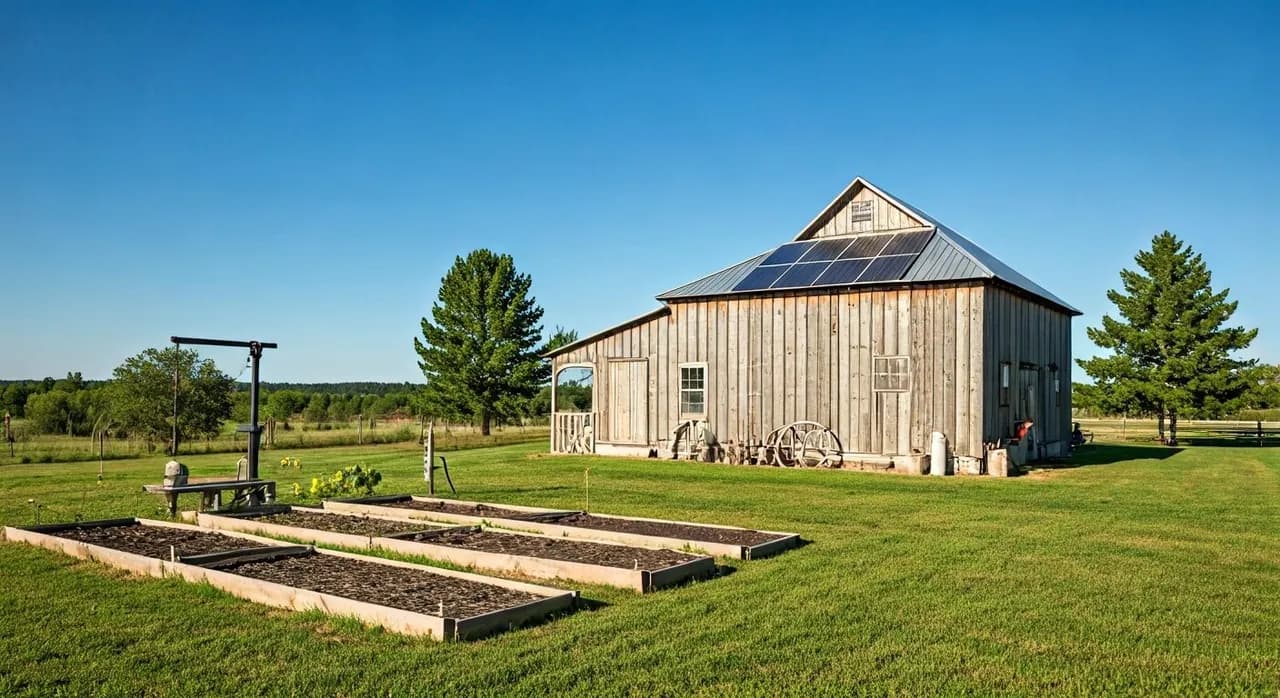
Key takeaways
- Off-grid solar offers energy independence and reliability, especially in remote US locations, by disconnecting from the centralized power grid.
- Solar panels (monocrystalline or polycrystalline) convert sunlight into DC electricity, with efficiencies ranging from 15% to 22% and a typical degradation of 0.5% per year.
- Charge controllers (PWM or MPPT) regulate power from panels to batteries, preventing overcharging and optimizing energy harvest, with MPPT controllers achieving 90% to 99% efficiency.
- Battery banks (lead-acid or lithium-ion) store solar energy; lithium-ion offers higher depth of discharge (80-90%) and longer lifespans (10-15 years) despite higher upfront costs.
- Inverters convert DC battery power to usable AC household power (120V or 240V), with pure sine wave models offering 90-95% efficiency and compatibility with all electronics.
- Proper system sizing, based on daily energy consumption (e.g., 10-30 kWh for a homestead) and regular maintenance, is essential for long-term off-grid system performance.
Quick answer: Off-grid solar systems provide energy independence for homesteads by using solar panels, charge controllers, batteries, and inverters to generate and store electricity, disconnecting from the centralized power grid. This setup ensures reliable power, eliminates utility bills, and is ideal for remote US locations.
In the rugged mountains of northern Idaho, a family homestead powers its entire 2,500 square foot home and a small workshop with a 6,000-watt off-grid solar system. This setup provides consistent electricity, even when winter storms knock out grid power for days in surrounding communities. For many rural residents across the United States, from the high desert of Arizona to the humid plains of Arkansas, the idea of energy independence holds significant appeal.
Building an off-grid solar system means taking control of your power supply, eliminating monthly utility bills that can exceed $200, and ensuring a reliable energy source that is not subject to distant infrastructure failures. Understanding the four core components (solar panels, charge controllers, batteries, and inverters) is the first step toward generating your own electricity and achieving self-sufficiency on your property, potentially saving thousands of dollars over two decades.
Understanding the power grid and the off-grid choice
The traditional electrical grid, as it exists across the United States, is a complex network designed to deliver electricity from centralized power plants to consumers [1]. This vast system, comprising power lines, substations, and transformers, ensures that electricity generated in one state, like a coal plant in Wyoming, can power homes hundreds of miles away in Nebraska [2], [3]. However, this centralized model has vulnerabilities. A single point of failure, such as a downed transmission line during a severe ice storm, can leave millions without power, as Texas saw in February 2021. Opting for an off-grid solar system means disconnecting from this shared infrastructure entirely, relying solely on your own generation and storage.
Why homesteaders choose off-grid power
For homesteaders in regions like the high plains of Montana or the remote valleys of Appalachia, the decision to go off-grid often comes down to a combination of factors: the high cost of extending grid lines to a remote property, the desire for self-sufficiency, and the need for reliable power that is not susceptible to widespread outages. Extending grid power to a new build site can be very expensive, sometimes costing tens of thousands of dollars per mile., making off-grid solar a financially sound alternative for many rural properties. A well-designed off-grid system, sized correctly for a typical US household consuming a large amount of energy each month, offers true energy independence and peace of mind. You can learn more about living off the grid by visiting our article on off-grid living.
- Cost savings: Avoid monthly utility bills and connection fees, potentially saving thousands of dollars over 20 years.
- Energy independence: Produce your own electricity, free from utility rate hikes or service interruptions.
- Reliability: Maintain power during grid outages, which can affect millions of Americans annually.
- Property value: A well-installed off-grid system can increase the value of remote properties.
- Reduced infrastructure: Bypass the need for expensive grid line extensions, which can cost $25,000 per mile.
Solar panels: harvesting the sun’s energy
Solar panels are the primary components of any photovoltaic (PV) system, responsible for converting sunlight into direct current (DC) electricity [5]. On a typical homestead in sunny regions like southern California or the high desert of New Mexico, a 6,000-watt array might consist of twenty 300-watt panels, each measuring about 65 in by 39 in. The choice often comes down to two main types: monocrystalline and polycrystalline panels. Monocrystalline panels, identifiable by their uniform dark appearance, are generally more efficient, converting 18% to 22% of sunlight into electricity, making them a good choice for smaller roof spaces or areas with limited sun exposure [5].
Monocrystalline vs. polycrystalline panels
Polycrystalline panels, with their speckled blue appearance, are typically less efficient, operating at 15% to 17% efficiency, but are often more cost-effective per watt [5]. Both types experience a gradual degradation in performance, usually around 0.5% per year, meaning a 20-year-old panel might produce 10% less power than it did new. For a system in a USDA Zone 7 area receiving five peak sun hours per day, a 6,000-watt array could generate approximately 30 kWh daily. Understanding how these panels work is critical for any off-grid setup; you can explore the mechanics further in our detailed article on how a solar panel works.
- Monocrystalline: Higher efficiency (18-22%), darker appearance, performs better in low light, costs more per watt.
- Polycrystalline: Lower efficiency (15-17%), speckled blue appearance, more cost-effective, larger footprint for same power.
- Panel degradation: Typically 0.5% loss of efficiency per year, resulting in 10% less power after 20 years.
- Temperature coefficient: Performance decreases by about 0.3% to 0.5% for every 1.8°F (1°C) above 77°F (25°C).
- Warranty: Most panels come with a 25-year performance warranty, guaranteeing 80% to 85% of original output.
Charge controllers: safeguarding your battery bank
Once solar panels convert sunlight into DC electricity, that power needs to be managed before it reaches your batteries. This is where a charge controller comes in, acting as the brain between your solar array and your battery bank. Its primary role is to regulate the voltage and current coming from the solar panels to prevent overcharging your batteries, which can significantly shorten their lifespan and even cause damage. For a 48-volt battery bank on a homestead in upstate New York, a charge controller ensures the panels’ higher voltage (e.g., 60 volts) is safely stepped down.
Pwm vs. mppt charge controllers
There are two main types of charge controllers: Pulse Width Modulation (PWM) and Maximum Power Point Tracking (MPPT). PWM controllers are simpler and less expensive, and are generally less efficient. They are best suited for smaller systems, like a 100-watt panel charging a 12-volt battery for a remote cabin light. MPPT controllers, on the other hand, are more sophisticated, tracking the maximum power point of the solar array to optimize energy harvest, and are highly efficient. This higher efficiency means an an MPPT controller can extract significantly more power from your panels, especially in cooler conditions or when panel voltage significantly exceeds battery voltage. For larger systems, such as a 5,000-watt array powering a home in rural Oregon, an MPPT controller is almost always the more cost-effective choice in the long run.
- PWM (Pulse Width Modulation): Simpler, less expensive, 75-80% efficient, best for small systems where panel voltage matches battery voltage.
- MPPT (Maximum Power Point Tracking): More complex, more expensive, 90-99% efficient, optimizes power harvest, ideal for larger systems and varying conditions.
- Overcharge protection: Prevents batteries from being damaged by excessive voltage, extending battery life by years.
- Reverse current protection: Stops batteries from discharging back into the panels at night, preventing energy loss.
- Temperature compensation: Adjusts charging voltage based on battery temperature, critical for battery health in extreme climates.
Batteries: the heart of your off-grid system
Batteries are the most important component of an off-grid solar system, serving as the reservoir for the electricity generated by your panels. Without a sturdy battery bank, your homestead in southern Georgia would only have power when the sun is shining directly on your panels. The capacity of a battery bank is measured in amp-hours (Ah) or kilowatt-hours (kWh), and for a typical off-grid home, a system might require 20 kWh to 40 kWh of usable storage to cover two to three days of autonomy.
Lead-acid vs. lithium-ion batteries
The most common types are lead-acid and lithium-ion. Lead-acid batteries, including flooded lead-acid (FLA) and sealed absorbed glass mat (AGM), are generally less expensive upfront. However, they typically have a lower depth of discharge (DoD) — often 50% to 60% — meaning you can only use about half their stored energy without significantly shortening their lifespan. They also require more maintenance, especially FLAs, which need regular water top-offs. A well-maintained lead-acid bank might last five to seven years, providing 1,500 to 2,000 cycles. Lithium-ion batteries, particularly Lithium Iron Phosphate (LiFePO4), offer a much higher DoD (80% to 90%), longer lifespan (10 to 15 years or 3,000 to 6,000 cycles), and are virtually maintenance-free. While their upfront cost is higher, often two to three times that of lead-acid, their extended lifespan and higher usable capacity can make them more economical over the long term. For more on sizing your battery bank, refer to our guide on sizing solar panels and batteries.
- Lead-acid (FLA/AGM): Lower upfront cost, 50-60% DoD, 5-7 year lifespan, requires more maintenance for FLA.
- Lithium-ion (LiFePO4): Higher upfront cost, 80-90% DoD, 10-15 year lifespan, maintenance-free, better performance.
- Depth of Discharge (DoD): The percentage of battery capacity that has been discharged, impacting lifespan.
- Cycle life: The number of charge/discharge cycles a battery can endure before its capacity significantly degrades (e.g., to 80%).
- Battery bank voltage: Systems are commonly 12V, 24V, or 48V; higher voltages are more efficient for larger systems.
Inverters: converting DC to usable AC power
Your solar panels produce direct current (DC) electricity, and your batteries store it as DC. However, most household appliances in the United States operate on alternating current (AC) electricity at 120 volts or 240 volts. This is where the inverter comes into play, converting the DC power from your battery bank into the AC power needed to run everything from your refrigerator to your power tools. A quality inverter is critical for the efficient operation of any off-grid home so a homestead in central Texas can power its well pump and air conditioning units.
Pure sine wave vs. modified sine wave inverters
There are two primary types of inverters relevant to off-grid systems: pure sine wave and modified sine wave. Pure sine wave inverters produce a clean, smooth AC waveform that is identical to grid power. This makes them compatible with all electronics, including sensitive equipment like computers, medical devices, and variable-speed motors, which typically operate without issues. They are more expensive but offer higher efficiency, often 90% to 95%, and reduce the risk of damage to appliances. Modified sine wave inverters produce a stepped, blocky AC waveform that is less precise. While they are more affordable, they can cause some appliances to run less efficiently, hum, or even fail prematurely. They are generally suitable for simpler loads like incandescent lights or heating elements, but should be avoided for sensitive electronics or motors, which could experience a 20% to 30% reduction in lifespan. For larger homesteads, especially those using power tools or multiple appliances, a pure sine wave inverter with a capacity of 4,000 watts to 8,000 watts is almost always the recommended choice. You can learn more about different solar system configurations in our article on off-grid and hybrid solar systems.
- Pure Sine Wave: Produces clean power, compatible with all electronics, 90-95% efficient, higher cost.
- Modified Sine Wave: Produces stepped power, suitable for basic loads, lower cost, can damage sensitive electronics.
- Continuous power rating: The maximum power an inverter can supply continuously (e.g., 5,000 watts).
- Surge power rating: The maximum power an inverter can supply for a short period (e.g., 10,000 watts for 10 seconds) to start motors.
- Efficiency: The percentage of DC power converted to AC power, typically 90% or higher for good models.
Sizing your system and ongoing maintenance
Designing an off-grid solar system for a homestead in the Pacific Northwest or the arid southwest requires careful planning to ensure it meets your energy needs year-round. The process begins with a detailed energy audit to calculate your daily electricity consumption in watt-hours or kilowatt-hours. A typical off-grid home might consume 10 kWh to 30 kWh per day, depending on appliance usage and seasonal variations. Once you know your daily load, you can determine the size of your solar array, factoring in your local peak sun hours (e.g., four to five hours in much of the US) and the efficiency of your panels and charge controller.
Maintaining your off-grid system
Next, size your battery bank to store enough power for several days of autonomy, especially for periods of cloudy weather or high demand. A common recommendation is two to three days of storage. Finally, select an inverter with a continuous wattage rating that can handle your largest simultaneous loads, plus a surge capacity for starting motors. Regular maintenance is key to the longevity and efficiency of your system. This includes cleaning solar panels every six to twelve months, especially in dusty regions like Arizona, to maintain optimal output (a dirty panel can lose significant efficiency). For flooded lead-acid batteries, check electrolyte levels monthly and top off with distilled water. Inspecting wiring for corrosion and ensuring all connections are tight should be done annually. A comprehensive off-grid solar kit can help get you started; learn more at our guide to off-grid solar kits.
- Energy audit: Calculate daily kWh consumption for all appliances, typically 10 kWh to 30 kWh for a homestead.
- Solar array sizing: Determine panel wattage needed based on daily load and local peak sun hours (e.g., four to five hours).
- Battery bank sizing: Ensure two to three days of autonomy for cloudy weather, considering battery DoD.
- Inverter sizing: Match continuous wattage to peak simultaneous loads and surge capacity for motors.
- Regular cleaning: Clean solar panels every six to twelve months to prevent 10-20% efficiency loss from dirt.
Inverter Types for Off-Grid Systems
Feature | Pure Sine Wave | Modified Sine Wave |
|---|---|---|
Output Waveform | Smooth, identical to grid power | Stepped, blocky approximation |
Efficiency | 90-95% | 75-85% |
Cost (per watt) | Higher (e.g., $0.30-$0.50) | Lower (e.g., $0.10-$0.25) |
Appliance Compatibility | All electronics, sensitive devices | Basic loads (lights, heaters), not sensitive electronics |
Risk to Appliances | Very low | Can cause humming, inefficiency, premature failure |
Best Use Case | Whole-home power, sensitive equipment | Small, simple systems, non-critical loads |
Grid Outages: In 2021, over 4.5 million homes and businesses in Texas lost power during a severe winter storm, showing grid vulnerabilities.
Panel Efficiency: Modern monocrystalline solar panels convert 18% to 22% of sunlight into electricity, making them highly effective for homestead use.
Battery Lifespan: Lithium-ion (LiFePO4) batteries can last 10 to 15 years with 3,000 to 6,000 charge cycles, significantly outperforming lead-acid options.