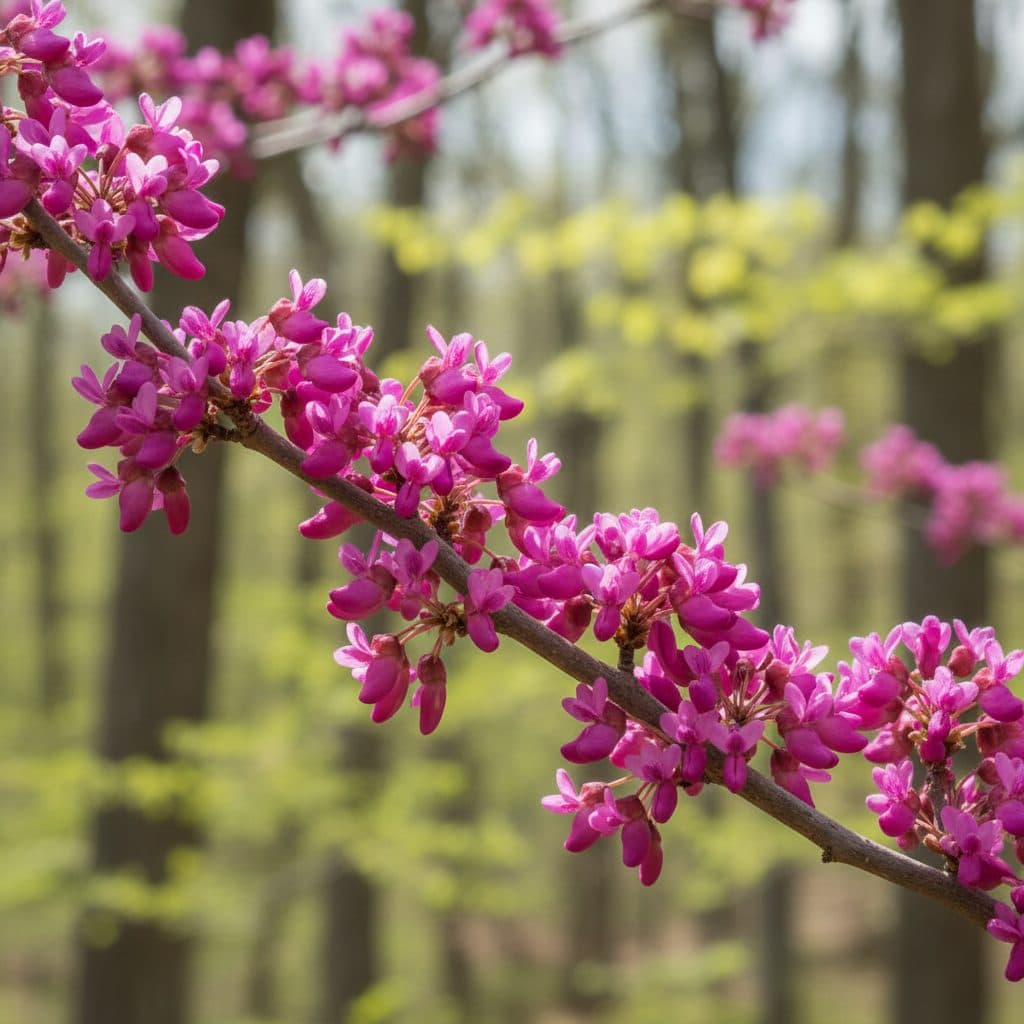
Key takeaways
- Redbud flowers (Cercis canadensis) are edible and bloom in early spring, typically from March to May across USDA zones 4-9.
- Black locust flowers (Robinia pseudoacacia) offer a sweet, fragrant edible option, appearing from late April to June in USDA zones 4-8.
- Proper identification matters; black locust bark, leaves, and pods are toxic, but the flowers are safe when correctly identified.
- Both flowers can be used in various culinary applications, from salads and teas to fritters and syrups.
- Harvest flowers responsibly, taking only a small percentage (10% to 15%) from each plant to ensure plant health and future yields.
- Always forage in areas free from pesticides and heavy pollution, maintaining a distance of at least 50 ft from roads.
Quick answer: Redbud and black locust flowers are edible spring blooms found in USDA zones 4-9, offering unique culinary opportunities. Proper identification and responsible harvesting are critical for safety and sustainability.
In the Appalachian foothills of North Carolina, as winter’s chill recedes, two distinct floral displays herald the arrival of spring: the pink-purple blossoms of the eastern redbud and the creamy white, fragrant clusters of the black locust. For growers and foragers across USDA zones 4-9, these early spring blooms offer more than just visual appeal; they present unique opportunities for edible harvesting. Redbud (Cercis canadensis) flowers typically emerge from March to May, while black locust (Robinia pseudoacacia) follows from late April to June, providing a staggered harvest window for those keen to explore wild edibles.
Understanding the specific characteristics of each plant is paramount for safe foraging. While both species are widely distributed across the eastern and central United States, their growth habits and bloom times vary slightly depending on local climate conditions and elevation. For instance, redbud trees can reach heights of 20 to 30 ft, while black locust trees often grow taller, up to 80 ft or even 100 ft in mature stands. This guide will walk you through identifying these spring edibles, harvesting them responsibly, and incorporating them into your kitchen.
The spring harvest window and regional distribution
Spring in the United States brings a succession of edible blooms, with eastern redbud and black locust flowers among the earliest and most abundant. The eastern redbud (Cercis canadensis) is native to a broad swath of the eastern and central US, thriving in USDA zones 4 through 9 [4]. Its distinctive magenta to pinkish-purple flowers appear directly on the branches, often before the leaves emerge, typically from late March to mid-May, depending on latitude and elevation. For example, in Georgia, redbuds might bloom in late March, while in Michigan, they can not appear until early Can. These trees generally reach a height of 20 to 30 ft with a similar spread, making their flowers accessible for harvesting.
Understanding bloom times and habitats
Black locust (Robinia pseudoacacia), another native species, is found across a similar range, primarily in USDA zones 4 through 8, though it has naturalized in many other regions [1]. Its pendulous clusters of fragrant, creamy-white flowers typically bloom from late April to early June, often just as the redbud season concludes. Black locust trees can grow much taller, frequently reaching 50 to 80 ft, with some specimens exceeding 100 ft. They prefer well-drained soils and are often found in disturbed areas, along forest edges, and in open woodlands. When foraging, always ensure you are on public land or have explicit permission from private landowners, and maintain a safe distance of at least 50 ft from roadsides to avoid vehicle exhaust and pollutants. This responsible approach ensures both personal safety and the sustainability of wild populations.
- Redbud bloom: March to May, USDA zones 4-9.
- Black locust bloom: April to June, USDA zones 4-8.
- Redbud height: 20 to 30 ft.
- Black locust height: 50 to 80 ft, sometimes 100 ft.
- Forage at least 50 ft from roads.
Identifying and harvesting redbud flowers
The eastern redbud (Cercis canadensis) is relatively easy to identify, making it an excellent choice for beginner foragers. Its most striking feature is the profusion of small, pea-like flowers, typically one-half inch to three-quarters of an inch long, that emerge directly from the branches and even the trunk in early spring [5]. These flowers range in color from a magenta to a soft pinkish-purple. The leaves, which appear after the flowers, are heart-shaped, 3 to 5 in long, and have smooth margins. Redbuds are often found in forest understories, along stream banks, and in open woodlands throughout the eastern and central US, particularly in states like Missouri and Tennessee, which are central to its native range.
Safe harvesting practices for redbud
When harvesting redbud flowers, select fresh, healthy blossoms that are fully open and free from blemishes or insect damage. Use clean scissors or your fingers to gently pluck the individual flowers or small clusters, leaving the larger clusters to continue blooming. Harvest responsibly, taking only a small portion of the flowers from any single tree to ensure its health and future productivity. Avoid harvesting from trees near busy roads or industrial areas, as flowers can accumulate pollutants. A good practice is to gather flowers into a breathable basket or paper bag to prevent crushing, and use them within 24 hours for optimal freshness. For more general foraging tips, consider reviewing resources like Foraging for beginners: identifying common wild edibles safely.
- Flower size: one-half to three-quarters of an inch.
- Leaf shape: Heart-shaped, 3 to 5 in long.
- Harvest percentage: Max 10% to 15% per tree.
- Storage: Use within 24 hours.
- Avoid roadsides: At least 50 ft distance.
Identifying and harvesting black locust flowers
Black locust (Robinia pseudoacacia) is a fast-growing deciduous tree, often reaching heights of 50 to 80 ft, with some mature trees exceeding 100 ft [1]. Its flowers are distinct: fragrant, creamy-white, pea-like blossoms arranged in drooping clusters (racemes) that can be 4 to 8 in long [2]. These clusters hang gracefully from the branches, typically appearing from late April to early June. The leaves are compound, with 7 to 19 oval leaflets per stem, and the branches often have sharp thorns, one-half to one inch long, which are a key identifying feature. While the flowers are edible and quite sweet, it is critical to remember that the bark, leaves, seeds, and pods of the black locust are toxic, containing robin and phasin [1]. Therefore, only the flowers should be consumed.
Responsible collection of black locust blossoms
When harvesting black locust flowers, focus on collecting entire racemes that are fully open and fragrant. Use pruning shears or sharp scissors to cleanly snip the flower clusters from the branches. Note that black locust can spread aggressively through root suckers, especially when cut, and is considered invasive in many regions. Due to the thorns, wearing gloves is highly recommended to protect your hands. As with redbud, practice sustainable harvesting by taking no more than 10% to 15% of the available flowers from a single tree. Black locust trees are common in disturbed sites, old fields, and along roadsides in regions like the Ohio River Valley, but always choose foraging locations at least 50 ft away from potential contaminants. Once harvested, the flowers are best used fresh, though they can be gently dried for teas or infused into syrups, maintaining their delicate flavor for several months if stored properly in an airtight container.
- Flower clusters: 4 to 8 in long.
- Leaflets: 7 to 19 per compound leaf.
- Thorns: one-half to one inch long.
- Toxic parts: Bark, leaves, seeds, pods.
- Harvesting tool: Pruning shears.
Culinary uses and safety considerations
Both redbud and black locust flowers offer unique culinary profiles, adding a touch of spring to various dishes. Redbud flowers have a mild, slightly tart, and somewhat nutty flavor, making them excellent raw additions to salads, like a spring mix with wild violets (Wild violets: how to identify Viola sororia, eat the flowers, and decide whether to keep it) or as a garnish for desserts. They can also be lightly battered and fried as fritters or steeped to make a delicate pink tea. Black locust flowers, in contrast, are distinctively sweet and fragrant, often compared to honey or fresh peas. They are superb in fritters, where their sweetness shines, and are also commonly used to make syrups, jellies, and infused honeys. A simple black locust syrup can be made by steeping 2 cups of flowers in 1 cup of hot water with 1 cup of sugar, then straining, yielding about 1.5 cups of syrup.
Ensuring safety and responsible consumption
Safety is paramount when foraging. Always be 100% certain of your identification. If there’s any doubt, do not consume the plant. For black locust, this is especially critical due to the toxicity of its bark, leaves, and seeds [1]. Only the flowers are edible. Furthermore, always forage in areas that have not been treated with pesticides or herbicides, and maintain a distance of at least 50 ft from roadsides to avoid heavy metal contamination from vehicle exhaust. Foragers in urban or suburban areas should be particularly cautious, as many ornamental trees are routinely sprayed. Start with a small amount when trying any new wild edible to check for individual sensitivities. The USDA Natural Resources Conservation Service provides detailed plant profiles (Small-Leaved Wild Grape) that can aid in identification and understanding native ranges [6].
- Redbud flavor: Mild, tart, nutty.
- Black locust flavor: Sweet, honey-like.
- Black locust toxic parts: Bark, leaves, seeds, pods.
- Foraging distance: At least 50 ft from roads.
- New edibles: Start with a small portion.
Redbud bloom: Eastern redbud flowers typically bloom from March to May across USDA zones 4-9, offering a harvest window of up to 8 weeks in some regions [4].
Black locust toxicity: While black locust flowers are edible and sweet, its bark, leaves, seeds, and pods contain toxic compounds like robin and phasin [1].
Antioxidant potential: Black locust flowers contain bioactive compounds with antioxidant properties, with one study showing an extraction yield of 3.5 mg/g of total phenolic content [3].
References
- Black Locust / Robinia pseudoacacia (2024).
- Black Locust / Robinia pseudoacacia (2024).
- Microwave-assisted extraction of antioxidants from black locust flowers (Robinia pseudoacacia flos) (2023). https://doi.org/10.21175/rad.abstr.book.2023.45.1
- Eastern Redbud / Cercis canadensis (2024).
- Eastern Redbud / Cercis canadensis (2024).
- USDA Natural Resources Conservation Service (2024).