Key takeaways
- Calculate indoor seed starting dates by counting backward from your local spring average last frost date.
- Sow slow-growing crops like onions and peppers 8 to 12 weeks before your last frost, and tomatoes 6 to 8 weeks before.
- Fast-growing cucurbits (squash, cucumbers, melons) need only 2 to 4 weeks indoors to prevent root-bound stress.
- Starting seeds too early leads to leggy, root-bound, nutrient-starved seedlings that stall after transplanting.
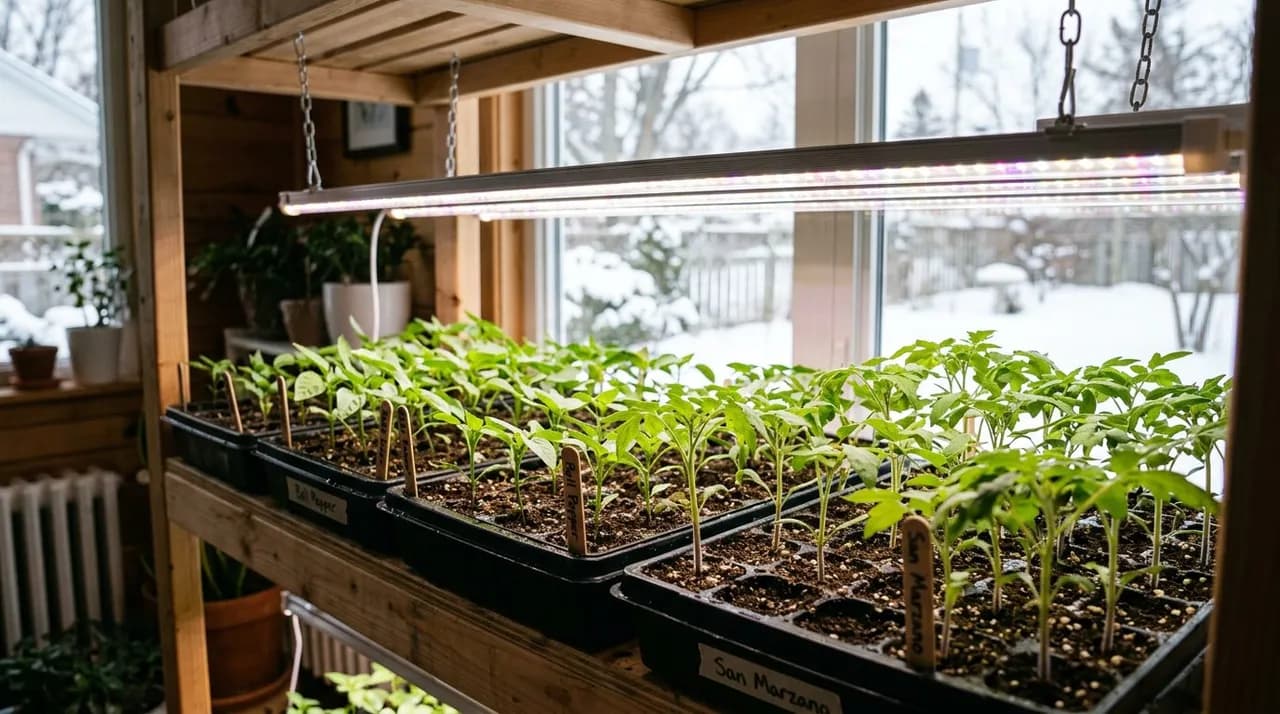
- Use grow lights for 14 to 16 hours daily to counter dim winter light (5 to 10 cm for fluorescent tubes, 15 to 45 cm for LED panels).
Quick answer: In Canada, start indoor seeds by counting backward from your local last spring frost date: onions and leeks at 10 to 12 weeks, peppers and eggplants at 8 to 10 weeks, tomatoes and brassicas at 6 to 8 weeks, and squashes at 2 to 4 weeks. Supplement with grow lights and bottom heat to ensure sturdy seedling growth.
Knowing when to start seeds indoors canada gardeners can depend on makes the difference between an abundant summer harvest and a frustrating season of stunted plants. Plant hardiness in Canada is officially mapped by Natural Resources Canada (NRCan) using a multi-factor formula, though many seed packets and garden references quote USDA cold-minimum zones instead. Always check which system a chart or seed packet is using.
Starting warm-season vegetables indoors gives heat-loving crops the head start they need to flower, set fruit, and ripen before autumn cold sets in. However, one of the most common mistakes Canadian gardeners make is starting seeds too early in late winter. Seeds sprouted in February on a dim windowsill quickly stretch into weak, leggy stems that collapse or suffer severe transplant shock when moved into cold spring garden soil.
By calculating your sowing dates based on your specific regional frost calendar, maintaining adequate heat and light, and executing a gradual hardening off transition, you can raise sturdy, vigorous transplants tailored for Canadian conditions.
How to calculate your Canadian seed starting timeline
Schedule your seed starting by counting backward from your region's average last spring frost date instead of following fixed calendar dates printed on seed packets. (Note: average frost dates represent a 50% probability of frost; conservative gardeners wait until after the frost-free date before moving tender crops out.)
Finding your regional frost date
Because Canadian geography spans multiple climate zones, last frost dates vary widely:
- Coastal British Columbia (Zones 7 to 9: Vancouver, Victoria, Nanaimo): Average last frost occurs late March to mid-April. Start peppers and eggplants in late January or early February; tomatoes in late February to early March; brassicas in February for March transplanting.
- Southwestern Ontario and Niagara (Zones 6a to 7b: Windsor, Niagara, Toronto): Average last frost occurs late April to mid-May. Start peppers and eggplants in late February or early March; tomatoes in late March to early April; brassicas in March for April transplanting. For a complete provincial breakdown, review our detailed guide to Ontario planting zones.
- Eastern Ontario, Ottawa, Montreal, and Maritimes (Zone 5): Last frost occurs late May (May 20 to May 28).
- Prairie Provinces, Central Ontario, and Inland BC (Zone 3 to 4): Last frost occurs late May to early June (May 28 to June 5).
- Northern Ontario and Boreal Regions (Zone 2 to 3): Last frost occurs early-to-mid June (June 5 to June 15).
To calculate your target sowing date for any vegetable, take your regional last frost date and count backward the specific number of weeks recommended for that crop family.
Complete crop-by-crop indoor sowing schedule
Follow this structured timeline to ensure each crop enters the garden at its ideal size and physiological stage:
10 to 12 weeks before last frost
- Crops: Bulb onions, leeks, shallots from seed, celeriac, celery, rosemary, lavender, and perennial herbs.
- Management: These slow-maturing species require cool temperatures (15°C to 18°C / 59°F to 64°F) once sprouted and benefit from occasional trimming to 7 cm (3 in) tall to stimulate strong root bases.
8 to 10 weeks before last frost
- Crops: Hot peppers (habanero, jalapeño, ghost peppers), sweet bell peppers, and eggplants (aubergines).
- Management: Solanaceous crops require consistent bottom heat (22°C to 26°C / 72°F to 79°F) on a seedling heat mat to achieve high germination rates. They grow slowly during their first month and require warm, bright conditions.
6 to 8 weeks before last frost
- Crops: Indeterminate (vining) and bush tomatoes, tomatillos, ground cherries, early brassicas (cabbage, broccoli, cauliflower, kohlrabi, kale for spring transplanting), and Swiss chard.
- Management: Tomatoes grow vigorously once true leaves appear. Pot them on into larger 9 cm (3.5 in) containers when they develop two sets of true leaves, burying the stems up to the lowest leaves to encourage adventitious root formation along the buried stem.
4 to 6 weeks before last frost
- Crops: Head lettuce, Asian greens (pak choi, tatsoi), basil, cosmos, marigolds, and zinnia flowers.
- Management: Keep cool-weather greens in bright, cool locations (16°C to 20°C / 61°F to 68°F) to prevent premature bolting and leggy stems.
2 to 4 weeks before last frost
- Crops: Cucumbers, zucchini, summer squash, winter squash, pumpkins, melons, and watermelons.
- Management: Cucurbits germinate rapidly and resent root disturbance. Sow seeds directly into large 8 cm to 10 cm (3 to 4 in) biodegradable pots or deep plastic cells. Never start cucurbits more than 4 weeks early, as large root-bound squash plants suffer permanent growth stunting after transplanting.
To master basic soil prep and potting mechanics, explore our foundational advice in seed starting for beginners.
Equipment: heat, light, and airflow
Canadian homes in late winter are often dry, cool, and poorly illuminated by low winter sun angles. Relying strictly on a south-facing windowsill usually results in pale, elongated seedlings reaching desperately toward the glass.
1. Dedicated full-spectrum grow lights
Standard domestic light fixtures lack the necessary photon intensity for healthy seedling photosynthesis:
- Use full-spectrum LED or high-output T5 fluorescent grow lights.
- Keep T5 or T8 fluorescent tubes 5 to 10 cm (2 to 4 inches) above seedling canopies; modern LED panels run brighter and cooler and should sit 15 to 45 cm (6 to 18 inches) above seedlings depending on wattage to avoid light stress.
- Raise the lights as the plants grow taller to maintain consistent intensity.
- Run lights on an automatic timer for 14 to 16 hours daily.
2. Thermostatically controlled heat mats
Cold Canadian basement or windowsill temperatures slow soil microbial activity and delay seed germination:
- Place seedling trays on electric heat mats set to 21°C to 25°C (70°F to 77°F) during the germination phase.
- Once 50% of the seeds in a tray have emerged, remove the tray from the heat mat and place it directly under cool, bright light. Leaving emerged seedlings on high bottom heat encourages rapid, soft, spindly growth.
3. Gentle air circulation
Stagnant, humid indoor air fosters fungal pathogens:
- Set up an oscillating desktop fan on low speed near your seedling shelves for 2 to 3 hours daily.
- The gentle air movement strengthens seedling stems by stimulating the production of structural lignin, while drying excess surface moisture.
- Learn how proper ventilation and clean soil prevent fungal collapse in our guide on preventing damping off seedling failure.
Potting up and root management
As seedlings expand beyond their initial starter cells, managing root space ensures uninterrupted growth:
- Timing the pot-up: When seedling roots begin circling the bottom drainage holes of their modular cells, pot them up into individual 9 cm (3.5 in) containers filled with nutrient-rich potting compost.
- Handling with care: Never grasp a delicate seedling by its tender central stem; if you crush the vascular stem, the plant will die. Always hold seedlings gently by their leaves or lift them from below the root plug using a plant label or spoon.
- Light fertilisation: Starter seed mixes contain negligible nutrients. Once seedlings develop two pairs of true leaves, feed them weekly with half-strength organic liquid seaweed or fish emulsion.
For broader spacing and post-germination care across direct-sown and transplanted vegetables, consult our guide on seedling care, thinning, and spacing.
The hardening off process for Canadian springs
Moving tender indoor seedlings directly into the Canadian garden without preparation will cause leaf scorch, windburn, and severe growth stalling. The hardening off process thickens leaf cuticles and acclimates plants to natural ultraviolet radiation, fluctuating temperatures, and wind gusts.
Step-by-step 7-to-10 day hardening off schedule
- Days 1 to 3: Move seedling trays outdoors to a sheltered, fully shaded location out of direct wind for 2 to 3 hours in the warm afternoon, then bring them back indoors overnight.
- Days 4 to 6: Move plants into dappled morning sunlight and increase outdoor exposure to 5 to 6 hours daily.
- Days 7 to 9: Place plants in full sun for the entire day. Check soil moisture frequently, as small pots dry out rapidly in outdoor breezes.
- Day 10 onwards: If nighttime temperatures remain safely above freezing (and above 10°C / 50°F for tender peppers, eggplants, and tomatoes), leave plants outdoors overnight in a sheltered porch or against a house wall before transplanting into prepared garden beds.
To protect newly transplanted vegetables from unexpected late spring frost dips down to 0°C (32°F), review emergency covers and row fabric strategies in how to protect plants from frost.
By matching your sowing dates to your regional Canadian frost timeline and providing adequate light, warmth, and gradual outdoor acclimation, you will produce healthy, resilient transplants that thrive throughout the Canadian summer.