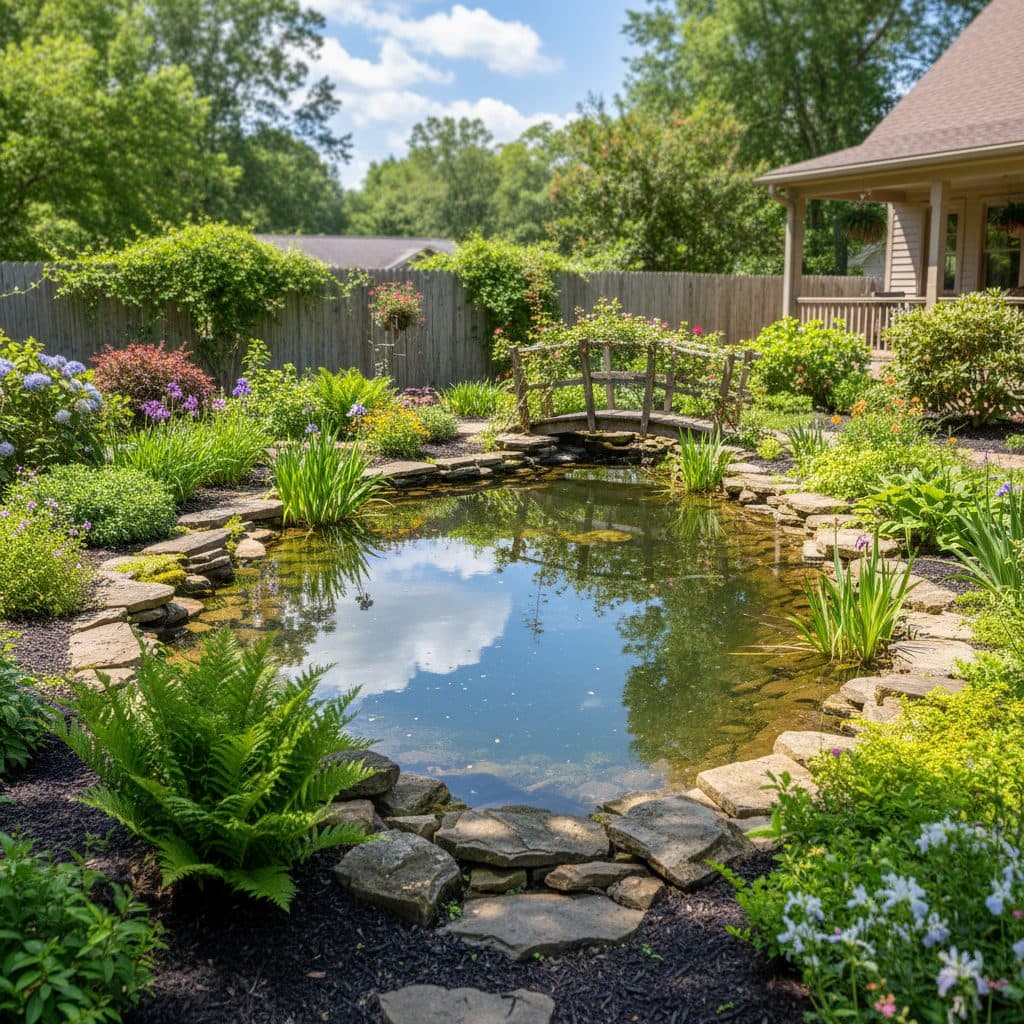
Key takeaways
- EPDM liners offer flexibility and durability, often lasting over 20 years, making them a reliable choice for various pond shapes and sizes up to 10,000 gallons.
- Preformed ponds provide quick installation and consistent shapes, typically ranging from 50 to 500 gallons, ideal for smaller, formal water features.
- Natural clay bottoms can be cost-effective for larger projects, requiring specific soil compositions with at least 20% clay content and proper compaction.
- Installation complexity varies significantly, from laying flexible EPDM sheets to compacting multiple layers of clay, impacting labor and time investments.
- Long-term maintenance and repair considerations differ, with EPDM patches being straightforward and clay requiring careful attention to prevent seepage.
- Cost per square foot can range from $0.50 for EPDM to potentially zero for suitable natural clay, depending on local material availability and labor.
Quick answer: For a pond bottom, common materials include flexible EPDM liners for durability and custom shapes, rigid preformed shells for quick installation in smaller features, and natural clay for cost-effectiveness in areas with suitable soil composition.
When planning a water feature or a small water harvesting pond in your backyard, say in a typical USDA zone 7 garden in the Mid-Atlantic, one of the first decisions you will face is what material to use for the pond bottom. This choice impacts everything from initial cost and installation effort to long-term durability and maintenance. For many growers, the goal is to create a reliable water source for irrigation, whether for wicking beds or an olla system, without constant refilling.
We’ll look at three primary options: flexible EPDM liners, rigid preformed pond shells, and natural clay bottoms. Each has distinct advantages and disadvantages that can influence your project’s success. Understanding these differences can save you significant time and money, especially when considering a pond larger than 100 gallons for your property.
EPDM pond liners: flexibility and longevity
EPDM (Ethylene Propylene Diene Monomer) liners are a popular choice for many growers due to their flexibility and impressive lifespan. These synthetic rubber sheets are highly resistant to UV radiation, ozone, and extreme temperatures, making them suitable for diverse climates from arid Arizona to humid Florida. A properly installed 45-mil EPDM liner can last 20 years or more, with some installations exceeding 30 years without significant degradation. This material has held up in demanding applications like geothermal tubulars since at least 1987 [1].
installation considerations for EPDM
Installing an EPDM liner involves careful excavation and preparation of the pond bed. The site needs to be free of sharp rocks or roots, often requiring a layer of sand or underlayment fabric to protect the liner from punctures. For a pond measuring 10 feet by 15 feet and 2 feet deep, you would need an EPDM sheet approximately 14 feet by 19 feet to account for overlap and edges. Once laid, the liner conforms to the contours of your excavation, allowing for custom shapes and sizes. Seams can be made with specialized tape, creating a watertight bond that holds hundreds or even thousands of gallons of water, such as a 1,500-gallon pond. You can then connect an irrigation hose directly to a pump in the pond.
- Durability: Resists UV and ozone damage for decades.
- Flexibility: Conforms to complex pond designs.
- Repairability: Punctures can be patched with specialized kits.
- Cost-effective: Often costs $0.50 to $1.00 per square foot for 45-mil thickness.
- Chemical resistance: Safe for aquatic plants and fish.
Preformed ponds: quick setup for smaller features
Preformed ponds are rigid, molded shells made from high-density polyethylene (HDPE) or fiberglass. They come in a variety of predetermined shapes and sizes, typically ranging from small 50-gallon tubs to larger 500-gallon units. These are particularly suitable for gardeners in urban or suburban settings, perhaps in USDA zone 8 in the Pacific Northwest, where space might be limited or a formal look is desired. Their primary advantage lies in their ease and speed of installation, often taking just a few hours to set up.
sizing and placement of preformed ponds
When selecting a preformed pond, consider its volume and dimensions. A 100-gallon preformed pond might measure 4 feet by 3 feet with a depth of 1.5 feet. The excavation needs to precisely match the pond’s contours, which can be a bit tricky. Once the hole is dug, the preformed shell is placed, and the gaps around it are backfilled with sand or soil, ensuring it’s level. While their rigidity means they cannot be customized in shape, they offer a consistent depth and are resistant to punctures from below. They are ideal for small water features, a home for Chinese Water Chestnuts, or as a reservoir for a small solar water pump system.
- Fast installation: Can be set up in a single afternoon.
- Consistent shape: Offers a predictable, often formal, aesthetic.
- Durable material: HDPE and fiberglass are robust and long-lasting.
- No folding or seaming: Eliminates potential leak points from seams.
- Limited size: Generally restricted to smaller pond volumes, typically under 500 gallons.
Natural clay bottoms: traditional and sustainable
For those seeking a more naturalistic approach, especially on larger properties or in rural settings, a natural clay pond bottom can be an excellent choice. This method relies on the inherent properties of clay soils to create an impermeable barrier, preventing water from seeping into the ground. In regions like the Mississippi Delta or parts of the Great Plains, where native soils often have a high clay content (20% to 30% or more), this can be a highly cost-effective solution. The key is proper compaction and ensuring the clay forms a continuous, dense layer. Vitrified clay liner plates, while used for pipes and channels, demonstrate the inherent sealing capabilities of processed clay [1, 2].
achieving a watertight clay pond
Creating a watertight clay pond requires specific soil conditions and careful construction. The soil must contain a minimum of 20% clay particles to achieve effective sealing. If your native soil lacks sufficient clay, you may need to import bentonite clay, which expands significantly when wet, sealing pores. The process involves laying down 6 to 12 inches of clay in multiple layers, each compacted to a density of at least 95% of its maximum dry density. A common compaction ratio is 30:1, meaning 30 pounds of pressure per square inch, to achieve the desired impermeability [6]. This method is labor-intensive but results in a pond that can hold thousands of gallons, blending seamlessly into the landscape. For large-scale water harvesting, such as a 5,000-gallon pond, this can be a sustainable long-term solution.
- Natural aesthetic: Blends perfectly with the surrounding landscape.
- Potentially low cost: If native soil is suitable, material costs are minimal.
- Self-healing: Small cracks can sometimes seal themselves with moisture.
- Labor-intensive: Requires significant effort for proper compaction.
- Soil dependency: Effectiveness relies heavily on existing soil composition.
Comparing costs, lifespan, and maintenance
When deciding between EPDM, preformed, and natural clay, the total cost of ownership—including initial outlay, expected lifespan, and ongoing maintenance—is a critical factor. For a 500-gallon pond, an EPDM liner might cost $150-$250 for the material itself, plus potentially $100-$300 for underlayment and adhesive, leading to a material cost of $250-$550. A preformed pond of the same volume could range from $300 to $600. A natural clay pond, if suitable clay is on site, might have zero material cost but could incur significant labor costs for excavation and compaction, potentially $500-$1,500 for professional work on a larger project.
long-term considerations for pond bottoms
Lifespan expectations vary greatly. EPDM liners are known to last 20-30 years or more, offering excellent long-term value. Preformed ponds typically last 15-25 years, though they can become brittle in extreme cold over time. Natural clay ponds, if properly constructed and maintained, can last indefinitely, essentially becoming a permanent part of the landscape. Maintenance for EPDM and preformed ponds usually involves cleaning and occasional repairs of punctures or cracks. Clay ponds require monitoring for erosion or animal burrows that could compromise the seal. For larger water harvesting systems, like those feeding rainwater harvesting tanks, the durability of the pond bottom is paramount to ensure consistent water supply.
- EPDM: Excellent lifespan (20+ years), moderate material cost, easy patch repairs.
- Preformed: Good lifespan (15-25 years), moderate material cost, simple cleaning.
- Natural Clay: Potentially indefinite lifespan, low material cost if clay is native, requires specialized compaction.
- Labor: EPDM and preformed are DIY-friendly; clay often requires professional earthmoving.
- Environmental impact: Natural clay uses local materials; EPDM is synthetic but durable.
Comparison of Pond Bottom Materials
Feature | EPDM Liner | Preformed Pond | Natural Clay |
|---|---|---|---|
Typical Lifespan | 20-30+ years | 15-25 years | Indefinite (with maintenance) |
Initial Material Cost (per sq ft) | $0.50 – $1.00 | $1.50 – $3.00 (for small units) | $0 (if native) – $0.20 (for bentonite) |
Installation Complexity | Moderate DIY | Easy DIY | High (requires specialized equipment/knowledge) |
Shape/Size Flexibility | High (customizable) | Low (fixed shapes) | High (customizable) |
Repair Ease | Easy (patch kits) | Moderate (sealants/fiberglass kits) | Difficult (re-compaction) |
Ideal Pond Size | Small to very large (up to 10,000+ gal) | Small (50-500 gal) | Medium to very large (1,000+ gal) |
EPDM Durability: EPDM liners have held up in demanding industrial applications since 1987, resisting environmental stress for decades [1].
Clay Content: For a natural clay pond to be effective, the soil needs a minimum of 20% clay content, and each layer must be compacted to 95% density [6].
Frequently asked questions
How thick should an EPDM liner be for a typical garden pond?
For most garden ponds up to 3 feet deep, a 45-mil (0.045 inch) EPDM liner is sufficient. For larger, deeper ponds or those with heavy foot traffic, a 60-mil liner offers increased puncture resistance and durability, potentially extending its lifespan beyond 30 years.
Can I use natural clay if my soil doesn’t have enough clay content?
If your native soil has less than 20% clay, you can amend it by mixing in bentonite clay, which swells significantly when wet to create a seal. Typically, 2 to 5 pounds of bentonite per square foot, mixed into the top 6 inches of soil, can be effective for sealing a pond.
What is the average cost difference between EPDM and a preformed pond?
For a 100-gallon pond, an EPDM liner might cost around $75-$125 for the material, while a preformed pond of the same volume could range from $150-$300. The preformed option often has a higher upfront material cost but simpler installation, potentially saving on labor.
How do I repair a leak in an EPDM pond liner?
Leaks in EPDM liners are typically repaired with specialized EPDM patch kits, which include a primer and a self-adhesive patch. For a small puncture, a patch roughly 6 inches by 6 inches can effectively seal the hole, restoring the pond’s integrity for many years.
Are preformed ponds suitable for fish and aquatic plants?
Yes, most preformed ponds are made from fish-safe HDPE or fiberglass, making them suitable for aquatic life and plants. Their smooth surfaces are easy to clean, and they often include shelves for placing potted aquatic plants like Water Hyssop (Bacopa monnieri) at various depths.
What maintenance does a natural clay pond require?
A natural clay pond requires monitoring for erosion, especially around the edges, and protecting against animal burrowing. Periodically, you may need to add a thin layer of clay and re-compact it in areas where seepage is observed, particularly if water levels drop by more than 1 inch per week.
References
- Elastomer liners for geothermal tubulars Y267 EPDM Liner Program: (1987). Elastomer liners for geothermal tubulars Y267 EPDM Liner Program:.
- Specification for Vitrified Clay Liner Plates (2023). Specification for Vitrified Clay Liner Plates.
- Specification for Vitrified Clay Liner Plates (2023). Specification for Vitrified Clay Liner Plates.
- Specification for Vitrified Clay Liner Plates (2023). Specification for Vitrified Clay Liner Plates.
- Specification for Vitrified Clay Liner Plates (2023). Specification for Vitrified Clay Liner Plates.
- Viewing Natural Clay Soils as Replacements for Synthetic Materials (2014). Viewing Natural Clay Soils as Replacements for Synthetic Materials.