Key takeaways
- Softwood or semi-hardwood cuttings are generally most effective for these four plants, taken during specific seasons.
- A sterile, well-draining rooting medium, such as a 1:1 mix of sand and peat, significantly improves rooting success.
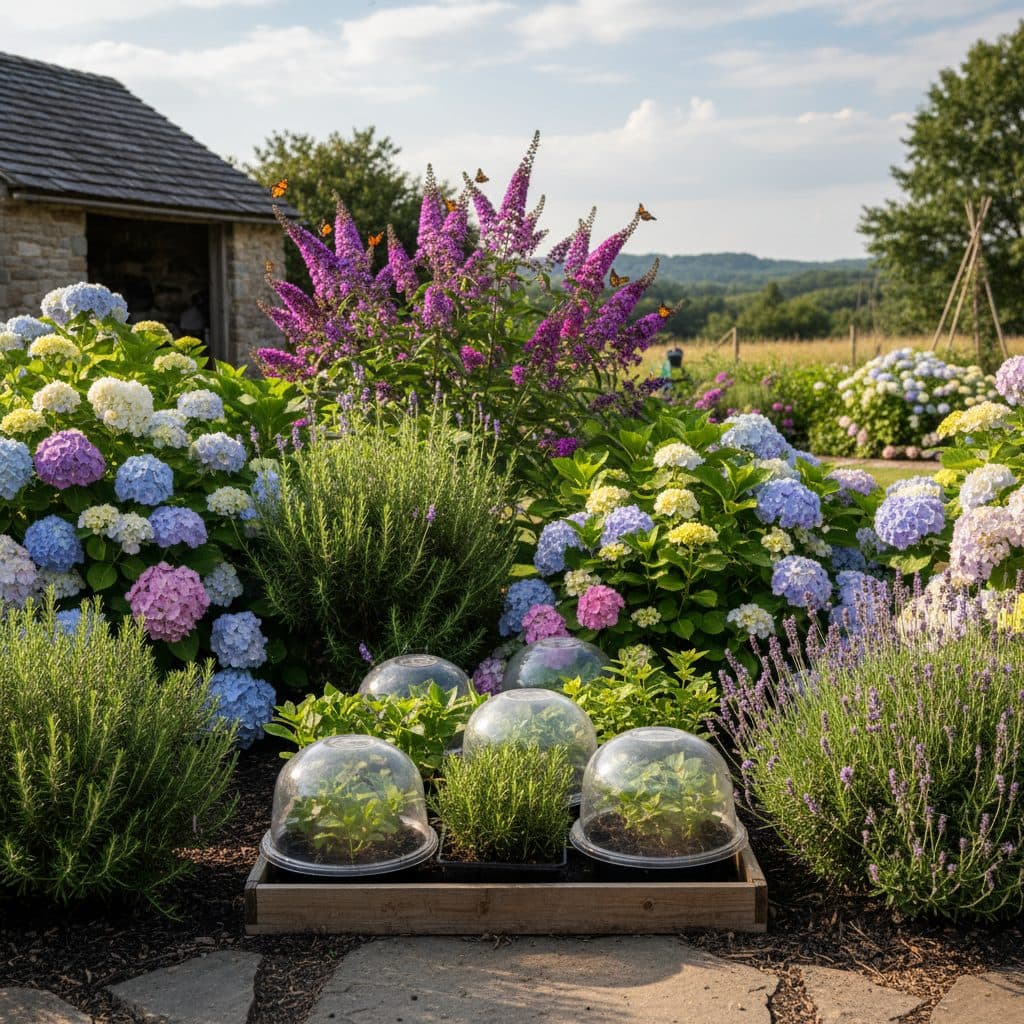
- Maintaining high humidity around cuttings, often with a propagation dome, prevents desiccation.
- Rooting hormones, particularly those containing IBA, can increase rooting percentages and speed for many species.
- Hydrangeas root reliably in sand and peat mixtures, while lavender benefits from specific growth regulators.
- Rosemary and butterfly bush are relatively straightforward to root, often achieving 70% or more success with basic techniques.
Quick answer: Achieve high success rates in plant propagation by using softwood or semi-hardwood cuttings, a sterile well-draining medium, and maintaining high humidity. Rooting hormones can improve success for plants like hydrangea, rosemary, and lavender.
For home growers across the United States, from USDA zone 5 to USDA zone 9, expanding your garden with shrubs and herbs through cuttings is a practical project. Propagating plants like hydrangea, rosemary, lavender, and butterfly bush allows you to multiply existing specimens, share with neighbors, or replace older plants without significant cost. One thing to check first: hydrangeas and butterfly bushes are among the most heavily patented shrubs in US retail, and a US plant patent restricts asexual propagation of that cultivar. If your plant came with a tag naming a trademarked series, look it up before you take cuttings. With careful attention to detail, success rates of 80% or even 90% are achievable for many species.
This guide will walk you through the practical steps for rooting these four popular plants, drawing on established horticultural practices and research. We will cover the best types of cuttings, ideal timing, suitable rooting mediums, and environmental conditions to ensure your efforts yield a robust collection of new plants for your garden beds and borders.
Understanding the basics of plant propagation from cuttings
Successful plant propagation begins with understanding the fundamental requirements for cuttings to form roots. Cuttings are essentially severed plant parts that, under the right conditions, can regenerate into a whole new plant. Important factors include the type of cutting, its physiological state, the rooting medium, and environmental controls like humidity and temperature. For many common landscape plants, including the four discussed here, softwood or semi-hardwood cuttings are the most effective, typically taken when the plant is actively growing in spring or early summer. A good rooting medium provides both support and moisture retention without becoming waterlogged, which can lead to rot.
Selecting the right cutting material and tools
The quality of your cutting material directly impacts your success rate. Always choose healthy, disease-free stems from vigorous parent plants. For most species, a cutting length of 4 to 6 inches is ideal to ensure it has several nodes where roots and new shoots can develop. Make clean cuts using sharp, sterilized pruners or a knife to minimize damage and prevent disease transmission. Removing the lower leaves helps reduce water loss and exposes nodes for rooting. Using a propagation tray with a dome, such as a 24-Cell Seedling Propagation Tray with Dome, can create the high-humidity environment many cuttings need to thrive.
- Select healthy, disease-free stems.
- Aim for cutting lengths of 4 to 6 inches.
- Use sharp, sterilized cutting tools.
- Remove lower leaves to expose nodes.
- Take cuttings in the morning for best hydration.
Propagating hydrangea from cuttings
Hydrangeas are a staple in many US gardens, prized for their large, showy blooms from USDA zone 3 to USDA zone 9. Propagating hydrangeas, particularly bigleaf hydrangeas (Hydrangea macrophylla), is quite straightforward using softwood cuttings. The best time to take these cuttings is in late spring or early summer, typically from May through July, when the plant is actively growing but before flower buds have fully developed. Cuttings taken during this period tend to root more readily, often achieving rooting percentages above 70%.
Preparing and planting hydrangea cuttings
To prepare a hydrangea cutting, select a stem that is about 4 to 6 inches long and has at least three to four sets of leaves. Make a cut just below a node to ensure the stem is still pliable but snaps when bent, indicating it’s not too soft. Remove the bottom two sets of leaves, and if the remaining leaves are very large, you can cut them in half horizontally to reduce water loss. Dip the cut end into a rooting hormone powder or gel – products containing 0.1% to 0.3% indole-3-butyric acid (IBA) are commonly recommended. Plant the cutting into a pre-moistened rooting medium. A 1:1 mixture of coarse sand and peat is a well-established medium for hydrangea cuttings, giving the drainage and the moisture retention they need [4]. Other effective mediums include sand and perlite mixes, which also provide excellent drainage and aeration. Maintain consistent moisture and humidity for approximately three to four weeks until roots begin to form.
- Take 4 to 6 inch softwood cuttings in late spring or early summer.
- Cut below a node; remove lower leaves.
- Dip in rooting hormone (e.g., 0.2% IBA).
- Plant in a 1:1 sand and peat mix for optimal results [4].
- Keep humid and moist for three to four weeks.
Rooting rosemary and lavender for fragrant gardens
Rosemary (Salvia rosmarinus) and lavender (Lavandula angustifolia) are highly valued for their aromatic foliage and beautiful flowers, thriving in many US climates, particularly in USDA zones 7-10 for rosemary and 5-9 for lavender. Both can be successfully propagated from cuttings, though the ideal cutting type and timing differ slightly. Rosemary often roots best from semi-hardwood cuttings taken in late summer or early fall, after the flush of new growth has slightly matured. Lavender, on the other hand, can be rooted from softwood cuttings in spring or semi-hardwood cuttings in early summer, with success rates often exceeding 75% with proper technique.
Optimizing conditions for rosemary and lavender cuttings
For rosemary, select 4 to 6 inch semi-hardwood stems that are firm but still slightly flexible. Strip the leaves from the bottom 2 inches of the cutting, leaving several sets of leaves at the top. Dipping the cut end in a rooting hormone containing 0.1% IBA can improve root development. Plant these cuttings in a well-draining medium, such as a 50:50 mix of perlite and peat moss, which prevents waterlogging. Rosemary and lavender rot at the base more readily than most cuttings, so lean toward the coarse end of that mix and let the surface dry slightly between waterings rather than keeping it saturated. Lavender cuttings, typically 3 to 4 inches long, also benefit from rooting hormone and a similar well-drained substrate. Research indicates that specific growth regulating agents can significantly improve rooting parameters for lavender, with some studies showing increased root numbers and lengths with optimal hormone concentrations [3]. Maintaining a soil temperature around 70°F and high humidity is beneficial for both herbs. Rooting typically occurs within four to six weeks.
- Take 4 to 6 inch semi-hardwood rosemary cuttings in late summer.
- Use 3 to 4 inch softwood or semi-hardwood lavender cuttings in spring/early summer.
- Apply rooting hormone to cut ends.
- Plant in a well-draining mix like perlite and peat moss.
- Maintain 70°F soil temperature and high humidity.
Propagating butterfly bush for garden beds
Butterfly bush (Buddleja davidii) is a fast-growing shrub whose flowers draw adult butterflies, and it grows across a wide range of climates from USDA zone 5 to USDA zone 9. Before you propagate it, check where you live: B. davidii seeds prolifically and has escaped into riparian and disturbed land across much of the US, and several states (Oregon and Washington among them) regulate it as a noxious weed, restricting sale and planting of the seeding forms. Sterile or low-fertility cultivars are the approved alternative in those states. It is also worth knowing that butterfly bush feeds adult butterflies but hosts no native caterpillars, so it is not a substitute for larval host plants. Its ease of propagation makes it a popular choice for gardeners looking to expand their plant collection. Softwood cuttings taken in late spring or early summer, typically from May through July, offer the highest success rates, often reaching 80% or more without much difficulty. These cuttings root quickly, sometimes in as little as three weeks, making butterfly bush one of the more forgiving plants to propagate.
Simple steps for butterfly bush cuttings
To root butterfly bush, select healthy, non-flowering stems that are about 6 inches long. Make a clean cut just below a leaf node. Remove all but the top two or three leaves, and if these are large, cut them in half to reduce transpiration. While rooting hormone is not strictly necessary for butterfly bush, applying a powder with 0.1% IBA can accelerate rooting and improve uniformity. Plant the cuttings in a moist, well-draining medium such as perlite, coarse sand, or a mix of peat and perlite. Maintain high humidity around the cuttings using a clear plastic dome or bag. Keep the medium consistently moist but not waterlogged. New leaf growth is a good indicator of successful rooting, usually appearing within three to four weeks. Once rooted, gradually acclimate the young plants to outdoor conditions over a period of one to two weeks before planting them in the garden.
- Take 6 inch softwood cuttings in late spring or early summer.
- Remove lower leaves; trim large upper leaves.
- Optional: dip in rooting hormone for faster results.
- Plant in a well-draining medium like perlite or sand.
- Maintain high humidity and consistent moisture.
Choosing the right rooting medium and environmental controls
The rooting medium provides the necessary support, moisture, and aeration for cuttings to develop roots. A good medium must be sterile to prevent disease, drain well to avoid rot, and retain enough moisture to keep cuttings hydrated. Common components include coarse sand, perlite, vermiculite, and peat moss. For example, a 1:1 mixture of coarse sand and peat is highly effective for hydrangea cuttings [4]. For rosemary and lavender, a mix with more perlite or sand, like a 50:50 blend with peat, ensures the sharp drainage these plants prefer.
Maintaining ideal humidity and temperature
High humidity is a primary environmental factor for successful rooting. Cuttings lack roots to absorb water, so they rely on high ambient humidity to prevent desiccation. This can be achieved by using a propagation dome, a clear plastic bag over the pot, or a dedicated misting system. Aim for relative humidity levels between 70% and 90%. Consistent moisture in the rooting medium is also necessary; a 3-in-1 Soil pH, Moisture & Light Meter can help monitor this. Ideal temperatures for rooting typically range from 65°F to 75°F. Bottom heat, provided by a heating mat, can significantly speed up root development, especially for more challenging species, by keeping the rooting zone warmer than the ambient air. Ensure cuttings receive bright, indirect light, as direct sun can scorch tender foliage and increase water loss.
- Use sterile, well-draining mediums like sand, perlite, or peat mixes.
- Maintain 70% to 90% relative humidity with domes or bags.
- Keep rooting medium consistently moist, not waterlogged.
- Aim for rooting temperatures between 65°F and 75°F.
- Provide bright, indirect light to prevent scorching.
Comparison of rooting requirements for four popular garden plants
Plant | Cutting Type | Best Timing | Rooting Hormone Benefit | Typical Rooting Time (weeks) |
|---|---|---|---|---|
Hydrangea | Softwood | Late spring to early summer | Significant improvement | 3-4 |
Rosemary | Semi-hardwood | Late summer to early fall | Moderate improvement | 4-6 |
Lavender | Softwood/Semi-hardwood | Spring to early summer | Significant improvement | 4-6 |
Butterfly Bush | Softwood | Late spring to early summer | Moderate, speeds up process | 3-4 |
Hydrangea rooting medium: A 1:1 mixture of coarse sand and peat is one of the most reliable substrates for hydrangea cuttings.
Lavender root enhancement: Specific growth regulating agents can significantly improve lavender rooting parameters, increasing root numbers and lengths [3].
Butterfly bush hardiness: Butterfly bush grows across USDA zones 5 to 9, which is also why its escapes are so widespread. Check your state noxious weed list before planting seeding forms [5],.
Frequently asked questions
What is the best time of year to take cuttings for these plants?
For hydrangea and butterfly bush, late spring to early summer (May-July) is ideal for softwood cuttings. Rosemary roots best from semi-hardwood cuttings in late summer or early fall. Lavender can be rooted from softwood in spring or semi-hardwood in early summer, often showing good results within four to six weeks.
Do I always need rooting hormone for these cuttings?
While not always strictly necessary, especially for easy rooters like butterfly bush, rooting hormone significantly increases rooting percentages and speeds up the process for hydrangea, rosemary, and lavender. Products with 0.1% to 0.3% IBA are commonly recommended for optimal results.
What kind of soil or medium should I use for rooting?
A sterile, well-draining medium is essential. A 1:1 mix of coarse sand and peat moss is highly effective for hydrangeas [4]. For rosemary and lavender, a mix with more perlite or sand, such as a 50:50 perlite and peat blend, ensures excellent drainage and aeration, which these plants prefer for root development.
How do I maintain high humidity for my cuttings?
High humidity, ideally between 70% and 90%, prevents cuttings from drying out. This can be achieved by placing a clear plastic dome over your propagation tray, using a clear plastic bag tented over the pot, or employing an intermittent misting system. Consistent humidity is necessary for the first three to six weeks.
When can I transplant my rooted cuttings into the garden?
Once your cuttings have developed a robust root system, typically 1 to 2 inches long, they are ready for transplanting. This usually takes four to eight weeks, depending on the plant and conditions. Gradually acclimate the young plants to outdoor conditions over one to two weeks before planting them directly into your garden beds.
Can I root these plants in just water?
While some plants can root in water, it’s generally not recommended for these species as water roots are often weaker and less adaptable to soil. Rooting in a sterile, solid medium provides a better transition to garden soil and typically results in stronger, healthier plants with higher survival rates, often exceeding 70%.
References
- Hydrangea Bush (2021). Hydrangea Bush.
- The formation of 7-oxygenated coumarins in hydrangea and lavender (1965). The formation of 7-oxygenated coumarins in hydrangea and lavender.
- Effects of Rooting Mediums and Growth Regulating Agents on Rooting Parameters of Lavender and Lavandin Cuttings (Lavandula sp.) (2024). Effects of Rooting Mediums and Growth Regulating Agents on Rooting Parameters of Lavender and Lavandin Cuttings (Lavandula sp.).
- Rooting of hydrangea varieties by green cuttings on different substrate options (2023). Rooting of hydrangea varieties by green cuttings on different substrate options.
- BUDDLEIA (Butterfly-Bush) (2023). BUDDLEIA (Butterfly-Bush).