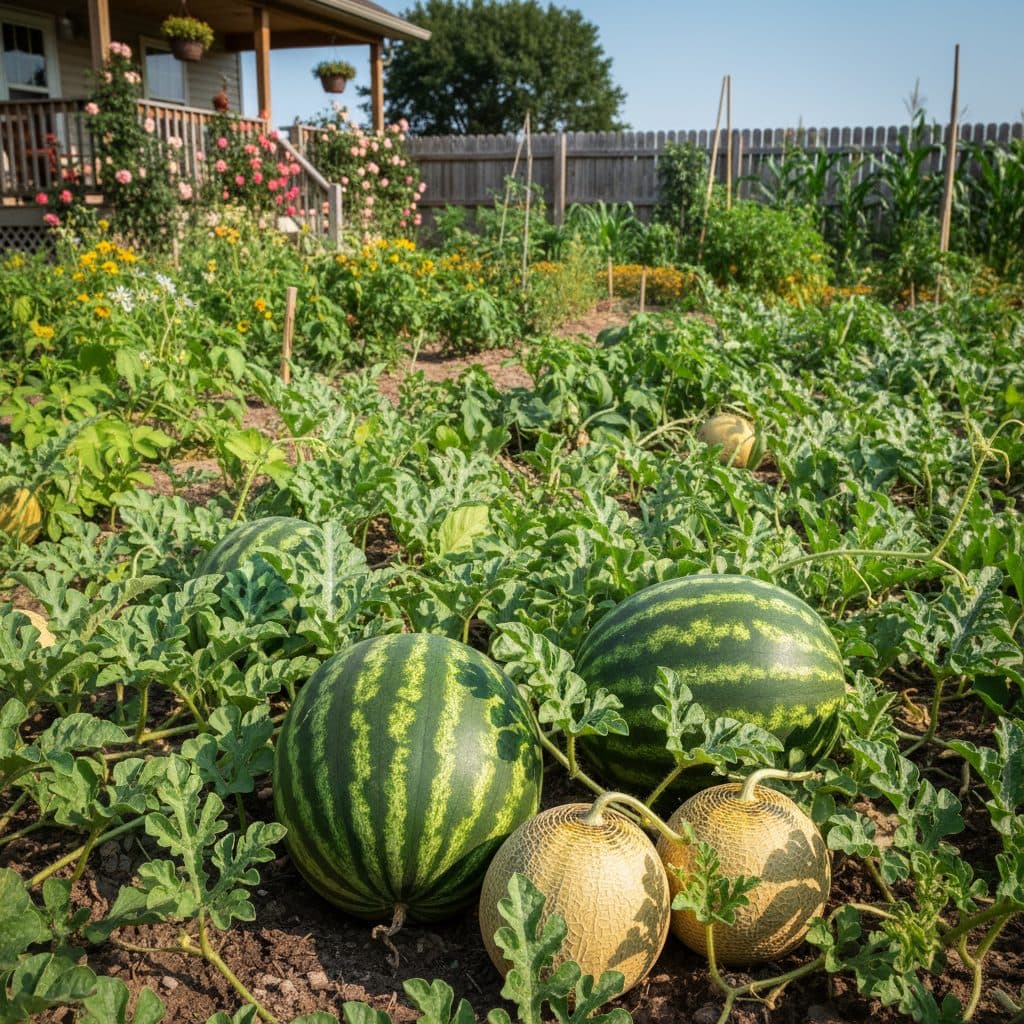
Key takeaways
- Manage water carefully, especially reducing irrigation in the final 7-14 days before harvest to concentrate sugars.
- Ensure adequate potassium and phosphorus in the soil, maintaining a pH between 6.0 and 6.8 for optimal nutrient uptake.
- Protect foliage from pests and diseases to allow continuous photosynthesis, which is vital for sugar production.
- Learn specific ripeness cues for each fruit type, such as rind color, tendril drying, and ground spot color, to harvest at peak sweetness.
- Provide consistent, deep watering during fruit development, aiming for 1-2 inches of water per week.
- Good pollination, often from honey bees, is essential for proper fruit set and development, impacting overall yield and quality.
Quick answer: To grow sweeter watermelon and cantaloupe, manage water carefully by reducing irrigation before harvest, ensure adequate nutrients and sunlight, protect foliage from pests, and harvest at peak ripeness using specific cues.
In the warm, sunny fields of Georgia, where watermelon is a major crop, or the irrigated cantaloupe farms of Colorado, growers know that a truly sweet fruit comes from careful management, not luck. Achieving that peak sugar content in your watermelon and cantaloupe, often measured in Brix, requires understanding a few core principles. We’re talking about Brix levels that can climb from a standard 8% to a delightful 12% or even 15% in well-managed plants.
It comes down to science and observation. From the moment the seeds germinate in late spring, perhaps in a USDA zone 7 garden, every decision about water, nutrients, and plant health impacts the final flavor. We’ll walk through the practical steps to ensure your cucurbits develop the maximum sweetness they’re capable of.
The science of sweetness: how sugars develop in cucurbits
The sweetness in your watermelon and cantaloupe comes primarily from sugars like sucrose, fructose, and glucose, which are produced through photosynthesis in the plant’s leaves. For instance, a healthy watermelon leaf can convert sunlight into sugars at an impressive rate, sending these carbohydrates to the developing fruit. This process is most efficient when plants have ample sunlight, healthy foliage, and consistent temperatures, ideally between 70°F and 90°F during the day.
photosynthesis and sugar accumulation
To maximize sugar accumulation, you need strong, disease-free leaves. Any damage from pests or diseases, like the Monosporascus cannonballus fungus found in California’s cantaloupe and watermelon fields since at least 1995 [\0], directly reduces the plant’s ability to produce sugars. Consider using a reflective indoor grow tent for starting seedlings, which can help ensure strong initial growth and protect against early season issues. Adequate sunlight exposure is paramount, with most cucurbits needing at least six to eight hours of direct sun daily. Without sufficient light, even the best soil and water management won’t yield truly sweet fruit, often resulting in Brix levels below 8%.
- Healthy foliage: Essential for converting sunlight into sugars.
- Optimal temperatures: 70°F to 90°F for efficient photosynthesis.
- Consistent sunlight: At least six to eight hours daily.
- Pest and disease control: Protects leaves from damage.
- Nutrient availability: Supports overall plant vigor.
Water management: the critical balance for brix levels
Water is a double-edged sword for cucurbits. While essential for growth and nutrient transport, too much or too little at the wrong time can significantly impact sweetness. In arid regions like Colorado, successful cantaloupe cultivation has relied on careful irrigation since at least 1910 [\3]. During the initial growth phase and fruit set, consistent moisture is essential. Plants need about one to two inches of water per week, either from rainfall or irrigation, to support vigorous vine growth and fruit development.
reducing water for concentrated sweetness
The most critical period for water management, however, is during the final two weeks before harvest. Reducing irrigation during this time forces the plant to concentrate the sugars already present in the fruit, rather than diluting them with excess water. For a watermelon, this can mean the difference between a Brix reading of 9% and a truly exceptional 12%. If you’re growing in a raised bed or container, this water reduction is easier to control. Just be sure not to let the plant completely wilt, as extreme stress can also negatively affect flavor. This technique is especially important for varieties that mature in 70 to 90 days, like many popular cantaloupes.
- Consistent watering: One to two inches per week during growth.
- Deep watering: Encourages deep root development.
- Reduce irrigation: In the final 7-14 days before harvest.
- Avoid wilting: Don’t stress the plant excessively.
- Monitor soil moisture: Use a moisture meter to guide watering.
Reading the ripeness cues: when to harvest for peak flavor
Harvesting at the right time is perhaps the most critical factor for sweetness. Unlike some fruits that continue to ripen off the vine, watermelon and cantaloupe accumulate most of their sugars while still attached to the plant. A watermelon harvested too early might only register 7% Brix, while one picked at its prime could easily hit 11% or more. This means knowing the specific cues for each fruit matters most.
specific ripeness indicators for each fruit
For watermelon, look for a few reliable signs. First, the ground spot (the area where the melon rests on the soil) should turn from white or light green to a creamy yellow or even orange-yellow. Second, the tendril closest to the fruit stem will often dry and turn brown. A third sign is a dulling of the rind’s sheen; a ripe watermelon loses its glossy appearance. For cantaloupe, the stem slip is the primary indicator. When ripe, the fruit will easily detach from the vine with a gentle pull, leaving a smooth, clean scar. The netting on the rind will also become more pronounced, and the fruit will emit a sweet, musky aroma. Many cantaloupe varieties mature in 70 to 90 days, so keep track of your planting dates.
- Watermelon ground spot: Changes from white to creamy yellow.
- Watermelon tendril: Dries and turns brown near the fruit.
- Watermelon rind sheen: Becomes dull, loses gloss.
- Cantaloupe stem slip: Fruit detaches easily from the vine.
- Cantaloupe aroma: Develops a sweet, musky smell.
Soil nutrition and plant health: building a strong foundation for sweet fruit
The foundation for sweet fruit starts with healthy soil. Cucurbits are heavy feeders, and they need a balanced supply of nutrients to support vigorous growth and sugar production. A soil test is always the best starting point, but generally, a soil pH between 6.0 and 6.8 is ideal for nutrient availability, as recommended by the USDA Natural Resources Conservation Service [\5]. Insufficient nutrients, particularly potassium and phosphorus, can lead to smaller fruit and lower Brix levels, sometimes dropping below 8%.
key nutrients for sugar development
Potassium plays a central role in sugar transport within the plant and is often called the ‘quality nutrient’ for fruits. Phosphorus is vital for energy transfer and root development. Incorporating organic matter, such as compost or well-rotted manure, improves soil structure, water retention, and nutrient availability. For an added boost, consider amending your soil with a slow-release organic fertilizer like fermented soybean meal, which provides a steady supply of nitrogen and other micronutrients over several weeks. A healthy plant, free from stress and disease, can put all its energy into producing sweet, flavorful fruit, often increasing yields by 15% to 20% compared to neglected plants.
- Soil pH: Maintain between 6.0 and 6.8.
- Potassium: Essential for sugar transport and fruit quality.
- Phosphorus: Important for energy and root development.
- Organic matter: Improves soil structure and nutrient holding.
- Balanced fertilization: Supports overall plant vigor and fruit set.
Key Differences: Watermelon vs. Cantaloupe
Feature | Watermelon | Cantaloupe |
|---|---|---|
Typical Brix Range | 8-12% | 9-14% |
Maturity (Days from Planting) | 80-95 days | 70-90 days |
Primary Ripeness Cue | Ground spot color, tendril drying | Stem slip, musky aroma |
Pollination Requirement | High (bees per acre [3]) | High (bees per acre [3]) |
Brix Levels: Achieving Brix levels of 12% or higher in watermelon and cantaloupe is a sign of excellent growing conditions and proper harvest timing.
Water Reduction: Reducing irrigation by 30% to 50% in the final two weeks before harvest can significantly increase fruit sugar concentration.
Soil pH: Maintaining soil pH between 6.0 and 6.8 ensures optimal nutrient uptake for cucurbit plants, as supported by USDA guidelines.
Frequently asked questions
How much water do watermelon and cantaloupe need per week?
Watermelon and cantaloupe plants generally require one to two inches of water per week, especially during their active growth and fruit development stages. This ensures the vines stay hydrated and the fruit can expand properly, often reaching full size in 80 to 95 days.
Can I make my melons sweeter after harvesting?
No, watermelon and cantaloupe do not significantly increase their sugar content after being harvested. They accumulate sugars while still attached to the vine, so harvesting at the peak of ripeness, indicated by cues like a yellow ground spot or stem slip, is essential for maximum sweetness.
What soil pH is best for sweet melons?
For optimal sweetness and plant health, watermelon and cantaloupe thrive in soil with a pH range of 6.0 to 6.8. This slightly acidic to neutral range ensures that essential nutrients like potassium and phosphorus are readily available to the plant, supporting sugar production.
How do I know when a cantaloupe is ripe?
A ripe cantaloupe will typically ‘slip’ easily from the vine with a gentle pull, leaving a clean scar. It will also develop a strong, sweet, musky aroma and its netting will become more pronounced. Most varieties reach this stage around 70 to 90 days after planting.
What role do bees play in melon sweetness?
Bees, particularly honey bees, are vital for pollinating watermelon and cantaloupe flowers, which is necessary for fruit set. Adequate pollination, often requiring one colony per acre, leads to well-formed, larger fruits that have the potential to accumulate more sugars and reach their full genetic sweetness potential [3].
References
- Occurrence of Acremonium sp. and Monosporascus cannonballus in the Major Cantaloupe and Watermelon Growing Areas of California. (1995). Occurrence of Acremonium sp. and Monosporascus cannonballus in the Major Cantaloupe and Watermelon Growing Areas of California..
- Watermelon and cantaloupe seed / (1919). Watermelon and cantaloupe seed /.
- Honey Bee Pollination of Cantaloupe, Cucumber, & Watermelon (1997). Honey Bee Pollination of Cantaloupe, Cucumber, & Watermelon.
- Cantaloupe culture : a treatise on cantaloupe growing under irrigation in Colorado / by Philo K. Blinn. (1910). Cantaloupe culture : a treatise on cantaloupe growing under irrigation in Colorado / by Philo K. Blinn..