Key takeaways
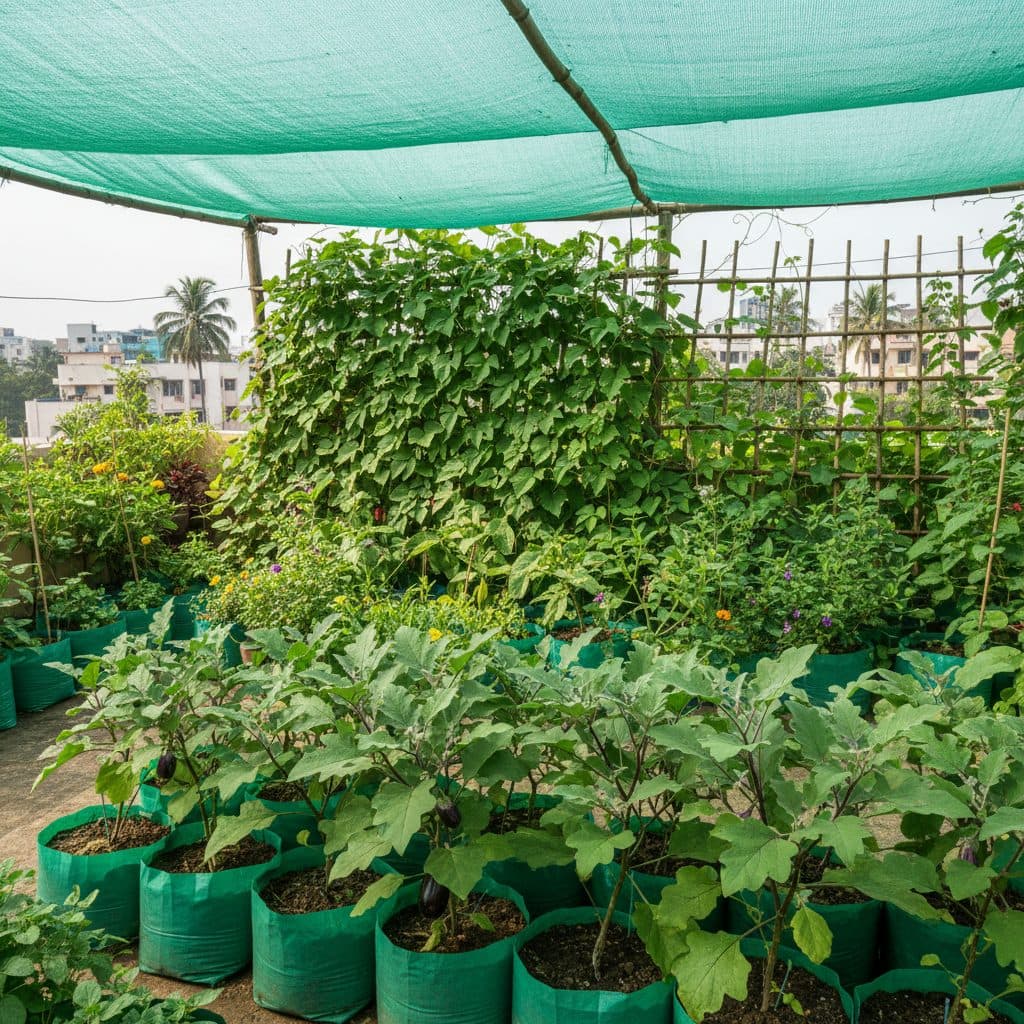
- Install 50% UV-stabilised green shade netting from March to June to shield rooftop plants from extreme Kathiri Veyyil heat.
- Grow heat-loving tropical vegetables including brinjal, bhindi, cluster beans, and trellised traditional gourds.
- Anchor shade net structures and tall trellises securely to withstand cyclonic wind gusts during the Northeast Monsoon.
- Use lightweight cocopeat-based potting mixes in UV-treated HDPE grow bags elevated on drain tiles or PVC stands.
- Inquire with the Tamil Nadu Department of Horticulture or local district offices regarding government rooftop kit schemes.
Quick answer: Setting up a terrace garden in Chennai requires adapting to intense tropical heat, high humidity, and heavy cyclonic rains during the Northeast Monsoon. Gardeners succeed by using 50% shade nets in peak summer, planting resilient local crops like traditional gourds, brinjal, and keerai, and elevating grow bags on drain cells to protect the rooftop slab.
Rooftop gardening in Chennai offers an incredible opportunity to harvest crisp organic greens and fresh vegetables right from your home. However, Chennai's coastal tropical climate presents distinct microclimatic extremes that challenge conventional gardening approaches. From the scorching 40°C heat of Agni Nakshatram (Kathiri Veyyil) in May to the relentless deluges and cyclonic winds of the Northeast Monsoon in November, rooftop plants must withstand dramatic weather shifts.
Developing a thriving terrace garden chennai residents can maintain year-round requires designing for heat dissipation, wind resistance, and rapid water runoff. Concrete slabs in Chennai absorb enormous solar thermal energy during daytime hours, turning unshaded pots into miniature ovens that can cook tender root systems.
By choosing climate-hardy native crops, formulating well-draining lightweight potting media, and deploying seasonal shade protection, you can turn a bare concrete terrace into a productive, cooling urban oasis.
Understanding the Chennai rooftop climate
Unlike northern and inland Indian cities that experience distinct cool winters, Chennai experiences hot, humid weather for most of the year, punctuated by three primary seasons:
+-------------------------------------------------------------------------------+
|                       CHENNAI SEASONAL GARDENING CALENDAR                     |
|                                                                               |
|   Peak Summer (March to June):     Intense UV, 33°C (Mar) to 38°C-42°C (May)  |
|   Southwest Monsoon (July to Sept):Moderate rains, warm, good sowing window   |
|   Northeast Monsoon (Oct to Dec):  Heavy rains, cyclonic gales; drainage vital|
|   Mild Season (January to Feb):    Optimal growing weather, full sun for crops|
+-------------------------------------------------------------------------------+
High ambient humidity along the Coromandel Coast means fungal leaf spots and sap-sucking pests flourish quickly if container spacing is crowded. Siting containers to take advantage of cross-breezes while providing structural protection against coastal gales is fundamental to your setup.
Essential infrastructure: grow bags, stands and shade nets
Setting up terrace gardening in chennai requires durable, UV-resistant materials designed to survive coastal heat and salt air.
+-------------------+---------------------------+-------------------------------------------------------+
| Component         | Recommended Specification | Why It Matters on Chennai Rooftops                    |
+-------------------+---------------------------+-------------------------------------------------------+
| Containers        | 200-240 GSM Green HDPE    | UV-treated; resists degradation; light root weight    |
| Pot Elevation     | PVC stands or drain cells | Prevents hot slab contact; permits free water runoff  |
| Shade Netting     | 50% Agro Green Shade Net  | Cuts scorching UV while still admitting enough light  |
| Trellising        | GI pipes or treated coir  | Withstands Northeast Monsoon wind shear without snap  |
| Potting Blend     | 40% Coir, 40% Compost,    | Retains moisture without slab waterlogging            |
|                   | 20% Red Soil              |                                                       |
+-------------------+---------------------------+-------------------------------------------------------+
1. Elevating containers off the concrete slab
Never place grow bags or pots directly onto bare concrete. Direct contact transfers scorching heat from the roof slab into the root zone during summer. Furthermore, standing water trapped beneath pots encourages fungal dampness and damages terrace waterproofing over time.
Place grow bags on interlocking plastic drain cells, recycled terracotta tiles, or galvanised iron pot stands. Elevating containers by just 5 cm allows air to circulate underneath, cooling the root system and allowing excess monsoon rain to flow unimpeded toward roof drain outlets. For detailed structural loading and waterproofing advice, consult our reference on terrace garden waterproofing.
2. Summer shade netting setup
From May until late June, unshaded rooftop temperatures frequently climb past 40°C, with March and April already hot enough to cook an unshaded root zone. Erect a 50% green agro shade net positioned 2.5 metres above the terrace floor. This height ensures ample air circulation while cutting solar radiation and reducing leaf transpiration stress.
To explore how shade cloth transforms heat tolerance in perennial container plants, read our article on shade netting desert fruit trees.
Best plants for Chennai heat and coastal conditions
Selecting crops naturally adapted to hot, humid tropical conditions ensures high productivity with minimal pest vulnerability:
+-------------------+---------------------------+-------------------+-------------------------------------------+
| Vegetable Group   | Tamil / Common Name       | Botanical Name    | Growing Season & Notes                    |
+-------------------+---------------------------+-------------------+-------------------------------------------+
| Traditional Gourd | Snake Gourd (Pudalangai)  | Trichosanthes cuc.| July–Jan; vigorous climber on roof trellis|
| Traditional Gourd | Ribbed Gourd (Peerkangai) | Luffa acutangula  | Year-round; exceptional heat tolerance    |
| Solanaceous Veg   | Brinjal (Kathirikai)      | Solanum melongena | Year-round; thrives in 30 cm grow bags    |
| Warm Pods         | Ladies Finger (Vendaikkai)| Abelmoschus escul.| Year-round; rapid 55-day harvest cycle    |
| Local Greens      | Sirukeerai / Arakeerai    | Amaranthus spp.   | 25-day turnaround; harvested repeatedly   |
| Perennial Edibles | Curry Leaf (Karuveppilai) | Murraya koenigii  | Permanent 40 cm pot; loves full sun & heat|
| Perennial Edibles | Drumstick (Murungai)      | Moringa oleifera  | Dwarf annual moringa; heavy pod producer  |
+-------------------+---------------------------+-------------------+-------------------------------------------+
Traditional South Indian climbing gourds, such as bottle gourd (Sorakkayai), bitter gourd (Pavakkai), and ridge gourd (Peerkangai), thrive on rooftop trellises in Chennai. Their expansive leaf canopies provide cooling shade to lower grow bags while producing heavy harvests of nutrient-dense vegetables throughout the post-monsoon months.
For maintaining healthy nightshades and managing seasonal thrips and virus vectors on your terrace, refer to our diagnostic guide on leaf curl disease in chilli.
Potting soil formulation and watering strategies
Because Chennai's sun evaporates moisture rapidly, your growing medium must hold water without becoming soggy.
Formulate your grow bags using the standard how to make potting mix at home india framework:
- 40% Washed Cocopeat (retains essential moisture and keeps pots lightweight)
- 40% Well-Rotted Vermicompost or Cow Manure (supplies rich biological nutrients)
- 20% Red Soil or Coarse Sand (provides physical anchorage and minerals)
- 2 handfuls Neem Cake Powder per bag (helps suppress root-knot nematodes and adds slow-release nitrogen)
Watering rhythms
- Summer (March–June): Water twice daily, early morning before 7:30 AM and late evening after 5:30 PM. Avoid watering in the midday heat: most of it evaporates off a hot slab before it reaches the roots. Water early morning and again in the evening instead.
- Monsoon (October–December): Water only when the top 3 cm of mix feels completely dry. Clear all drain holes regularly to prevent waterlogging.
Government schemes: Tamil Nadu horticulture kits
The Tamil Nadu Department of Horticulture periodically promotes urban rooftop agriculture through subsidised "Do-It-Yourself" (DIY) rooftop vegetable garden kit schemes across Chennai and surrounding districts.
These government schemes typically provide:
- Pre-packed UV-stabilised HDPE grow bags
- Compressed cocopeat blocks
- Assorted vegetable seed packets (traditional greens, brinjal, bhindi, gourds)
- Bio-fertilisers (Azospirillum, Phosphobacteria) and biocontrol agents (Trichoderma, Pseudomonas)
- Water-soluble micro-nutrient formulations
Scheme components, availability windows, and application guidelines change periodically across administrative zones. To apply or verify current program terms, visit your local district horticulture office (such as the Semmozhi Poonga horticulture centre or Madhavaram facility) or check the official web portal of the Tamil Nadu Department of Horticulture.