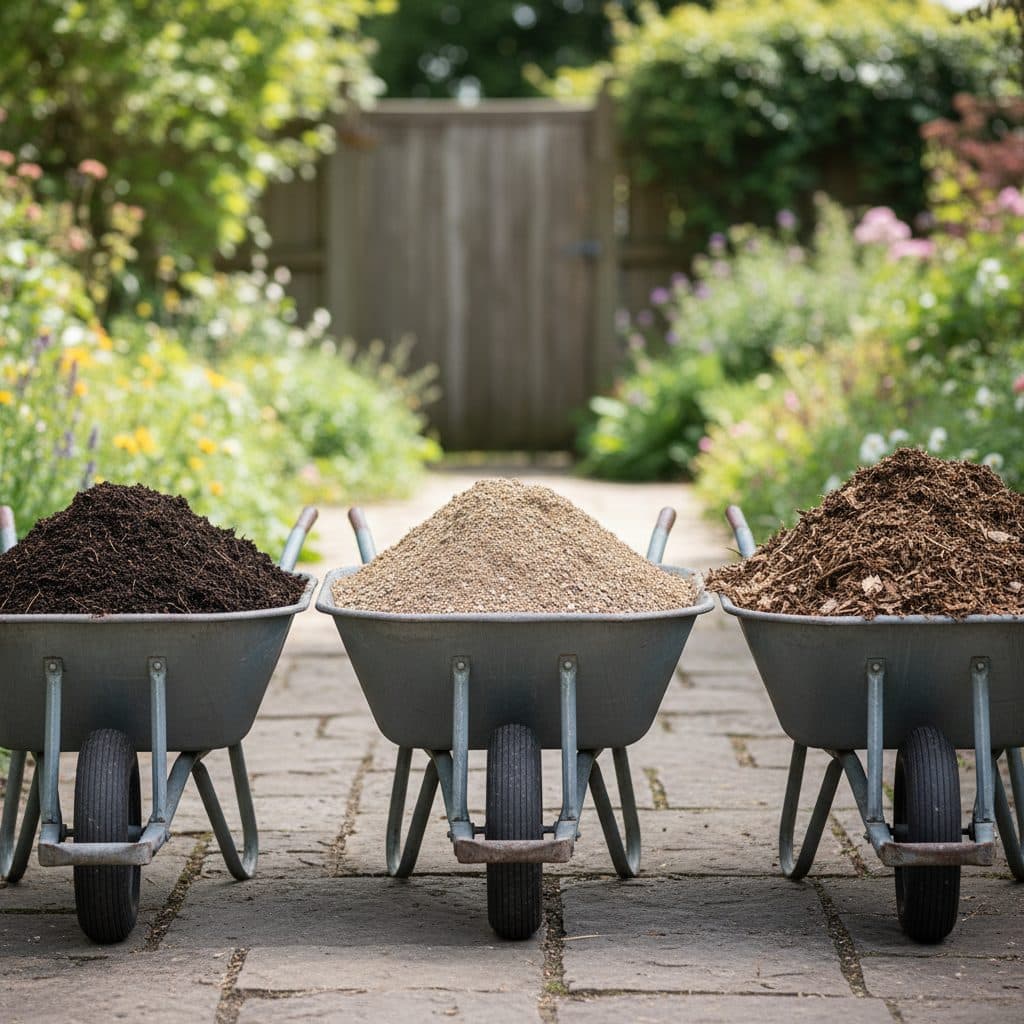
Key takeaways
- Topsoil is naturally occurring, screened mineral soil (sand, silt, and clay) from the upper earth layer, ideal for grading lawns, filling low spots, and providing raw soil mass.
- Garden soil is an enriched blend of topsoil and organic amendments (compost, aged bark fines, peat moss, or manure) formulated specifically for in-ground planting beds.
- Never use plain topsoil alone in raised beds or containers; its dense mineral composition compacts rapidly, suffocating roots and impeding drainage.
- The ideal soil formula for raised beds is a 50/30/10/10 blend: 50% screened native topsoil, 30% finished compost, 10% peat moss or coco coir, and 10% perlite or coarse sand.
- Pure compost is a biological soil amendment rather than a complete growing medium; use it at 10 to 25 percent volume to enrich existing soil.
- Buying soil in bulk by the cubic yard saves 50 to 70 percent on material costs compared to individual bags when filling large raised beds or garden projects exceeding 1 cubic metre (1.3 cubic yards).
Quick answer: The difference between topsoil and garden soil comes down to composition and intended use. Topsoil is basic screened mineral dirt used for bulk grading and filling large holes, while garden soil is a pre-mixed blend of topsoil and organic compost engineered to improve moisture retention and nourish in-ground vegetable and flower beds.
Walking down the garden supply aisle or calling a local landscape depot can be confusing. Bags and bulk piles are labeled as topsoil, garden soil, raised bed mix, potting soil, planting mix, and compost. Choosing the wrong type can result in compacted, rock-hard garden beds that suffocate root systems or lightweight mixes that dry out within hours.
Understanding the differences in topsoil vs garden soil helps you match the correct soil product to your specific gardening project. Whether you are building new raised cedar beds, establishing an in-ground vegetable plot, or smoothing an uneven lawn, selecting the proper soil blend provides the structural foundation for healthy, vigorous plants.
+-------------------------------------------------------------+
|              GARDEN SOIL PRODUCTS AT A GLANCE               |
|                                                             |
|   PRODUCT         COMPOSITION             BEST USE          |
|   -------         -----------             --------          |
|   Fill Dirt       Subsoil, rocks, clay    Grading, deep holes
|   Topsoil         Screened mineral earth  Lawn repair, base |
|   Garden Soil     Topsoil + 50% compost   In-ground beds    |
|   Raised Bed Mix  Topsoil + compost + gritRaised timber beds|
|   Potting Mix     Soilless peat & perlite Pots & containers |
|   Compost         100% decomposed organic Soil amendment    |
+-------------------------------------------------------------+
Comparing soil types: definitions and characteristics
Each soil category serves a distinct structural and biological role in landscape construction and horticultural design.
+-------------------------------------------------------------+
|                  SOIL PROFILE CHARACTERISTICS               |
|                                                             |
|   TOPSOIL (Mineral Foundation):                             |
|   - Screened upper 15 to 30 cm (6 to 12 in) of native earth |
|   - Sand, silt, and clay with 2% to 5% organic matter       |
|   - Heavy mass; holds mineral nutrients; compacts in pots   |
|                                                             |
|   GARDEN SOIL (Enriched Planting Medium):                   |
|   - Engineered 50/50 blend of mineral topsoil and compost   |
|   - Enhanced with aged forest products, manure, or peat     |
|  - Improves in-ground sandy or heavy clay garden soils      |
|                                                             |
|   COMPOST (Biological Inoculant):                           |
|   - 100% fully decomposed plant and animal organic matter   |
|   - Rich in humic acids, nitrogen, phosphorus, and microbes |
|   - Used as an annual top-dressing or blending amendment    |
+-------------------------------------------------------------+
Fill dirt vs topsoil
Fill dirt is excavated from beneath the biologically active top layer (the subsoil layer). It consists of un-screened clay, rocks, and sand with zero organic matter. Use fill dirt solely for stabilizing retaining walls, backfilling foundations, or raising low building pads. Never attempt to grow vegetables in raw fill dirt.
Topsoil is stripped from the topmost 15 to 30 cm (6 to 12 in) of agricultural land and passed through mechanical screens (typically 1.25 cm / 0.5 in mesh) to remove rocks, root clumps, and debris. It provides the heavy mineral skeleton needed to anchor root systems and hold moisture across large landscape areas.
Topsoil vs compost
A common mistake is treating topsoil and compost as interchangeable products. Compost is entirely organic matter—the decomposed result of plant material, leaves, manure, and food scraps. While compost is packed with beneficial microorganisms and plant nutrients, it contains no mineral sand, silt, or clay.
Because compost continues to decompose and oxidize over time, planting entirely in pure compost causes the growing medium to shrink dramatically in volume, while creating loose structural conditions where plant roots struggle to anchor.
To understand how home compost is produced, read our complete guide on how long does compost take.
Soil selection by planting application
Matching the soil mix to your specific container or bed architecture ensures optimal drainage and aeration.
Growing Location | Recommended Soil Type | Why This Formula Works |
|---|---|---|
In-Ground Vegetable Beds | Garden Soil blended with native soil | Breaks up native clay; adds organic nutrients to sand |
Raised Garden Beds | 50% Topsoil + 30% Compost + 10% Peat/Coir + 10% Perlite | Balances mineral density, water retention, and aeration |
Patio Pots & Hanging Baskets | Soilless Potting Mix (Peat/Coir + Perlite) | Lightweight; maximum aeration; prevents pot waterlogging |
Lawn Repair & Leveling | Screened Sandy Loam Topsoil | Settles smoothly; anchors grass seed; matches lawn grade |
Fruit Trees & Shrubs | Native soil backfill + top-dressed compost | Prevents "potted hole" effect; encourages deep rooting |
+-------------------------------------------------------------+
|                 RAISED BED 50/30/10/10 FORMULA              |
|                                                             |
|   [ 10% Aeration: Perlite, Coarse Sand, or Pumice ]         |
|   - Prevents compaction; ensures free root drainage         |
|   -------------------------------------------------------   |
|   [ 10% Moisture Buffer: Peat Moss or Coconut Coir ]        |
|   - Enhances moisture retention and lightens mix density    |
|   -------------------------------------------------------   |
|   [ 30% Organic Matter: Aged Compost & Leaf Mold ]          |
|   - Delivers bio-active plant nutrients & beneficial biology|
|   -------------------------------------------------------   |
|   [ 50% Screened Loam Topsoil ]                             |
|   - Provides mineral anchor, clay CEC, and structural mass  |
+-------------------------------------------------------------+
Why topsoil fails in containers and pots
If you fill a plastic patio pot or indoor container with topsoil or garden soil, the soil will perform poorly. In the confined space of a container with solid vertical walls, fine mineral clay and silt particles wash downward with each watering, forming a dense, cemented mass at the base of the pot.
For containers, always use a soilless potting mix composed of peat moss or coconut coir, pine bark fines, perlite, and vermiculite. Soilless mixes provide large macro-pore air pockets that allow roots to breathe freely.
For raised garden bed design principles and materials, explore our overview in raised bed gardening and material choices in raised bed materials and protection.
Formulating the ideal raised bed soil blend
Raised beds require a soil blend that combines the structural durability of mineral topsoil with the drainage of potting mix and the fertility of compost.
+-------------------------------------------------------------+
|               RAISED BED RECIPE PER CUBIC YARD              |
|                                                             |
|   - 13.5 cubic feet (50%) Screened Loam Topsoil             |
|   - 8.1 cubic feet (30%) Well-Aged Finished Compost         |
|   - 2.7 cubic feet (10%) Sphagnum Peat Moss or Coco Coir    |
|   - 2.7 cubic feet (10%) Perlite or Coarse Sand             |
|   - 2 cups Organic Kelp Meal & Bone Meal                    |
+-------------------------------------------------------------+
This 50/30/10/10 formula will not settle or shrink drastically over the season, retains moisture through summer dry spells, and allows excess storm water to drain through the bottom of the bed into the native subsoil.
To test your soil's natural drainage before building in-ground or raised beds, perform the simple percolation test detailed in soil drainage percolation test.
To integrate continuous underground fertility into your beds, review our method in trench composting.
Bulk soil vs bagged soil: volume math and economics
Deciding whether to buy bagged soil from a garden centre or order bulk delivery from a landscape supplier depends on total project volume.
+-------------------------------------------------------------+
|                 SOIL VOLUME CONVERSION GUIDE                |
|                                                             |
|   1 Cubic Yard = 27 Cubic Feet = ~0.76 Cubic Metres         |
|                                                             |
|   1 Cubic Yard equals:                                      |
|   - 18 Bags of 1.5 cubic foot garden soil                   |
|   - 27 Bags of 1.0 cubic foot soil                          |
|   - 54 Bags of 0.5 cubic foot topsoil                       |
+-------------------------------------------------------------+
When to buy bagged soil:
- Small patio container gardens, window boxes, or single small raised beds (under 10 cubic feet / 0.3 cubic metres).
- Projects where a dump truck cannot access your driveway or backyard.
- Specialized seed-starting or potting blends that require certified pathogen-free, sterilized conditions.
When to order bulk delivery:
- Filling two or more standard 1.2 m by 2.4 m (4x8 ft) raised beds 30 cm (12 in) deep.
- Large landscaping, regrading, or lawn establishment projects requiring more than 1 cubic yard (27 cubic feet).
- Commercial bagged garden soil typically costs significantly more per cubic yard than bulk screened topsoil, because of the cost of packaging and added amendments.
Quality checks: how to inspect bulk topsoil and garden soil
Not all bulk soil products are created equal. When ordering bulk soil from local suppliers:
- Ask for screening and weed-free certification: Check that bulk topsoil is certified weed-free and screened (typically through a 1/2-inch / 12 mm mesh) to remove rocks, root fragments, and debris. Always ask the supplier for a soil test report showing organic matter percentage and pH.
- Inspect the compost source: Ask what raw materials were used to create the blended compost. Quality suppliers use aged forest trimmings, leaves, and well-composted livestock manure. Avoid cheap blends containing un-composted municipal biosolids or raw wood mulch.
- Check for herbicide contamination: Inquire whether the supplier accepts grass clippings from lawns treated with persistent pyridine herbicides (such as aminopyralid or clopyralid), which can stunt tomatoes, peppers, and beans.
- Smell and feel test: Quality garden soil should smell sweet and earthy, feel cool and friable in your hand, and crumble easily when pressed into a ball without forming a greasy clay brick.