Key takeaways
- Identify the specific cause of sogginess, whether it is poor drainage or direct downspout runoff, to select appropriate plants.
- Choose plants native to your USDA zone that naturally tolerate wet feet, as they require less ongoing maintenance.
- Consider plants with deep, fibrous root systems that can help absorb excess water and improve soil structure over time.
- For downspout outflows, select species that can withstand both temporary inundation and periods of drier soil.
- Amend heavy clay soils with 2-4 inches of organic matter to improve drainage and aeration before planting.
- Group plants with similar moisture needs together to ensure consistent growth and reduce plant stress.
Quick answer: To select plants for persistently wet lawn areas or downspout outflows in USDA Zone 6, choose native species that tolerate ‘wet feet’ and deep root systems. Diagnose the cause of sogginess and amend heavy clay soils with organic matter to improve drainage.
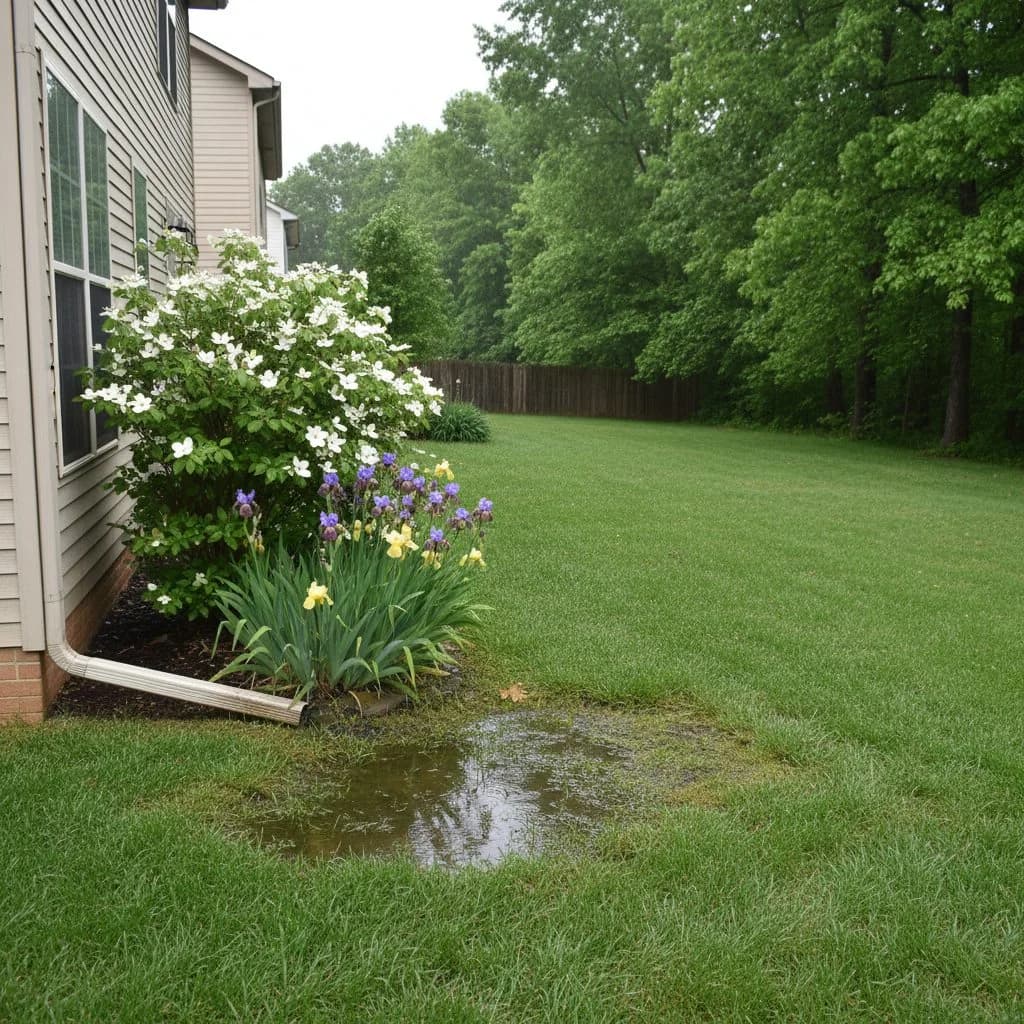
Many homeowners across the United States face the challenge of a chronically soggy lawn area or a downspout that deposits a steady stream of water onto their property. In regions like the Pacific Northwest, where annual rainfall can exceed 40 inches, or in areas with heavy clay soils common in the Southeast, standing water can be a persistent issue. Perpetually wet soil can lead to turfgrass decline, mosquito breeding grounds, and even foundation damage if water pools too close to the house.
Instead of battling the water with expensive drainage systems or chemical treatments, a functional approach involves selecting plants that naturally thrive in these conditions. By choosing the right species, you can transform a problematic wet spot into a beautiful, water-managing landscape feature. This article provides practical plant selection lists for various wet scenarios, grounded in real-world growing conditions for US gardeners, particularly those in USDA zones 5 through 9.
Diagnosing your wet area and soil type
Before selecting any plants, you need to understand why your lawn is soggy. Is it a low spot in the yard where water naturally collects, or is it directly in the path of a downspout’s outflow? A typical downspout can discharge a significant volume of water during a 1-inch rain event, creating a localized flood zone [2]. Observing the area during and after a rainstorm will provide clues. For instance, if water stands for more than 24 hours after a significant rain, you likely have poor drainage or a high water table.
What sits under the turf matters just as much. Heavy clay soils across the Midwest and Southeast have fine particles that pack down tightly and slow water movement. Dig a 6-inch hole to check your soil alongside a pH test: if a handful feels sticky and holds a tight ball when squeezed, you are dealing with heavy clay. Working 2-4 inches of compost into the ground improves drainage steadily over one to two years. For tougher sites, check our guide on plants for clay soil that actually thrive.
Understanding your soil’s drainage capacity
To assess drainage, dig a hole 12 inches deep and 12 inches wide, fill it with water, and let it drain. Once empty, refill it and measure how long it takes for the water level to drop by 6 inches. If it takes longer than 4 hours, your soil has poor drainage. This test provides a quantitative measure for selecting plants that can tolerate standing water or consistently moist conditions. A soil moisture meter, like the Soil Moisture Meter, can also help monitor conditions over time, showing how quickly the soil dries out between rain events. Understanding these factors will guide you toward plants that genuinely flourish in a wet lawn environment.
- Observe water pooling duration after a 1-inch rainfall.
- Perform a percolation test: dig a 12-inch hole and measure drainage time.
- Identify soil type: sandy, loamy, or heavy clay.
- Consider the proximity to a downspout or natural low point.
- Note the amount of sunlight the area receives daily, typically 6-8 hours for full sun.
Plants for consistently wet, poorly drained areas
For areas that remain wet for extended periods, often due to heavy clay or a high water table, selecting plants that tolerate “wet feet” is essential. These species are adapted to anaerobic conditions that would quickly kill most common landscape plants. In USDA zone 6, for example, several native plants excel in these conditions. Cardinal Flower (Lobelia cardinalis) is a striking perennial growing 2-4 feet tall, known for its red blooms that attract hummingbirds. It thrives in full sun to partial shade and consistently moist to wet soil, making it ideal for a perpetually damp spot.
Another excellent choice is Swamp Milkweed (Asclepias incarnata), a critical host plant for Monarch butterfly caterpillars. This perennial reaches 3-5 feet in height and produces clusters of pink flowers from mid-summer. It prefers full sun and wet to moist soils, tolerating up to 6 inches of standing water for short periods. For a shrub option, consider Red Twig Dogwood (Cornus sericea), which can grow 6-9 feet tall and wide. Its bright red stems provide winter interest, and it is highly tolerant of wet soils, even thriving in standing water in USDA zones 2-7. These plants survive and contribute to the local ecosystem, providing food and habitat for wildlife.
Establishing plants in wet conditions
When planting in soggy areas, consider mounding the soil slightly to raise the plant’s crown above the wettest conditions, especially for species that tolerate moist but not perpetually saturated soil. Incorporating 1-2 cubic feet of compost per plant hole can improve soil structure and aeration around the root ball. Ensure the planting hole is at least twice as wide as the root ball to encourage outward root growth. For larger areas, creating a rain garden can manage significant water volumes, effectively absorbing more runoff than a traditional lawn [6].
- Cardinal Flower (Lobelia cardinalis): 2-4 ft tall, full sun to partial shade, USDA zones 3-9.
- Swamp Milkweed (Asclepias incarnata): 3-5 ft tall, full sun, USDA zones 3-9.
- Red Twig Dogwood (Cornus sericea): 6-9 ft tall, full sun to partial shade, USDA zones 2-7.
- Blue Flag Iris (Iris versicolor): 2-3 ft tall, full sun to partial shade, USDA zones 3-9.
- Buttonbush (Cephalanthus occidentalis): 5-12 ft tall, full sun to partial shade, USDA zones 4-10.
Plants for downspout outflows and intermittent wetness
Areas directly impacted by downspout outflows experience a unique challenge: periods of intense saturation followed by drier conditions. This calls for plants that are adaptable and resilient. Switchgrass (Panicum virgatum) is an excellent native ornamental grass, growing 3-6 feet tall, that handles both wet and dry spells with ease. Its deep, fibrous root system helps stabilize soil and absorb excess water, making it perfect for managing runoff. It thrives in full sun across USDA zones 5-9 and provides year-round interest with its upright form and fall color.
For flowering options, Joe Pye Weed (Eutrochium purpureum) is a perennial reaching 4-7 feet tall, producing large clusters of purple flowers in late summer. It attracts a wide array of pollinators and prefers full sun to partial shade in moist to wet soils, performing well near downspouts in USDA zones 4-9. Another reliable choice is Coneflower (Echinacea purpurea), which grows 2-5 feet tall and offers cheerful purple-pink blooms. While it prefers well-drained soil, it can tolerate temporary wetness if the area dries out between rain events, especially in USDA zones 3-8. These plants are functional and add aesthetic value to the landscape.
Designing a downspout-friendly planting area
When designing a planting area around a downspout, consider creating a small, shallow basin or swale to direct and hold water temporarily, allowing it to infiltrate slowly. This approach, often called a rain garden, can manage a significant portion of the nutrients and pollutants in stormwater runoff, according to the USDA Natural Resources Conservation Service [6]. Place the most water-tolerant plants directly in the path of the outflow, with progressively drier-tolerant plants further away. For example, a 100 square foot rain garden can effectively manage runoff from a 1,000 square foot roof area. Remember to select plants that are also deer resistant if deer are a problem in your area, as some wet-tolerant plants can be quite palatable.
- Switchgrass (Panicum virgatum): 3-6 ft tall, full sun, USDA zones 5-9.
- Joe Pye Weed (Eutrochium purpureum): 4-7 ft tall, full sun to partial shade, USDA zones 4-9.
- Coneflower (Echinacea purpurea): 2-5 ft tall, full sun, USDA zones 3-8.
- Turtlehead (Chelone glabra): 2-3 ft tall, partial shade, USDA zones 3-8.
- Cinnamon Fern (Osmundastrum cinnamomeum): 2-3 ft tall, partial to full shade, USDA zones 2-10.
Ground covers and smaller plants for wet areas
Not every soggy spot requires a towering shrub or perennial. Sometimes, a low-growing ground cover or smaller plant is more appropriate, especially for tight spaces or as an underplanting. Creeping Jenny (Lysimachia nummularia ‘Aurea’) is a yellow-green ground cover that spreads rapidly. It thrives in consistently moist to wet soils and can even tolerate shallow standing water for short periods. However, it is considered invasive in many parts of the US and can escape cultivation, so it should be planted with caution and contained carefully. Its bright foliage provides a striking contrast against darker plants or rocks.
For shady, wet areas, Foamflower (Tiarella cordifolia) is an excellent native choice. It forms a low mound of attractive foliage, typically 6-12 inches tall, and produces delicate white flower spikes in spring. It prefers partial to full shade and moist, well-drained to wet soils in USDA zones 3-8. Another option is Golden Ragwort (Packera aurea), a semi-evergreen perennial that grows 1-2 feet tall and produces bright yellow daisy-like flowers in spring. It naturalizes easily in moist to wet woodlands and tolerates both sun and shade in USDA zones 3-9. These smaller plants can effectively cover bare ground, suppress weeds, and add texture to a wet landscape, often filling in an area relatively quickly within two growing seasons. For more ground cover ideas, consult our article on ground cover plants.
Maintenance for ground covers in wet conditions
Ground covers in wet areas generally require minimal maintenance once established. Ensure they receive adequate water during dry spells, especially in their first year. For Creeping Jenny, occasional trimming can prevent it from becoming too aggressive, particularly if it starts to spread beyond its designated area. Foamflower and Golden Ragwort benefit from a thin layer of compost applied annually in the spring, providing essential nutrients and improving soil structure. Monitor for signs of fungal diseases, which can be more prevalent in consistently damp conditions, though most wet-tolerant species have a natural resistance.
- Creeping Jenny (Lysimachia nummularia ‘Aurea’): 2-4 in tall, full sun to partial shade, USDA zones 4-9.
- Foamflower (Tiarella cordifolia): 6-12 in tall, partial to full shade, USDA zones 3-8.
- Golden Ragwort (Packera aurea): 1-2 ft tall, sun to shade, USDA zones 3-9.
- Marsh Marigold (Caltha palustris): 1-2 ft tall, full sun to partial shade, USDA zones 3-7.
- Winterberry Holly (Ilex verticillata ‘Red Sprite’): 3-5 ft tall, full sun to partial shade, USDA zones 3-9 (dwarf shrub, but small enough for this category).
Comparison of plants for wet lawn areas
Plant Name | USDA Zones | Sun Exposure | Height (ft) | Moisture Tolerance |
|---|---|---|---|---|
Cardinal Flower | 3-9 | Full sun to partial shade | 2-4 | Consistently wet |
Swamp Milkweed | 3-9 | Full sun | 3-5 | Wet to standing water |
Red Twig Dogwood | 2-7 | Full sun to partial shade | 6-9 | Wet to standing water |
Switchgrass | 5-9 | Full sun | 3-6 | Wet to dry |
Joe Pye Weed | 4-9 | Full sun to partial shade | 4-7 | Moist to wet |
Creeping Jenny | 4-9 | Full sun to partial shade | 0.2-0.3 | Consistently moist to wet |
Rain garden efficiency: A well-designed rain garden can absorb more runoff than a traditional lawn, significantly reducing local water pooling [6].
Downspout discharge: A single downspout can discharge a significant volume of water during a 1-inch rain event, requiring plants that tolerate temporary inundation [2].
References
- lawn (2014).lawn.
- Urban landscaping: Lawn legacy (2017).
- Crop breeding: Turning a lawn into a field (2017).
- Correction: Crop breeding: Turning a lawn into a field (2017).
- USDA Natural Resources Conservation Service (2024).