Key takeaways
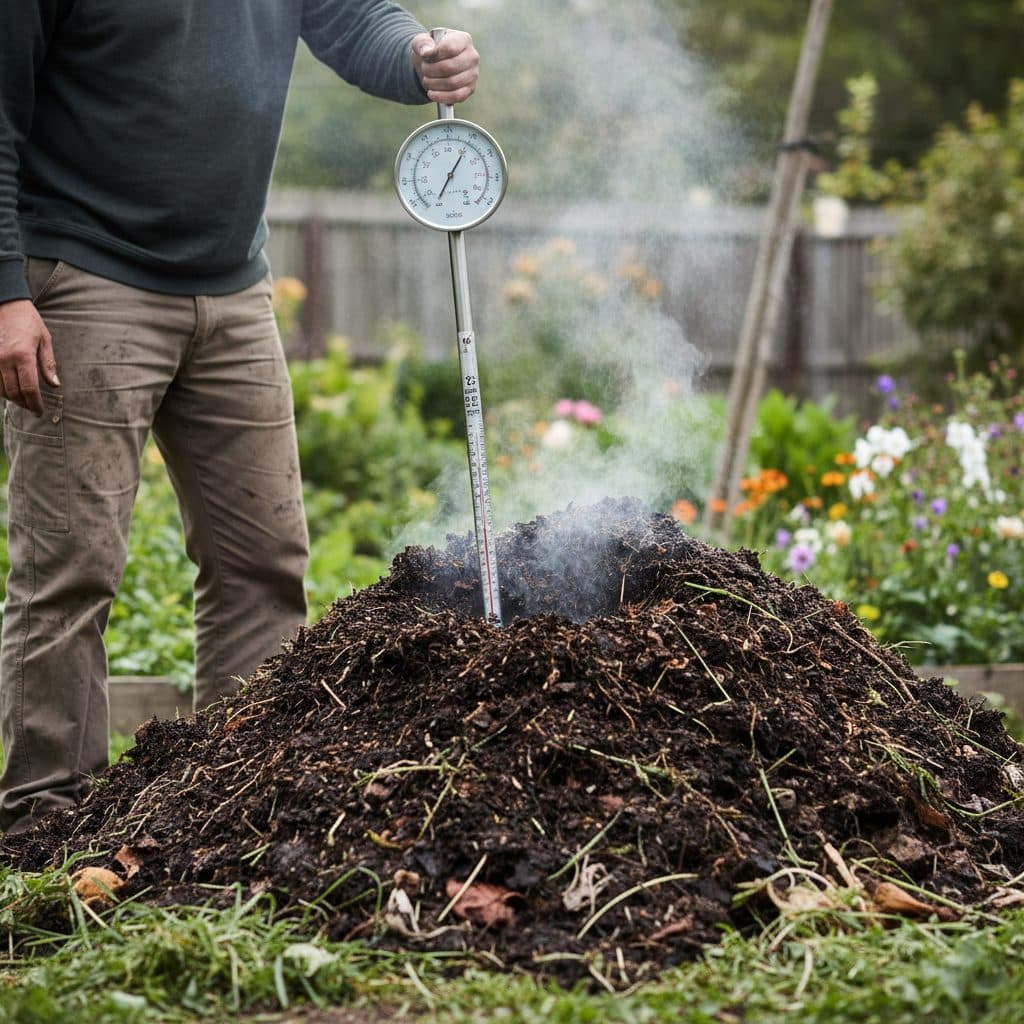
- Composting timelines range from three weeks to eighteen months depending on the composting method, management intensity, and environmental factors.
- Actively managed hot composting (such as the 18-day Berkeley method) produces finished compost in three to eight weeks.
- Passive cold composting heaps require minimal labor but take between six and eighteen months to break down completely.
- Accelerate decomposition by chopping feedstocks to 2.5 to 5 cm (1 to 2 in), maintaining a 30:1 carbon-to-nitrogen ratio, and keeping moisture levels between 45 and 60 percent.
- A hot compost pile requires a minimum of about 1 cubic yard (0.75 m3, a 3x3x3 ft heap) to retain internal thermophilic heat.
- Compost is finished when it has cooled to ambient outdoor temperature, smells like rich forest soil, and displays a dark, crumbly, homogeneous texture.
Quick answer: Composting typically takes between three weeks and eighteen months. Hot, actively turned compost piles finish in 3 to 8 weeks, enclosed compost tumblers take 4 to 8 weeks, vermicomposting worm bins take 3 to 6 months, and passive unturned cold piles require 6 to 18 months. Shredding materials and balancing carbon and nitrogen speeds up the process.
Transforming raw organic waste—such as autumn leaves, grass clippings, coffee grounds, and kitchen vegetable peels—into dark, crumbly garden humus is one of the most rewarding parts of gardening. However, one of the most frequent questions beginners ask is how long does compost take before it is safe and ready to apply to growing beds.
The speed of decomposition is not random; it is governed by biological physics and the activity of microorganisms. By managing the balance of moisture, oxygen, surface area, and the carbon-to-nitrogen ratio, you can control whether your compost takes three weeks or one full year to mature.
+-------------------------------------------------------------+
|              COMPOST TIMELINE BY METHOD COMPARISON          |
|                                                             |
|   METHOD                 ACTIVE TIMELINE     MANAGEMENT     |
|   ------                 ---------------     ----------     |
|   Active Hot Pile        3 to 8 Weeks        High (Turn 2-3x/wk)
|   Compost Tumbler        4 to 8 Weeks        High (Batch drum)  |
|   Bokashi Fermentation   4 to 6 Weeks        Medium (Two-stage)
|   Vermicomposting (Worms)3 to 6 Months       Low to Medium  |
|   Trench / In-Ground     4 to 8 Months       Zero (No-turn) |
|   Passive Cold Heap      6 to 18 Months      Zero (Slow rot)|
+-------------------------------------------------------------+
Detailed composting timelines by method
Different composting techniques utilize distinct biological pathways, leading to widely varying completion schedules.
+-------------------------------------------------------------+
|               DECOMPOSITION TIMELINES COMPARED              |
|                                                             |
|   1. THERMOPHILIC HOT COMPOSTING (3 to 8 Weeks):            |
|   - Rapid bacterial multiplication generates 55°C to 65°C   |
|   - Frequent turning introduces oxygen; fast particle decay |
|                                                             |
|   2. COMPOST TUMBLERS (4 to 8 Weeks):                       |
|   - Vented drum speeds breakdown via easy mixing/aeration   |
|   - Batch loading with shredded matter finishes fastest     |
|                                                             |
|   3. VERMICOMPOSTING WORM BINS (3 to 6 Months):             |
|   - Red wigglers (*Eisenia fetida*) digest pre-rotted waste |
|   - Yields dense, high-potency castings                     |
|                                                             |
|   4. PASSIVE COLD COMPOST HEAPS (6 to 18 Months):           |
|   - Fungi and actinomycetes work slowly at ambient temps    |
|   - Low-effort "add as you go" backyard pile                |
+-------------------------------------------------------------+
1. Active hot composting (3 to 8 weeks)
Hot composting is the fastest biological method. By building a pile all at once with a precise 30:1 carbon-to-nitrogen ratio and turning it every three to four days, aerobic thermophilic bacteria multiply rapidly. Internal pile temperatures surge to between 55°C and 65°C (131°F to 149°F), breaking down cellulose and proteins in a matter of weeks and killing most weed seeds and many plant pathogens — provided the pile is turned so that the outer material passes through the hot core.
To understand the core differences in microbial ecology, review our guide comparing hot vs cold composting.
2. Compost tumblers (4 to 8 weeks)
Tumblers are vented drums that speed things up through easy mixing and moisture control rather than through heat — most are too small to hold thermophilic temperatures. The 4 to 8 week figure applies to a drum loaded as a single batch with shredded material; adding fresh scraps restarts the clock.
3. In-ground trench composting (4 to 8 months)
When you bury waste directly beneath a 20 cm (8 in) soil cap, native earthworms and soil bacteria decompose the buried matter without pile turning. For step-by-step garden bed integration, see our dedicated manual on trench composting in place.
4. Vermicomposting worm bins (3 to 6 months)
In a worm bin, specialized composting worms (such as red wigglers, Eisenia fetida) consume decaying organic scraps and microflora, leaving behind rich worm castings. A mature bin takes three to six months to generate a harvestable batch of pure vermicompost. To compare castings with thermal compost, read our guide on vermicompost vs regular compost.
5. Passive cold compost heaps (6 to 18 months)
Cold composting is the simplest method: you add yard waste and kitchen scraps to a pile or bin as they become available, with little or no turning. Decomposition relies on ambient-temperature mesophilic fungi, actinomycetes, and resident earthworms. It takes six to eighteen months to yield finished humus, and because it does not reach thermophilic temperatures, avoid adding weed seeds or diseased plant matter.
6. Bokashi fermentation (4 to 6 weeks, two-stage)
Bokashi uses an anaerobic microbial inoculant to ferment kitchen food scraps in an airtight container for two weeks. The output is an acidic pre-compost, not finished soil humus; it must be buried in garden soil or mixed into an outdoor compost pile for a further two to four weeks before plant roots can use it.
The five critical factors that determine composting speed
If your compost pile is taking too long to break down, one or more of these environmental factors is out of balance.
+-------------------------------------------------------------+
|                 THE 5 COMPOST ACCELERATION PILLARS          |
|                                                             |
|   1. Carbon-to-Nitrogen Ratio: Target 25:1 to 30:1          |
|   2. Particle Size: Shred to 2.5 to 5.0 cm (1 to 2 in)      |
|   3. Moisture Content: 45% to 60% (Damp wrung-out sponge)   |
|   4. Oxygen & Aeration: Turn pile every 3 to 7 days         |
|   5. Pile Volume: Minimum ~1 cubic yard (0.75 m3 / 3x3x3 ft)|
+-------------------------------------------------------------+
Factor | Optimal Target | Problem If Too Low | Problem If Too High |
|---|---|---|---|
Carbon-to-Nitrogen (C:N) | 25:1 to 30:1 | Excess nitrogen causes ammonia smell and slime | Excess carbon slows breakdown; pile stays cold |
Particle Size | 2.5 to 5 cm (1 to 2 in) | Fine dust can pack tightly, suffocating airflow | Intact branches take 2+ years to rot |
Moisture Content | 45% to 60% | Microbes go dormant below 35% moisture | Waterlogged pile turns anaerobic and sour |
Oxygen Levels | > 10% oxygen throughout pile | Anaerobic stagnation; foul rotten egg odor | Excessive turning dries out pile too fast |
Pile Volume | ~1 yd³ / 0.75 m³ (3x3x3 ft min) | Fails to retain self-generated heat | Piles much over 1.5 m (5 ft) high compress and starve oxygen |
1. Carbon-to-nitrogen ratio (Greens vs Browns)
Microorganisms require carbon for energy and cellular structure, and nitrogen for protein synthesis. The ideal balance is 30 parts carbon to 1 part nitrogen (30:1).
- Browns (High Carbon): Dry autumn leaves, straw, shredded cardboard, wood shavings.
- Greens (High Nitrogen): Fresh grass clippings, coffee grounds, kitchen vegetable trimmings, fresh livestock manure.
To dial in your feedstock ratios accurately, see our reference on the compost brown to green ratio.
2. Particle surface area
Bacteria feed on the exterior surfaces of organic materials. Shredding whole autumn leaves with a lawnmower or chopping dense kitchen rinds with a spade greatly increases the surface area available to microbes, which is one of the most effective ways to shorten the process.
3. Moisture and aeration balance
Compost microbes live in the microscopic water film surrounding organic particles. Squeeze a handful of compost: it should feel like a damp, wrung-out sponge, yielding only a drop or two of moisture when squeezed firmly. If it is dry and dusty, decomposition stops; if it drips water, pore spaces fill with liquid, suffocating oxygen-loving bacteria.
To kickstart sluggish piles naturally, explore organic catalysts in our guide to natural compost accelerators.
How to tell when compost is completely finished and ready
Using un-decomposed or "immature" compost in garden beds harms plants. Active microbes will rob nitrogen from the surrounding soil to continue breaking down raw carbon, stunting seedling growth.
+-------------------------------------------------------------+
|                FINISHED COMPOST READINESS CHECKLIST         |
|                                                             |
|   1. VISUAL TEST:                                           |
|   - Dark rich brown/black colour; loose, crumbly texture    |
|   - Original feedstocks (leaves, food scraps) unrecognizable|
|                                                             |
|   2. AROMA TEST:                                            |
|   - Pleasant earthy forest scent; zero sour or ammonia smell|
|                                                             |
|   3. TEMPERATURE TEST:                                      |
|   - Pile has cooled to ambient temperature and stays cool   |
|   - Does not reheat after thorough turning and watering     |
|                                                             |
|   4. THE ZIPLOC BAG TEST:                                   |
|   - Seal damp compost in a plastic bag at room temperature  |
|   - If bag does not inflate or smell sour after 3 days,     |
|     the compost is fully stabilized and cured               |
+-------------------------------------------------------------+
The curing phase
Even after a hot compost pile finishes its active thermophilic cycle, it requires a curing period of two to four weeks. During curing, lower-temperature mesophilic fungi, actinomycetes, and protozoa colonize the material, stabilizing humic acids and producing plant-available nutrients.
Fast practical ways to speed up your compost pile
If your compost heap is taking too long to break down, implement these immediate fixes:
- Turn the pile weekly: Insert a compost aerator tool or use a pitchfork to move un-decomposed outer layers into the hot centre of the pile.
- Add high-nitrogen boosters: Mix in two shovels of fresh chicken manure, blood meal, or fresh comfrey leaves to spark microbial heating.
- Shred all carbon: Never throw whole cardboard boxes or intact tree branches into a fast pile; shred all dry materials before layering.
- Cover with a tarp: In wet or windy climates, cover your compost bin with a breathable tarp to prevent heavy rains from waterlogging the core and leaching soluble nutrients.