Key takeaways
- A single zucchini plant can out-produce a household in a good season, often leading to excess.
- Dehydrating removes about 90% of the squash’s weight, making it ideal for long-term storage and saving pantry space.
- Fermenting summer squash, like making lacto-fermented pickles, improves nutrient availability and can extend shelf life for several months.
- Freezing blanched squash chunks or grated squash is a quick method that preserves quality for 8 to 12 months.
- Making relish or preserves from excess squash adds flavor and can utilize large quantities, storing well for over one year.
- Proper storage conditions, such as a consistent 50-60°F for root cellaring, help extend the life of many preserved foods.
Quick answer: To preserve a summer squash glut, common methods include dehydrating to remove over 90% of the squash’s weight, fermenting for probiotic benefits, and freezing blanched chunks for up to a year.
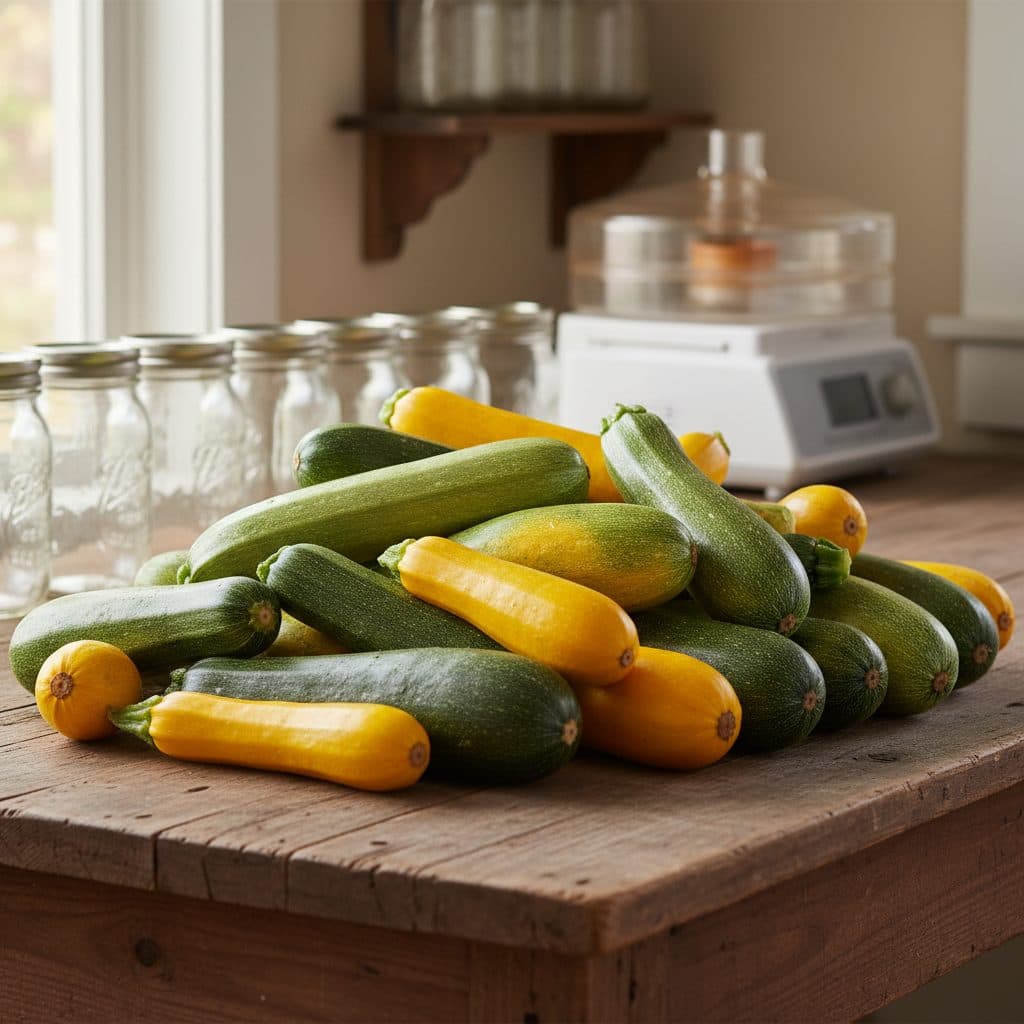
During midsummer, many US growers, particularly in warmer climates like USDA zones 6 to 9, find themselves with an abundance of zucchini and other summer squash. A single healthy plant can easily produce more than a family can consume fresh over its growing season. This annual glut, while a sign of a productive garden, presents a practical challenge: how to utilize and store this bounty before it spoils.
Preservation methods such as drying, fermenting, freezing, and making relish extend the life of summer squash for months, so a 30-pound garden harvest does not end up in the compost pile.
Dehydrating summer squash for long-term storage
Dehydrating is one of the most efficient ways to preserve summer squash, reducing its weight by over 90% and concentrating its flavor. This method is particularly useful for growers in humid regions like the Southeast, where fresh produce molds quickly, and can extend the shelf life for 12 months or more. For best results, choose firm, blemish-free squash, ideally 6 to 8 inches long, as larger fruits can be watery. Wash the squash thoroughly and slice it into 1/4-inch thick rounds or half-moons. Blanching is an optional but recommended step for better color and nutrient retention, especially for longer storage; submerge slices in boiling water for 1 to 2 minutes, then immediately cool in ice water for 2 minutes to halt the cooking process. This pre-treatment helps maintain the squash’s color and prevents enzymatic browning during storage.
Preparing squash for drying
After blanching, pat the squash dry with a clean towel. Arrange the slices in a single layer on dehydrator trays, ensuring good air circulation for even drying. A typical electric dehydrator operates at 125°F to 135°F, and drying can take anywhere from 8 to 14 hours, depending on slice thickness, the dehydrator model, and ambient humidity levels. The squash is fully dry when it’s brittle and snaps easily, similar to a potato chip; there should be no pliable spots. Store dried squash in airtight containers like glass jars or vacuum-sealed bags, away from direct sunlight, in a cool pantry where temperatures remain below 70°F. For more instructions on drying herbs and fruits, see our guide on dehydrating food. A 10-pound harvest of fresh squash will yield about 1 pound of dried product, saving significant storage space.
- Choose squash 6-8 inches long for optimal texture.
- Slice squash 1/4 inch thick for even drying.
- Blanching for 1-2 minutes helps preserve color.
- Dehydrate at 125-135°F for 8-14 hours.
- Store in airtight containers below 70°F.
Fermenting summer squash for unique flavors
Fermentation transforms summer squash into a tangy, probiotic-rich food, adding a complex flavor profile that fresh squash lacks. This method is particularly popular in regions with a strong tradition of pickling, such as the Midwest and parts of New England, and can extend the shelf life of your harvest for 3 to 6 months when refrigerated. To ferment squash, start with young, tender fruits, preferably 4 to 6 inches long, as larger squash can become overly watery and less crisp. Wash them thoroughly and slice them into spears or rounds. For a simple brine, dissolve 1 tablespoon of non-iodized salt per 1 quart of filtered water for roughly 2% salinity, or 1 1/2 tablespoons for about 3%. You’ll need about 1/2 gallon of brine for every 5 pounds of squash to ensure full submersion, which maintains the anaerobic environment for fermentation.
Making lacto-fermented squash pickles
Pack the squash tightly into clean glass jars, leaving 1 inch of headspace at the top. Add optional flavorings like garlic cloves (2-3 per pint jar), fresh dill sprigs, or mustard seeds (1 teaspoon per pint). Pour the prepared brine over the squash, ensuring all pieces are fully submerged; a fermentation weight or a small, clean rock can help keep them below the liquid. Cover the jars with airlocks or loosely fitting lids to allow fermentation gases to escape without letting oxygen in. Ferment at room temperature, ideally between 65°F and 75°F, for 5 to 14 days. The fermentation process is complete when the bubbling subsides and the squash reaches your desired level of tanginess. Once fermented, move the jars to a refrigerator at 38°F to 40°F to slow down further fermentation and preserve quality. For additional brine recipes and troubleshooting, see our guide on fermenting and pickling vegetables.
- Use young squash, 4-6 inches long, for best texture.
- Prepare a brine with 1 to 1 1/2 tablespoons salt per 1 quart water.
- Pack squash tightly in jars, leaving 1 inch headspace.
- Ferment at 65-75°F for 5-14 days.
- Refrigerate fermented squash at 38-40°F for storage.
Freezing summer squash for quick meals
Freezing is perhaps the simplest and quickest method for preserving large quantities of summer squash, making it a favorite for busy gardeners across the US, from the humid Gulf Coast to the arid Southwest. It maintains much of the squash’s flavor and nutritional value for 8 to 12 months when properly stored. While you can freeze raw grated squash for baking without pre-treatment, blanching preserves the texture and color of sliced or cubed squash, preventing it from becoming mushy upon thawing. For every 1 pound of squash you plan to freeze, you’ll need about 1 gallon of rapidly boiling water. Cut squash into 1/2-inch thick slices or 1-inch cubes. Blanch in boiling water for exactly 3 minutes, then immediately transfer to an ice bath for 3 minutes to stop the cooking process and lock in freshness.
Blanching and freezing squash
After blanching and cooling, drain the squash thoroughly and pat dry with paper towels. Excess moisture can lead to freezer burn and a poor, icy texture. For individual pieces that won’t clump together, spread the blanched squash in a single layer on a baking sheet and freeze for 1 to 2 hours until solid. This “flash freezing” step is highly recommended. Once frozen, transfer the squash to heavy-duty freezer bags or airtight containers, removing as much air as possible to prevent oxidation. Label each package with the date and store at 0°F or below. Grated squash, often used for muffins or bread, can be frozen raw in 1-cup or 2-cup portions without blanching; just squeeze out excess moisture before placing it in freezer bags. This efficient method can help you manage a harvest of 10 to 15 pounds of squash in a single afternoon, turning potential waste into future meals.
- Blanch sliced/cubed squash for 3 minutes.
- Cool immediately in ice water for 3 minutes.
- Flash freeze individual pieces on a baking sheet.
- Store in airtight freezer bags at 0°F or below.
- Raw grated squash can be frozen without blanching.
Making summer squash relish and preserves
Turning excess summer squash into relish or preserves is an excellent way to use a substantial harvest, adding a flavorful condiment to your pantry that can last for over one year. This method is particularly satisfying for gardeners in states like Pennsylvania or Ohio, where canning traditions are strong, and it provides a delicious way to utilize fruits that might be slightly past their prime for fresh eating. A single batch of relish can utilize 5 to 10 pounds of squash, transforming it into a versatile topping for hot dogs, burgers, or even as a flavorful side dish. The process typically involves chopping or grating the squash, often with other vegetables like onions and bell peppers, then cooking it down with vinegar, sugar, and a blend of spices. The acidity from the vinegar ensures safe preservation.
Canning squash relish safely
For safe canning, always follow tested recipes from reliable sources like the National Center for Home Food Preservation at the University of Georgia, or your state extension service. Use a named tested recipe instead of an approximation: the National Center for Home Food Preservation’s pickled bread-and-butter zucchini and the tested zucchini relish recipes published by state extension services give exact vegetable-to-vinegar ratios along with their own process times. Cook the mixture until it thickens to your desired consistency, usually taking 20 to 30 minutes. Ladle the hot relish into hot, sterilized pint or half-pint canning jars, leaving 1/2 inch of headspace. Process pint jars in a boiling water canner for 15 minutes at 0 to 1,000 feet, then add 5 minutes at 1,001 to 3,000 feet, 10 minutes at 3,001 to 6,000 feet, 15 minutes at 6,001 to 8,000 feet, and 20 minutes above 8,000 feet. After processing, let the jars cool undisturbed for 12 to 24 hours on a towel. Check seals before storing in a cool, dark pantry. This method is a great way to manage a large output, such as 20 pounds of squash from a few prolific plants, ensuring that your hard work doesn’t go to waste.
- Utilize 5-10 pounds of squash per batch of relish.
- Combine chopped squash with onions, peppers, vinegar, and spices.
- Follow USDA-tested recipes for safe canning.
- Process pint jars in a boiling water canner for 15 minutes.
- Store sealed jars in a cool, dark pantry for over one year.
Comparison of summer squash preservation methods
Method | Shelf Life | Best Use | Estimated Yield (from 10 lbs squash) |
|---|---|---|---|
Dehydrating | 12+ months | Soups, stews | 1 lb dried |
Fermenting | 3-6 months (refrigerated) | Pickles, relishes | 9 lbs fermented |
Freezing | 8-12 months | Baking, stir-fries | 10 lbs frozen |
Relish/Canning | 12+ months (pantry) | Condiment, side dish | 8-10 pints |
Dehydration ratio: Dehydrating removes over 90% of the squash’s weight, with 10 pounds of fresh squash yielding about 1 pound dried, which saves storage space.
Fermentation temperature: Optimal fermentation for squash pickles occurs between 65°F and 75°F, extending shelf life for several months.
Frequently asked questions
How much squash can one plant produce in a season?
A single healthy zucchini or summer squash plant can yield a significant amount, far more than a household can eat fresh over its growing season, especially in favorable conditions such as USDA zone 7. This high output often necessitates preservation methods.
Is blanching necessary before freezing summer squash?
For sliced or cubed summer squash, blanching is highly recommended for 3 minutes to preserve color, texture, and nutrient quality, extending its freezer life to 8-12 months. However, grated squash for baking can be frozen raw, after squeezing out excess moisture.
What is the ideal temperature for fermenting squash?
The ideal temperature range for lacto-fermenting squash pickles is between 65°F and 75°F. This range promotes beneficial bacterial activity, leading to proper fermentation and a safe, flavorful product within 5 to 14 days.
How long can dehydrated squash be stored?
When properly dehydrated until brittle and stored in airtight containers in a cool, dark place below 70°F, dried summer squash can maintain its quality for 12 months or even longer. This method removes over 90% of the squash’s weight.
Can I use any salt for fermenting squash?
Use non-iodized salt for fermenting squash, typically at a 2% to 3% salinity level, as iodine can inhibit the beneficial bacteria required for fermentation. Pickling salt or sea salt without additives are good choices.
What is the shelf life of canned squash relish?
Properly canned summer squash relish, processed according to USDA guidelines in a boiling water canner for 15 minutes for pint jars, can be safely stored in a cool, dark pantry for over one year. Always check for a proper seal before storage.
References
- EPA — Soak Up the Rain (2024). EPA — Soak Up the Rain.
- SARE — Sustainable Agriculture Research & Education (2023). SARE — Sustainable Agriculture Research & Education.
- ATTRA / NCAT Sustainable Agriculture (2023). ATTRA / NCAT Sustainable Agriculture.
- USDA National Agroforestry Center (2023). USDA National Agroforestry Center.