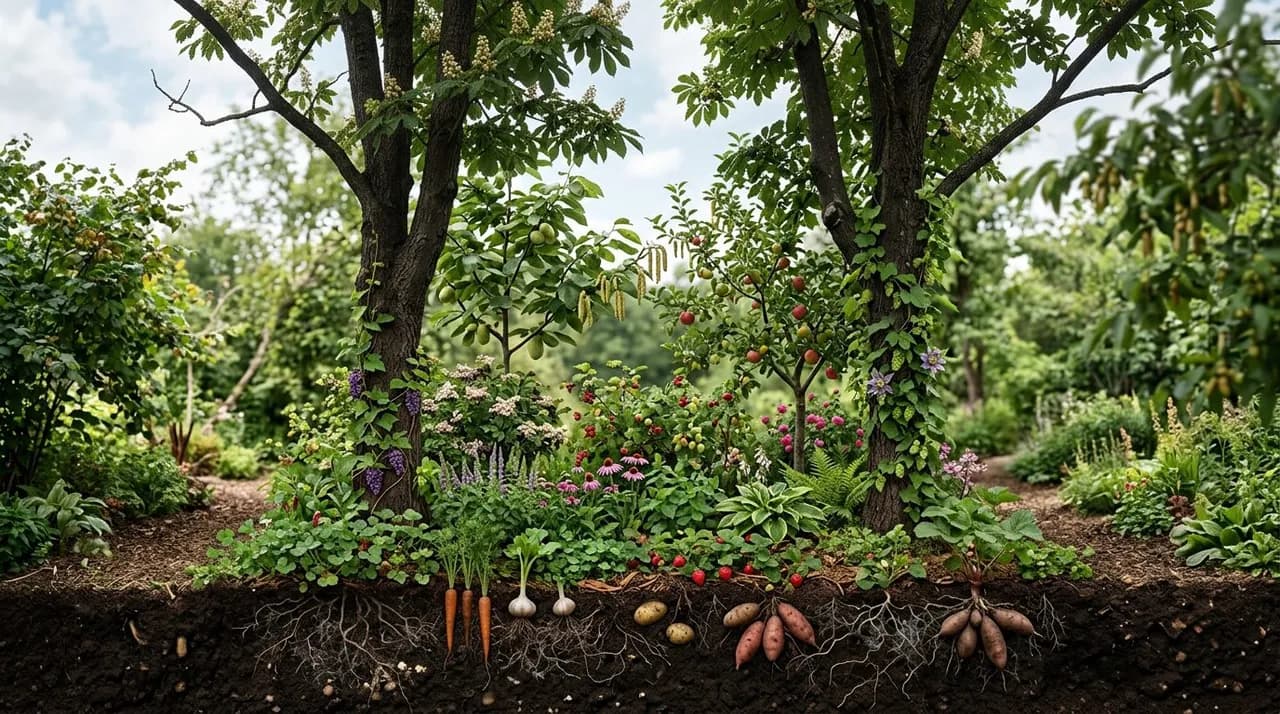
Key takeaways
- Vertical stacking organizes plants into distinct ecological niches to capture sunlight across multiple tiers.
- The seven classic layers span tall canopy, sub-canopy, shrubs, herbaceous perennials, ground covers, rhizosphere roots, and vertical climbers.
- Some practitioners include an eighth layer for mycelial fungi and a ninth for wetland aquatic plants.
- Proper canopy spacing ensures filtered sunlight reaches understory berry bushes and edible ground covers.
- Plant species selections vary across temperate, Mediterranean, and subtropical climates while maintaining the same physical structure.
Quick answer: The 7 food forest layers are canopy trees, understory or sub-canopy trees, shrub bushes, herbaceous perennials, ground covers, rhizosphere root crops, and vertical climbing vines. Stacking these structural tiers mimics natural woodland ecosystems, maximizing space and sunlight capture while minimizing labor and external fertilizers.
In conventional agriculture, crops occupy a single horizontal plane, leaving empty vertical space above and below ground vulnerable to weeds, wind damage, and erosion. Designing with food forest layers replaces this fragile monoculture with a diverse polyculture modeled on self-regulating forest edges.
Understanding the 7 layers of a food forest allows growers to utilize every cubic meter of garden space. By selecting plants that occupy complementary light niches and root zones, you create an interconnected system where each tier supports the vitality of the whole forest garden.
Whether designing an urban courtyard, a community garden, or a multi-hectare farm, vertical stacking permaculture principles provide a practical blueprint for food resilience across varied climate zones.
Why does vertical stacking work in food forest design layers?
Vertical stacking works because natural plant communities do not compete uniformly for identical resources; they partition resources through structural adaptation. In a mature forest edge, tall trees capture intense upper sunlight, while lower layers thrive in dappled shade using broader, shade-adapted foliage.
Below the surface, root systems partition moisture and nutrients at different depths. Deep taproots draw water and trace minerals from subsoil strata, while fibrous shrub roots forage through upper leaf litter. Mycorrhizal fungal networks bridge these root zones, transferring carbon, phosphorus, and moisture between species.
Structuring forest garden layers intentionally reduces weeding and artificial irrigation. Dense foliage creates an insulated microclimate that reduces ground-level wind speeds, suppresses evaporation, and cushions the soil against intense rainstorms. For deeper design theory, explore our guide on permaculture design.
What are the seven layers of the forest garden?
The foundational framework developed in modern temperate permaculture outlines seven distinct vertical tiers:
1. The canopy layer (overstory)
The tallest tier consists of large mature trees reaching heights of 9 to 15 m (30 to 50 ft) or more. In large systems, these provide shade, wind protection, large-scale biomass, and major harvests of nuts or timber.
- Cool temperate species: Sweet chestnut (Castanea sativa), walnut, standard apple, oak.
- Subtropical and Mediterranean species: Pecan, carob, avocado, mango, moringa.
2. The sub-canopy layer (understory or small trees)
Reaching 3 to 9 m (10 to 30 ft), this layer consists of dwarf or semi-dwarf fruit trees and nitrogen-fixing pioneer species that thrive in the open light between large canopy specimens.
- Cool temperate species: Semi-dwarf apples, European pears, plums, cherries, medlars, quinces.
- Subtropical and Mediterranean species: Figs, pomegranates, citrus, loquats, guavas.
3. The shrub layer
Occupying the 1 to 3 m (3 to 10 ft) height range, the canopy understory shrub layer contains woody bushes that produce abundant berries, medicinal crops, and wildlife forage.
- Cool temperate species: Blackcurrants, redcurrants, gooseberries, blueberries, raspberries, jostaberries, hazels.
- Subtropical and Mediterranean species: Rosemary bushes, pigeon pea (Cajanus cajan), pineapple guava (Acca sellowiana), barbados cherry.
4. The herbaceous layer
Non-woody perennial plants growing 30 cm to 1.5 m (1 to 5 ft) tall die back each winter and re-emerge in spring. They accumulate deep soil minerals, attract pollinators, and produce culinary herbs and leafy vegetables.
- Cool temperate species: Russian comfrey (Symphytum x uplandicum), borage, sweet cicely, rhubarb, fennel, lovage.
- Subtropical and Mediterranean species: Lemongrass, tulsi (holy basil), perennial brassicas, cardoons.
5. The ground cover layer (horizontal tier)
Creeping, low-growing plants hugging the ground at 5 to 30 cm (2 to 12 in) form a living green mulch that stabilizes topsoil, retains humidity, and blocks opportunistic weeds.
- Cool temperate species: Alpine strawberries, creeping thyme, white clover, bugleweed (Ajuga reptans), wintergreen.
- Subtropical and Mediterranean species: Creeping oregano, sweet potato vine, nasturtiums, prostrate rosemary.
6. The rhizosphere (root layer)
This subterranean tier consists of edible roots, bulbs, and nutrient-storing tubers that develop within the top 30 to 60 cm (12 to 24 in) of soil.
- Cool temperate species: Jerusalem artichokes, horseradish, garlic, walking onions, scorzonera.
- Subtropical and Mediterranean species: Cassava, taro, ginger, turmeric, yams (Dioscorea).
7. The vertical layer (vines and climbers)
Climbing and scrambling plants utilize tree trunks, trellises, and fence lines to reach available light without taking up substantial ground space.
- Cool temperate species: Hardy kiwi (Actinidia arguta), runner beans, hops, climbing peas.
- Subtropical and Mediterranean species: Passionfruit, grapevines (Vitis vinifera), chayote, malabar spinach.
Are there additional layers in modern agroforestry systems?
Many contemporary practitioners expand the classic model to eight or nine layers to incorporate fungal and aquatic elements:
- The Mycelial (Fungal) Layer: Saprophytic and mycorrhizal fungi growing within woodchip mulch and rotting logs, such as oyster mushrooms (Pleurotus) and wine cap mushrooms (Stropharia rugosoannulata). They decompose coarse lignin into humic soil while yielding edible protein.
- The Wetland or Aquatic Layer: In sites with swales, ponds, or chinampas, aquatic species like watercress, lotus (Nelumbo nucifera), and water chestnuts harvest nutrient-rich runoff.
To see how these structural tiers integrate on compact domestic properties, read our overview of backyard food forest layouts.
How do climate conditions alter food forest layer plants?
While the seven physical layers remain consistent globally, species choices and canopy spacing must adjust to local temperature, humidity, and rainfall:
In cool temperate climates (UK/US north/Northern Europe): Sunlight is the primary limiting factor. Space overstory trees widely to let light reach lower tiers. Select deciduous cultivars that leaf out late in spring, giving understory ground covers and bulbs a full window of direct early sunlight.
In subtropical and arid climates (AU/IN/Mediterranean/US south): Excessive solar radiation and moisture evaporation are the main challenges. Plant denser upper canopies to provide shade for tender understory berries and herbs. Emphasize drought-tolerant nitrogen fixers and thick succulent ground covers.
To start planting these tiers methodically from bare soil, proceed to our step-by-step tutorial on how to start a food forest.
How do you arrange layers into balanced companion guilds?
Designers assemble these layers into small, repeating self-supporting clusters known as guilds instead of separate rows across a property.
Each guild centers on a productive canopy or sub-canopy tree, surrounded by a ring of herbaceous accumulators (like comfrey) at the drip line, a nitrogen-fixing shrub (like goumi or sea buckthorn) on the sunny side, insect-attracting umbel flowers, and a ground-hugging living mulch beneath. Climbing vines are added only once the central tree trunk has developed sufficient girth to support their weight.
To select specific companion species that optimize pest management and nutrient cycling around fruit trees, consult our guide to fruit tree guild construction.