secondary
Gooseberry
Ribes uva-crispa
International hardiness
- USDA 3-8
- RHS H6
- AU: Cool temperate
Where it grows — regional guide
| Zones / rating | Regional notes |
|---|---|
USDA 3-8 | Check state Department of Agriculture regulations regarding Ribes planting restrictions before ordering bushes, as laws vary widely by state. |
| Zones / rating | Regional notes |
|---|---|
H6 (-20 to -15C) | An enduring kitchen garden classic across England and Scotland; grows reliably in open ground or trained as cordons against walls. |
| Zones / rating | Regional notes |
|---|---|
Cool temperate | Adapted to the cooler southern tablelands of New South Wales, Victoria, and Tasmania; needs protection from scorching summer winds. |
| Zones / rating | Regional notes |
|---|---|
USDA 3-8 (USDA scale) Canada uses its own zone system; Canadian zones run roughly one lower than USDA. | Exceptionally cold-hardy across Canadian zones 3 to 7; choose mildew-resistant cultivars for areas with humid continental summers. |
| Zones / rating | Regional notes |
|---|---|
No region-specific data yet | No region-specific data yet |
Gooseberry (Ribes uva-crispa) is a compact, thorny deciduous shrub in the gooseberry family (Grossulariaceae). Native to rocky woods, thickets, and hedgerows across Europe, northwestern Africa, and southwestern Asia, this long-lived woody perennial has been a cornerstone of cool-temperate kitchen gardens for centuries. Known historically under the botanical synonym Ribes grossularia, the modern gooseberry plant produces translucent, veined berries that range from sharply acidic culinary fruit to honey-sweet dessert delicacies eaten straight from the branch.
In a homestead food forest, gooseberry thrives in the understory or edge niche. Its dense, armed branches create an effective low-barrier planting, while its early spring leaf break provides sheltered nesting habitat for ground birds and predatory beneficial insects. Beneath fruit trees or along the cooler side of property boundaries, gooseberries turn dappled light into productive fruit yields. They pair naturally with cool-season crops like garlic, which share similar soil moisture requirements and can be grown in adjacent cultivated borders.
Growers divide gooseberry cultivars into two culinary groups: culinary types picked early for tart cooking and jellies, and dessert varieties left to soften on the branch into sweet fruit. Modern breeding has introduced cultivars with robust resistance to powdery mildew and smoother spines, making the crop easier to manage in humid climates.
Growing gooseberry
Gooseberries are built for cold climates, requiring 800 to 1,000 hours of winter chilling below 7 °C (45 °F) to initiate spring bud development. Fully dormant bushes endure winter temperatures down to -35 °C (-31 °F), thriving across USDA Hardiness Zones 3 through 8. The shrub's primary climatic vulnerability is severe summer heat. In areas where temperatures consistently exceed 32 °C (90 °F), gooseberry foliage suffers solar scorch and defoliates prematurely. In southern or continental regions, position bushes where they receive morning sun and sheltering shade during hot afternoons.
The ideal soil is moisture-retentive, fertile, well-drained loam with an optimal soil pH between 6.0 and 6.8. Gooseberries dislike waterlogged conditions but possess shallow, fibrous roots that suffer quickly in drought-prone sands. Incorporating generous amounts of well-rotted garden compost or leaf mould before planting improves water retention. Gooseberries have a notable nutritional demand for potassium; apply potassium sulphate annually in late winter, avoiding potassium chloride formulations because the plant is sensitive to chloride toxicity. Maintain a 7 to 10 cm (3 to 4 in) organic mulch of straw or woodchips around the base to keep roots cool and suppress weed competition.
Propagate gooseberries from hardwood cuttings taken in autumn. Select straight, pencil-thick, dormant one-year-old shoots roughly 25 to 30 cm (10 to 12 in) long. If training as a standard bush on a single stem, strip the lower buds, retaining only the top four or five buds to prevent suckering from beneath the soil line. Insert the cuttings into well-drained nursery beds with half their length submerged. Bare-root or potted shrubs can be transplanted into their permanent garden positions in autumn or early spring before growth resumes.
Space bushes 1.2 to 1.5 m (4 to 5 ft) apart in rows spaced 1.8 to 2 m (6 to 6.5 ft) apart. Shrubs reach 1 to 1.5 m (3.3 to 5 ft) in height and spread. To improve airflow and facilitate harvesting between thorny branches, many growers train gooseberries on a single clear stem, known as a "leg", roughly 15 to 20 cm (6 to 8 in) tall. Gooseberries also adapt exceptionally well to intensive wire-trained cordons spaced 30 to 45 cm (12 to 18 in) apart, which conserves garden space and simplifies pruning.
Pruning is conducted annually during winter dormancy. Gooseberries bear fruit on short spurs developed on two-year-old and older wood, as well as along the base of one-year-old shoots. Aim to create an open, goblet-shaped bush with an unobstructed centre to facilitate light penetration and airflow. Remove dead, diseased, or crossing branches. Cut back leading shoots by one-third of the previous season's growth, and shorten lateral shoots to two or three buds to encourage new fruiting spur formation.
Harvest and uses
Gooseberry bushes begin cropping lightly in their second season and achieve full maturity by their fourth year, yielding 3 to 6 kg (6.6 to 13 lb) of fruit per bush annually. The harvest takes place in two deliberate stages to maximise the season's culinary utility.
The first harvest occurs in late spring or early summer, typically in June, when the berries remain underripe, firm, green, and sharply acidic. Growers thin the heavy fruit clusters by half, removing alternate berries. These thinned green berries are packed with malic acid and natural pectin, making them prized for culinary processing. Simmered with sugar, they form classic gooseberry fools, pies, tarts, and sharp jams that set firmly without commercial pectin. In traditional British cookery, stewed green gooseberries are served as a tangy, cutting accompaniment to rich, oily mackerel or roasted pork.
The remaining berries are left on the bush until midsummer, typically July, to swell and ripen fully. During this second phase, dessert cultivars soften and develop high sugar concentrations, turning translucent green, yellow, or deep crimson-red with delicate skin and aromatic sweetness. Dessert gooseberries are eaten fresh out of hand, tossed into summer fruit salads, or pressed into delicate fruit wines and cordials. Harvest the ripe fruit carefully using small shears or gloved fingers to avoid skin tearing and spine punctures. Freshly picked fruit keeps under refrigeration at 0 to 2 °C (32 to 36 °F) for up to two weeks.
Identifying gooseberry
Gooseberry is readily distinguished from other ribes species by its thorny stems, solitary or paired flowers, and large, veined berries:
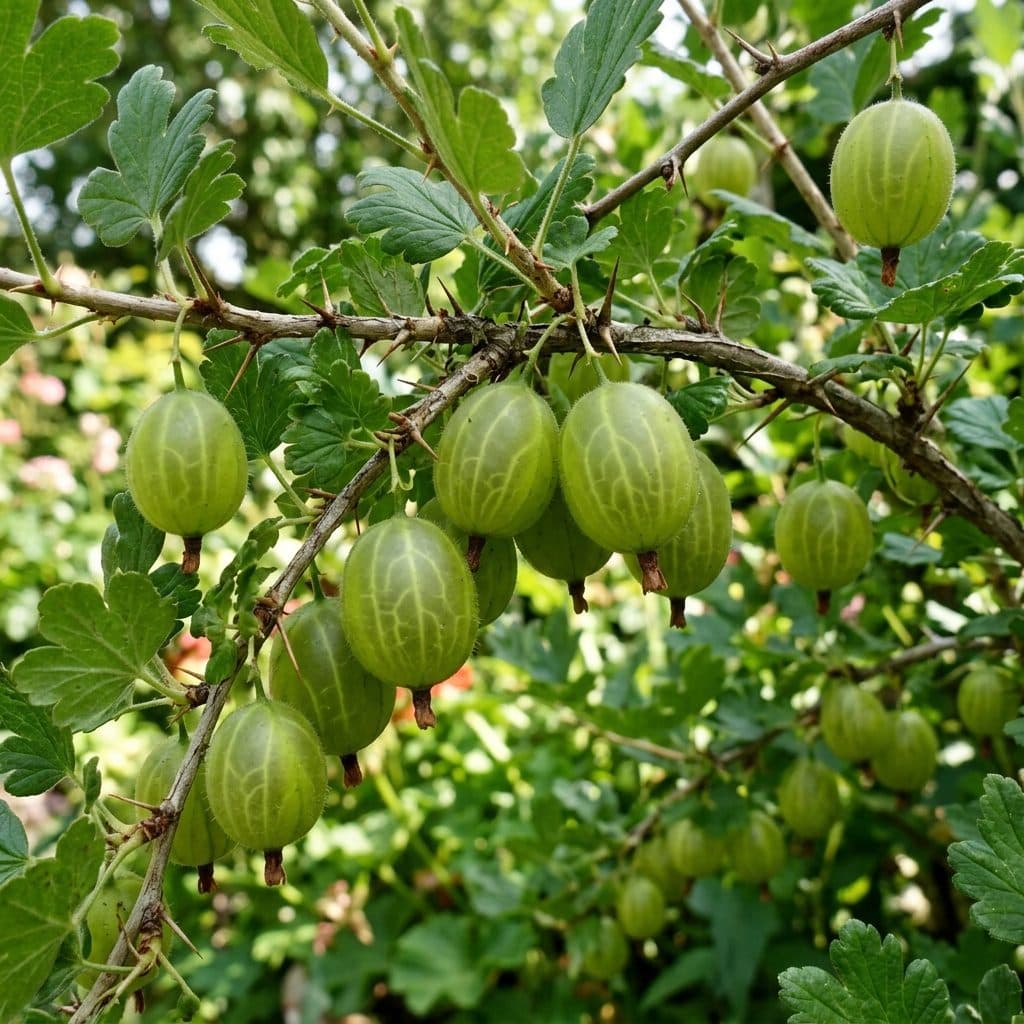
- Habit and stems: A woody deciduous shrub 1 to 1.5 m (3.3 to 5 ft) high with arching, greyish-brown branches armed with sharp nodal spines, usually grouped in sets of one to three at the leaf bases.
- Leaves: Alternate, simple, palmately 3- to 5-lobed, measuring 2 to 5 cm (0.8 to 2 in) across, with rounded teeth along the margins and soft, pubescent hairs on both surfaces.
- Flowers: Borne singly or in pairs (rarely trios) in leaf axils; small, bell-shaped, greenish to pinkish flowers with reflexed calyx lobes, hanging downward from short pedicels in early spring.
- Fruit: Large, fleshy, globose to ellipsoid berries measuring 1.5 to 2.5 cm (0.6 to 1 in) in diameter, displaying distinct longitudinal veins beneath a translucent skin, crowned by persistent withered calyx remnants. Skin colour ranges from pale green and yellow to deep red and purple, with smooth or softly bristly surfaces depending on cultivar.
Gooseberry differs markedly from red currant (Ribes rubrum) and black currant (Ribes nigrum), which completely lack nodal spines and bear smaller berries in elongated, multi-fruited racemes (strigs).
Cautions
Growers should prepare for specific pest, disease, and regulatory factors when planting gooseberry:
- American gooseberry mildew (Podosphaera mors-uvae): This fungal pathogen covers leaves, shoots, and developing fruit in a powdery white coating that matures into a felt-like brown crust. It stunts branch growth and ruins fruit crops. To manage mildew, plant resistant cultivars such as 'Invicta', 'Hinnonmaki Red', or 'Pax', maintain an open, well-pruned canopy, and avoid excessive nitrogen fertilisation that promotes lush, susceptible vegetative shoots.
- Gooseberry sawfly (Nematus ribesii): The green, black-spotted larvae of the gooseberry sawfly emerge in spring and can strip a bush of foliage within days. Inspect the lower interior of bushes weekly starting in May. Hand-pick larvae or apply biological controls like entomopathogenic nematodes or horticultural soap upon initial detection.
- Physical injury: Stout nodal spines cause painful puncture wounds and skin tears during pruning and harvest. Always wear heavy leather gauntlets when handling mature bushes.
- Regulatory status: Gooseberry is an alternate host for white pine blister rust (Cronartium ribicola), a fungus fatal to native five-needled pines. The plant is regulated in some jurisdictions; check your local list before planting.
Sources
- Royal Botanic Gardens, Kew. Ribes uva-crispa L. Plants of the World Online.
- Royal Horticultural Society. Gooseberries: How to grow
- Plants For A Future. Ribes uva-crispa - L.
- University of Minnesota Extension. Growing currants and gooseberries in the home garden
- Cornell University Cooperative Extension. Currants and Gooseberries