support
Comfrey
Symphytum officinale
International hardiness
- USDA 3-9
- RHS H7
- AU: Cool temperate, Warm temperate
Where it grows — regional guide
| Zones / rating | Regional notes |
|---|---|
USDA 3-9 | Widely naturalised across USDA Zones 3 to 9; deep brittle taproot fragments regenerate into new plants, making eradication from garden beds very difficult. |
| Zones / rating | Regional notes |
|---|---|
H7 (below -20C) | Native wetland wildflower rated RHS H7; wild plants self-seed aggressively, so growers often favour sterile Bocking 14 Russian comfrey to prevent spread. |
| Zones / rating | Regional notes |
|---|---|
Cool temperate, Warm temperate | Thrives in cool-temperate and moist tableland gardens; requires shade and regular summer irrigation to prevent leaf scorch in hot, dry Mediterranean climates. |
| Zones / rating | Regional notes |
|---|---|
USDA 3-9 (USDA scale) Canada uses its own zone system; Canadian zones run roughly one lower than USDA. | Extremely winter-hardy to -40 °C (-40 °F); valued on cold northern homesteads for producing multiple heavy cuttings of potassium-rich mulch each season. |
| Zones / rating | Regional notes |
|---|---|
No region-specific data yet | No region-specific data yet |
Comfrey (Symphytum officinale), historically referred to as common comfrey, knitbone, boneset, or consound, is a vigorous, clump-forming herbaceous perennial in the borage family (Boraginaceae). Native across Europe and western Asia, the species naturally inhabits damp riverbanks, canal verges, marshy meadows, and rich alluvial floodplains. For centuries, comfrey occupied a celebrated station in European folk herbalism as a topical poultice for fractures, bruises, and sprains. In modern regenerative agriculture and permaculture design, Symphytum officinale is a dynamic accumulator and "fertility engine" that produces enormous volumes of potassium-rich biomass, feeding surrounding orchard trees, activating compost piles, and replenishing depleted topsoils.
Within multi-strata food-forest systems, comfrey occupies a foundational support niche in the groundcover and herbaceous layer. Planted directly beneath the drip lines of hungry fruit trees such as apple, it acts as an in situ mulch factory while mining deep mineral reserves that shallow-rooted plants cannot reach. It works in close synergy with nitrogen-fixing cover crops like red clover and companion herbs such as spearmint. From mid-spring through late summer, its nodding, bell-shaped blossoms produce copious amounts of nectar with high sugar concentration, serving as an irresistible food source for long-tongued bumblebees and beneficial hoverflies.
Growing comfrey
Symphytum officinale is an extraordinarily resilient, cold-hardy perennial capable of thriving across USDA Hardiness Zones 3 through 9 and holding the highest cold-hardiness rating of RHS H7. Fully dormant root crowns comfortably survive winter blizzards and sub-zero soil freezes down to -40 °C (-40 °F). It requires a modest winter chill to initiate spring dormancy break and push vigorous vegetative crowns. Foliage dies back completely to the ground with the onset of hard autumn frost, re-emerging with explosive vigour in early spring. Comfrey thrives in temperate climates with regular rainfall; while it tolerates partial shade beneath high-canopy trees, maximum biomass accumulation and flowering occur in full sun receiving at least six hours of unobstructed light.
Soil requirements are modest, though comfrey performs best in deep, fertile, moisture-retentive loams rich in organic matter. Because comfrey develops a massive, vertical taproot extending 2 to 3 m (6.6 to 10 ft) deep into the earth, it requires reasonable soil depth to achieve full productive potential. It prospers in soils spanning a wide pH range of 6.0 to 7.5. While mature plants with established taproots withstand considerable surface drought, prolonged moisture stress halts vegetative growth and causes lower leaves to yellow and collapse. Comfrey possesses exceptional tolerance to municipal greywater and diluted animal manure slurries, thriving in positions adjacent to barn runoff or bio-filtration ditches.
Propagation of Symphytum officinale is straightforward, achieved via seed, crown divisions, or root cuttings. True common comfrey is fully fertile and produces viable seeds that germinate in warm spring soils. However, within managed permaculture gardens, growers almost exclusively propagate comfrey using root cuttings (measuring 5 to 8 cm [2 to 3 in] in length) planted horizontally 5 cm (2 in) deep in moist soil. Space individual crowns 60 to 90 cm (2 to 3 ft) apart in dedicated mulch beds or tree rings. Plants establish rapidly, producing harvestable foliage within four to six months of planting.
Harvest and uses
Comfrey is cultivated primarily for its prolific, nutrient-dense vegetative biomass. Leaves are harvested by cutting the entire plant down to roughly 5 to 8 cm (2 to 3 in) above the soil surface using a sharp sickle, scythe, or hand shears. In fertile soils with adequate moisture, comfrey can be cut four to five times per season from May to October, yielding up to 10 to 15 kg (22 to 33 lb) of fresh green biomass per square metre annually.
The cut foliage is uniquely rich in potassium, nitrogen, phosphorus, calcium, and magnesium, making it an extraordinary organic soil amendment:
- Chop-and-drop surface mulch: Freshly severed leaves are laid directly beneath fruit trees and berry bushes. Because comfrey possesses a low carbon-to-nitrogen ratio and minimal woody lignin, the thick, fleshy leaves decompose rapidly within weeks, releasing bio-available potassium directly to surface feeder roots without tying up soil nitrogen.
- Liquid fertiliser tea: Tightly packing a bucket or barrel with cut comfrey leaves, weighting them down with a brick, and adding water yields a dark, concentrated liquid extract after three to four weeks of anaerobic decomposition. Diluted with water until it resembles weak black tea (roughly 1:10 ratio), this liquid is a potent potassium boost for flowering vegetables and fruiting trees.
- Compost activator: Adding layers of comfrey foliage to carbon-heavy compost heaps generates intense biological heat, accelerating the decomposition of dry leaves, straw, and wood shavings.
Beyond soil fertility, comfrey roots and leaves contain allantoin, a cell-proliferant compound historically used in topical salves and poultices to soothe minor abrasions and sprains. However, comfrey must never be ingested internally due to serious biochemical risks.
Identifying comfrey
Symphytum officinale is easily recognised in the field by several definitive botanical characteristics:
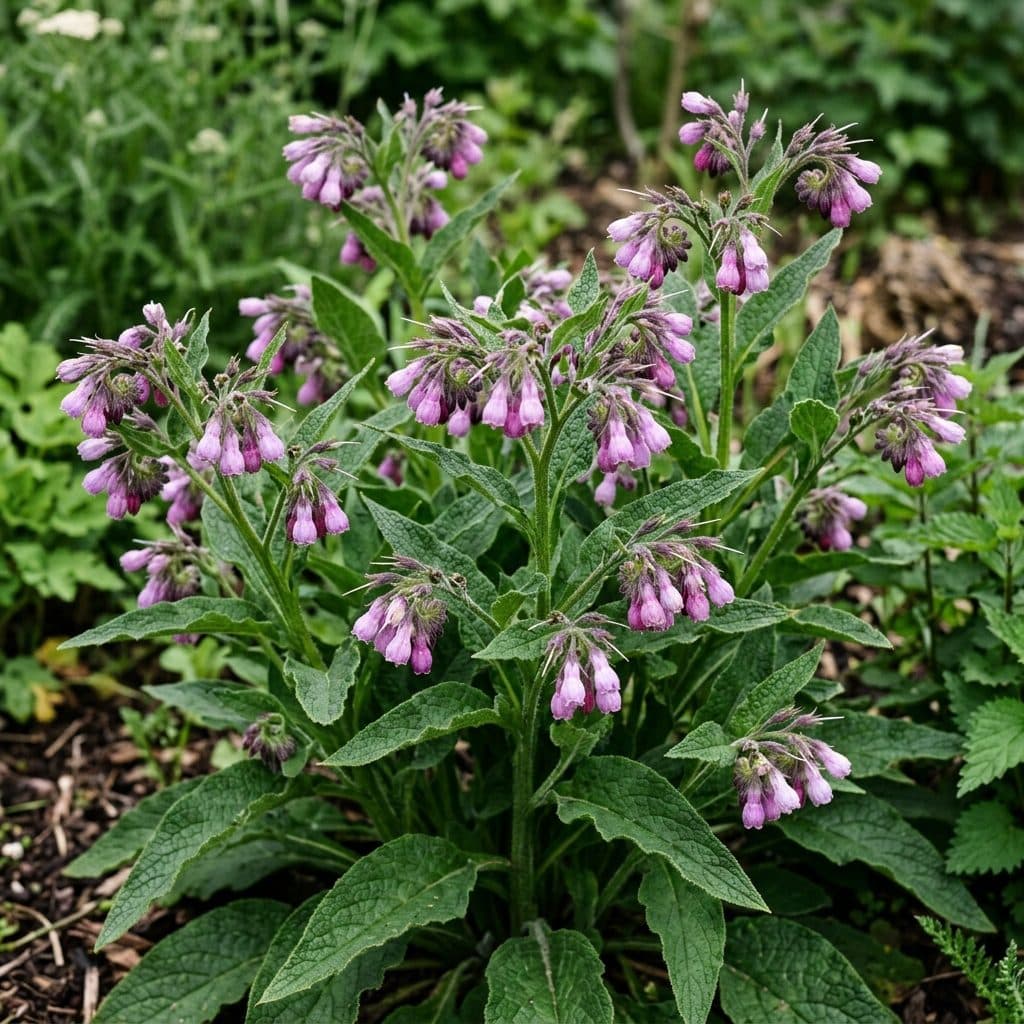
- Habit: A vigorous, clump-forming herbaceous perennial growing 60 to 100 cm (2 to 3.3 ft) tall and wide, forming a dense basal rosette of large, coarse foliage from which thick flowering stalks arise.
- Leaves: Alternate, simple, thick, lanceolate to broadly ovate leaves measuring 20 to 50 cm (8 to 20 in) long and 8 to 15 cm (3.1 to 5.9 in) wide. Margins are entire. The leaf surface is dull green, distinctly wrinkled, and densely blanketed on both sides with stiff, bristly, sharp multicellular hairs that feel abrasive to the touch. Upper stem leaves are decurrent, meaning the leaf base continues down the stem as a raised green wing.
- Flowers: Borne in dense, characteristic, one-sided coiled cymes (scorpioid cymes) that uncurl gradually as buds open. The nodding, tubular or bell-shaped flowers measure 12 to 18 mm (0.5 to 0.7 in) long, varying in colour from creamy-yellow and pinkish-purple to deep violet-blue.
- Roots: A thick, fleshy, brittle vertical taproot system with an exterior skin that is jet-black, contrasting sharply with the creamy-white, mucilaginous interior flesh.
Common comfrey is distinguished from Russian comfrey (Symphytum × uplandicum) by its prominently winged, decurrent upper stem leaves and viable seed production, whereas Russian comfrey has less winged stems and is sexually sterile.
Cautions
Cultivating comfrey demands absolute adherence to several critical toxicological, legal, and agronomic cautions:
- Severe hepatotoxicity from pyrrolizidine alkaloids: Comfrey contains concentrated levels of unsaturated pyrrolizidine alkaloids (principally symphytine, echimidine, and lycopsamine). When ingested orally, these compounds are bioactivated by hepatic enzymes into toxic pyrrolic metabolites that cross-link cellular DNA, causing acute and chronic hepatic veno-occlusive disease (HVOD), Budd-Chiari syndrome, irreversible liver cirrhosis, and liver failure. Pyrrolizidine alkaloids are also documented carcinogens. Regulatory health agencies worldwide—including the US FDA, Health Canada, the UK MHRA, and the European Medicines Agency—have banned or strictly prohibited comfrey products for internal use. Never drink comfrey tea, never eat comfrey leaves in salads or smoothies, and never ingest comfrey capsules.
- Livestock toxicity: While historically touted as high-protein livestock forage, comfrey causes cumulative liver damage in cattle, horses, sheep, and pigs when fed in significant quantities. Do not graze livestock on comfrey beds.
- Invasiveness and intractable persistence: True common comfrey (Symphytum officinale) produces viable seed that birds, ants, and water spread readily into garden beds, pastures, and pristine wetland habitats. Furthermore, its brittle black taproot shatters when dug up; every severed root fragment as small as 1 cm (0.4 in) will sprout into a new vigorous plant. Rotary-tilling a comfrey patch will multiply it into hundreds of unwanted plants that are practically impossible to eradicate mechanically. Homesteaders are strongly advised to plant only the sterile Bocking 14 Russian comfrey cultivar (S. × uplandicum), which cannot set seed.
- Contact dermatitis: The stiff, silica-bearing bristly hairs covering comfrey stems and leaves cause mechanical skin irritation, itching, and erythematous rash upon handling. Always wear heavy garden gloves and long sleeves when harvesting comfrey.
Sources
- Royal Botanic Gardens, Kew. Symphytum officinale L. Plants of the World Online.
- USDA PLANTS Database. Symphytum officinale L.
- Plants For A Future. Symphytum officinale - L.
- North Carolina State Extension Gardener Plant Toolbox. Symphytum officinale