secondary
Egyptian walking onion
Allium × proliferum
International hardiness
- USDA 3-9
- RHS H7
- AU: Cool temperate, Warm temperate
Where it grows — regional guide
| Zones / rating | Regional notes |
|---|---|
USDA 3-9 | Extremely cold-hardy across northern and prairie states; plant top-set bulbils in late summer or autumn for spring scallions. |
| Zones / rating | Regional notes |
|---|---|
H7 (below -20C) | An outstanding perennial cottage-garden crop across Britain; overwinters without protection and yields year-round salad greens. |
| Zones / rating | Regional notes |
|---|---|
Cool temperate, Warm temperate | Performs reliably in cool-temperate and Mediterranean regions of southern Australia; dormant during peak dry summer heat. |
| Zones / rating | Regional notes |
|---|---|
USDA 3-9 (USDA scale) Canada uses its own zone system; Canadian zones run roughly one lower than USDA. | Tolerates severe Canadian winters to Zone 3; bulbils survive under deep snow and root rapidly during spring thaw. |
| Zones / rating | Regional notes |
|---|---|
No region-specific data yet | No region-specific data yet |
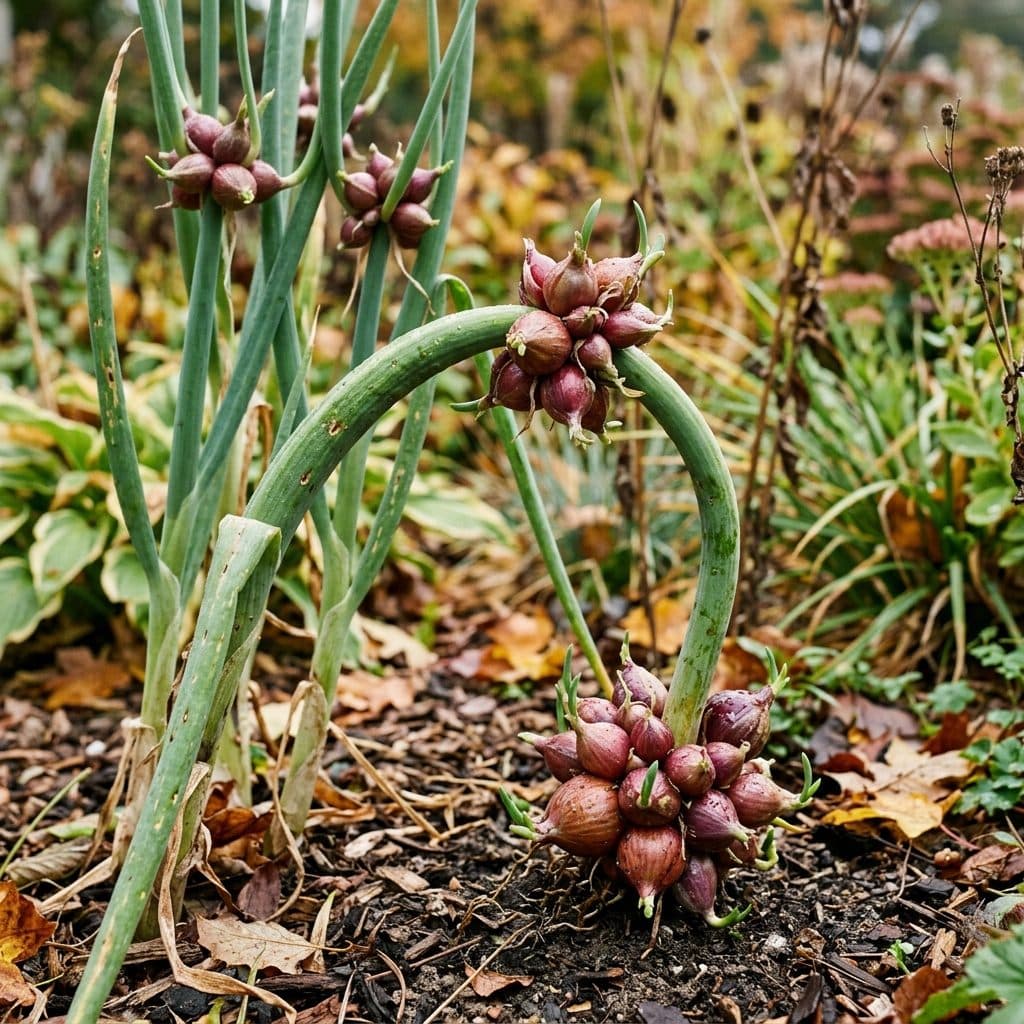
Egyptian walking onion (Allium × proliferum), also known as the tree onion, top onion, or catawissa onion, is a cold-hardy perennial geophyte in the amaryllis family (Amaryllidaceae). Botanically recognized as a natural interspecific hybrid between the common bulb onion and the Welsh spring onion, this remarkable plant does not produce typical floral blossoms or viable seeds. Instead, it develops clusters of miniature, reddish-purple aerial bulbils at the apex of its hollow stems. As these bulbils grow heavy, the stalks bow toward the ground, allowing the bulbils to root several feet away and effectively "walk" across the garden over successive seasons.
In a homestead food forest or permaculture guild, Egyptian walking onions provide a perpetual supply of allium aromatics with zero annual seed purchases. While biennial garden onions require precise seasonal sowing, thinning, and curing, walking onions form a permanent perennial ground layer. They can be integrated around the drip line of fruit trees or planted alongside perennial root crops, where their sulfurous root exudates and pungent foliage help deter grazing pests and soil pathogens.
Every portion of the plant is edible, with culinary uses across three separate harvesting phases each season. In early spring, growers cut the tender green hollow leaves like scallions; in midsummer, they harvest the pungent aerial bulbils for pickling; and in late autumn, they dig the dense clusters of underground bulbs for winter cooking.
Growing Egyptian walking onion
Egyptian walking onions are among the hardiest vegetables in cultivation, withstanding sub-zero winter temperatures down to -35 °C (-31 °F) without protective mulching, making them reliable across USDA Hardiness Zones 3 through 9. They require no special winter protection and emerge through frozen crusts or snowbanks as soon as daytime temperatures nudge above freezing in late winter.
The crop performs best in fertile, loose, well-drained loamy soils enriched with decomposed compost, with a soil pH between 6.2 and 7.0. While highly adaptable to various soil textures, including heavier clay-loams, good drainage is vital during wet winter months to prevent subterranean bulb rot. Full sunlight is ideal, which produces stout, upright scapes and rapid bulbil development, though plants tolerate partial shade in food forest borders.
Consistent soil moisture produces succulent, tender spring greens and plump bulbils. While established clumps survive extended summer dry periods by slipping into semi-dormancy, supplementary watering during dry spells maintains active foliage and prevents early drying of stems. A light annual application of composted manure or balanced organic fertiliser in early spring supplies all the nutrients necessary for healthy perennial growth.
Propagation is effortless and entirely vegetative. Plant aerial bulbils or divide established underground bulb clusters in late summer or early autumn. Set bulbils 2.5 to 5 cm (1 to 2 in) deep with the pointed tip facing upward. Space individual bulbils 15 to 20 cm (6 to 8 in) apart in rows spaced 30 cm (12 in) apart. Bulbils root rapidly in warm autumn soil, establishing small green shoots before winter dormancy and bursting into vigorous growth early the following spring.
If allowed to self-propagate, the heavy summer bulbils will pull the scapes downward. When they make contact with bare soil 40 to 60 cm (16 to 24 in) from the parent crown, they send down roots and form a new vegetative colony. To prevent the patch from invading neighbouring beds, growers can harvest the bulbils before the stalks collapse, or grow the patch within a timber-framed or stone-bordered bed.
Harvest and uses
A well-managed bed of Egyptian walking onions yields food throughout almost the entire year, distributed across three distinct harvests.
The first harvest begins in late winter and early spring, from March through May, when the plants produce an abundance of lush, hollow green leaves. Cut these tender leaves at ground level to use as fresh scallions, salad greens, or soup garnishes. As long as the central growing point remains intact, the plant continuously regenerates fresh leaves.
The second harvest occurs in midsummer, typically July and August, when the aerial bulbils mature. The bulbils develop in clusters of 3 to 15 atop the central scape, wrapped initially in a papery spathe that splits to reveal smooth, glossy, reddish-brown mini-onions measuring 1 to 2.5 cm (0.4 to 1 in) in diameter. Snap the bulbils off their stems. These marble-sized top-sets have a sharp, concentrated onion bite. They can be peeled and pickled whole in spiced vinegar, roasted whole in cast-iron skillets, or chopped into relishes and sauces.
The third harvest takes place in late autumn after top growth has died back. Dig down with a hand trowel or garden fork beneath the mature crowns. Each original plant divides into a tight subterranean cluster of three to six elongated, shallot-like bulbs with tough, coppery-red outer skins. Lift half of the bulbs in each clump for kitchen use and leave the remainder in the ground to renew the perennial patch for the coming spring. The lifted bulbs keep in a cool, dry pantry at 2 to 5 °C (35 to 41 °F) for three to four months.
Identifying Egyptian walking onion
Egyptian walking onion is readily identified by its perennial clustering habit, tubular foliage, and distinctive aerial top-sets:
- Foliage: Clump-forming basal fans of hollow, cylindrical (fistulose), glaucous blue-green leaves measuring 30 to 60 cm (12 to 24 in) long and 1 to 2 cm (0.4 to 0.8 in) in diameter, giving off a strong onion aroma when bruised.
- Flowering scapes: Stout, erect, hollow flowering stems reaching 60 to 90 cm (24 to 36 in) in height, terminating in a dense cluster of vegetative bulbils instead of true flowers.
- Bulbils: Clusters of 3 to 15 small, round to teardrop-shaped aerial bulbs, 1 to 2.5 cm (0.4 to 1 in) across, covered in reddish-purple to copper papery tunics. Frequently, secondary mini-scapes sprout directly from the primary bulbils, producing a tiered or "proliferating" architecture.
- Underground bulbs: Clustered, shallot-like, elongated ovoid bulbs measuring 2 to 4 cm (0.8 to 1.6 in) in diameter with crisp white flesh and reddish-brown outer skins.
The plant is distinguished from the common onion (Allium cepa) by its perennial clump-forming habit and aerial bulbils replacing flowers; from chives (Allium schoenoprasum) by its much thicker, robust scapes and substantial bulbs; and from garlic (garlic) by its hollow, tubular leaves rather than flat, strap-like foliage.
Cautions
Growers should keep several management, disease, and veterinary factors in mind:
- Aggressive wandering: Without intervention, falling stems deposit bulbils outward each year, allowing the patch to spread across garden beds and choke out slower-growing perennials. Collect aerial bulbils promptly or enclose plantings within bordered beds.
- Fungal liabilities: The plant can harbor onion white rot (Stromatinia cepivora), a persistent soil-borne fungal pathogen that rots the root plate and remains viable in soil for decades. Avoid planting walking onions where allium white rot has occurred. Downy mildew (Peronospora destructor) can cause yellowing and collapse of leaves during prolonged cool, wet spring weather; ensure adequate spacing for airflow.
- Toxicity to domestic pets: All members of the genus Allium contain organosulfur compounds, including n-propyl disulphide, that are toxic to dogs, cats, and other mammalian pets. Ingestion of raw, cooked, or dried walking onion greens or bulbs causes oxidative damage to red blood cells, resulting in hemolytic anemia. Keep trimmings and harvested bulbs strictly away from household pets.
- Regulatory note: The plant is regulated in some jurisdictions; check your local list before planting.
Sources
- Royal Botanic Gardens, Kew. Allium × proliferum (Moench) Schrad. ex Willd. Plants of the World Online.
- USDA PLANTS Database. Allium × proliferum (Moench) Schrad. ex Willd.
- University of Wisconsin–Madison Division of Extension. Egyptian Walking Onions, Allium × proliferum
- Plants For A Future. Allium proliferum
- Royal Horticultural Society. Allium × proliferum