secondary
Katuk
Breynia androgyna
International hardiness
- USDA 10-12
- RHS H1b
- AU: Tropical, Subtropical
Where it grows — regional guide
| Zones / rating | Regional notes |
|---|---|
USDA 10-12 | Perennial in south Florida and Hawaii (USDA Zones 10 to 12); killed by freezing temperatures and requires moist, humid conditions with afternoon shade. |
| Zones / rating | Regional notes |
|---|---|
H1b (10 to 15C) | Strictly a heated glasshouse or conservatory specimen across Europe rated RHS H1b; requires minimum temperatures above 10 °C (50 °F) to thrive. |
| Zones / rating | Regional notes |
|---|---|
Tropical, Subtropical | Thrives across tropical Queensland and the Top End; excellent understorey perennial green yielding high-protein harvests throughout the wet season. |
| Zones / rating | Regional notes |
|---|---|
USDA 10-12 (USDA scale) Canada uses its own zone system; Canadian zones run roughly one lower than USDA. | No region-specific data yet |
| Zones / rating | Regional notes |
|---|---|
No region-specific data yet | No region-specific data yet |
Katuk (Breynia androgyna, widely sold under its historical synonym Sauropus androgynus), widely known in Southeast Asia as sweet leaf, star gooseberry, mani cai, or cekur manis, is a slender, upright perennial shrub belonging to the leafflower family (Phyllanthaceae). Native to tropical lowland rainforests and riverine margins across South and Southeast Asia—ranging from India and southern China through Malaysia, Thailand, and Indonesia—katuk has long served as one of the most popular and nutritious homegrown leafy vegetables in the humid tropics. Often termed the "multivitamin plant", its dark green foliage has exceptional concentrations of plant protein, provitamin A, vitamin C, calcium, iron, and zinc. For homesteaders and permaculture designers working in tropical and subtropical regions, Sauropus androgynus provides an abundance of tender, nutrient-dense greens from an easy-to-manage understorey hedge.
Within tropical agroforestry systems, katuk performs admirably as a shade-tolerant secondary-stratum vegetable shrub or living garden hedge. Naturally adapted to the humid, dappled understorey of tropical rainforests, it thrives when interplanted beneath nitrogen-fixing canopy trees like moringa or established banana stools. It integrates smoothly into moist herbaceous layers alongside ginger, benefiting from steady soil moisture and shared wind protection. In addition to providing family sustenance, periodic hedge trimmings supply nitrogen-rich green mulch that decomposes quickly, feeding the surrounding soil food web and suppressing competitive weeds.
Growing katuk
Sauropus androgynus is an obligate tropical species adapted to warm, humid, frost-free environments with high annual rainfall, growing reliably outdoors in USDA Hardiness Zones 10 through 12 and holding an RHS hardiness rating of H1b. The plant has zero tolerance to freezing temperatures: foliage collapses and succulent stems suffer irreversible damage at 0 °C (32 °F). Even non-freezing temperatures below 10 °C (50 °F) cause severe physiological stress, resulting in extensive yellowing, defoliation, and halted growth. The species flourishes under steady tropical temperatures between 24 and 35 °C (75 and 95 °F). While katuk grows satisfactorily in full sun provided soil moisture is abundant, it produces significantly larger, sweeter, and more tender leaves when grown in partial shade or dappled forest light receiving 30 to 50 percent canopy filtration.
Soil requirements are modest, though the plant prefers fertile, moist, organically rich loams or alluvial clays with a slightly acidic to neutral pH between 6.0 and 7.0. Consistent soil moisture is essential for continuous succulent growth; during dry seasons or drought intervals, regular supplemental watering is necessary to prevent premature flowering, leaf toughening, and defoliation. However, soils must remain well aerated: waterlogged, stagnant anaerobic conditions encourage fungal root rots. Applying an organic compost mulch conserves essential root-zone humidity.
Propagation of katuk is exceptionally easy, carried out almost exclusively by semi-hardwood stem cuttings. Take healthy, pencil-thick green or greyish stems measuring 15 to 25 cm (6 to 10 in) in length from vigorous mature branches. Remove lower leaves and insert cuttings 8 to 10 cm (3 to 4 in) deep into moist, well-draining potting compost or directly into prepared, shaded garden beds. Under warm, humid conditions, cuttings develop vigorous root systems within two to three weeks with near-total success rates. Space plants 30 to 45 cm (12 to 18 in) apart for a dense, continuous edible hedge, or 60 to 90 cm (2 to 3 ft) apart for standalone specimen bushes. When bushes reach 1 m (3.3 ft) in height, pruning terminal leaders encourages lateral branching and keeps edible foliage within easy harvesting reach. Young plants produce initial harvests within three to four months.
Harvest and uses
Harvesting of katuk foliage takes place continuously throughout the warm tropical year. Growers harvest tender apical shoots—typically the top 10 to 15 cm (4 to 6 in) of the stem—along with young, tender leaves, by snapping them cleanly by hand or cutting them with sharp shears. Regular harvesting prevents stems from becoming leggy and woody, stimulating continuous flushes of succulent new growth.
In traditional Southeast Asian culinary practice, cooked katuk is celebrated for its unique flavour profile. Unlike many bitter tropical greens, katuk leaves possess a pleasant, sweet, nutty taste reminiscent of fresh green peas and asparagus, retaining a firm, tender texture without turning unpleasantly slimy upon cooking.
While small quantities of young leaves are occasionally nibbled fresh in Southeast Asian salads, culinary safety requires cooking. In traditional cooking, katuk leaves and tender shoot tips are stripped from woody stems and simmered in aromatic coconut-milk curries (such as Malaysian sayur manis), folded into egg drop soups, stir-fried with garlic and chillies, or steamed alongside rice. Cooking softens the slight fibrousness of older leaves and hydrolyses trace compounds, rendering the vegetable completely safe and wholesome. A single well-tended mature katuk hedge row measuring 3 m (10 ft) in length supplies regular weekly harvests of fresh greens for a household, yielding 4 to 8 kg (8.8 to 17.6 lb) of edible greens annually.
Identifying katuk
Sauropus androgynus is easily identified in tropical landscapes by the following distinctive morphological traits:
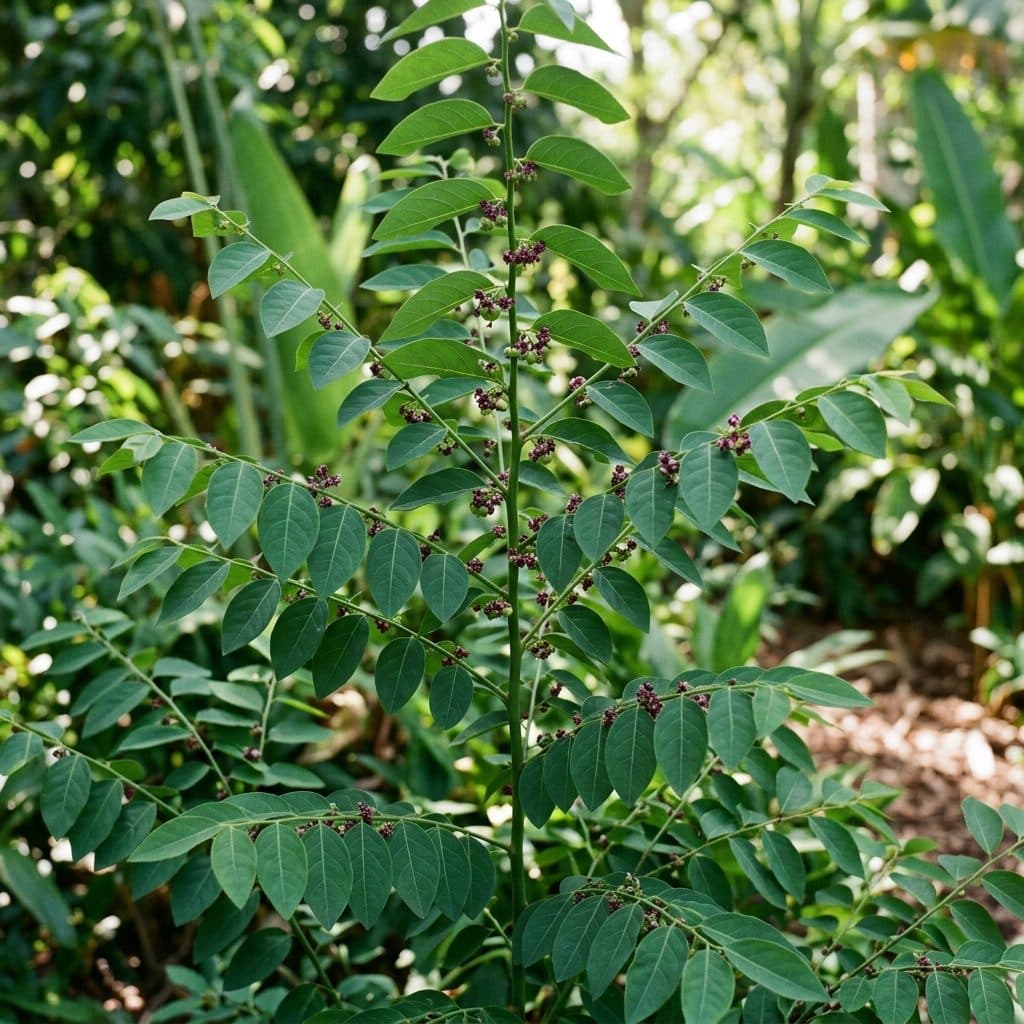
- Habit: An upright, slender, multi-stemmed perennial shrub typically growing 1.5 to 2.5 m (5 to 8 ft) in height, with arching, cylindrical green stems that become semi-woody with age.
- Leaves: Alternate, simple, distichous leaves arranged neatly in two flat, alternating ranks along slender green twigs, giving the appearance of pinnately compound foliage. Individual leaves are ovate to elliptic-lanceolate, measuring 3 to 10 cm (1.2 to 4 in) long and 1.5 to 3.5 cm (0.6 to 1.4 in) wide, with entire margins, acute tips, and short petioles. The upper surface is deep matte green, often bearing subtle silvery-white mottling along the central midrib, while the lower surface is paler green.
- Flowers: Minute, unisexual blossoms borne in small clusters in leaf axils. Flowers lack true petals; male flowers are tiny, flattened, dark purplish-red discs measuring 3 to 5 mm (0.1 to 0.2 in) across, while female flowers are slightly larger with six dark reddish-purple calyx lobes.
- Fruit: Small, fleshy, globose or depressed-globose capsules measuring 1 to 1.5 cm (0.4 to 0.6 in) across, turning creamy-white or pale purplish-pink at maturity, splitting open into three compartments containing small black seeds.
Katuk is easily distinguished from sweet potato greens (Ipomoea batatas) by its upright shrub habit, and from moringa (Moringa oleifera) by its simple, two-ranked leaves compared to moringa's tripinnately compound foliage.
Cautions
Cultivators and consumers of Sauropus androgynus must adhere strictly to documented biochemical, culinary, and pathological cautions:
- Pulmonary toxicity and bronchiolitis obliterans from raw juice: Consuming substantial quantities of fresh, raw katuk—particularly in the form of concentrated raw juicing—is medically documented to cause irreversible, life-threatening bronchiolitis obliterans (severe obstructive lung disease). During a weight-loss craze in Taiwan in the mid-1990s, hundreds of individuals who consumed daily glasses of raw, liquefied katuk juice developed progressive respiratory failure, with several fatalities and patients requiring lung transplants. The pulmonary endothelial damage is attributed to toxic alkaloids, principally papaverine and related spasmolytic compounds, which induce severe vascular and bronchiolar fibrosis. Concentrated raw juices, diet powders, and excessive daily consumption are strictly prohibited.
- Mandatory moderate culinary cooking: Traditional culinary consumption—where modest portions of leaves are cooked, boiled in soups, or stir-fried—has an extensive history of safe human use across Southeast Asia. Heat application degrades volatile constituents and denatures plant enzymes. However, katuk should always be treated as a cooked culinary vegetable eaten in moderate dietary portions, not as an extreme health tonic.
- Severe frost intolerance: Stems are destroyed at 0 °C (32 °F). In regions with occasional light winter frosts, katuk must be grown in containers and brought into warm, heated indoor spaces before autumn temperatures dip below 10 °C (50 °F).
- Sucking insect pests: In warm, dry greenhouse settings, katuk is vulnerable to infestations of two-spotted spider mites (Tetranychus urticae) and greenhouse whiteflies, which cause leaf stippling and defoliation. Maintain high ambient humidity to deter mite establishment.
Sources
- Royal Botanic Gardens, Kew. Breynia androgyna (L.) Chakrab. & N.P.Balakr. Plants of the World Online.
- USDA PLANTS Database. Sauropus androgynus (L.) Merr.
- Plants For A Future. Sauropus androgynus - (L.)Merr.
- PubMed Central (PMC). Sauropus androgynus (L.) Merr. Induced Bronchiolitis Obliterans: From Botanical Studies to Toxicology. Evidence-Based Complementary and Alternative Medicine.