Key takeaways
- Select succulents and cacti that need at least four hours of direct sunlight daily for best growth.
- Provide well-draining soil, typically a mix with 50% or more inorganic material like perlite or pumice.
- Water deeply but infrequently, allowing the soil to dry completely between waterings, often every two to four weeks.
- Choose species like Haworthia, Gasteria, Opuntia microdasys, and Mammillaria elongata for their beginner-friendly nature.
- Monitor for common pests like mealybugs, which can be treated with a 70% isopropyl alcohol solution.
- Repot plants every two to three years into a slightly larger container to support healthy root development.
Quick answer: To grow succulents and cacti in US homes, provide at least 4-6 hours of direct sunlight, use well-draining soil, and water deeply but infrequently. Choose beginner-friendly species like Haworthia or Mammillaria that fit your available light.
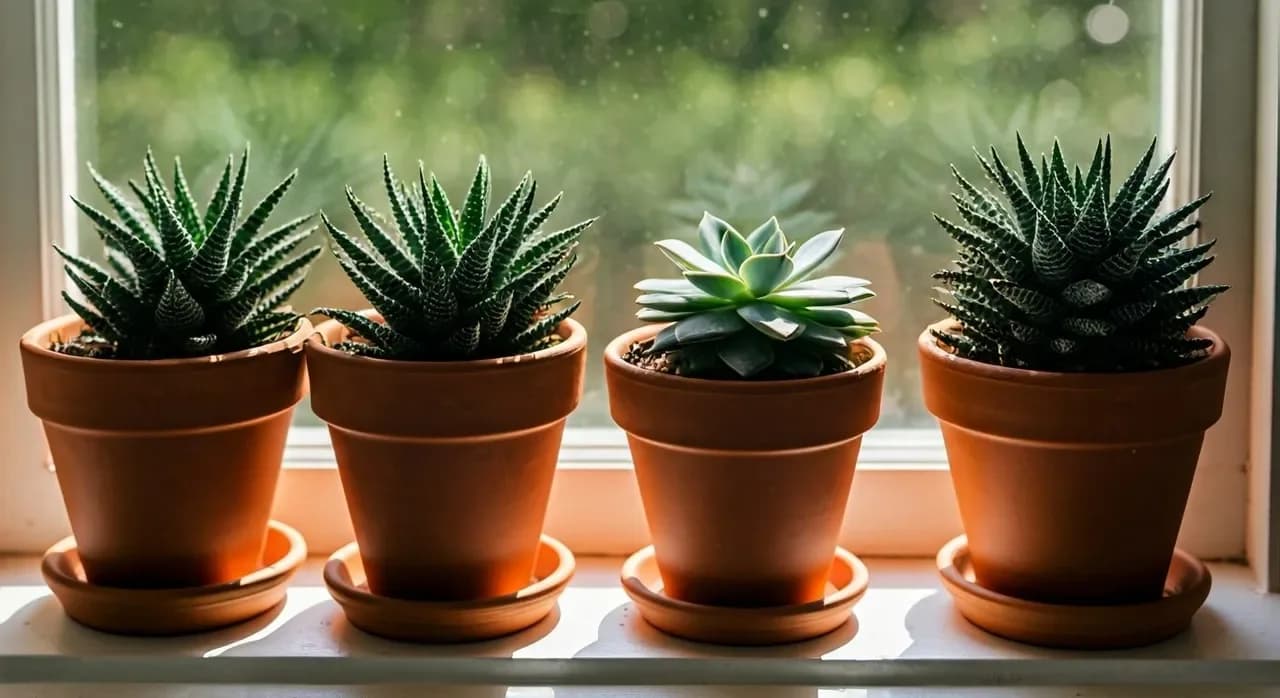
In many US homes, particularly apartments in urban centers like New York City or Chicago, a sunny windowsill might be the only available space for growing plants. For those living in USDA zones 6 through 10, where outdoor conditions can vary widely, bringing a bit of the desert indoors gives a rewarding gardening experience. Succulents and cacti, known for their resilience and striking forms, are excellent choices for these bright, limited spaces, often requiring only 4 to 6 hours of direct sunlight each day.
While some growers might find the prospect of caring for these unique plants daunting, many species are surprisingly forgiving, making them ideal for beginners. Once you dial in light, watering, and soil drainage, you can grow healthy plants indoors even on a 24-inch window ledge. This guide will walk you through selecting and caring for the best beginner succulents and cacti suited for the consistent light of a US windowsill.
Understanding the basics of succulents and cacti
Many people use the terms “succulent” and “cactus” interchangeably, but there’s a key distinction. All cacti are succulents, but not all succulents are cacti [2]. Succulents are a broad group of plants that have evolved to store water in their leaves, stems, or roots, allowing them to survive in arid climates with infrequent rainfall, sometimes receiving less than 10 inches of precipitation annually. Cacti, on the other hand, are a specific family of succulents (Cactaceae) characterized by areoles—small, cushion-like structures from which spines, flowers, and new growth emerge [2]. This anatomical difference is fundamental to their classification.
These plants originate from diverse dry regions across the globe, from the deserts of the US Southwest, such as Arizona and New Mexico, to the semi-arid regions of South Africa and the high altitudes of the Andes mountains. In their native habitats, they often experience intense sunlight for 8 to 12 hours daily and prolonged dry spells, sometimes lasting several months. When grown indoors in a US apartment, replicating these conditions, particularly the abundant light and infrequent watering, matters for their health. A south-facing window in a home in USDA zone 7, for example, typically provides sufficient light for many species, offering 6 or more hours of direct sun.
Key differences between cacti and other succulents
While both store water, their structural adaptations vary. Cacti generally have spines and areoles, which are absent in most other succulents. For instance, an Aloe vera plant, a common succulent, stores water in its thick leaves, while a Mammillaria cactus stores water in its ribbed stem. Understanding these basic differences helps in providing tailored care so your plants thrive in a 70°F indoor environment.
- Cacti: Possess areoles, often with spines or glochids, typically leafless or with highly reduced leaves.
- Leafy Succulents: Store water primarily in fleshy leaves, such as Echeveria or Crassula.
- Stem Succulents: Store water in their stems, like some Euphorbia species, which can resemble cacti but lack areoles.
- Root Succulents: Less common for indoor plants, they store water in underground root structures.
Choosing the right plants for your windowsill
Selecting the correct species is the first step to success for any indoor gardener in the US. Not all succulents and cacti are suited for windowsill life, especially if your window only receives a few hours of indirect light. For optimal growth, aim for a south-facing window that provides at least six hours of direct sunlight daily, particularly in northern states like Michigan or Montana during winter months. East or west-facing windows can also work, offering 3 to 5 hours of direct sun, but may require supplemental lighting, such as a compact LED grow light, to prevent etiolation. Consider exploring options like a reflective indoor grow tent if natural light is consistently insufficient.
When evaluating plants, consider their mature size. A Saguaro cactus, for instance, can grow over 40 feet tall in its native Arizona desert, making it unsuitable for a 12-inch windowsill. Instead, focus on compact varieties that typically reach a maximum height of 6 to 12 inches indoors. Species like Haworthia fasciata, often called Zebra Haworthia, remain relatively small, usually under 6 inches in diameter, and tolerate slightly lower light conditions than many other succulents, making them excellent choices for homes in USDA zone 5 or 6. Just as you’d select the best perennials for specific garden roles, choose succulents that fit your indoor space and light conditions.
Top five beginner-friendly species
For those new to succulent and cactus care, certain species stand out for their resilience and ease of maintenance. These plants are forgiving of occasional neglect and can thrive with consistent, moderate care. Many will flower indoors, adding a splash of color to your home, often producing blooms that last for several days or even weeks.
- Haworthia fasciata (Zebra Haworthia): Tolerates lower light, grows to about 4 inches tall, and needs water every 3-4 weeks.
- Gasteria glomerata (Ox Tongue Plant): Similar to Haworthia, it has thick, rough leaves and reaches 3-5 inches in height, thriving in bright, indirect light.
- Echeveria pulidonis (Pulido’s Echeveria): Forms a compact rosette, up to 6 inches wide, with red-tipped leaves, requiring 6+ hours of direct sun.
- Opuntia microdasys (Bunny Ear Cactus): A spineless cactus with distinctive glochids, reaching 12-24 inches tall, excellent for sunny windows [4].
- Mammillaria elongata (Ladyfinger Cactus): A clumping cactus with small, finger-like stems, growing to 6 inches tall, and producing small yellow or white flowers.
Essential care for indoor success
The foundation of healthy succulents and cacti lies in proper potting and watering. These plants are highly susceptible to root rot if their roots sit in consistently wet soil, a common issue in indoor environments where humidity can be higher than in their native deserts. Use a specialized succulent and cactus potting mix, or create your own by amending standard potting soil with inorganic materials like perlite, pumice, or coarse sand. A good mix should contain at least 50% inorganic material to ensure rapid drainage, allowing excess water to escape quickly [4]. A 4-inch terracotta pot, for example, will dry out much faster than a glazed ceramic pot of the same size, reducing the risk of overwatering.
Watering is perhaps the most critical aspect of care. The “soak and dry” method is generally recommended: water thoroughly until water drains from the bottom of the pot, then allow the soil to dry out completely before watering again. This can mean watering every two weeks in summer or as infrequently as once a month in winter, depending on your home’s temperature, humidity, and the plant’s growth cycle. For plants in a 6-inch pot in a typical 72°F indoor setting, checking the soil moisture by inserting a finger two inches deep can guide your watering schedule. Overwatering is the most common cause of succulent and cactus failure, accounting for over 70% of reported issues among new growers [1].
Managing light and common pests
Even with the best watering schedule, insufficient light will lead to weak, leggy growth, known as etiolation. If your windowsill doesn’t provide the recommended 6+ hours of direct sunlight, consider supplementing with a full-spectrum LED grow light, positioned 6 to 12 inches above the plants. For example, a low-wattage LED grow light can effectively illuminate a small area. Keep an eye out for common indoor pests, particularly mealybugs, which appear as small, white, cottony masses, often in leaf axils or on stems. These pests can be effectively treated by dabbing them with a cotton swab dipped in 70% isopropyl alcohol [1].
- Potting Mix: Use a mix with 50% or more inorganic material for drainage, such as a 1:1 ratio of potting soil to pumice.
- Watering Frequency: Water every two to four weeks, or when the soil is completely dry to a depth of two inches, adjusting for seasonal changes.
- Light Supplementation: Employ a 15-watt full-spectrum LED grow light for 10-12 hours daily if natural light is insufficient.
- Mealybug Treatment: Dab visible mealybugs with a cotton swab soaked in 70% isopropyl alcohol, repeating every 5-7 days until gone.
- Spider Mite Control: Increase humidity around plants and use insecticidal soap if tiny webs or stippling on leaves are observed.
Troubleshooting common issues and long-term care
Even experienced growers encounter challenges, but understanding common issues can help you quickly address them. Etiolation, or stretching, is a clear sign of insufficient light, where stems become elongated and leaves are widely spaced, indicating the plant is reaching for more sun. If an Echeveria rosette, typically 4 inches wide, starts to stretch to 6 inches tall with sparse leaves, it needs more light. Moving the plant to a brighter south-facing window or adding a grow light for 10-12 hours daily can reverse this, though existing stretched growth won’t revert. Root rot, as mentioned, is another prevalent problem, almost always caused by overwatering. If stems feel soft and mushy, or leaves turn yellow and fall off, the plant is likely suffering from too much moisture.
For long-term health, occasional repotting and fertilization are beneficial. Most succulents and cacti benefit from repotting every two to three years, or when they outgrow their current container, typically when roots start emerging from drainage holes. Choose a pot that is only one to two inches larger in diameter than the previous one; a 6-inch plant moving into an 8-inch pot is a good progression. This provides fresh soil and space for root growth without overwhelming the plant with too much moist soil. During the active growing season, generally spring and summer, a diluted liquid fertilizer (e.g., a 5-10-5 formulation) applied at half strength, once every 4-6 weeks, can support vigorous growth.
Maintaining plant vitality
Beyond basic care, paying attention to your plants’ subtle cues can prevent major problems. Healthy succulents and cacti typically have firm, plump leaves or stems and strong coloration. If an Aloe plant, which usually has firm leaves, develops soft, shriveled leaves, it likely needs water. Conversely, if the leaves are soft and discolored, it might be overwatered. Regular inspection, perhaps once a week during your watering check, allows for early detection of pests or disease. For more general gardening advice, you might find related insights in articles like Vegetable gardening for beginners: your questions answered, as many principles of plant health are universal.
- Etiolation Correction: Increase light exposure to 6-8 hours of direct sun or use a grow light; existing stretched growth cannot be reversed.
- Root Rot Recovery: Unpot the plant, trim away all soft, discolored roots, allow to callus for 2-3 days, then repot in fresh, dry succulent mix.
- Repotting Schedule: Repot every 2-3 years into a container one to two inches larger, or when roots fill the current pot.
- Fertilization: Apply a balanced liquid fertilizer at half strength once every 4-6 weeks during spring and summer growing seasons.
- Pest Prevention: Inspect plants weekly for signs of pests, especially under leaves and in crevices, and isolate new plants for 2-4 weeks.
Comparison of popular beginner succulents and cacti
Species | Light Requirement | Watering Frequency (Avg.) | Mature Size (Indoor) | Special Features |
|---|---|---|---|---|
Haworthia fasciata | Bright, indirect (4-6 hours) | Every 3-4 weeks | 4 in tall, 4 in wide | Zebra-like stripes, very compact |
Echeveria pulidonis | Direct sun (6+ hours) | Every 2-3 weeks | 6 in wide rosette | Red-tipped leaves, classic rosette form |
Opuntia microdasys | Direct sun (6-8 hours) | Every 2-4 weeks | 12-24 in tall | Bunny ear pads, no sharp spines (glochids present) |
Mammillaria elongata | Direct sun (6+ hours) | Every 2-4 weeks | 6 in tall, clumping | Finger-like stems, small yellow flowers |
Gasteria glomerata | Bright, indirect (4-6 hours) | Every 3-4 weeks | 3-5 in tall | Ox tongue-like leaves, tolerant of lower light |
Light Needs: Most beginner succulents and cacti require a minimum of six hours of direct sunlight daily to maintain compact growth and healthy color indoors.
Watering Rule: Over 70% of indoor succulent and cactus failures are attributed to overwatering, stressing the importance of a ‘soak and dry’ watering method.
References
- Grower’s Spotlight: Growing Cacti and Succulents in a Non-Native Environment (2025).
- Cacti and other succulents: stem anatomy of “other succulents” has little in common with that of cacti (2004).
- A Prospective Study of Singing on the Development of Cacti and Succulent Plants – A Medical Satire (2023).
- Cacti, Succulents, and Yucca (2014).
- Rare cacti and succulents / (1932).
- USDA Natural Resources Conservation Service (2024).