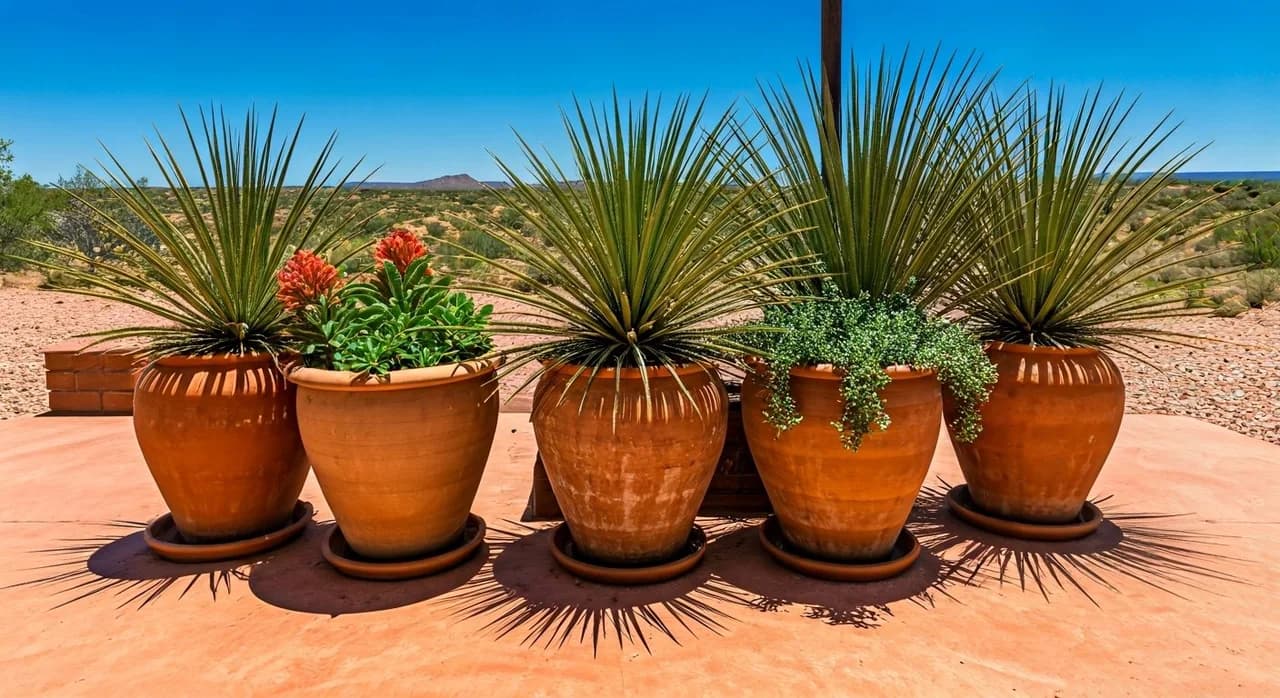
Key takeaways
- Southwest patios run hotter than forecasts: 105–118°F air and <10–15% relative humidity combine with 130–150°F stucco and paver reradiation—lift pots on 2-inch feet and pull them 18–24 inches clear of west-facing walls.
- Match pot materials to thermal load: double-walled light resin, thick 18-inch+ glazed ceramic, fiberstone, and 15–25 gal tan fabric bags hold roots near 82–95°F, while black plastic tops 120°F and small unglazed terracotta dries in 4 hours and spalls from salts.
- Mix a high-mineral substrate (35% pumice or scoria, 35% fine pine bark, 20% buffered coco coir, 10% compost; zero bottom gravel) and flush 3× pot volume every 4–6 weeks to clear crusty white Na+ and CaCO3 rim burn.
- Plant desert ornamentals (bougainvillea, red yucca, rosemary, Mexican bush sage, desert marigold, Opuntia) in full sun, and protect edibles (dwarf pomegranate, okra, hot peppers, heat-hardy basil, cowpeas) under 30–40% white shade cloth.
- Enforce P0 patio safety: ban fatal Nerium oleander (cardiac glycosides) around pets or kids, keep toxic Lantana and Aloe off dog/cat patios, and wear gloves, sleeves, and eye protection around caustic Agave sap.
Quick answer: Container survival in Phoenix, Tucson, Las Vegas, El Paso, and Inland Southern California starts with pot physics before plant choice. Use 15–25 gallon double-walled light resin, thick glazed ceramic, fiberstone, or tan fabric bags raised on 2-inch pot feet off 145°F pavers—skipping small unglazed terracotta (dries in 4 hours) and black plastic (cooks roots past 120°F). Fill with a high-mineral pumice or scoria, pine bark, and coco coir mix, run a 3× pot-volume tap-water flush every 4–6 weeks to wash out pH 8.0+ municipal salts, rig 30–40% white shade cloth over summer edibles, and screen every patio plant for ASPCA pet and agave sap hazards.
Desert Southwest Container Physics: Why 115°F Air Means 145°F Patios
Generic gardening advice treats Phoenix, Tucson, Las Vegas, El Paso, and Inland Southern California like slightly warmer humid southern states. That mistake kills container plantings by June. Across the low and mid-desert Southwest, afternoon air sits at 105–118°F while relative humidity drops below 10–15%, ripping water out of leaves three times faster than in humid regions.
Potted root balls have zero cool subsoil underneath. Infrared readings on Southwest patios regularly hit 140–150°F on sunlit concrete pavers and 130–150°F reradiating off west-facing stucco walls into evening. Setting a pot flat against a hot slab channels heat straight up through drain holes while reflected glare bakes the sidewalls. Feeder roots halt water uptake past 95°F and die above 115–120°F, causing sudden wilt inside damp soil—a mechanism detailed in container gardens summer survival and Southwest and Texas heat gardening.
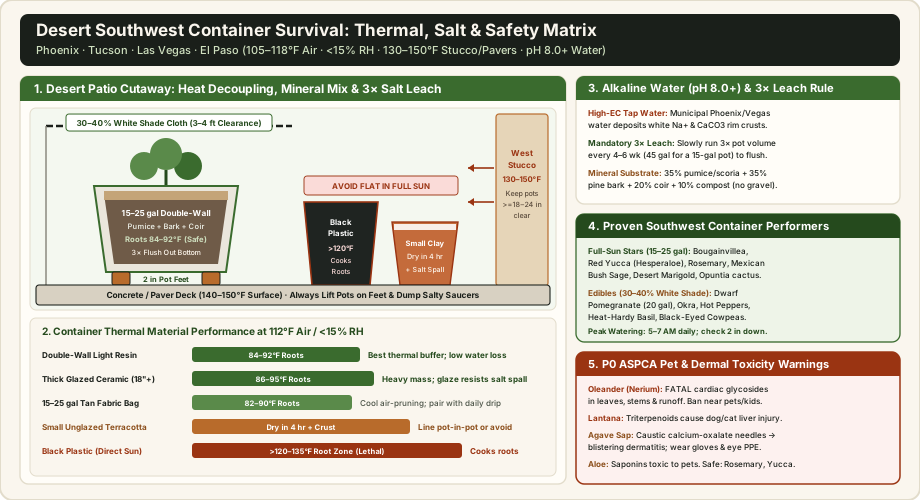
Container Thermal Material Matrix: What Survives vs. What Cooks Roots
Pot volume and wall construction decide root survival far more than moisture gels. University of Arizona Cooperative Extension (AZ1713) and New Mexico State University Extension advise 15–25 gallon planters (16–24 inches wide) for permanent shrubs and fruiting crops so soil volume acts as thermal mass. Compare materials below alongside terracotta, plastic, and glazed pots and our container pot size cheat sheet.
Southwest Desert Container Material Performance at 110–118°F Air & <15% RH
Container Material | Peak Root-Zone Temp | Dry-Out Speed (<15% RH) | Alkaline Salt Behavior | Southwest Verdict & Min Size |
|---|---|---|---|---|
Double-Walled Light Resin (White / Sandstone / Tan) | 84–92°F (air-gap insulation) | Slow (24–48 hr in 15–25 gal) | Non-porous; zero wall spalling | Top overall desert pick; balcony-light; 15–25 gal |
Thick Glazed Ceramic (Light Colors, 18"+) | 86–95°F (high thermal mass) | Slow (24–48 hr in 18–24" pot) | Glaze blocks Na+/CaCO3 wall flaking | Top permanent patio choice; place on wheeled caddy |
Fiberstone / Light Concrete Planters | 88–96°F (reflective mineral wall) | Moderate-Slow (24–36 hr) | Minor surface mineral haze; durable | Wind-stable for bougainvillea & pomegranate (20–30 gal) |
15–25 gal Tan Fabric Grow Bags | 82–90°F (evaporative cooling) | Fast (requires daily morning drip + mulch) | White salt crust on cloth; scrub seasonally | Strong cool-root option for okra & peppers on drip |
Small Unglazed Terracotta (<14") | 92–100°F (brief cool dip, then bakes) | Lethal fast: bone-dry in 4 hours at 115°F | Heavy wicking causes white crust and clay spalling | Avoid standalone in desert; line via pot-in-pot sleeve |
Black Plastic Nursery Pots (Full Sun) | 120–135°F+ (solar oven) | Rapid surface boil-off | Concentrates high-EC salts in cooked roots | NEVER expose to desert sun; nest inside light outer pot |
Decoupling 145°F pavers, pot-in-pot sleeves, and 30–40% white shade cloth
Three physical adjustments drop root temperatures by 15–25°F immediately. First, set every container on 2-inch ceramic or rubber pot feet so air sweeps beneath the base instead of conducting 145°F concrete heat upward, and pull planters 18–24 inches off west-facing stucco walls. Second, slip existing unglazed clay or dark nursery pots inside a wider light-colored shell packed with a 1-inch air or bark gap using double-potting to cool roots.
Third, suspend 30–40% white knitted HDPE shade cloth at least 3–4 feet above canopies from late May through mid-September over summer edibles and young transplants. White cloth reflects infrared heat while transmitting fruiting light; see exact rigging spans in shade cloth for hot container zones and desert sun management.
High-Mineral Substrate and Mandatory 3× Tap-Water Salt Leaching
Never fill pots with native desert caliche or yard clay—confined dirt seals tight and suffocates roots, as shown in why garden soil kills container plants. Standard bagged peat mixes also oxidize fast in 110°F heat, shrinking from pot walls into a water-repellent puck inside one summer. Blend a durable high-mineral Southwest container mix instead:
- 35% volcanic pumice or 1/4-inch crushed scoria: Permanent mineral aeration that resists breakdown, floats less than perlite during heavy flushes, and weights pots against monsoon gusts (raise to 50–60% for Agave, Aloe, and Opuntia).
- 35% aged fine pine bark (1/8–3/8 inch): Decays slowly in desert heat while adding gentle acidity against alkaline municipal water.
- 20% buffered coco coir + 10% screened compost: Re-wets cleanly between dawn waterings and supports root biology without slumping. Top with 2 inches of light pea gravel or bark mulch.
- Zero bottom drainage gravel: New Mexico State University Extension confirms rocks at the pot base create a perched water table that holds soggy soil higher around roots—cover drain holes with mesh screen only, per the container drainage gravel myth.
Purging pH 8.0+ alkaline tap-water salts every 4–6 weeks
Mandatory 3× Pot-Volume Salt-Leach Protocol (Every 4–6 Weeks): Municipal tap water in Phoenix, Tucson, Las Vegas, El Paso, and Inland SoCal runs strongly alkaline (pH 7.8–8.4) with high electrical conductivity (EC) loaded with sodium (`Na+`) and calcium carbonate (`CaCO3`). Daily summer evaporation concentrates dissolved salts until crusty white rim deposits scorch leaf margins brown. Every 4 to 6 weeks from May through October, slowly run 3× the container's volume through the potting mix (for instance, 45 gallons over three gentle passes through a 15-gallon pot) until clear runoff exits the base, then dump every saucer immediately.
Water between 5:00 AM and 7:00 AM after purging scalding hose water onto gravel, following our summer container watering schedule. Because 3× leaching strips soluble nitrogen and iron alongside sodium, apply half-strength balanced feed right after flushing via container leaching compensation and summer fertilizer in extreme heat. Treat interveinal yellowing from alkaline water with iron chlorosis fixes for western soils.
Proven Southwest Container Plants: Desert Ornamentals and Summer Edibles
Combine low-water regional stars vetted by the Arizona Municipal Water Users Association (AMWUA) with warm-season edibles proven in Texas A&M AgriLife and University of Arizona trials. Note that native desert marigold (Baileya multiradiata) is a silvery Southwest perennial completely distinct from annual bedding marigolds; see companion species in saline and alkaline Southwest plants and drought-tolerant plants.
Heat-Tolerant Container Plants for Phoenix, Tucson, Las Vegas & El Paso Summers
Plant & Botanical Name | Min Pot Size | Sun & 30–40% Shade Rule | Peak Summer Watering | Pet & Dermal Safety |
|---|---|---|---|---|
Dwarf Bougainvillea (Bougainvillea 'Torch Glow' / 'La Jolla') | 15–25 gal | Full blazing sun (6–10 hr); blooms best slightly tight | Deep soak every 2–3 days; dry top 2 in between | Mild sap irritant + thorns; wear leather gloves |
Red Yucca (Hesperaloe parviflora) | 15–20 gal | Full west-facing reflected heat; zero shade needed | Every 4–7 days in 50% mineral mix | Pet-safe (ASPCA non-toxic); spineless soft tips |
Rosemary (Salvia rosmarinus) | 10–15 gal | Full sun; afternoon filter helps past 112°F | Every 2–3 days in gritty mix | Pet-safe (ASPCA non-toxic); culinary herb |
Mexican Bush Sage (Salvia leucantha) | 15–20 gal | Full sun to light afternoon filter | Every 2 days peak summer; fall–spring bloom | Pet-safe (ASPCA non-toxic); hummingbird magnet |
Desert Marigold (Baileya multiradiata) | 10–15 gal | Full desert sun; thrives on high-UV reflection | Every 3–4 days in 50% pumice mix | Mildly toxic if chewed heavily; keep off dog paths |
Prickly Pear (Opuntia 'Santa Rita' / 'Burbank') | 15–20 gal | Full sun; shrugs off 145°F stucco glare | Every 7–10 days in 60% mineral mix | Edible once glochid bristles removed; use tongs |
Compact Agave & Aloe (Agave parryi, Aloe vera) | 10–15 gal | Agave: full sun; Aloe: morning sun + afternoon shade | Every 7–10 days in 60% pumice cactus mix | P0 HAZARD: Agave caustic sap; Aloe toxic to pets |
Dwarf Pomegranate (Punica granatum 'Nana') | 20–25 gal | Full sun; 30% white cloth cuts fruit sunscald | Every 1–2 days; steady water stops splitting | Pet-safe; see pomegranates in pots |
Okra & Cowpeas ('Pinkeye Purple Hull') | 10–15 gal | Full sun to 30% white shade cloth (100–110°F) | Daily dawn soak in resin or tan fabric bag | Pet-safe edibles; light gloves for scratchy okra stems |
Hot Peppers ('Chiltepin', 'Jalapeño') & Basil ('Thai') | 10–15 gal / 7–10 gal | Mandatory 30–40% white shade cloth 12–5 PM | Daily morning soak + 2 in mulch | Basil pet-safe; hot pepper capsaicin irritates pets |
Summer edible reality: skip July tomatoes, grow okra, cowpeas, peppers, and basil
Standard tomatoes stop pollinating when days pass 95°F and nights stay above 75°F—shift them to Southwest fall–spring windows (September and February planting). Through June–August heat, build edible containers around **okra, nitrogen-fixing black-eyed cowpeas, Sonoran chiltepin and jalapeño peppers** under 30–40% white cloth per Southwest shade for tomatoes and peppers, and woody Thai or African Blue basil pinched weekly using grow basil and prevent bolting. Fill spare sunny pots with thyme, oregano, edible purslane, and golden yellow bells (*Tecoma stans*).
P0 ASPCA Pet Toxicity and Human Dermal Safety on Southwest Patios
Desert plants carry fierce chemical defenses that become acute household hazards when confined to patio pots at dog, cat, and toddler height. Screen every plant against ASPCA Animal Poison Control toxicology and pet-safe container plants.
P0 Fatal Cardiac Toxicity Alert — Keep Nerium oleander Off Pet & Family Patios: Never grow oleander (Nerium oleander) in containers reachable by pets, livestock, or children. Every tissue—green leaves, dried windblown leaf litter, stems, blooms, and even saucer runoff steeped with fallen foliage—holds lethal cardiac glycosides (oleandrin). ASPCA Pro clinical guidance confirms chewing a single leaf or lapping contaminated drain water can cause fatal heart arrhythmias and sudden collapse.
P0 ASPCA Pet Toxicity & Human Dermal Hazard Matrix for Southwest Containers
Patio Plant | Toxic Compounds | Clinical Risk (Pets & Humans) | Containment & PPE Rule | Pet-Safe Container Swap |
|---|---|---|---|---|
Oleander (*Nerium oleander*) | Cardiac glycosides (oleandrin, neriine) | FATAL to dogs, cats, horses & humans; arrhythmia, collapse & death even from dry leaves/runoff | Ban from pet/family patios; never burn or compost trimmings (toxic smoke) | Dwarf Pomegranate or Yellow Bells (Tecoma stans) |
Lantana (*Lantana camara*) | Pentacyclic triterpenoids (lantadene A & B) | Toxic to dogs, cats & livestock: vomiting, bloody diarrhea, acute liver failure from leaves/berries | Keep strictly outside pet yards or on unreachable outer balconies; sweep berries | Mexican Bush Sage or Trailing Rosemary |
Agave (Agave americana, A. parryi) | Calcium oxalate raphide needles + caustic saponins | Humans: delayed blistering purpuric contact dermatitis + eye injury; Pets: oral burns, vomiting & punctures | Wear nitrile-over-leather gloves, long sleeves & eye PPE; never weed-whack near leaves; wash skin fast with soap | Red Yucca (Hesperaloe parviflora) — spineless & non-toxic |
Aloe (Aloe vera / A. barbadensis) | Anthraquinone glycosides (aloin latex) & saponins | Toxic to dogs & cats despite safe human inner gel: vomiting, diarrhea, lethargy & tremors | Keep on high shaded stands out of pet reach; see growing aloe safely | Haworthia (shade) or Rosemary & Thyme |
If a pet chews oleander, lantana, agave, or aloe, call your emergency vet or the ASPCA Animal Poison Control Center (888-426-4435) immediately. Wash human skin splashed with Agave sap under cool running water and dish soap right away to flush calcium oxalate needles before blistering rash forms 6–24 hours later.
Monsoon Winds, Drip Automation and Heatwave Triage
July–August desert monsoons hit Tucson, Phoenix, and El Paso with 45–60 mph gusts and sudden downpours. Wide-based 18–24 inch glazed ceramic, fiberstone, or double-walled resin planters weighted with volcanic pumice stay upright where narrow plastic tips over. After storms, empty every saucer immediately so dry-adapted roots do not rot in 95°F standing water.
Beyond six containers, add a 5:30 AM battery drip timer or buried clay vessels from DIY silicone-sealed ollas. Distinguish normal midday leaf droop from root failure using reading plant heat-stress signals and rescue scorched pots with container plant heat rescue.