Key takeaways
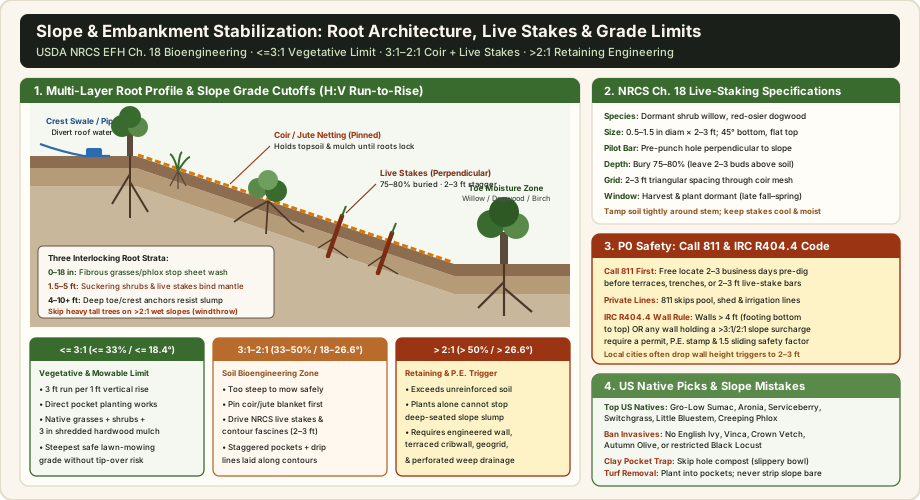
- Measure slope grade in H:V run-to-rise before choosing plants: <=3:1 (<=18.4°) supports standard vegetative planting; 3:1–2:1 (18.4–26.6°) requires pinned coir blankets and NRCS live stakes/fascines; >2:1 (>26.6°) exceeds unreinforced soil stability and requires engineered retaining structures.
- Call 811 at least 2–3 business days before excavating planting pockets, cutting terraces, or driving 2–3 ft steel rebar pilot holes for live stakes—and hire a private locator for yard irrigation or shed lines that 811 skips.
- Under IRC Section R404.4, any retaining wall taller than 48 inches from the bottom of the footing OR any wall supporting a sloping surcharge steeper than ~3:1/2:1 requires a building permit, gravel weep drainage, and P.E.-stamped calculations.
- Combine fibrous surface-binding roots (0–18 in grasses and phlox) with suckering shrub colonies (1.5–5 ft) rather than planting top-heavy tall trees on steep >2:1 wet slopes where windthrow lever forces trigger slips.
- Skip clay planting-hole compost amendments (which create slippery water-logged bowls) and never strip existing turf bare all at once; cut staggered pockets through pinned coir netting and run contour drip lines.
Quick answer: Match slope stabilization plants to exact horizontal-to-vertical (H:V) grade before breaking ground. Always call 811 two to three business days ahead to locate buried utilities, and divert roof downspouts away from the slope crest. Gentle grades up to 3:1 (33.3%, 18.4 degrees) hold well with pocket-planted fibrous grasses, creeping groundcovers, and suckering native shrubs. Slopes from 3:1 to 2:1 (33.3–50%, 18.4–26.6 degrees) are too steep to mow and need pinned biodegradable coir netting plus USDA NRCS Chapter 18 dormant live stakes (0.5–1.5 in × 2–3 ft willow or red-osier dogwood buried 75–80% perpendicular to the slope). Grades steeper than 2:1 (>26.6 degrees)—or retaining walls over 4 ft from footing bottom or holding any sloping surcharge—trigger engineered retaining walls and permits under IRC Section R404.4.
Slope Grade Math (3:1 vs. 2:1) and IRC Retaining-Wall Engineering Triggers
The costliest mistake in hillside landscaping is confusing slope angle degrees with horizontal-to-vertical (H:V) grade ratios and assuming plants alone can hold any embankment up to 45 degrees. A 45-degree incline is a 1:1 slope (100% grade)—roughly twice as steep as ordinary unreinforced yard clay or sandy loam can hold without deep structural reinforcement.
Check your actual incline in two minutes using a 4-foot carpenter's level and a tape measure. Hold one end of the level on the slope, level it horizontally, and measure straight down from the outer end to the dirt. Divide 48 inches by that vertical drop in inches to get your H:V ratio (for instance, a 16-inch drop equals 3:1; a 24-inch drop equals 2:1).
Slope Stabilization Limits by H:V Grade Ratio, Bioengineering Needs & IRC R404.4 Code Triggers
Slope Ratio (H:V) | Percent Grade & Angle | Mowing & Footing Safety | Recommended Stabilization System | Engineering / Code Trigger |
|---|---|---|---|---|
4:1 to 3:1 (or flatter) | 25–33.3% (14.0°–18.4°) | 3:1 is maximum safe turf mowing grade | Direct staggered pocket planting of fibrous native grasses, groundcovers, and suckering shrubs + 3 in shredded hardwood mulch | Plants & mulch hold well once crest roof water is diverted |
3:1 to 2:1 | 33.3–50% (18.4°–26.6°) | Too steep to mow safely; loose bark washes out | Pinned biodegradable coir/jute erosion blanket + USDA NRCS Ch. 18 dormant live stakes or contour fascines + contour drip lines | Check slope toe for stream scour or seepage; retaining wall with any upslope surcharge loses code permit exemption |
Steeper than 2:1 (1.5:1 to 1:1) | >50% to 100% (>26.6°–45°) | Extreme erosion & shallow slump hazard | Engineered segmental/cantilever retaining wall, vegetated cribwall, or geogrid-reinforced soil lifts + perforated gravel weep drain | IRC Section R404.4 requires permit, P.E. stamp, and >=1.5 sliding/overturning safety factors (even walls <4 ft if holding a slope surcharge) |
IRC Section R404.4 retaining-wall trap: Under International Residential Code (IRC) Section R404.4, retaining walls up to 4 feet tall (measured from the bottom of the buried footing to the top of the wall, not just exposed blocks) are typically permit-exempt only when supporting flat level backfill. The moment a wall retains a sloping hillside surcharge—and many local cities lower wall triggers to 2 or 3 feet—you legally need a building permit, P.E.-stamped drawings, geogrid tiebacks, and crushed-stone weep drainage so hydrostatic water pressure never pushes the wall over.
Pre-Dig Safety: Call 811, Crest Runoff Diversion & Turf Pocket Planting
Before cutting a single terrace bench or driving steel pilot bars for live stakes, handle utility safety and slope hydrology. Soil erosion routinely strips 6 to 12 inches of cover off older hillsides, leaving buried gas, electric, fiber, and water lines far shallower than homeowners expect.
- Call 811 two to three business days before digging: Federal and state laws require calling 811 (or filing an online state locate ticket) prior to excavating shrub pits, trenching fascines, or pounding 2-to-3-foot steel rebar pilot rods. Public utility locators mark power (red), gas (yellow), telecom (orange), water (blue), and sewer (green) for free—yet 811 does not mark private lines running to sheds, pools, septic tanks, or drip irrigation systems, which require a private locator or careful hand probing.
- Divert crest water before planting: Roof downspouts, driveway aprons, and upper-lawn swales pouring across an unestablished face will carve gullies around new root balls overnight. Route downspouts through solid buried pipe to the slope toe or build a shallow contour keyline swale set back safely from foundations per swale permit and foundation rules.
- Never strip an entire hillside bare at once: Purdue University Extension warns that rototilling or herbicide-killing an entire grassy slope exposes raw earth to the very next thunderstorm. Instead, kill or scalp small planting pockets in staggered zig-zag rows—leaving dead turf roots intact to lock soil between pockets until new roots spread—or pin biodegradable coir mesh directly over prepared soil.
Fibrous Root Mats vs. Deep Taproots (And Tree Windthrow Risk)
Roots stabilize earth through two completely different mechanical actions, and neither architecture works alone on a challenging embankment. Mixing surface-mat binders with deeper woody anchors turns loose topsoil and deeper subsoil into a composite reinforced matrix, while active evapotranspiration pumps excess water out of saturated banks to raise soil shear strength.
- Fibrous surface mats (0–18 inches deep): Native bunchgrasses, sedges, and creeping perennials pack thousands of fine hair roots per cubic foot right near the surface. They shield soil from raindrop splash impact, slow sheet runoff velocity, and prevent rills and gullies before they start. See native grasses for erosion control and groundcovers for unmowable slopes.
- Suckering woody rhizome webs (1.5–5 feet deep): Clonal native shrubs spread underground shoots outward across the slope, tying individual plants into one interlocking tensile grid across the shallow shear plane where topsoil tries to slide off clay subsoil.
- Deep taproots and spreading heart roots (4–10+ feet deep): Large oaks, maples, birches, and pines anchor deeper soil strata on stable crests, flat benches, and slope toes.
Do not plant tall top-heavy trees on steep wet >2:1 embankments: Washington State Department of Ecology bluff studies show that planting tall, heavy canopy trees directly onto steep, saturated clay or bluff faces actually worsens slide risk. High winds leverage the tall crown like a crowbar against waterlogged roots, peeling out massive root-wad divots and triggering shallow landslides. Keep tall trees on level crest setbacks or wide slope toes, and stabilize steep mid-slope faces with lighter flexible shrubs, live stakes, and grasses.
USDA NRCS Chapter 18 Live-Staking and Fascine Installation
When an embankment is damp, springs seep near the toe, or a creek undercuts the base, nursery container stock often washes out or costs too much to plant at high density. USDA NRCS Engineering Field Handbook Chapter 18 (Soil Bioengineering) and Construction Specification 465 use dormant, unrooted woody cuttings—live stakes and live fascines—that sprout adventitious roots along their buried bark and pin down erosion blankets at the same time.
Step-by-step live-stake protocol (late fall through early spring)
- Pick high-rooting native wood: Harvest dormant, healthy 1-to-3-year-old stems from native shrub willows (Salix discolor, Salix exigua, Salix sericea), red-osier dogwood (Cornus sericea), or native elderberry while leaves are completely off and buds remain tight.
- Cut to NRCS dimensions: Trim stakes 0.5 to 1.5 inches in diameter and 2 to 3 feet long. Cut the bottom (basal) end at a 45-degree slant for clean driving and instant right-side-up orientation; cut the top flat and square just above a bud pair and strip side twigs without bruising bark. Keep stakes shaded and wrapped in wet burlap until installation.
- Pre-punch with a steel pilot bar: Never hammer wooden stakes straight into rocky or compacted embankment clay, which splits wood and strips root-producing cambium. Drive a steel rebar or soil probe perpendicular to the slope face (90 degrees to the incline, not straight vertical) to roughly 75–80% of stake length, leaving 2 to 3 buds (about 4–6 inches) exposed above ground.
- Set on a 2–3 ft triangular grid through coir mesh: Drive stakes directly through open-weave coir or jute netting on a 2-to-3-foot staggered triangular pattern, tamp soil firmly (or pour soil-water slurry) around the stem to eliminate drying air pockets, and keep heavy moisture-loving willows at least 20 feet clear of septic fields and sewer pipes.
For longer slopes shedding sheet flow between 3:1 and 2:1, tie dormant willow and dogwood branches into compressed 6-to-8-inch-diameter live fascine bundles (wattles) using natural twine every 12–18 inches. Bury bundles halfway in shallow horizontal contour trenches anchored with live and dead stakes so each bundle acts as a sprouting micro-terrace that traps sediment and slows water down.
Best US Native Slope Plants by Region (And Invasives to Ban)
Decades ago, highway departments and nurseries planted aggressive non-native vines across American embankments. Today extension services in Clemson, Penn State, Oregon, and California urge removing those legacy weeds because shallow-rooted vines smother native shrubs, pull down perimeter trees, and jump into local woodlands. Replace invasive bank covers with proven native picks—plus sterile `Sunshine` vetiver only in warm Zone 8–11 frost-free climates—checking regional erosion-control strategies and deep-rooted hillside plants for local adaptation.
US Slope Stabilization Matrix: Root Architecture, Zone Fit, Moisture & Invasive Replacements
Species & Habit | USDA Zones | Root Architecture & Depth | Site Fit & Spacing | Notes & Invasive Lookalikes to Skip |
|---|---|---|---|---|
Fragrant Sumac 'Gro-Low' (Rhus aromatica) / Smooth Sumac | Zones 3–9 | Aggressive suckering woody rhizomes (2–4 ft deep) | Dry sun, rocky or clay banks; space 4–5 ft staggered | Replaces invasive autumn olive and crown vetch; low 2 ft height resists windthrow |
Black Chokeberry (Aronia melanocarpa) & Serviceberry | Zones 2–8 | Dense fibrous-colonial shrub network (2–5 ft deep) | Full sun to part shade, moist to average clay; space 3–5 ft | Superior native replacement for non-native Chinese leatherleaf viburnum and burning bush |
Red-Osier Dogwood (Cornus sericea) & Shrub Willow (Salix spp.) | Zones 2–8 | Rapid adventitious spreading roots (3–6 ft deep) | Moist slope toes, swales & streambanks; live stakes 2–3 ft apart | Pair with wet-soil native shrubs and creek-bank buffers |
Creeping Juniper (Juniperus horizontalis) & Creeping Phlox | Zones 2–9 | Mat-forming woody/fibrous surface net (6–24 in) | Hot, dry, sunny well-drained banks; space 18–36 in staggered | Replaces invasive English ivy (Hedera helix) and periwinkle (Vinca minor); avoid fire-prone juniper right against walls in WUI wildfire zones |
Switchgrass (Panicum virgatum), Little Bluestem & Buffalo Grass | Zones 3–9 | Dense vertical fibrous roots (4–9 ft deep in prairie loam) | Sunny upland slopes; plant plugs 12–18 in staggered through coir | Replaces shallow turfgrass; combine with ground covers for slopes |
Vetiver (Chrysopogon zizanioides 'Sunshine' ONLY) | Zones 8–11 | Massive vertical fibrous curtain (8–12+ ft deep) | Hot Southern, Gulf & CA slopes; plant hedgerow slips 6–8 in apart | Use ONLY sterile 'Sunshine' cultivar; skip cold zones and never use invasive cogon grass |
Zones 3–9 | Deep anchoring roots + suckering colonies (5–10+ ft) | Stable upper crests, berms, and wide lower toes; space 8–15 ft | Skip invasive black locust in restricted NE/Midwest states (also livestock-toxic bark/seeds); verify local rules before planting suckering trees |
When choosing ground-cover alternatives for shady north-facing slopes where sun-loving sumac thins out, use native Pennsylvania sedge (Carex pensylvanica), golden groundsel (Packera aurea), or creeping thyme on brighter dry pockets—leaving invasive Hedera helix, Vinca minor, Japanese honeysuckle, and non-native Pacific Cotoneaster off the planting sheet. In warm, dry Southern and Western sun exposures, rosemary 'Prostratus' and ice plant (Delosperma rather than California-invasive Carpobrotus) hold rocky banks with minimal water.
Slope Planting Mechanics, Coir Netting, and Contour Drip Care
Planting on a hillside turns two standard flat-yard habits into failure traps. First, never dig an oversized pit in heavy clay and backfill with spongy compost: water runs downhill through the looser amended pocket, hits the slick clay wall at the bottom, and pools into a heavy, lubricated slip zone. Second, never dump loose shredded bark or straw onto bare dirt steeper than 3:1; the first 2-inch rain washes loose mulch straight into storm drains at the toe.
- Anchor the fabric first on 3:1–2:1 slopes: Smooth minor rills, broadcast a native cover crop such as white clover or annual ryenurse grass if needed, and roll 400–700 g/m² woven coconut coir or jute netting horizontally or vertically per manufacturer overlap rules, stapling tightly every 12–18 inches with U-shaped biodegradable or steel landscape pins. Cut X-slits in the netting to slip in 1-gallon shrubs and grass plugs.
- Backfill native soil on contour: Dig planting pockets perpendicular to slope grade or slightly level-benched on the downhill lip, keeping the root flare level with the uphill soil grade so sediment does not bury the crown. Backfill strictly with native soil and avoid heavy chemical fertilizer (which pushes weak top growth ahead of roots).
- Run drip tubing along contour lines: Overhead sprinklers waste water down the face and trigger sheet erosion. Pin 1/2-inch mainline and 1/4-inch drip emitters along level contours above each plant row—pairing with soil percolation drainage checks and clay soil management—to deliver 1 inch per week slowly into root zones during year one without saturating the bank.
- Pin wood chips only on <=3:1 flats or pockets: Where slopes are gentle enough (`<=3:1`) for wood-chip mulch, use fibrous, interlocking shredded bark rather than round pine nuggets, verify supplies are free of persistent aminopyralid herbicide carryover, and monitor bare pockets after every heavy storm for the first autumn.