Key takeaways
- Plant roots reinforce shallow surface erosion and translational slips in the top 3 to 6 feet only; slopes steeper than 1.5:1 or showing deep rotational cracks require a licensed geotechnical engineer.
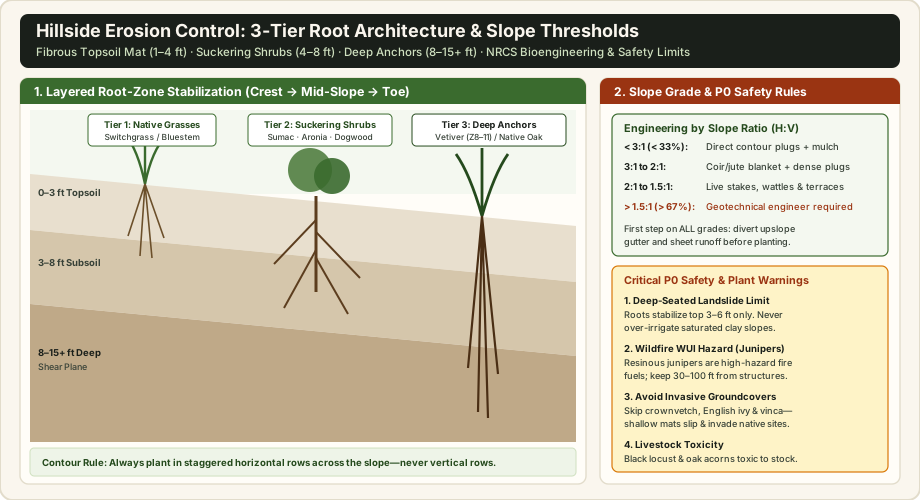
- Layer three root architectures across staggered horizontal contours—never vertical rows—so foliage intercepts raindrop splash while fibrous mats and woody roots knit topsoil to subsoil.
- Skip state-listed invasive groundcovers (crownvetch, English ivy, periwinkle/vinca), which form shallow root mats that peel off saturated banks and invade surrounding native ecosystems.
- In Wildland-Urban Interface (WUI) wildfire zones, avoid resinous junipers within 30 to 100 feet of structures; choose fire-wise native bunchgrasses and deciduous shrubs instead.
- On slopes steeper than 3:1 (33% grade), divert upslope roof/gutter runoff first and plant through stapled biodegradable coconut coir or jute blankets to hold soil during the 1-to-3-year establishment window.
Quick answer: Effective hillside erosion control combines three root tiers planted on staggered horizontal contours: native fibrous bunchgrasses (switchgrass, big and little bluestem, sideoats grama) to bind the top 1 to 6 feet, suckering native shrubs (fragrant sumac, chokeberry, redosier dogwood) to lock subsoil 4 to 8 feet deep, and deep vertical anchors such as sterile vetiver grass (USDA Zones 8–11) or native oaks. Divert upslope runoff first, install biodegradable coir or jute blankets on slopes steeper than 3:1, and never rely on plants alone for deep-seated landslides or slopes steeper than 1.5:1.
How Root Architecture Stops Erosion—And Where Plants Reach Their Limit
Bare or turf-covered hillsides fail during heavy storms because standard lawn grasses root only 2 to 6 inches deep and offer almost zero shear resistance once the topsoil saturates. University of Washington slope-hydrology research and USDA Natural Resources Conservation Service (NRCS) bioengineering standards show that durable stabilization requires a multi-layered root matrix combining fine fibrous nets, suckering woody rhizomes, and deep vertical anchors.
Above ground, multi-tier canopies break the kinetic energy of falling raindrops before they dislodge soil aggregates. Below ground, dense root channels increase water infiltration, lower pore-water pressure through transpiration, and mechanically bind soil particles like steel rebar in concrete. Before selecting species, evaluate your soil texture and drainage with our guides to plants for clay soil, loamy soil, and how to read a soil test.
Geotechnical safety boundary (shallow vs. deep-seated slides): Vegetation only stabilizes surface rill erosion and shallow translational slips (typically the top 3 to 6 feet of soil). Plant roots cannot arrest deep-seated rotational landslides, over-steepened cut banks steeper than 1.5:1 (67% grade), or slopes undermined by septic seepage and broken drainpipes. Watch for tension cracks at the slope crest, leaning trees, or bulging toes—and consult a licensed geotechnical engineer before planting or grading.
Best Deep-Rooted Erosion Control Plants by USDA Zone
No single plant stabilizes every hillside. A dry, south-facing crest loses water rapidly, while the shaded toe at the bottom of the same slope stays damp for days after rain. Match species to your USDA Hardiness Zone, annual rainfall, and slope micro-position—crest, mid-slope, or toe—using the extension-verified matrix below.
Deep-Rooted Hillside Erosion Control Plants by USDA Zone, Root Depth & Site Fit
Plant & Botanical Name | USDA Zones | Typical Root Depth & Habit | Best Slope Position & Soil | Key Trade-Offs & Notes |
|---|---|---|---|---|
Vetiver Grass (Chrysopogon zizanioides) | 8–11 (7b w/ mulch) | 8–12 ft vertical spongy curtain (non-spreading) | Steep warm-climate contours; sun; wide soil range | Use sterile cultivar ('Sunshine') only; NRCS Code 601 vegetative barrier |
Switchgrass (Panicum virgatum) | 4–9 | 6–9 ft dense fibrous prairie root mass | Mid-slope to toe; clay, loam, or periodic wet soils | Stiff stems slow runoff; zero-mow native; cut back in late winter |
Big Bluestem (Andropogon gerardii) | 3–9 | 6–8 ft deep fibrous bunchgrass | Sunny crest to mid-slope; dry to mesic soils | Native prairie workhorse; pair with shorter sedges at base |
Little Bluestem & Sideoats Grama | 3–9 | 4–6 ft tough fibrous roots | Dry, rocky, nutrient-poor upper slopes and crests | High drought tolerance; ideal for arid West and Plains slopes |
Fragrant Sumac (Rhus aromatica 'Gro-Low') | 3–9 | 4–6 ft woody suckering rhizome thicket | Dry to mesic sunny or part-shade banks | Low 2-ft mat; colonizes steep banks rapidly without mowing |
Black Chokeberry (Aronia melanocarpa) | 3–9 | 3–5 ft dense suckering root web | Mid-slope to moist toe; tolerates heavy clay | Compact cultivars ('Low Scape Mound') fit residential slopes |
Redosier Dogwood (Cornus sericea) | 2–7 | 4–7 ft stoloniferous woody root network | Wet toes, seeps, and streambanks; clay-tolerant | Roots easily from dormant live stakes driven directly into bank |
Native Oaks (Quercus spp.) | 3–9 | 8–15+ ft deep taproot + wide lateral anchor | Lower/mid slopes on large properties | Slow initial cover; acorns/buds toxic to cattle and horses in volume |
Tier 1: Native fibrous grasses and sedges (rapid surface binding)
Purdue Extension, Iowa State Extension, and University of Arizona Extension all place deep-rooted native bunchgrasses at the foundation of slope stabilization. Unlike creeping fescue—whose roots rarely exceed 6 to 12 inches in compacted bank soils—warm-season natives like switchgrass, big bluestem, little bluestem, and sideoats grama drive dense fibrous roots 4 to 9 feet deep. For shady banks where sun-loving prairie grasses thin out, substitute native sedges (Carex spp.). Explore regional grass selections in native grasses for erosion control by region and groundcovers for steep unmowable slopes.
Tier 2: Suckering native shrubs (mid-depth structural pins)
Suckering shrubs spread via underground stems to weave a continuous woody grid across mid-slopes. Fragrant sumac (Rhus aromatica 'Gro-Low') handles dry, lean upper banks, while black chokeberry (Aronia melanocarpa) and redosier dogwood (Cornus sericea) lock damp clay toes and seepage zones. On wet banks, dormant dogwood and willow (Salix spp.) cuttings can be installed as live stakes—driven 12 to 18 inches deep at right angles to the slope in late winter so they root directly into undisturbed subsoil.
Tier 3: Vetiver hedges and deep woody anchors
In USDA Zones 8–11, sterile vetiver (Chrysopogon zizanioides, 'Sunshine' cultivar) is the gold-standard bioengineering barrier. Planted 6 inches apart along level contours (NRCS Practice Code 601), vetiver sends a vertical, non-invasive root curtain 8 to 12 feet straight down within 12 to 18 months while its stiff above-ground hedge traps sediment and forces runoff to infiltrate. In cooler Zones 3–7, pair deep-rooted native shrubs with strategically sited native trees—avoiding heavy mature trees on already saturated, slide-prone clay banks. For dry-climate woody options, see drought-tolerant trees and shrubs by zone and windbreak trees.
Slope-Grade Engineering: Matching Bioengineering to Steepness
Planting plugs into bare dirt on a steep hillside without mechanical protection guarantees washout during the first 1-inch thunderstorm. NC State Extension and Mississippi State Extension stress a strict sequence: control upslope water first, armor the bare surface second, and establish layered roots third.
USDA NRCS & Extension Bioengineering Thresholds by Slope Steepness (H:V Ratio)
Slope Ratio (H:V) & Grade | Primary Erosion Mechanism | Required Mechanical / Bioengineering Support | Planting Density & Establishment Window |
|---|---|---|---|
Gentle: < 3:1 (< 33%) | Sheet flow and minor rills | Contour planting + 2–3 in coarse wood-chip mulch (never fine bark that floats) | Plugs 18–24 in on center; 1 growing season for surface lock |
Moderate-Steep: 3:1 to 2:1 (33–50%) | Active rilling and shallow topsoil washout | Upslope diversion swale + stapled biodegradable coconut coir or jute blanket (NRCS Code 484) | Plant plugs through slits at 12–18 in staggered contour spacing; 1–2 years |
Severe: 2:1 to 1.5:1 (50–67%) | Gully cutting and shallow translational slips | Coir wattles/fascines on contour, dormant willow/dogwood live stakes, rock check dams or low terraces | Dense multi-tier mix (grasses + shrubs + live stakes); 2–3+ years |
Critical: > 1.5:1 (> 67%) | Deep-seated rotational failure / slumping | Geotechnical engineer design: retaining wall, soil nails, or re-grading before vegetation | Vegetation is secondary cover only, not primary structural support |
Before laying a single erosion blanket, redirect roof downspouts, driveway runoff, and upslope sheet flow away from the face of the bank using a shallow diversion berm or contour channel (see keyline design and swales and rain garden basin depth and ponding). For additional mechanical stabilization tactics, review plants for erosion control and slope stabilization and ground cover for slopes.
High-Risk Slope Plants to Avoid: Invasives, Wildfire Fuels & Toxicity
Outdated highway-department and nursery lists still recommend several plants for hillsides that university extensions now actively warn against. Installing the wrong species can trigger wildfire liability, ecological damage, livestock poisoning, or worse erosion.
High-Risk Slope Plants to Avoid & Extension-Approved Native Replacements
Problematic Plant | Specific P0 Hazard / Failure Mode | Extension-Recommended Alternative |
|---|---|---|
Crownvetch (Securigera / Coronilla varia) | State-listed invasive/noxious weed across Midwest & Northeast; smothers native prairies | Native switchgrass, little bluestem, or wild lupine (Lupinus spp.) |
English Ivy (Hedera helix) & Periwinkle (Vinca minor) | Shallow fibrous mat traps weight and peels off saturated banks; aggressive forest invader | Fragrant sumac ('Gro-Low'), native sedges (Carex), or Pennsylvania sedge |
Creeping & Common Juniper (Juniperus spp.) near homes | High-hazard wildfire fuel (volatile resins + dead interior thatch); banned in many WUI Zone 1–2 codes | Deciduous low-resin native shrubs (Aronia, sumac) + irrigated fire-wise bunchgrasses |
Black Locust (Robinia pseudoacacia) near pastures | Aggressive root suckering (invasive outside native range); bark and foliage toxic to horses/livestock | Native dogwoods, serviceberry (Amelanchier), or fenced native oaks |
Wildfire defensible-space rule for sloped lots (UNR & OSU Extension): Fire travels dramatically faster uphill because flames pre-heat vegetation above them. Resinous junipers (Juniperus horizontalis, J. communis, J. virginiana) accumulate dry dead thatch underneath and ignite explosively. Keep junipers at least 30 to 100 feet away from structures in wildfire-prone Western and Southern WUI zones. If removing mature junipers from a steep slope for defensible space, cut trunks flush at ground level and leave the roots intact to hold soil while native fire-resistant bunchgrasses establish.
If deer browse your hillside heavily, choose unpalatable natives and consult our guide to deer-resistant plants so new plugs are not stripped before they anchor.
Step-by-Step Installation & First-Year Establishment Without Over-Watering
University slope-planting studies consistently find that smaller container plants (plugs or 1-gallon pots) establish deeper, more resilient root architecture faster than large balled-and-burlapped nursery stock, which often remains root-bound in compacted bank soil. Follow this five-step installation protocol:
- Divert upslope water first: Route gutters and upslope runoff to a stabilized outlet so concentrated water never cuts across newly disturbed soil.
- Skip deep tilling on steep banks: Tilling loosens the entire topsoil layer and invites washout. Instead, dig individual planting pockets on staggered horizontal contours and backfill with native soil (avoid over-amending pockets with rich compost, which creates a 'bathtub effect' in clay).
- Pin biodegradable erosion blankets: On slopes steeper than 3:1, unroll coconut coir (2–4 year lifespan) or jute netting (1–2 years) from top to bottom, overlap edges by 6 inches, trench the top edge 6 inches deep, and staple every 2 to 3 feet. Cut X-slits to plant plugs directly through the mesh.
- Mulch with coarse wood chips—not fine bark: Apply 2 to 3 inches of coarse arborist wood chips between plants to stop raindrop splash without floating away in heavy rain. Avoid excess nitrogen fertilizer, which forces weak top growth at the expense of deep roots (see soil food web and mycorrhizal fungi).
- Water deeply and infrequently—never saturate clay: Provide 1 inch of water per week via slow drip irrigation during the first 8 to 12 weeks, then taper off. Over-irrigating a hillside adds massive water weight to the soil profile and is a leading trigger of residential slope failure.
Seasonal maintenance and post-storm slope inspection
After the first growing season, shift from watering to structural inspection. Walk the top crest, mid-slope, and toe after every 1.5-inch or heavier rainstorm to catch early rill formation before it cuts into a gully. If you spot a small washout channel forming under a coir blanket, pack it immediately with coarse wood chips, drive two extra wooden stakes across the flow line, and plug the gap with switchgrass or native sedge divisions.
Prune suckering shrubs such as fragrant sumac and redosier dogwood selectively in late winter—removing one-third of the oldest canes every two to three years stimulates denser basal suckering and tighter root knitting without stripping surface cover. Cut warm-season prairie grasses back to 6 to 8 inches in late winter before spring green-up, leaving the cut stalks laid horizontally along the contour as free sediment-trapping mulch. Never mow a slope steeper than 3:1 with a riding mower; rollovers are a major residential injury hazard, and close mowing weakens root depth across every grass species.
For large agricultural or homestead hillsides, integrate alley cropping, types of agroforestry, or winter cover crops between permanent perennial strips to build organic matter while woody anchors mature.