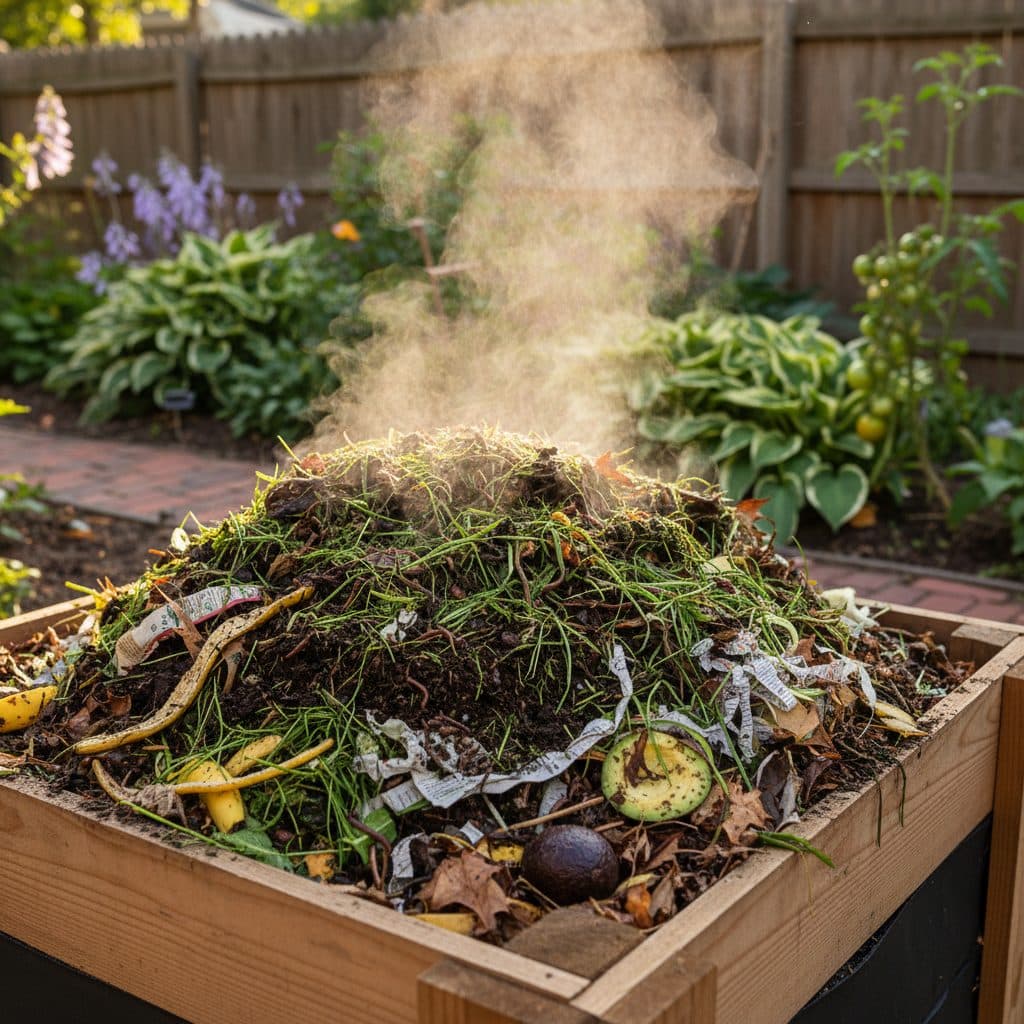
Key takeaways
- Aim for a carbon-to-nitrogen (C:N) ratio of roughly 30:1 in your compost pile for efficient decomposition.
- Brown materials like dried leaves and wood chips provide carbon, while green materials such as grass clippings and food scraps supply nitrogen.
- Layering browns and greens, maintaining 40% to 60% moisture, and regular turning are crucial for active composting.
- Vermicomposting offers a faster way to produce nutrient-rich castings, especially for kitchen waste, with an ideal C:N ratio around 25:1.
- Biochar, though not a direct C:N input, improves soil structure and nutrient retention for decades.
- Monitoring pile temperature and moisture, perhaps with a 3-in-1 soil meter, ensures optimal microbial activity.
Quick answer: To balance the brown-to-green ratio for robust compost, aim for a carbon-to-nitrogen (C:N) ratio of roughly 30:1. This ensures efficient decomposition by providing microbes with adequate energy from carbon-rich browns and protein from nitrogen-rich greens.
Out here in the Willamette Valley of Oregon, or anywhere across the US where folks are serious about their soil, we know that healthy plants start from the ground up. For many of us, that means composting. But it’s not just about tossing scraps into a pile; there’s a science to it, specifically the carbon-to-nitrogen ratio, often called the C:N ratio or simply brown-to-green. Getting this right means the difference between a slow, smelly mess and rich, dark compost ready in a few months.
The ideal C:N ratio for rapid composting sits around 30:1. This balance ensures the microorganisms responsible for breaking down organic matter have enough energy (carbon) and protein (nitrogen) to thrive. Too much carbon, and decomposition slows to a crawl, taking over a year in some cases. Too much nitrogen, and your pile can become anaerobic, producing unpleasant odors like ammonia, which is a common issue in many suburban backyards in USDA zone 7.
Understanding the carbon-to-nitrogen ratio in your compost
The carbon-to-nitrogen ratio is fundamental to successful composting. Microbes in your compost pile need both carbon and nitrogen to do their work. Carbon provides energy, while nitrogen is essential for building proteins and enzymes. Think of it like baking a cake – you need both flour (carbon) and eggs (nitrogen) in the right proportions. If you have too much flour, the cake is dry; too many eggs, and it’s runny. For compost, the sweet spot is generally considered to be around 30 parts carbon to one part nitrogen (30:1). This ratio is well-established in composting science and it enables efficient breakdown of materials [2].
Why the 30:1 ratio matters for decomposition
When the C:N ratio is too high, meaning there’s an excess of carbon-rich ‘brown’ materials, the microbes don’t have enough nitrogen to reproduce and process the carbon efficiently. This leads to a very slow decomposition rate, sometimes extending beyond twelve months. Conversely, if the ratio is too low, with too many nitrogen-rich ‘green‘ materials, the microbes will consume the nitrogen quickly, releasing excess nitrogen as ammonia gas, which causes foul odors and wastes nutrients from your pile. A balanced 30:1 ratio ensures a steady supply of both elements, promoting vigorous microbial activity and a compost pile that heats up to 140°F to 160°F, killing weed seeds and pathogens within a few weeks.
- Carbon sources: Dried leaves, wood chips, straw, shredded paper.
- Nitrogen sources: Grass clippings, food scraps, coffee grounds, fresh manure.
- Ideal C:N ratio: Roughly 30:1 for active composting.
- Too high C:N: Slow decomposition, cold pile, takes over one year.
- Too low C:N: Ammonia odor, nutrient loss, can become anaerobic.
Gathering your browns: US yard materials for carbon
Brown materials are the backbone of your compost pile, providing the carbon that fuels microbial activity. In most US yards, especially those in USDA zones 4 through 9, these are abundant. Think about the fall leaves that blanket your lawn, the woody trimmings from shrubs, or even old hay from a local farm. These materials are generally dry, coarse, and break down slowly if not balanced with greens. For example, dried oak leaves have a C:N ratio of about 50:1 to 60:1, while pine needles can be as high as 80:1. Shredding these materials into smaller pieces, ideally 2 inches or less, significantly increases their surface area, speeding up decomposition by 25% or more.
Common carbon-rich materials and their ratios
Wood chips, especially from deciduous trees common in the Midwest, are another excellent carbon source, often with a C:N ratio ranging from 100:1 to 500:1 depending on the wood type and age. Sawdust, if finely ground, can be used in moderation, but its fine texture can compact a pile if used excessively, reducing airflow. Straw, frequently available from agricultural areas in states like Iowa or Kansas, offers a C:N ratio around 80:1. Even shredded newspaper or cardboard, free from glossy inks, can contribute to your brown layer, typically around 175:1. Always ensure a good mix of these materials to create varied textures and air pockets throughout the pile, which is vital for aerobic decomposition.
- Dried leaves: C:N 50:1 to 60:1 (e.g., oak, maple).
- Wood chips: C:N 100:1 to 500:1 (e.g., mixed hardwood).
- Straw/Hay: C:N 80:1 to 100:1 (e.g., wheat straw).
- Shredded newspaper: C:N 175:1.
- Pine needles: C:N 60:1 to 110:1.
Sourcing your greens: boosting nitrogen for microbial growth
Green materials are your nitrogen powerhouses, essential for feeding the microbes that break down carbon. These are typically fresh, moist, and decompose rapidly. Common sources include fresh grass clippings, kitchen scraps, and garden trimmings. Grass clippings, especially after a spring rain in states like Ohio or Illinois, are a prime example, boasting a C:N ratio of about 15:1 to 20:1. However, too many fresh grass clippings in one go can quickly lead to an anaerobic, smelly pile due to their high nitrogen content and tendency to compact. Aim to mix them thoroughly with browns, using a ratio of one part green to two or three parts brown by volume.
High-nitrogen materials and their contribution
Kitchen scraps, including fruit and vegetable peels, coffee grounds, and tea bags, typically have a C:N ratio around 15:1 to 25:1. These are excellent additions but should be buried within the pile to deter pests. Fresh manure from herbivores like chickens or rabbits is another potent nitrogen source, with chicken manure often ranging from 10:1 to 15:1 C:N. For gardeners in colder climates, like USDA zones 2-6, cold-hardy nitrogen fixers like clover or vetch can be grown as cover crops and then chopped and added to the pile, offering a sustainable source of nitrogen. Even spent annuals from your garden, before they dry out, can contribute valuable nitrogen, usually around 20:1 C:N.
- Grass clippings: C:N 15:1 to 20:1.
- Kitchen scraps: C:N 15:1 to 25:1 (fruit/veg peels, coffee grounds).
- Fresh manure (chicken/rabbit): C:N 10:1 to 15:1.
- Garden trimmings (fresh): C:N 20:1 to 30:1.
- Alfalfa meal: C:N 12:1.
Building the pile: layering and mixing for success
Once you have your browns and greens, the art of composting comes down to layering and mixing. A common approach is to build your pile in layers, much like a lasagna. Start with a 6-inch layer of coarse brown material at the bottom to ensure good airflow. Follow this with a 2- to 4-inch layer of green material, then a thin sprinkle of garden soil or finished compost to introduce beneficial microbes. Repeat these layers, moistening each one as you go, until your pile reaches a minimum size of 3 feet by 3 feet by 3 feet. This volume matters for generating and retaining heat, especially in cooler climates like USDA zone 5.
Maintaining moisture and aeration
Moisture is another critical factor; your compost pile should feel like a wrung-out sponge, roughly 40% to 60% moisture by weight. If it’s too dry, decomposition slows down dramatically. If it’s too wet, the pile can become waterlogged and anaerobic. Regular turning, every few days to once a week, introduces oxygen, which is vital for aerobic microbes, and helps distribute moisture and heat evenly throughout the pile. You can monitor the pile’s internal temperature with a compost thermometer, aiming for 130°F to 160°F. For moisture levels, a simple tool like a 3-in-1 soil pH, moisture, and fertility meter can be quite helpful, giving you a quick reading on your pile’s hydration. In arid regions like Arizona, consistent watering might be needed, sometimes adding 5-10 gallons of water per week to a large pile.
- Layering: Alternate 6 in of browns with 2-4 in of greens.
- Moisture: Keep pile consistently moist, like a wrung-out sponge (40-60%).
- Aeration: Turn the pile every few days to once a week for oxygen.
- Size: Aim for a minimum 3 ft x 3 ft x 3 ft pile for heat generation.
- Temperature: Maintain 130°F to 160°F for optimal breakdown.
Vermicomposting and biochar: specialized fertility solutions
While traditional hot composting is excellent for large volumes of yard waste, other methods offer specialized benefits. Vermicomposting, or composting with worms, is particularly effective for kitchen scraps and smaller-scale operations, often producing finished compost in just 2-3 months. Red wigglers (Eisenia fetida) are the workhorses here, thriving in bedding made of shredded newspaper and cardboard, consuming food waste with a C:N ratio typically around 25:1. A 10-gallon worm bin can process about one pound of food scraps per day, making it ideal for urban gardeners in places like New York City apartments or small suburban homes in USDA zone 7.
Integrating biochar for long-term soil health
Biochar, a form of charcoal produced by heating biomass in the absence of oxygen, isn’t about balancing C:N ratios in the same way. Instead, it’s a stable carbon material that significantly improves soil structure, water retention, and nutrient availability over decades. While biochar itself has an extremely high C:N ratio (often 500:1 or more), it acts as a permanent soil amendment rather than a rapidly decomposing input. When added to compost piles at a rate of 5% to 10% by volume, biochar can absorb excess nutrients and moisture, then slowly release them to plants later. Studies in places like the Pacific Northwest have shown that biochar can increase crop yields by 10% to 30% in nutrient-poor soils, making it useful for long-term soil fertility [6].
- Vermicomposting speed: Finished compost in 2-3 months.
- Worm species: Red wigglers (Eisenia fetida) are preferred.
- Biochar C:N: Extremely high, 500:1 or more, acts as a soil amendment.
- Biochar benefits: Improves water retention, nutrient availability, soil structure.
- Application rate: Add biochar at 5% to 10% by volume to compost or soil.
Approximate Carbon:Nitrogen Ratios of Common Composting Materials
Material | Approximate C:N Ratio |
|---|---|
Fresh Grass Clippings | 15:1 to 20:1 |
Vegetable Scraps | 15:1 to 25:1 |
Coffee Grounds | 20:1 |
Dried Leaves (mixed) | 50:1 to 60:1 |
Straw | 80:1 to 100:1 |
Wood Chips | 100:1 to 500:1 |
Sawdust | 200:1 to 750:1 |
Newspaper (shredded) | 175:1 |
Optimal C:N Ratio: The ideal carbon-to-nitrogen ratio for active composting is approximately 30:1, ensuring efficient microbial breakdown [2].
Compost Temperature: A well-balanced compost pile can reach internal temperatures of 140°F to 160°F, effectively killing most weed seeds and pathogens within a few weeks.
Moisture Level: Maintain compost moisture between 40% and 60% by weight, similar to a wrung-out sponge, for optimal microbial activity.
Frequently asked questions
What happens if my compost pile has too much carbon?
If your compost pile has too much carbon (brown materials), decomposition will slow significantly, taking over a year in many cases. The pile will likely remain cold, and microbial activity will be sluggish because there isn’t enough nitrogen for them to reproduce effectively. You’ll need to add more nitrogen-rich green materials to balance the ratio.
How can I tell if my compost pile has too much nitrogen?
Too much nitrogen (green materials) in your compost pile often results in a strong, unpleasant ammonia odor, which signifies nitrogen escaping as gas. The pile might also become slimy and compacted due to excessive moisture. To correct this, add more high-carbon brown materials like shredded leaves or wood chips, aiming for a 2:1 or 3:1 brown-to-green volume ratio.
Can I compost all my kitchen scraps?
Most fruit and vegetable scraps, coffee grounds, and tea bags are excellent for composting, contributing valuable nitrogen and moisture with a C:N ratio typically around 15:1 to 25:1. However, avoid adding meat, dairy products, oily foods, or pet waste to home compost piles, as these can attract pests and introduce pathogens. A 10-gallon worm bin can process about one pound of suitable scraps per day.
How often should I turn my compost pile?
For a hot, active compost pile, turning it every 3 to 7 days is generally recommended. This introduces oxygen, which is crucial for aerobic microbes, and helps distribute moisture and heat evenly. Regular turning can help a pile reach finished compost in as little as 2 to 3 months, compared to 6-12 months for an unturned pile.
What is the minimum size for an effective compost pile?
For a compost pile to effectively heat up and maintain the necessary temperatures (130°F to 160°F) for rapid decomposition and pathogen killing, it should be at least 3 feet by 3 feet by 3 feet (27 cubic feet). Smaller piles may not generate enough heat, while much larger piles can be difficult to manage and aerate properly.
References
- Nitrogen Removal with Aerobic Granules – Effect of Dissolved Oxygen and Carbon/Nitrogen Ratio (2023). Nitrogen Removal with Aerobic Granules – Effect of Dissolved Oxygen and Carbon/Nitrogen Ratio.
- Carbon/nitrogen ratio (2010). Carbon/nitrogen ratio.
- Table 1: Variations in the carbon, nitrogen and carbon-to-nitrogen ratio (C/N) in the roots, stalks and leaves of
<i>C. tinctoria</i>
(2023). [Table 1: Variations in the carbon, nitrogen and carbon-to-nitrogen ratio (C/N) in the roots, stalks and leaves of
<i>C. tinctoria</i>
](https://doi.org/10.7717/peerj.12152/table-1). - Figure 3. Complexes of MukF N- and C-terminal domains with MukB head variants. (2023). Figure 3. Complexes of MukF N- and C-terminal domains with MukB head variants..
- THE INFLUENCE OF SOME COMMON HUMUS-FORMING MATERIALS OF NARROW AND OF WIDE NITROGEN-CARBON RATIO ON BACTERIAL ACTIVITIES.* (1916). THE INFLUENCE OF SOME COMMON HUMUS-FORMING MATERIALS OF NARROW AND OF WIDE NITROGEN-CARBON RATIO ON BACTERIAL ACTIVITIES.*.
- USDA Natural Resources Conservation Service (2024). USDA Natural Resources Conservation Service.