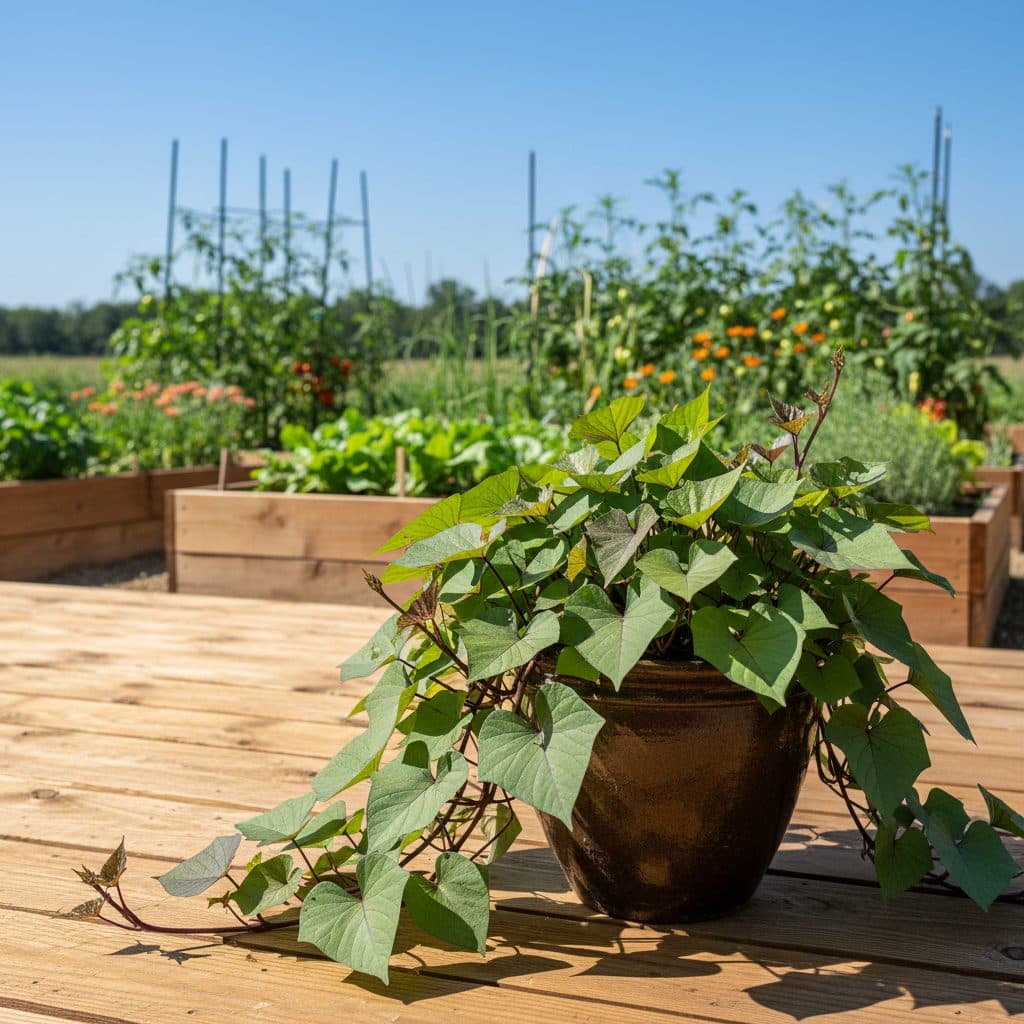
Key takeaways
- Select short-season sweet potato varieties like ‘Vardaman’ or ‘Beauregard’ for northern climates with 90-120 frost-free days.
- Use large containers, at least 15-20 gallons in volume, to accommodate the sprawling root system and ensure adequate soil moisture.
- Start sweet potato slips indoors 6-8 weeks before the last expected frost date to maximize the growing season.
- Provide consistent moisture, about 1 inch of water per week, and a balanced fertilizer with lower nitrogen (e.g., 5-10-10) for optimal tuber development.
- Harvest tubers before the first fall frost, typically 90-120 days after planting slips, and get them out before soil temperature falls below 55°F — sweet potatoes chill-injure in cold soil and then rot in storage.
- Cure sweet potatoes at 85-90°F and 85-90% relative humidity for 5-10 days to enhance sweetness, then store cool for up to six months.
Quick answer: To grow sweet potatoes in containers in USDA Zones 4 and 5, select short-season varieties like ‘Vardaman’ or ‘Beauregard’ and use large containers (15-20 gallons). Start slips indoors 6-8 weeks before the last frost, provide consistent moisture, and ensure 6-8 hours of daily sunlight.
For many growers in northern regions, like those in USDA zones 4 and 5, the idea of cultivating sweet potatoes (Ipomoea batatas) might seem ambitious due to shorter growing seasons. Traditional sweet potato cultivation typically requires 90 to 120 frost-free days with consistent warmth, a challenge in areas where the last spring frost can occur in late May and the first fall frost arrives by early October. However, with careful planning and the strategic use of containers, it is entirely possible to achieve a satisfying harvest, even if your season offers only 100 to 110 warm days. This approach allows for earlier planting and better temperature control, mitigating some of the inherent climatic limitations.
Container gardening provides a distinct advantage by allowing growers to extend the effective growing season. You can start plants indoors or in sheltered areas, moving them outside only when conditions are optimal. This method also offers flexibility in managing soil conditions, moisture, and even pest pressure, making it a practical solution for urban gardeners, those with limited in-ground space, or anyone looking to push the boundaries of what they can grow in a shorter season. By selecting appropriate varieties and providing consistent care, you can enjoy homegrown sweet potatoes from your patio or balcony, regardless of your geographical location north of USDA zone 6.
Choosing the right varieties and containers for northern zones
Successfully growing sweet potatoes in short-season northern zones, such as USDA zone 4 or 5, begins with selecting appropriate varieties and ensuring adequate container size. Varieties like ‘Vardaman’, ‘Georgia Jet’, and ‘Beauregard’ are often recommended because they mature in 90 to 100 days, fitting within a typical 120-day frost-free window. ‘Georgia Jet’, for instance, is known for its relatively quick maturity and good yields, even in cooler conditions. The choice of container is equally critical; sweet potatoes develop extensive root systems, so a minimum of 15 gallons per plant is advisable, with 20-gallon containers offering even better results for larger yields. A 20-gallon container — closer to 19-20 inches across and 16-18 inches deep — provides ample space for tuber formation and helps maintain consistent soil moisture, which is vital for healthy growth. Using a high-quality potting mix that drains well but retains moisture is also important, as waterlogged conditions can lead to root rot.
selecting soil and siting your containers
Beyond variety and container size, the soil medium and placement of your containers significantly influence success. A good potting mix for sweet potatoes should be loose, well-draining, and rich in organic matter. Many growers find success with a blend of compost, peat moss or coco coir, and perlite or vermiculite, aiming for a pH between 6.0 and 6.5. This mixture provides the aeration and nutrient retention sweet potatoes need. Positioning your containers in a spot that receives at least six to eight hours of direct sunlight daily matters for tuber development. In cooler climates, placing containers against a south-facing wall or on a dark-colored surface can help absorb and radiate heat, slightly increasing the ambient temperature around the plants. This can provide a few crucial degrees of warmth, especially in regions like northern Michigan or Maine, where summer nights can still be cool, often dropping below 55°F.
- Select short-season varieties (e.g., ‘Vardaman’, ‘Georgia Jet’).
- Use containers of at least 15-20 gallons volume.
- Ensure potting mix is loose, well-draining, and rich in organic matter.
- Position containers for 6-8 hours of direct sunlight daily.
- Consider dark-colored containers or south-facing walls for added warmth.
Starting slips and planting for an early start
For growers in short-season areas, starting sweet potato slips indoors is perhaps the most critical step to ensure a successful harvest. Sweet potatoes are not grown from seed but from ‘slips,’ sprouts grown from a mature sweet potato tuber. You should begin this process 6-8 weeks before your last expected spring frost date, which might be as late as early June in USDA zone 4. To start slips, place a healthy, unblemished sweet potato in a jar of water or directly in moist potting mix, ensuring about half of the tuber is submerged or covered. Use an organic or certified seed tuber rather than a supermarket one: conventionally stored sweet potatoes may be treated to suppress sprouting and can be slow to sprout or fail outright, and an untested tuber can also carry disease. Roots will develop in one to two weeks, followed by leafy sprouts. Once these sprouts are 4-6 inches long and have several leaves, carefully twist or cut them from the parent tuber. Place these slips in water for a few days to develop roots before planting them in your containers. This early start can provide an extra 30-45 days of growth, which is invaluable in a region with only 90-120 frost-free days.
transplanting and initial care
When transplanting your rooted slips into containers, wait until all danger of frost has passed, the mix has warmed to around 65°F, and night temperatures stay reliably above 55°F — slips set out into cold soil sulk for weeks and never fully catch up. In northern states like Montana or North Dakota, this might not be until mid-June. Plant one slip per 15-20 gallon container, burying it up to the first set of leaves; if you are using a much wider planter, allow 10-12 inches between slips. Water thoroughly after planting to settle the soil around the roots. For more detailed guidance on this process, you can refer to resources like how to grow sweet potatoes from slips. Sweet potatoes are relatively heavy feeders, but initially, a balanced fertilizer or one slightly higher in phosphorus and potassium (e.g., a 5-10-10 ratio) will encourage root development over excessive vine growth. Avoid high-nitrogen fertilizers, as they promote leafy growth at the expense of tuber formation. Consistent moisture is also crucial during this establishment phase; aim for about 1 inch of water per week, either from rainfall or irrigation, to prevent stress on the young plants.
- Start slips indoors 6-8 weeks before the last frost.
- Plant one slip per 15-20 gallon container.
- Ensure night temperatures are consistently above 55°F and the mix has warmed to about 65°F before transplanting.
- Water thoroughly after planting.
- Use a balanced fertilizer or one with higher phosphorus/potassium.
Ongoing care and maintenance for container-grown sweet potatoes
Once your sweet potato slips are established in their containers, consistent care throughout the summer months is essential for a good harvest in northern regions like upstate New York or Wisconsin. Sweet potatoes thrive in warm conditions, with optimal soil temperatures ranging from 65°F to 85°F. Container-grown plants tend to dry out faster than in-ground plants, so regular watering matters. Aim to provide about 1 inch of water per week, adjusting based on rainfall and ambient temperatures. During hot spells, which can reach 90°F or higher in many northern summers, you might need to water daily. Monitoring soil moisture by sticking your finger about 2 inches deep into the soil is a reliable method; if it feels dry, it’s time to water. Mulching the surface of the container with a 1-2 inch layer of straw or wood chips can help retain moisture and regulate soil temperature, reducing the frequency of watering.
fertilization and pest management
Fertilization should be approached carefully to encourage tuber development rather than excessive vine growth. After the initial planting, a second application of a low-nitrogen fertilizer (e.g., 0-10-10 or 5-10-10) about 4-6 weeks after transplanting can be beneficial. Avoid fertilizers with high nitrogen content, which will result in lush foliage but few tubers, a common mistake for new growers. For instance, a 10-10-10 fertilizer might be too high in nitrogen for sustained use. Pests are generally less of an issue for container-grown sweet potatoes compared to in-ground crops, but keep an eye out for sweet potato weevils, aphids, or flea beetles. Inspect plants regularly, perhaps once every three to five days. If you spot pests, a strong spray of water can dislodge aphids, while more persistent issues might require an application of neem oil, following product instructions carefully. Healthy plants are more resilient, so maintaining proper watering and nutrient levels is your first line of defense. For general gardening questions, beginner vegetable gardening FAQs can offer additional guidance.
- Provide 1 inch of water per week, adjusting for weather.
- Monitor soil moisture daily during hot periods.
- Apply low-nitrogen fertilizer (e.g., 0-10-10) 4-6 weeks after planting.
- Mulch containers with 1-2 inches of straw to retain moisture.
- Regularly inspect plants for pests and address issues promptly.
Harvesting and curing for maximum sweetness and storage
The harvest timing for sweet potatoes in northern zones is crucial due to the impending cold. Sweet potatoes are sensitive to frost, and even a light frost can damage tubers close to the soil surface, reducing their storage potential. Aim to harvest before the first hard frost, typically in late September or early October in USDA zone 5, or even earlier in zone 4. The plants will have grown for approximately 90-120 days since slips were planted. Look for signs of maturity, such as yellowing leaves, but primarily rely on your planting date and the weather forecast. To harvest, carefully tip the container onto a tarp or gently dig around the plant with a trowel or pitchfork, starting about 6-8 inches from the main stem to avoid damaging the tubers. Handle the tubers gently, as their skin is very delicate at this stage. You can expect a yield of 2-5 pounds per 20-gallon container, depending on the variety and growing conditions.
the curing process for long-term storage
After harvesting, sweet potatoes require a curing process to convert starches into sugars, enhancing their sweetness and improving their skin toughness for long-term storage. This process matters for quality and involves holding the tubers at a high temperature and humidity for several days. Specifically, sweet potatoes should be cured at 85°F to 90°F with 85% to 90% relative humidity for 5-10 days. In northern homes, this might mean placing them near a wood stove, in a heated bathroom, or using a small space heater and a humidifier in a confined area. After curing, store the sweet potatoes in a cool, dark, and moderately humid environment, ideally between 55°F and 60°F — never in the refrigerator, where cold causes internal damage and a hard core that stays hard after cooking. Under these conditions, properly cured sweet potatoes can last for up to six months, providing a taste of summer well into the winter months. Remember that Ipomoea batatas is a tropical plant, and these specific conditions mimic its native environment.
- Harvest before the first hard frost (late September/early October in zone 5).
- Handle tubers gently to avoid bruising.
- Cure at 85-90°F and 85-90% humidity for 5-10 days.
- Store cured sweet potatoes at 55-60°F in a dark, moderately humid place.
- Expect 2-5 pounds of tubers per 20-gallon container.
Comparison of Sweet Potato Growing Methods in Northern Zones
Feature | Container Growing | In-Ground Growing |
|---|---|---|
Season Extension | Excellent (start indoors 6-8 weeks early) | Limited (reliant on natural frost dates) |
Temperature Control | Good (move containers, use dark surfaces) | Poor (subject to ambient soil/air temps) |
Soil Quality | Full control (custom potting mix) | Variable (dependent on native soil amendments) |
Space Requirement | Low (balconies, patios, rooftops) | High (garden beds) |
Yield per Plant | 2-5 pounds (in 20-gallon container) | 3-6 pounds (can be higher in ideal conditions) |
Pest Management | Easier (isolated plants, easier inspection) | More challenging (larger area, soil-borne pests) |
Optimal Curing: Curing sweet potatoes at 85-90°F and 85-90% humidity for 5-10 days increases their sweetness and lets properly stored roots keep for up to six months.
Container Size: A minimum 15-gallon container is necessary for one sweet potato plant, with 20-gallon containers providing better yields, often 2-5 pounds per plant.
Frequently asked questions
How many sweet potato plants can I grow in a 20-gallon container?
For optimal tuber development and yield, it’s best to plant only one sweet potato slip per 20-gallon container. This provides enough space for the roots to spread and tubers to form, typically yielding 2-5 pounds per plant.
What is the best soil temperature for growing sweet potatoes?
Sweet potatoes thrive in warm conditions, with an optimal soil temperature range of 65°F to 85°F. Consistent temperatures within this range are crucial for vigorous growth and good tuber formation, especially in regions with shorter warm seasons.
When should I start sweet potato slips indoors in USDA zone 5?
In USDA zone 5, you should start sweet potato slips indoors about 6-8 weeks before your last expected spring frost date, which typically falls in late May or early June. This early start gives your plants an extra 30-45 days of growth before transplanting outdoors.
Can I use regular garden soil in my sweet potato containers?
It’s generally not recommended to use regular garden soil directly in containers for sweet potatoes. Garden soil can be too dense, leading to poor drainage and compaction, which inhibits tuber development. A loose, well-draining potting mix with a pH of 6.0-6.5 is preferred for container success.
How long do sweet potatoes need to cure after harvest?
Sweet potatoes require a curing period of 5-10 days immediately after harvest. During this time, they should be kept at a high temperature of 85-90°F and 85-90% relative humidity to convert starches to sugars and toughen their skin for storage.
References
- Growing Sweet Potatoes (2019). Growing Sweet Potatoes.
- Growth and Development of Short and Long Season Sweet Potatoes in Sub-Tropical Australia (1976). Growth and Development of Short and Long Season Sweet Potatoes in Sub-Tropical Australia.
- Chapter Three: Growing Sweet Potatoes (2019). Chapter Three: Growing Sweet Potatoes.
- 3. BIG SWEET POTATOES (2017). 3. BIG SWEET POTATOES.
- USDA Natural Resources Conservation Service (2024). USDA Natural Resources Conservation Service.