Key takeaways
- Rocket stoves offer 30-50% fuel efficiency over open fires, using small diameter wood.
- Proper outdoor cooking station setup, 10 feet from structures, minimizes fire risk.
- Mastering fuel feeding and heat control allows for diverse cooking techniques like frying and boiling.
- Safe canning practices, following USDA guidelines for water bath and pressure canning, matter.
- Integrating rocket stoves with a solar power system enhances overall homestead resilience.
- Reduced emissions from rocket stoves, up to 90% less carbon monoxide, improve air quality.
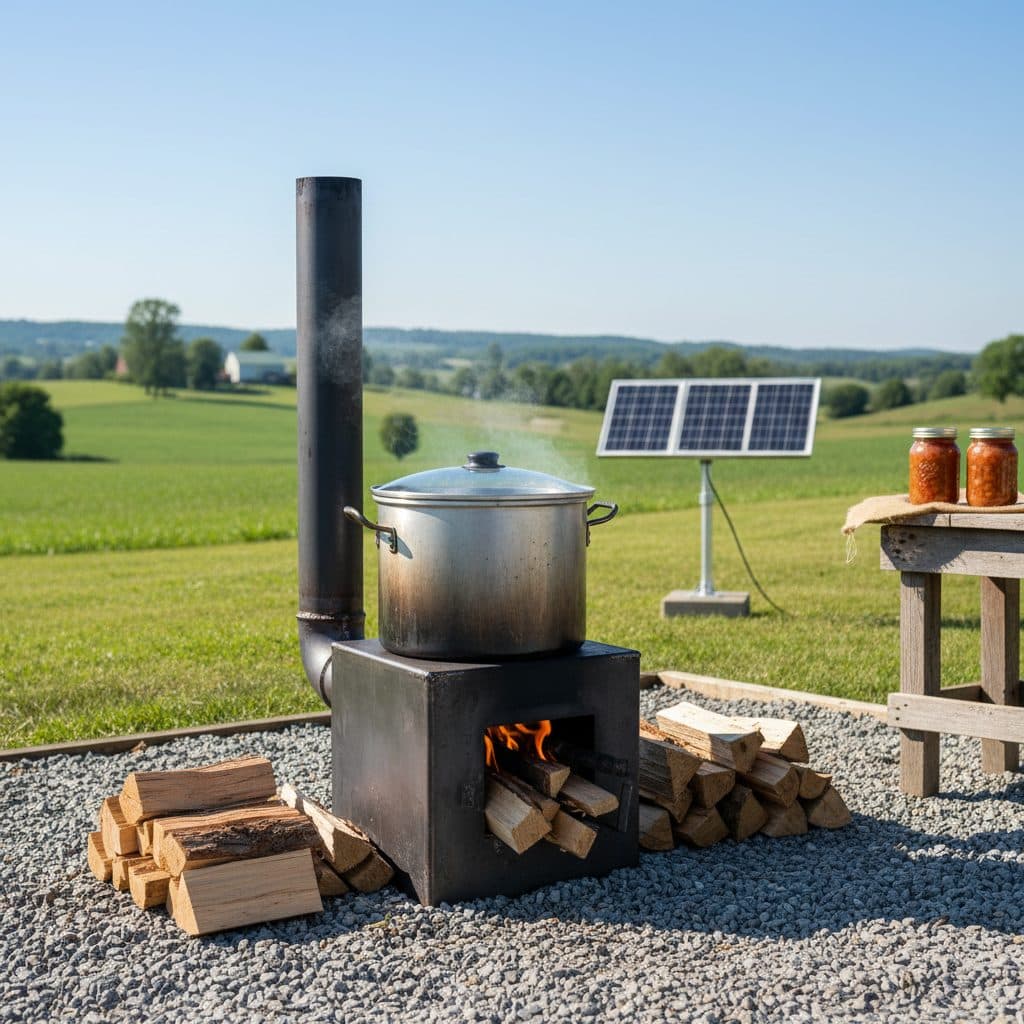
Quick answer: Rocket stoves enable efficient, low-emission outdoor cooking and canning during power outages by using small diameter wood and concentrating heat. They are a resilient solution for homesteaders, especially in regions prone to grid disruptions.
In regions like the Pacific Northwest or the Gulf Coast, where power outages from severe weather can last for days or even weeks, reliable cooking and food preservation methods are essential for homesteaders. Relying solely on a gas grill or a cold pantry during a prolonged grid disruption isn’t a sustainable long-term strategy, especially when you have a garden producing a bounty of fresh vegetables. A well-designed rocket stove, for example, can reduce fuel consumption compared to traditional open fires, making it a highly efficient option for off-grid cooking and canning.
Building resilience into your homestead means having backup systems for critical needs like cooking and food preservation. For many growers in USDA zone 6, this involves preparing for winter storms or summer heatwaves that can strain electrical grids. Learning to operate a rocket stove for everyday meals and for canning your harvest ensures that your family has hot food and preserved goods, even when the lights are out for an extended period, potentially for over 72 hours.
Understanding rocket stove efficiency for homesteaders
Rocket stoves operate on a principle of highly efficient combustion, directing heat into a single cooking surface while minimizing fuel use. This design typically features a J-shaped feed tube, an insulated combustion chamber, and a chimney. Studies in rural Ethiopia have shown that these stoves can achieve a thermal efficiency of 30% to 40%, significantly better than the 10% to 20% of a three-stone open fire [1]. This means you can cook meals using less wood, perhaps just one pound of small diameter branches for a typical dinner, rather than three pounds.
The science behind clean combustion
The insulated combustion chamber of a rocket stove ensures that wood burns at a high temperature, often exceeding 1,100°F, leading to more complete combustion. This process drastically reduces the emission of harmful pollutants. For instance, rocket stoves can produce fewer harmful emissions like carbon monoxide and particulate matter compared to open fires. This cleaner burn is not just about efficiency; it’s about reducing exposure to hazardous air pollutants, which can include volatile organic compounds (VOCs) and polycyclic aromatic hydrocarbons (PAHs) [4].
- fuel efficiency: uses 30-50% less wood than open fires.
- reduced emissions: up to 90% less carbon monoxide [2].
- faster cooking: concentrates heat for quicker boil times.
- portability: many models are lightweight, weighing under 20 pounds.
- cost-effective: uses readily available small wood scraps.
Setting up a safe outdoor cooking station
Establishing a dedicated and safe outdoor cooking station is paramount, especially when dealing with open flames and high heat. Choose a location at least 10 feet away from any combustible structures, such as your home, shed, or woodpile. The ground surface should be non-combustible; a concrete slab, gravel pad, or a layer of fire bricks measuring at least 3 ft by 3 ft provides an excellent base. In a typical homestead in northern California, where wildfire risk is a concern, maintaining a defensible space around structures is often recommended, and your cooking station should adhere to similar principles [6].
Weather protection and ventilation
While rocket stoves are designed for outdoor use, protecting your cooking area from wind and rain improves efficiency and comfort. A simple lean-to or a sturdy tarp shelter, positioned at least 8 feet above the stove, can shield you from the elements. Ensure adequate ventilation to prevent smoke buildup, even with the cleaner burn of a rocket stove. A 10-foot open-sided structure can provide ample airflow. Always have a fire extinguisher or a 5-gallon bucket of water readily accessible, within 5 feet of the cooking area, for immediate response to any sparks or flare-ups.
- clearance: maintain 10 feet from structures and dry vegetation.
- stable surface: use concrete, gravel, or fire bricks for the base.
- ventilation: ensure open airflow to prevent smoke accumulation.
- fire suppression: keep a fire extinguisher or water source nearby.
- shelter: consider a non-combustible overhead cover for weather protection.
Mastering cooking on a rocket stove
Cooking on a rocket stove requires a slightly different approach than a conventional kitchen range, but with practice, it becomes intuitive. The key is consistent fuel feeding and understanding how to regulate heat. Use small, dry pieces of wood, ideally 1 to 2 inches in diameter and 6 to 12 inches long. Hardwoods like oak, maple, or fruitwood burn longer and hotter, providing about 8,000 BTUs per pound, compared to softer woods. Feed the fuel horizontally into the feed tube as it burns, maintaining a steady flame. This continuous feeding ensures consistent heat output for simmering stews or boiling water for pasta.
Heat regulation and cookware choices
Heat regulation is achieved by adjusting the amount of fuel and how far it’s pushed into the combustion chamber. For a rolling boil, feed more fuel; for a gentle simmer, reduce the fuel and allow it to burn down slightly. Cast iron cookware, with its excellent heat retention and even distribution, is ideal for rocket stove cooking. A 10-inch cast iron skillet or a 6-quart Dutch oven can handle most cooking tasks effectively. Remember that the concentrated heat can quickly scorch food, so frequent stirring, especially with thicker sauces, is often necessary. A 2021 study on cooking stoves noted that consistent heat management is key to preventing chronic obstructive pulmonary disease (COPD) from prolonged smoke exposure [5].
- fuel size: use small, dry wood pieces, 1-2 inches in diameter.
- consistent feeding: maintain a steady flame by regularly adding fuel.
- cast iron: ideal for even heat distribution and retention.
- stir frequently: prevent scorching due to concentrated heat.
- monitor flame: adjust fuel input for desired cooking temperature.
Preserving harvests with outdoor canning
Canning outdoors on a rocket stove is an excellent way to preserve your harvest during a power outage, or simply to keep the heat out of your kitchen during summer months in places like the hot and humid Southeast. The concentrated heat of a rocket stove is perfectly suited for bringing large canning pots up to temperature and maintaining a steady boil or pressure. For high-acid foods like tomatoes, pickles, and fruit jams, water bath canning is the appropriate method. A 21-quart water bath canner, capable of holding seven pint jars, can be brought to a rolling boil efficiently on a well-fueled rocket stove.
Pressure canning for low-acid foods
For low-acid foods such as green beans, corn, meats, and soups, pressure canning is absolutely essential to prevent the growth of harmful bacteria like Clostridium botulinum. This requires reaching temperatures of 240°F (10 pounds of pressure at sea level). While a rocket stove can provide the necessary heat, maintaining a consistent pressure can be more challenging than with a controlled indoor burner. It demands vigilant monitoring and careful fuel management. Always follow USDA canning guidelines precisely, which recommend specific processing times and pressures for different foods to ensure safety and quality, often requiring specific processing times for vegetables.
- water bath: suitable for high-acid foods like pickles and jams.
- pressure canning: required for low-acid foods to ensure safety.
- USDA guidelines: always follow recommended processing times and pressures.
- large pots: use 21-quart canners for efficiency.
- vigilant monitoring: essential for maintaining consistent pressure and temperature.
Complementing rocket stoves with solar power
While a rocket stove handles the cooking, a solid off-grid solar power system can manage other essential needs during a power outage, creating a truly resilient homestead. By using the rocket stove for cooking and canning, you significantly reduce the electrical load on your battery bank, freeing up precious stored energy for critical appliances like refrigeration, lighting, and communication devices. For example, a typical refrigerator might draw 100-200 watts, and running it for 24 hours consumes 2.4-4.8 kWh. By cooking with wood, you save this energy for other uses. You can explore options for off-grid and hybrid solar systems to build out your energy independence.
Sizing your solar backup for essential needs
A modest solar setup, perhaps with two 400-watt solar panels and a 200 Ah (amp-hour) 12V lithium battery bank, can provide enough power for essential loads for 2-3 days without sun. This setup could power LED lights for 8 hours, charge phones, and run a small chest freezer for 12 hours, drawing perhaps 600-watt hours per day. Understanding solar panels for off-grid living and sizing your array and battery correctly matters. This hybrid approach — using wood for high-heat tasks and solar for electricity — provides a comprehensive solution for prolonged grid disruptions, ensuring your homestead remains functional and comfortable, even during a week-long outage.
- reduced electrical load: cooking with wood saves battery power for other uses.
- extended battery life: less demand on solar batteries means longer runtime.
- critical appliance support: power refrigerators, lights, and communication.
- energy independence: less reliance on the grid for daily operations.
- hybrid resilience: combining wood fuel and solar electricity for comprehensive backup.
rocket stove vs. propane camp stove for power outages
feature | rocket stove | propane camp stove |
|---|---|---|
fuel source | small diameter wood, twigs | propane cylinders (1 lb or 20 lb) |
fuel cost | free (foraged) | $5-20 per 1 lb cylinder |
emissions | low particulate matter, CO (if efficient) [2] | low CO, some VOCs |
heat output | concentrated, high (10,000 BTU/hr) | adjustable, moderate (7,000-15,000 BTU/hr) |
canning suitability | excellent for water bath, good for pressure (with attention) | good for water bath, pressure (consistent heat) |
portability | moderate (15-30 lbs for sturdy models) | high (5-10 lbs) |
maintenance | ash removal, occasional cleaning | fuel line inspection, burner cleaning |
fuel savings: Rocket stoves can reduce fuel consumption by 30% to 50% compared to traditional open fires, saving resources during outages [1].
cleaner air: Using a rocket stove can cut carbon monoxide emissions by up to 90% and particulate matter by 50% over open fires, improving air quality around your homestead [2].
References
- Design and Performance Evaluation of Rocket Stove for Cleaner Cooking in Rural Ethiopia (2020). Design and Performance Evaluation of Rocket Stove for Cleaner Cooking in Rural Ethiopia.
- Emission of Volatile Organic Compounds During Open Fire Cooking with Wood Biomass: Traditional Three-Stone Open Fire vs. Gasifier Cooking Stove in Rural Kenya.
- Technology including cooking (2022). Technology including cooking.
- Hazardous Air Pollutants Found in Cooking Stove Gas (2022). Hazardous Air Pollutants Found in Cooking Stove Gas.
- Chronic Obstructive Pulmonary Disease Among the Users of Improved Cooking Stove and Traditional Cooking Stove (2021). Chronic Obstructive Pulmonary Disease Among the Users of Improved Cooking Stove and Traditional Cooking Stove.
- USDA Natural Resources Conservation Service.