Key takeaways
- Modern, heirloom, and overripe tomatoes routinely test at pH 4.3–4.9 above the pH 4.6 Clostridium botulinum ceiling, making standardized acid mandatory for both boiling-water bath and pressure canning.
- Add 1 tablespoon bottled 5% lemon juice OR 1/4 teaspoon citric acid per pint (2 tablespoons OR 1/2 teaspoon per quart)—never unstandardized fresh lemon juice.
- Use 5% vinegar (2 Tbsp/pint, 4 Tbsp/quart) for plain tomatoes only, and never substitute vinegar for bottled lemon or lime juice in tested salsa.
- Adjust water-bath times above 1,000 ft (+5/+10/+15 min for >20-minute packs) or raise dial/weighted pressure PSI per USDA elevation charts.
- Five P0 bans stop botulism: no custom salsa ratios, no flour/cornstarch/oil thickeners, no oven/open-kettle/Instant Pot canning, no sea-level shortcuts above 1,000 ft, and never tasting bulging, foaming, or unsealed jars.
Quick answer: Tomatoes, tomato sauce, and salsa require standardized acidification because modern, heirloom, and vine-ripened tomatoes routinely test at pH 4.3–4.9—above the pH 4.6 Clostridium botulinum germination ceiling. Add 1 tablespoon bottled 5% lemon juice or 1/4 teaspoon citric acid per pint (2 tablespoons or 1/2 teaspoon per quart) before processing in either a boiling-water canner or a pressure canner, use lab-tested salsa formulas in pint or half-pint jars only, adjust times or PSI above 1,000 feet, never add flour/cornstarch/oil or use ovens/Instant Pots, and store sealed jars ring-free at 50–70°F.
Why pH 4.6 Makes Mandatory Acidification Non-Negotiable
Growing productive tomatoes delivers summer crates that outpace fresh slicing, yet preserving that harvest safely hinges on food microbiology rather than folklore. Clostridium botulinum bacteria survive harmlessly as dormant spores on soil-grown produce and in raw air. Sealed inside a moist, oxygen-free canning jar between 40°F and 120°F, those spores germinate and generate botulinum neurotoxin whenever food acidity sits above pH 4.6.
Generations ago, standard canning guides treated tomatoes as reliably high-acid. Laboratory pH surveys published through the USDA Complete Guide to Home Canning and the National Center for Home Food Preservation (NCHFP) changed that guidance permanently: many modern hybrids, sweet heirlooms, late-season vine-ripened fruit, and tomatoes picked from frost-killed or diseased vines measure pH 4.3 to 4.9. Because boiling-water bath canning peaks at 212°F at sea level—hot enough to destroy vegetative molds and yeasts, yet far too cool to kill heat-resistant C. botulinum spores—dropping every jar to pH 4.6 or lower is the chemical barrier that blocks toxin formation.
Acidify even when using a pressure canner: A common myth claims pressure canning replaces lemon juice or citric acid. USDA Guide 3 pressure schedules for tomatoes (10 to 25 minutes at 10–15 PSI) are calibrated strictly on acidified tomatoes—never omit bottled lemon juice or citric acid when pressure canning plain tomatoes, crushed tomatoes, tomato juice, or standard sauce.
Review our home canning 101 guide, water-bath vs. pressure canning guide, and botulism, acidity, and altitude reference before firing a burner. Pack only firm, unblemished fruit free of early or late blight and blossom-end rot; bruised, overripe, or frost-killed tomatoes exhibit higher pH and heavier spore loads.
Standardized Acidification Ratios: Bottled Lemon Juice, Citric Acid & 5% Vinegar
Drop the acid straight into each hot jar immediately before ladling tomatoes or sauce, then stir gently after filling or pack cleanly so acidity distributes through the whole jar. If tartness bothers your palate, stir in a pinch of white sugar to taste—sugar balances flavor without raising pH, whereas skipping or cutting acid strips away botulism protection.
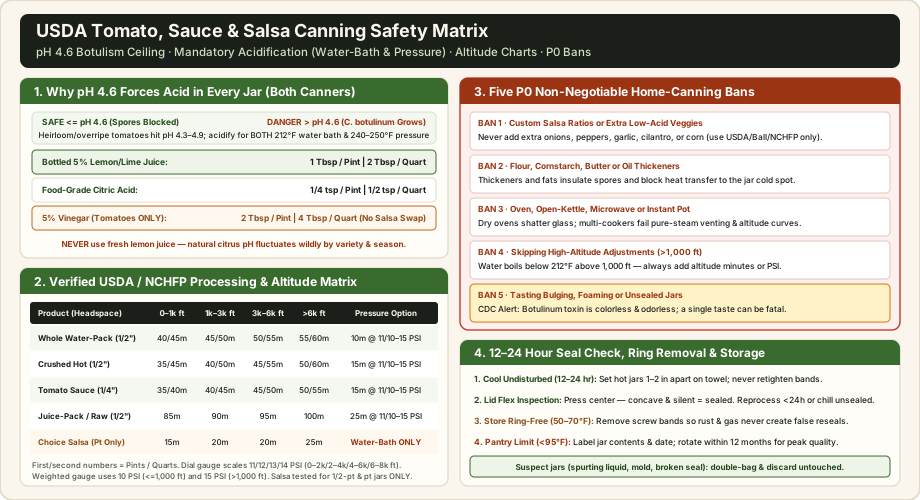
USDA / NCHFP Mandatory Acidification Rates per Jar (Boiling-Water Bath & Pressure Canning)
Acidifying Agent | Amount per Pint Jar | Amount per Quart Jar | USDA / NCHFP Rules & Flavor Notes |
|---|---|---|---|
Commercial Bottled 5% Lemon or Lime Juice | 1 tablespoon (1/2 fl oz) | 2 tablespoons (1 fl oz) | Standardized 5% acidity; safe for tomatoes, juice, sauce, and tested salsas (never use bottled Key lime juice). |
Food-Grade Citric Acid (Granular) | 1/4 teaspoon | 1/2 teaspoon | Sulfite-free and virtually flavor-neutral; ideal when avoiding lemon taste or sulfite preservatives. |
Commercial 5% Acidity Vinegar | 2 tablespoons | 4 tablespoons | Permitted in plain tomato packs only (stronger tang); NEVER substitute vinegar for lemon juice in tested salsa. |
Fresh-Squeezed Lemon or Lime Juice | DO NOT USE | DO NOT USE | BANNED for safety: fresh citrus pH swings widely by cultivar, tree stress, and ripeness. |
Never try to outsmart tested recipes with cheap home litmus strips or pocket pH pens. Solids and liquids inside chunky crushed tomatoes or pepper-heavy salsa equilibrate slowly over days in storage, causing surface brine readings to look safer than the dense vegetable centers. Rely on standardized commercial bottles labeled 5% acidity rather than homemade vinegars or fresh fruit.
USDA / NCHFP Tomato, Sauce & Tested Salsa Processing Schedules
Match pack density, jar size, headspace, and elevation strictly to published USDA Bulletin 539 tables. Blanch firm ripe paste or slicing tomatoes in boiling water for 30 to 60 seconds until skins split, plunge into ice water, slip skins, and trim away woody cores. Tomato peels carry concentrated soil bacteria and curl unpleasantly during long storage; always peel tomatoes unless a specific tested sauce method instructs pressing skins and seeds out through a food mill.
Verified USDA / NCHFP Processing Times & Elevation Adjustments (All Jars Acidified First)
Tomato Product & Headspace | Boiling-Water: 0–1,000 ft | Boiling-Water: 1,001–3,000 ft | Boiling-Water: 3,001–6,000 ft | Boiling-Water: >6,000 ft | Dial-Gauge / Weighted-Gauge Pressure Option |
|---|---|---|---|---|---|
Whole or Halved (Water-Packed, 1/2 in headspace) | 40 min (Pt) / 45 min (Qt) | 45 min (Pt) / 50 min (Qt) | 50 min (Pt) / 55 min (Qt) | 55 min (Pt) / 60 min (Qt) | 10 min @ 11–14 PSI dial (10/15 PSI weighted) OR 15 min @ 6–9 PSI dial |
Crushed Tomatoes (No Added Liquid, 1/2 in headspace, Hot Pack) | 35 min (Pt) / 45 min (Qt) | 40 min (Pt) / 50 min (Qt) | 45 min (Pt) / 55 min (Qt) | 50 min (Pt) / 60 min (Qt) | 15 min @ 11–14 PSI dial (10/15 PSI weighted) OR 20 min @ 6–9 PSI dial |
Standard Tomato Sauce (1/4 in headspace, Hot Pack) | 35 min (Pt) / 40 min (Qt) | 40 min (Pt) / 45 min (Qt) | 45 min (Pt) / 50 min (Qt) | 50 min (Pt) / 55 min (Qt) | 15 min @ 11–14 PSI dial (10/15 PSI weighted) OR 20 min @ 6–9 PSI dial |
Whole or Halved in Tomato Juice OR Raw No-Liquid (1/2 in headspace) | 85 min (Pt or Qt) | 90 min (Pt or Qt) | 95 min (Pt or Qt) | 100 min (Pt or Qt) | 25 min @ 11–14 PSI dial (10/15 PSI weighted) OR 40 min @ 6–9 PSI dial |
USDA / NCHFP Choice Salsa (1/2 in headspace, Hot Pack — 1/2 Pt & Pt ONLY) | 15 min (Half-Pt or Pt) | 20 min (1,001–6,000 ft) | 20 min (1,001–6,000 ft) | 25 min (Half-Pt or Pt) | Boiling-water canner ONLY (no tested USDA salsa pressure times; NO quarts) |
Whole, Crushed & Juice-Packed Tomatoes: Why Times Double Between Packs
Water-packed whole tomatoes process in 40 minutes (pints) and 45 minutes (quarts) at 0–1,000 ft, whereas raw no-liquid packs and tomato-juice packs jump to 85 minutes because thick juice slows heat convection. Boiling crushed tomatoes for 5 minutes before hot-packing prevents separation and trims processing to 35 minutes (pints) and 45 minutes (quarts).
Standard Tomato Sauce: Yield Weights & Meat/Vegetable Sauce Rules
NCHFP Standard Tomato Sauce yields 7 quarts from 35 lb tomatoes (thin sauce, reduced one-third) or 46 lb (`28 lb` per 9 pints, thick sauce reduced one-half), packed at 1/4-inch headspace (`35 min` pints / `40 min` quarts at sea level). Adding sautéed onions, garlic, vegetables, or meat requires a dedicated USDA low-acid pressure-canning spaghetti sauce formula rather than tomato-only times.
Salsa Safety Rules: Tested Pint Formulas Only
Salsa mixes tomatoes with low-acid onions, sweet and hot peppers, chilies, garlic, and cilantro that push pH upward. Use our safe canning salsa guide or NCHFP's Choice Salsa (`6 cups` chopped tomatoes, `9 cups` diced onions/peppers, `1 1/2 cups` bottled 5% lemon/lime juice, `3 tsp` canning salt) strictly in pint or half-pint jars:
- Safe swaps: Trade pepper cultivars cup-for-cup (hot jalapeños for bell peppers without raising total volume); adjust dried oregano or cumin; swap bottled lemon juice for 5% vinegar.
- Forbidden swaps: Never raise total onions, peppers, or garlic; never swap vinegar for bottled lemon/lime juice; never add extra cilantro, corn, or black beans; and never pack salsa in quarts.
Five P0 Non-Negotiable Home-Canning Bans (Life-Safety Rules)
CDC surveillance attributes most US home-canning botulism outbreaks not to bad luck, but to improvised recipes, unapproved appliances, and ignored spoilage cues. Treat these five rules as hard boundaries—if an internet blog or family notebook breaks even one, freeze the batch instead of canning it.
Five P0 Home-Canning Bans vs. Validated USDA / CDC Protocols
P0 Ban | Dangerous Practice to Reject | Microbiological / Physical Failure Mechanism | Verified Safe Protocol |
|---|---|---|---|
1. Custom Salsa Ratios | Winging fresh salsa ratios or tossing extra onions, peppers, garlic, cilantro, or sweet corn into canning pots. | Low-acid vegetables dilute acid below the pH 4.6 safety wall, letting surviving C. botulinum spores grow. | Use USDA, NCHFP, Ball, or Extension tested formulas ONLY; freeze custom fresh salsa in plastic/freezer jars. |
2. Starch or Fat Thickeners | Adding flour, cornstarch, ClearJel, olive oil, butter, or bacon grease before canning sauces or salsas. | Starches turn viscous under heat and slow thermal convection; fats coat spores and shield them from moist steam. | Drain excess liquid, simmer longer before filling, use paste tomatoes, or thicken with cornstarch AFTER opening. |
3. Unverified Heating Appliances | Canning in conventional ovens, open-kettle pots, jar-inversion cooling, dishwashers, microwaves, or Instant Pots. | Dry oven air cracks glass and fails to sterilize; open-kettle leaves mold spores that raise pH; multi-cookers fail pure-steam venting and altitude hold. | Process ONLY in deep boiling-water bath (water >=1–2 in above lids), tested atmospheric steam canners (<45 min), or stove-top pressure canners. |
4. Ignoring Altitude Adjustments | Running sea-level times or weights above 1,000 ft elevation. | Boiling temperature drops roughly 2°F per 1,000 ft (water boils near 203°F in Denver at 5,280 ft), leaving jars under-processed. | Add +5/+10/+15 min in water-bath above 1,000/3,000/6,000 ft; bump weighted-gauge to 15 PSI >1,000 ft and dial-gauge +1 PSI per 2,000 ft. |
5. Tasting Suspect or Ringed Jars | Storing jars with screw bands locked on, or tasting an odd-smelling/bubbling jar 'just to check'. | Rusted bands trap moisture and cause false reseals after spoilage gas pops lids; botulinum toxin is odorless, invisible, and lethal in microscopic doses. | Store clean jars ring-free at 50–70°F; if a lid bulges, leaks, spurts foam, smells off, or fails flex test, discard untouched. |
Why Altitude Rules Matter for Both Water-Bath and Pressure Canners
At sea level, water boils at 212°F. Climb above 1,000 feet and lower atmospheric pressure drops the boiling point—down near 203°F at 5,000 feet and 198°F at 7,500 feet. Notice how USDA altitude brackets differ between equipment types so you never confuse them:
- Boiling-water bath (>20 min base time): Add `+5 min` (`1,001–3,000 ft`), `+10 min` (`3,001–6,000 ft`), and `+15 min` (`>6,000 ft`). For Choice Salsa (`15 min` base), jump to `20 min` (`1,001–6,000 ft`) and `25 min` (`>6,000 ft`).
- Dial-gauge pressure canner (base `11 PSI` or `6 PSI`): Scales continuously every `2,000 ft` (`11 PSI` at `0–2,000 ft`; `12 PSI` at `2,001–4,000 ft`; `13 PSI` at `4,001–6,000 ft`; `14 PSI` at `6,001–8,000 ft`). Have dial gauges tested annually by your County Extension office.
- Weighted-gauge pressure canner (base `10 PSI` or `5 PSI`): Shifts immediately above `1,000 ft` (`10 PSI` at `0–1,000 ft` jumps to `15 PSI` above `1,000 ft`). Notice NCHFP marks `10-min @ 15 PSI` schedules as Not Recommended above 1,000 ft—use the `15-min` or `25-min` row at `15 PSI` instead.
Step-by-Step Safe Processing, 12–24h Seal Check & Ring-Free Pantry Storage
Clean execution after cooking protects your seal rate just as much as accurate acid dosing. Follow this sequence for every batch alongside our beginner canning checklist:
- Inspect glass & prep lids: Discard nicked rims and always use brand-new flat metal lids; reuse metal screw bands only if straight and rust-free.
- Acidify, pack & debubble: Measure acid into hot jars first, fill leaving 1/2-inch headspace (1/4-inch for sauce), debubble with a non-metallic wand, wipe rims clean, and screw bands fingertip-tight.
- Process full count: Submerge jars under 1 to 2 inches of rolling boiling water, or vent pressure canners 10 full minutes of pure steam before pressurizing and timing at target PSI.
- Cool undisturbed 12–24 hours: Lift jars straight onto a folded towel 1–2 inches apart; never retighten warm bands.
- Test seals & store ring-free (`50–70°F`): After 12 to 24 hours, remove bands and press lid centers—concave lids with zero flex are sealed. Refrigerate, freeze, or reprocess unsealed jars within 24 hours with new lids, wash sticky residue, label, and store ring-free in a cool dark pantry (`50–70°F`, always `<95°F`).
CDC Botulism Spoilage Protocol — When in Doubt, Throw It Out: Botulinum toxin has no smell, taste, or color, and one taste can be fatal. Discard any jar with a bulging lid, broken seal, leaking residue, spurting foam, mold, or off-odor—double-bag and dispose safely without tasting. For sealed home-canned tomatoes with uncertain processing history, CDC notes boiling in a saucepan for 10 minutes (plus 1 minute per 1,000 ft elevation) before tasting.
Beyond canning jars, turn cherry tomatoes into solar-dehydrated powder, ferment extra chilies into fermented hot sauce, make shelf-stable pickles, or protect fresh basil using safe oil-infusion rules and herb freezing. Browse garden glut playbooks, homesteading kitchen preservation, pressure-canned green beans, and water-bath peaches for other crops.