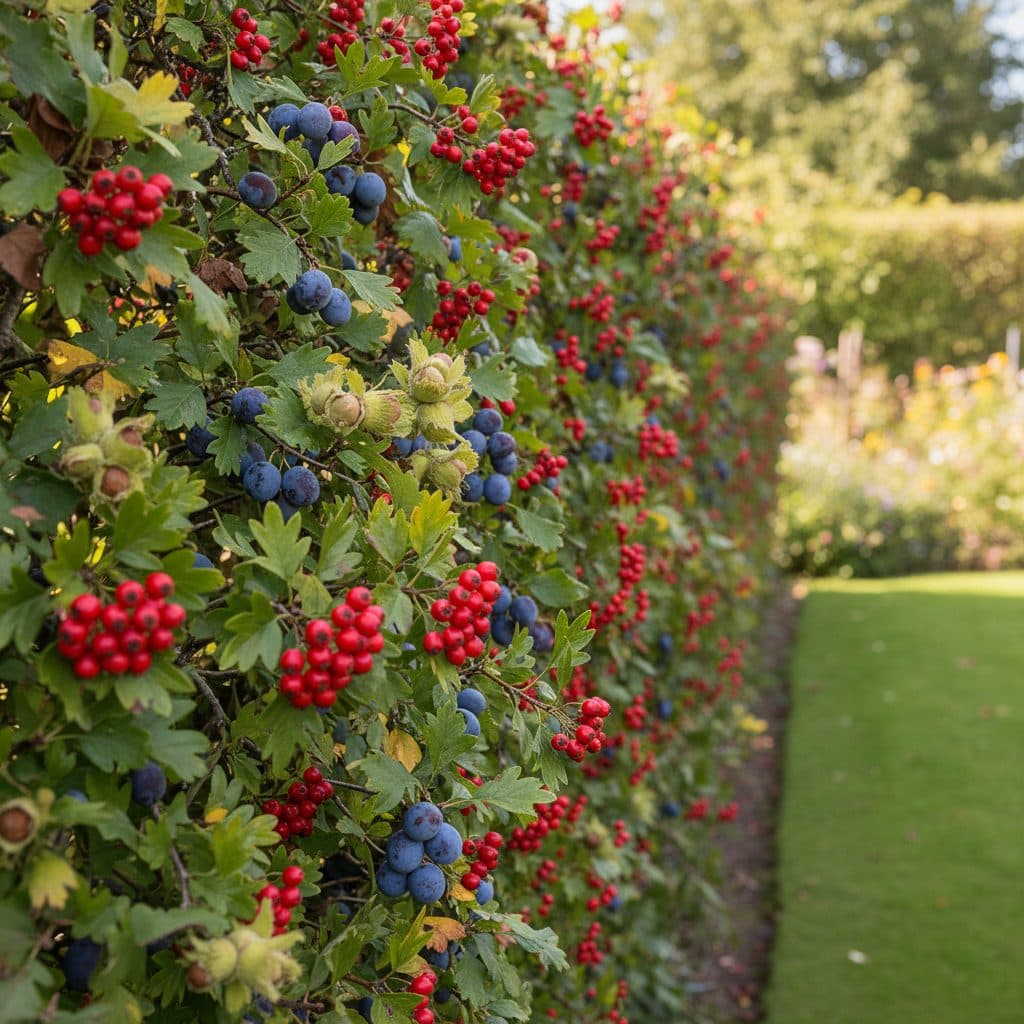
Key takeaways
- Planting a mixed edible hedge creates a multifunctional boundary that provides seasonal fruits, nuts, culinary teas, wind protection, and wildlife habitat.
- A balanced UK native mix typically uses 50% to 60% hawthorn as the structural backbone, interplanted with hazel, blackthorn, elderberry, dog rose, and crabapple.
- Bare-root whips planted between November and March establish deep root systems at a fraction of the cost of container-grown shrubs.
- Planting in a staggered double row with 33 to 40 cm spacing creates a dense, stock-proof barrier (giving the standard 5 whips per linear metre) that blocks prevailing gales and filters garden noise.
- Edible hedgerows require annual winter pruning to encourage dense base branching while preserving two-year-old fruiting wood for autumn harvests.
Quick answer: To plant an edible hedge in the UK, choose a diverse mix of native deciduous whips, such as hawthorn (50%), hazel, blackthorn, elderberry, dog rose, and crabapple. Plant bare-root whips in staggered double rows spaced 33 to 40 cm apart (5 whips per linear metre) between November and March, mulch deeply with woodchips, and prune lightly each winter to encourage dense, bushy growth.
Traditional garden boundaries rely on timber fence panels or single-species evergreen hedges like laurel or leylandii. An edible hedge instead provides a living boundary that yields wild foods throughout the year.
The British hedgerow is an iconic historical feature of the countryside. By adapting traditional agricultural hedging techniques to modern gardens, allotments, and smallholdings, you can harvest elderflowers in June, hazelnuts in August, and sloes, rosehips, and crabapples from September until the first frosts.
Beyond food production, a mixed native fruiting hedge is a microclimate buffer. It filters cold winds, traps moisture, and provides nesting sites for predatory birds, hedgehogs, and pollinators that keep garden pests in check.
+-------------------------------------------------------------+
|              EDIBLE HEDGEROW SPECIES PROFILE                |
|                                                             |
|   SPECIES         BOTANICAL NAME      EDIBLE HARVEST        |
|   -------         --------------      --------------        |
|   Hawthorn        *Crataegus monogyna*Spring greens, Haws   |
|   Blackthorn      *Prunus spinosa*    Autumn Sloes          |
|   Hazel           *Corylus avellana*  Late Summer Hazelnuts |
|   Elderberry      *Sambucus nigra*    Flowers, Cooked berries|
|   Dog Rose        *Rosa canina*       Autumn Rosehips       |
|   Crabapple       *Malus sylvestris*  High-pectin Jelly     |
+-------------------------------------------------------------+
Which native UK species work best in an edible hedgerow?
Selecting a resilient, locally adapted blend of deciduous native shrubs ensures your hedge survives harsh winter wet, resists local pests, and fruits reliably without synthetic fertilisers.
1. Hawthorn (Crataegus monogyna)
Hawthorn forms the dense, thorny skeleton of the hedge. Its young, tender spring leaves (traditionally known as "bread and cheese") have a mild, nutty flavour suitable for fresh salads. In autumn, the tree bears heavy clusters of red haws, which make rich fruit pastes and savoury jellies. Cook the haws whole and sieve the pulp; do not crush or eat the pips, which contain cyanogenic compounds.
2. Hazel (Corylus avellana)
Hazel is a vigorous native that produces delicious cobnuts in late summer. It tolerates frequent coppicing, providing a steady supply of straight pea sticks, bean poles, and woven hurdles for your vegetable garden.
3. Blackthorn / Sloe (Prunus spinosa)
Blackthorn produces stiff, spiny branches that make the hedge line genuinely stock-proof and deter casual access, while its dense thorny structure is prime nesting cover and its early blossom provides nectar. Wear thick gloves and eye protection when pruning: blackthorn punctures readily turn septic. In late autumn, its deep purple sloes are harvested after the first frost to infuse traditional sloe gin, syrups, and preserves. Note that wild blackthorn can sucker; prune root suckers during routine maintenance to keep the hedge line neat.
4. Elderberry (Sambucus nigra)
Elder produces two distinct seasonal crops: fragrant white umbels of elderflower in early summer for cordials and champagnes, followed by heavy purple-black berry clusters in autumn. Raw elderberries contain mildly toxic sambunigrin; always cook elderberries into syrups, jams, or wine before consumption.
5. Dog Rose (Rosa canina)
Scrambling through the hedge canopy, native dog rose produces pale pink summer blooms followed by bright scarlet hips packed with vitamin C. Harvest hips after the first frost for traditional rosehip syrup. Strain the pulp through fine muslin or a jelly bag at least twice: the hairs surrounding the seeds are an irritant and must be removed from the finished syrup.
For foragers exploring complementary wild species to integrate along border margins, review our catalogue of wild edible plants.
+-------------------------------------------------------------+
|              HARVEST CALENDAR ACROSS THE YEAR               |
|                                                             |
|   SPRING:      Hawthorn young leaves, blossom               |
|   SUMMER:      Elderflower heads                            |
|   LATE SUMMER: Hazelnuts                                    |
|   AUTUMN:      Elderberries, sloes, bullaces, crabapples,   |
|                rosehips                                     |
|   WINTER:      Hawthorn and rosehip processing              |
+-------------------------------------------------------------+
How do you design and space a mixed fruiting hedge?
A successful edible hedge balances structural density with fruiting access. If you plant only soft fruiting bushes without thorny framework species, the hedge will look gappy and fail to keep animals out.
For a standard garden boundary or windbreak:
- Composition ratio: Allocate 50% to 60% of your total plant count to hawthorn. Distribute the remaining 40% to 50% evenly among hazel, blackthorn, elder, dog rose, and crabapple.
- Double staggered row: Mark two parallel planting lines 30 to 40 cm apart. Space whips 33 to 40 cm apart within each row, staggering the plants between the rows in a zig-zag pattern. This gives the standard 5 whips per linear metre.
- Sunlight orientation: Align the hedge on a north-south axis if possible, allowing both sides of the hedge to receive direct morning and afternoon sunshine for even fruit ripening.
+-------------------------------------------------------------+
|              DOUBLE STAGGERED ROW LAYOUT                    |
|                                                             |
|   Row 1:    (Haw)       (Hazel)       (Haw)       (Rose)    |
|               \           /             \           /       |
|   Row 2:        (Sloe)        (Haw)         (Elder)         |
|                                                             |
|   Spacing: 33-40 cm between plants, 30-40 cm between rows   |
+-------------------------------------------------------------+
To incorporate nitrogen-fixing support species or multi-tiered canopy borders, see our guide to nitrogen-fixing trees, which is written to US hardiness zones and will need translating to RHS ratings for UK planting, and compare drought-tolerant trees and shrubs.
What is the step-by-step planting procedure for bare-root whips?
The most economical and reliable way to establish a hedgerow is by planting dormant bare-root whips (40 to 60 cm tall) between November and March, when the soil is cool and moist.
- Clear the planting strip: Remove all perennial grass, docks, and nettles along a 1-metre-wide strip. Avoid rotovating if bindweed is present, as chopping roots spreads infestations.
- Dig a planting trench or slit-plant: For heavy soils, dig a continuous trench 30 cm deep and wide, loosening the base with a garden fork. In lighter soils, you can "notch plant" using a spade to open a T-shaped slit in the ground.
- Inspect and trim roots: Keep bare-root whips wrapped in damp hessian until the moment of planting. Prune off damaged root tips and soak roots in a bucket of water for two hours before installation.
- Firm the soil: Place each whip at the same depth it grew in the nursery (indicated by the soil mark on the stem). Backfill with native soil and firm down thoroughly with the heel of your boot to eliminate air pockets.
- Mulch heavily: Spread a thick 8 to 10 cm layer of coarse woodchips, leaf mould, or straw along the entire strip. Mulch conserves soil moisture and prevents weed competition during the first two seasons.
- Install spiral guards: If rabbits, hares, or deer are active in your area, protect each whip with a biodegradable spiral guard and bamboo cane.
+-------------------------------------------------------------+
|              WHIP PLANTING CHECKLIST                        |
|                                                             |
|   - Plant strictly between November and March (dormancy)    |
|   - Soak bare roots 2 hours prior to planting               |
|   - Maintain original nursery soil line depth               |
|   - Firm soil firmly to eliminate air voids around roots    |
|   - Apply 10 cm woodchip mulch across entire root strip     |
+-------------------------------------------------------------+
How do you prune and maintain an edible hedge for maximum fruit?
Pruning an edible hedge differs from maintaining a formal box or privet hedge. Tight summer shears slice off developing fruit and remove next year's flower buds.
First and second year establishment
In the first late winter after planting, cut all whips back by one-third of their height. While this feels counterintuitive, it stimulates vigorous dormant buds near the base, creating a dense, multi-stemmed thicket instead of leaving the base thin and leggy.
Ongoing maintenance cycle
Once established, prune your hedge once a year in late winter (January or February). Pruning during late winter ensures wild birds have finished eating any remaining autumn berries while avoiding the main bird nesting season, which runs roughly March to August. It is an offence under the Wildlife and Countryside Act 1981 to damage or destroy an active nest at any time of year, so check the hedge before any cut. Separate fixed-date restrictions on cutting hedgerows apply to agricultural land and differ between England, Scotland, Wales and Northern Ireland; check the current rules with your relevant government agriculture or environment body and, if you have one, your local authority before cutting.
Hawthorn and blackthorn fruit on short spurs on two-year-old and older wood, so hard annual shearing removes the crop. Hazel bears its nuts on the current season's shoots arising from last year's growth, and elder flowers on the current season's growth, so both tolerate harder cutting. Match the cut to the species instead of shearing the whole hedge to one regime.
For homesteaders managing livestock boundaries and supplemental animal feed, see our guide to the best fodder trees and shrubs by zone.