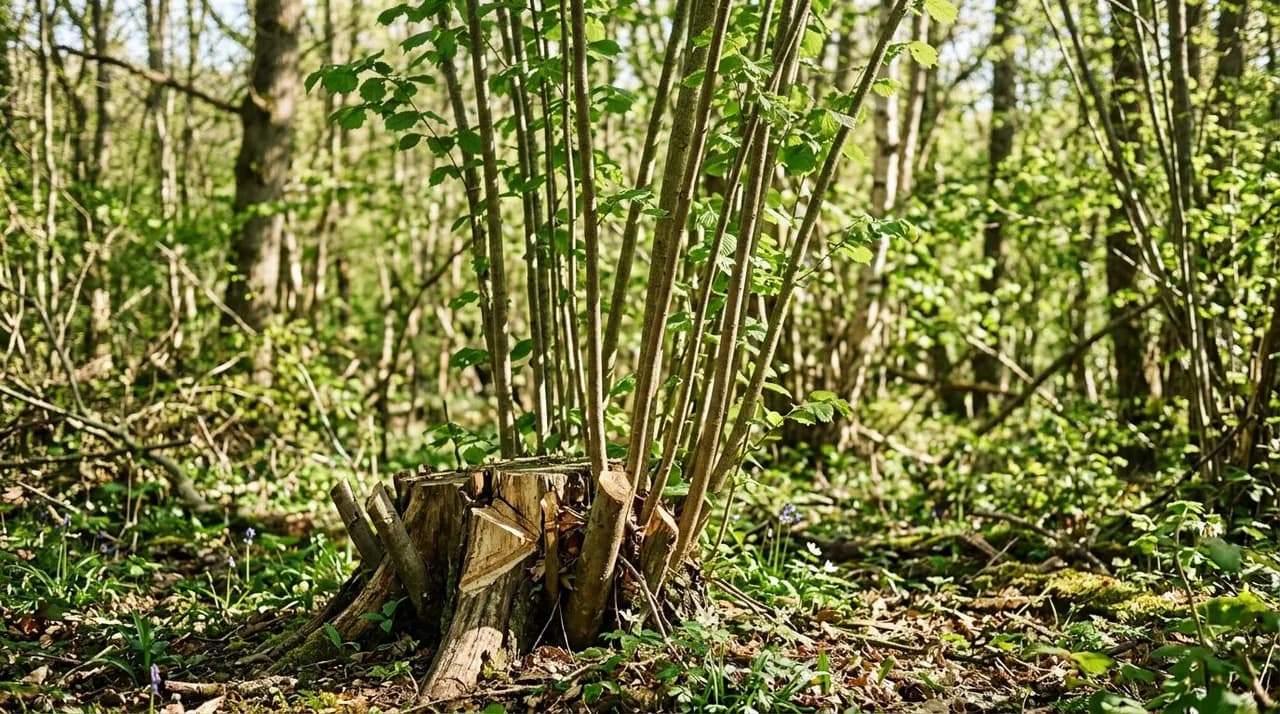
Key takeaways
- Coppicing is an ancient woodland management practice of cutting broadleaf trees down to ground level during winter dormancy.
- The intact living root system rapidly regenerates straight, multi-stemmed poles on predictable rotational cycles.
- Coppicing extends a tree's biological lifespan indefinitely, with historic stools surviving for centuries.
- Differs from pollarding, which cuts trees high on the main trunk (2 metres / 6 feet) out of reach of grazing livestock.
- Top coppice species include hazel, sweet chestnut, willow, alder, ash, and tropical nitrogen-fixers like gliricidia.
Quick answer: Coppicing is a traditional agroforestry technique where broadleaf trees are cut down to ground level during winter dormancy to stimulate rapid regrowth of straight timber poles. It yields a continuous harvest of firewood, garden stakes, fence materials, and organic biomass without killing the tree.
Mastering the practice of coppicing allows homesteaders, farmers, and permaculture practitioners to generate an endless supply of wood, garden structures, and living biomass from a modest plot of land. Practiced across Europe, Asia, and the Americas for thousands of years, coppicing harnesses a natural biological adaptation shared by many deciduous broadleaf trees: the ability to sprout vigorous new vegetative stems from dormant buds located around the root collar.
Unlike standard forestry, which clear-cuts and kills trees, coppicing works in harmony with the living tree. Because the mature underground root system remains fully established and connected to soil mycorrhizal networks, the regenerated shoots (known as poles, rods, or withies) grow at three to five times the rate of newly planted seedlings.
Coppicing supplies household firewood from a woodlot, bean poles and fencing stakes from garden hazel stools, or mulch material from fast-growing legumes.
What is coppicing: the biology of regeneration
When a broadleaf tree is severed near its base during the dormant season, the sudden removal of apical dominance triggers a hormonal cascade:
- The Coppice Stool: The base of the severed trunk is called the stool. Over successive harvesting cycles, the stool expands outward into a knobbly, multi-headed crown.
- Adventitious and Epicormic Buds: Latent dormant buds beneath the bark of the stool awaken, fueled by stored starches in the root system. In the first spring following cutting, the stool pushes dozens of vertical, straight, unbranched shoots that compete eagerly for sunlight.
- Indefinite Tree Longevity: Because coppicing regularly resets the tree's above-ground physiological age back to a juvenile state, coppiced trees virtually never die of old age. Across ancient European woodlands, active hazel, sweet chestnut, and small-leaved linden (Tilia cordata) coppice stools are estimated from their stool diameter to be over 800 to 1,000 years.
- Ecological Diversity: In a rotational coppice woodlot, cutting different sections (coupes) on staggered years creates a dynamic mosaic of light levels. Sun-drenched newly cut areas allow dormant woodland wildflowers, butterflies, and ground-nesting birds to flourish before the canopy closes again.
To understand how woody perennials provide continuous fertility within regenerative layouts, explore our guide to syntropic farming and principles in what is a food forest.
Coppicing vs pollarding: key differences explained
While both techniques stimulate juvenile regrowth from established roots, they differ fundamentally in harvesting height:
Coppicing (ground level)
- Cut Height: Trees are cut 5 cm to 15 cm (2 to 6 in) above ground level.
- Application: Ideal for enclosed woodlands, gardens, and fenced woodlots where browsing animals cannot damage the tender emerging regrowth.
- Products: Produces straight poles, withies for basket weaving, hurdles, bean poles, charcoal, and firewood.
Pollarding (elevated crown)
- Cut Height: Trees are cut at the top of a single main trunk, typically 2 m to 3 m (6 to 10 ft) above the ground.
- Application: Historically developed for wood pastures and urban streetscapes where grazing livestock (cattle, sheep, deer) or roaming horses would otherwise browse off ground-level shoots.
- Products: Produces leaf fodder for livestock, basket willow withies, and small firewood while allowing cattle to graze safely beneath the trees.
Best tree species for coppicing by climate
Selecting the right tree species dictates the rotation cycle, wood durability, and final utility of your harvest.
1. Hazel (Corylus avellana)
The quintessential temperate coppice tree:
- Rotation Cycle: 7 to 10 years for general stakes and poles; 3 to 5 years for flexible weaving withies.
- Wood Qualities: Flexible, straight, easy to split.
- Uses: Wattle hurdle fencing, garden bean wigwams, walking sticks, charcoal, and living hedge weaving. Combine hazel understories with perennial edibles by reviewing perennial vegetables for UK gardens.
2. Sweet chestnut (Castanea sativa)
The premier timber and fencing coppice across temperate regions:
- Rotation Cycle: 12 to 16 years for fencing posts; 20 to 25 years for small construction timber.
- Wood Qualities: High natural tannin content makes the heartwood exceptionally resistant to ground rot without chemical preservatives.
- Uses: Cleft post-and-rail fencing, vineyard stakes, shingles, and durable outdoor construction.
3. Willow (Salix species)
The fastest-growing temperate biomass and weaving species:
- Rotation Cycle: 1 to 2 years for basketry withies; 3 to 5 years for living willow structures and biochar.
- Wood Qualities: Extremely pliable and moisture-tolerant.
- Uses: Living arbors, erosion control along riverbanks, woven baskets, and rooting hormone extracts.
4. Alder (Alnus species)
A moisture-loving, nitrogen-fixing tree suited for damp soils and swale systems:
- Rotation Cycle: 8 to 12 years.
- Wood Qualities: Rot-resistant under water, fine-grained, burns with steady heat when dry.
- Uses: Charcoal production, clog making, and wetland bank stabilization. Discover cold-climate nitrogen fixers in our guide to cold-hardy nitrogen fixers.
5. Ash (Fraxinus excelsior, F. americana)
Long valued as one of the best firewood trees:
- Rotation Cycle: 15 to 20 years.
- Wood Qualities: Dense, shock-resistant, low natural moisture content. Note before planting: ash dieback (Hymenoscyphus fraxineus) has devastated ash across Europe and the UK, and emerald ash borer is spreading through North American ash. Existing healthy stools are still worth cutting, but ash is not a species to plant up a new coppice with in either region.
- Uses: Tool handles, sports equipment, and firewood — ash burns better than most species when green, but it still repays a year of seasoning.
6. Subtropical and tropical species
In subtropical and tropical climates:
- Gliricidia (Gliricidia sepium) and Leucaena (Leucaena leucocephala): Fast-growing nitrogen-fixing legume trees coppiced every 3 to 6 months for nutrient-dense green manure and protein-rich animal fodder.
- Eucalyptus species: Select species (such as Eucalyptus camaldulensis) coppiced on 8 to 12-year cycles for high-density firewood, construction poles, and charcoal in arid and Mediterranean regions.
Rotational cycles and woodlot management
To secure a continuous, annual harvest of wood, divide your woodlot into a series of equal management plots (coupes):
- Calculating Coupes: Divide your available land into the same number of plots as your intended rotation cycle in years. For example, if managing hazel on a 7-year cycle, divide your hazel grove into 7 equal plots.
- Annual Harvesting: Harvest Coupe 1 in Year 1, Coupe 2 in Year 2, and so on. By the time you return to harvest Coupe 1 in Year 8, its stems will have grown for seven full seasons and reached mature harvesting size.
- Firewood Self-Sufficiency: As a rough traditional rule of thumb, around a hectare of productive broadleaf coppice on a long rotation has historically supplied a household's firewood, but the real figure swings widely with climate, house size, stove efficiency and species yield — measure your own annual usage in cubic metres before sizing a woodlot.
Tools, cutting mechanics, and seasonal timing
Executing clean, biologically sound cuts ensures the stool remains healthy and prevents destructive fungal infections:
Seasonal timing
Always coppice trees during the depths of winter dormancy (November to February in the Northern Hemisphere, June to August in the Southern Hemisphere), when sap flow has retreated into the roots. Never coppice in late spring or midsummer when the tree's bark is soft and peeling, as cutting during active sap flow bleeds the root system and invites fatal rot.
Tool selection
- Billhook: The traditional single-handed curved woodland tool, ideal for cleanly severing rods up to 5 cm (2 in) in diameter in a single upward stroke.
- Pruning Saw or Bow Saw: For stems 5 cm to 15 cm (2 to 6 in) in diameter.
- Chainsaw: For large, mature chestnut or oak stools over 15 cm (6 in) in diameter. Learn proper cutting hygiene and equipment maintenance in our guide on how to prune fruit trees.
The sloping cut technique
- Cut stems as close to the existing stool base as possible (5 cm to 10 cm / 2 to 4 in above the root collar). Leaving tall, ragged stumps causes the wood to rot from the top down.
- Make a clean, smooth cut angled at approximately 45 degrees, sloping outwards and downwards away from the center of the stool.
- The sloping angle ensures rainwater runs off immediately rather than pooling on flat stump surfaces, which fosters wood-decaying fungal spores.
- Never rip or tear the bark away from the stool collar; damaged bark cannot form the callus tissue necessary for vigorous bud break.
Protecting young shoots from wildlife browse
The biggest threat to a newly coppiced stool is herbivorous wildlife. In the first spring after cutting, the tender, mineral-rich young shoots are irresistible delicacies for deer, rabbits, hares, and livestock:
- Dead Hedges: Pile the discarded brushwood and branch tops (brash) in a dense, interlocking dead hedge directly around the freshly cut stool to physically block deer and rabbits from reaching emerging shoots.
- Woven Cages: Erect small wire mesh cylinders around individual vulnerable stools for the first two years until the shoots grow above the browse line (1.8 m / 6 ft).
- Temporary Fencing: Install temporary electric or woven wire deer fencing around the active coupe for three growing seasons.
Selecting suitable tree species, maintaining rotational coupes, and making clean dormant-season cuts keeps a coppice productive for decades.