Key takeaways
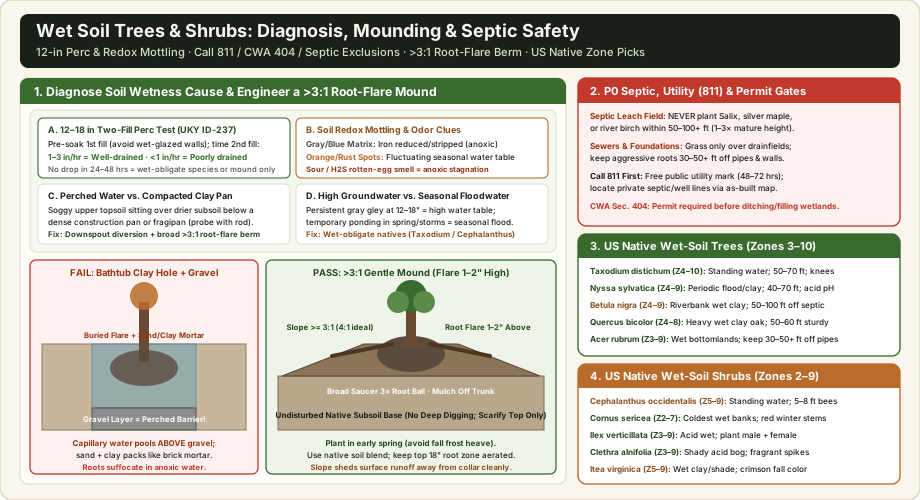
- Separate perched water tables, compacted clay pans, seasonal floodwater, and high groundwater with a 12-inch two-fill perc test (`1–3 in/hr` ideal; `<1 in/hr` poor) plus gray/orange soil redox mottling and H2S odor checks.
- Never plant Salix willows, silver maple (Acer saccharinum), or river birch (Betula nigra) within 50–100+ feet of septic leach fields, sewer lines, or shallow foundations—keep only turfgrass over absorption trenches.
- Always Call 811 (48–72 hours prior) to mark underground public lines and obtain local/USACE Clean Water Act Section 404 clearance before excavating ditches or filling potential wetlands.
- Match species to USDA zone, inundation duration, and soil pH across proven US natives (Taxodium distichum, Nyssa sylvatica, Betula nigra, Cephalanthus occidentalis, Cornus sericea, Ilex verticillata, Clethra alnifolia, Itea virginica).
- Never dump gravel at the bottom of a clay hole or mix sand into clay backfill; set the structural root flare 1–2 inches above grade on undisturbed native soil inside a gentle >3:1 (4:1 ideal) berm.
Quick answer: Before buying wet-soil plants, diagnose why water sits using a 12-inch two-fill percolation test (`<1 in/hr` signals poor drainage) and check subsoil color for gray iron-depleted matrices or orange redox mottling. Keep aggressive water-seeking trees (Salix willows, silver maple, river birch) at least 50–100+ feet from septic drainfields, sewer laterals, and foundations, call 811 before digging, and verify Clean Water Act Section 404 rules before ditching jurisdictional wetlands. For chronically soggy yards, plant adapted US natives—such as Taxodium distichum
, Nyssa sylvatica
, Cephalanthus occidentalis
, Cornus sericea
, Ilex verticillata
, Clethra alnifolia
, or Itea virginica
—in early spring on gentle >3:1 root-flare mounds without gravel at the hole base.
Diagnose Why Your Soil Stays Wet Before Choosing Plants or Digging
University of Kentucky Extension (ID-237) traces 80% to 90% of landscape plant losses back to soil and water mismatches. Once pore spaces (macropores) fill with water instead of air, roots stop taking up moisture even when standing in mud. Leaves wilt just like drought—tricking homeowners into watering more while anoxic pathogens rot roots in hours. Running a simple site diagnosis separates four distinct hydrology profiles before you spend money on stock or drainage rock.
Run the 12-inch two-fill percolation test and soil redox check
Skip single-fill guesswork and follow our complete soil drainage percolation test protocol modeled on UKY ID-237. Dig a 12-to-18-inch deep hole when soil is workable—avoid smearing wet clay walls with a shovel blade, which seals pores and creates false failures. Fill the hole with water and let it soak and drain completely first so clay swells to field capacity. Refill to a measured mark and time hourly drop on the second fill: 1 to 3 inches per hour is ideal, whereas under 1 inch per hour confirms severe drainage restriction.
While your pit is open, inspect soil color and smell using Purdue Agronomy's soil-redox criteria. Well-aerated soil stays uniform brown or reddish-brown because oxidized iron coats soil particles. When seasonal saturation starves soil microbes of oxygen, bacteria reduce iron and strip it away—leaving dull gray, blue-gray, or pale white matrices alongside bright orange or rust mottles where water tables rise and fall. A sour or rotten-egg hydrogen sulfide odor confirms chronic anaerobic stagnation where upland landscape trees will drown.
Field Diagnostic Matrix: Separating Four Causes of Chronic Soil Wetness
Wetness Cause | 12-in Perc & Profile Clues | Redox & Odor Signature | Site Fix vs. Planting Strategy |
|---|---|---|---|
Perched Water Table (Claypan / Fragipan) | Water stalls `<1 in/hr` over a dense subsurface shelf; soil 24–36" deeper often digs drier | Gray/orange mottling concentrated right above the restrictive pan | Redirect roof downspouts uphill, build shallow >3:1 mounds, or plant shallow-rooting wet shrubs |
Compacted Construction Clay | Metal rod or screwdriver hits hard refusal 4–10" down; ponding starts immediately in light rain | Mottling in top 6–12"; glazed shiny clods when sliced with a spade | Shatter crust surface gently, apply 3–4" wood chips to improve heavy clay, and plant tolerant natives |
Seasonal Floodwater / Low Swale | Drains reasonably (`1–2 in/hr`) in dry months, but floods for days to weeks during snowmelt or storms | Rust streaks along old root pores over mottled brown subsoil | Use rain garden sizing and flood-hardy natives (Taxodium, Cephalanthus, Cornus sericea) |
True High Groundwater / Hydric Seam | Hole refills from below after bailing; water lingers `>48 hrs` even in dry weeks | Continuous blue-gray gleyed matrix near surface + sour H2S rotten-egg smell | Do not fight water table with raised boxes for large trees; plant true wetland obligates or verify wetland status |
P0 Safety & Legal Gates: Septic Drainfields, Sewers, Call 811, and Clean Water Act 404
Wet soil articles frequently tell homeowners to drop fast-growing willows or river birches into soggy lawn corners to "drink up excess water." On residential US properties with septic systems, buried utility lines, or jurisdictional drainage channels, reckless planting or ditching causes five-figure repairs and federal or municipal fines.
Septic leach fields, sewer pipes, and house foundations
Septic absorption fields pump warm, nutrient-loaded moisture continuously into shallow soil trenches. According to University of Maine Cooperative Extension and Clemson Extension guidelines, aggressive phreatophytic trees actively chase that water gradient—invading perforated drain tiles, clogging gravel beds, and cracking sewer joints. Keep only shallow-rooted turfgrass directly over septic tanks, distribution boxes, and leach fields, and keep roof downspouts diverted away so trenches stay aerobic.
Mandatory Minimum Setbacks from Septic Leach Fields, Sewer Laterals & Foundations
Vegetation / Infrastructure Zone | Minimum Setback Distance | Flagged Wet-Soil Species | Engineering Reason |
|---|---|---|---|
Directly Over Septic Tank & Leach Trenches | 0 ft woody plants (Turfgrass only) | Ban all trees, woody shrubs, and deep vegetable beds | Grass prevents erosion without punching into perforated pipes or blocking oxygen exchange |
Aggressive Phreatophytes (Salix, Silver Maple, River Birch, Poplar, Elm) | 50–100+ ft (or `1–3×` mature height / `2–4×` canopy diameter) | Salix discolor, Acer saccharinum, Betula nigra (Betula also heaves walks) | Dense fibrous roots seek pipe condensation and crack clay/PVC sewer seals and basement drains |
Large Wet-Tolerant Canopy Trees (Swamp White Oak, Red Maple, Bald Cypress) | 30–50+ ft minimum from drainfields & foundations | Quercus bicolor, Acer rubrum, Taxodium distichum (`Taxodium` knees lift turf) | Broad lateral buttress roots lift shallow slabs and driveways within 15–20 ft |
Small Trees & Non-Aggressive Wet Shrubs | 20 ft (small trees) / 10+ ft (shrubs) from leach edges | Ilex verticillata, Clethra alnifolia, Itea virginica, Aronia melanocarpa | Compact woody root systems stay outside trench gravel envelopes when properly watered |
Call 811 before digging and check Clean Water Act Section 404 permits
Colorado State University Extension stresses calling 811 at least 48 to 72 business hours before planting trees or cutting swales. Utility crews mark public electric, gas, fiber, and water lines free of charge—yet 811 locators rarely mark private pipes running from house to septic tank, well casing, or detached outbuildings. Pull your county as-built septic map or hire a private locator before sinking deep tree holes.
Check Clean Water Act Section 404 before ditching or filling wet ground: Under Section 404 of the federal Clean Water Act, the U.S. EPA and U.S. Army Corps of Engineers (USACE) regulate discharging fill dirt, gravel, or dredged spoils into jurisdictional wetlands connected to waters of the United States. Side-casting excavated soil while cutting new backyard drainage ditches or filling low swales can require USACE Nationwide or Individual permits, and county stormwater ordinances often enforce stricter buffers—always verify local conservation rules and review swale permits and foundation setbacks before grading.
US Native Trees & Shrubs for Wet Soil Organized by USDA Zone
Selecting trees and shrubs native to North American bottomlands eliminates guesswork because these species evolved internal air channels (aerenchyma) or shallow adventitious roots to survive spring saturation. Rather than dumping random ornamentals into clay, match species across USDA Hardiness Zones 2 through 10 to exact flooding duration, mature height, soil pH, and utility distance via our USDA zone plant finder.
Zone-Banded US Native Trees & Shrubs for Wet, Saturated & Poorly Drained Sites
Botanical & Common Name | USDA Zones | Mature Size (H × W) | Wetness & Sun Tolerance | Key Soil pH, Care & Setback Notes |
|---|---|---|---|---|
Taxodium distichum (Bald Cypress) | Zones 4–9 (to 10 South) | 50–70 ft × 20–30 ft | Standing water to upland; full sun | Deciduous conifer; forms woody "knees" in standing water (avoid tight lawn mow paths); adapts from acid to neutral soil |
Nyssa sylvatica (Black Gum / Tupelo) | Zones 4–9 | 40–70 ft × 20–35 ft | Periodic flood/wet clay to dry; sun–part shade | Deep taproot (plant young stock in final spot); prefers acidic pH (`<6.5`)—yellows in high-pH alkaline clay |
Betula nigra (River Birch) | Zones 4–9 (3b–9) | 30–70 ft × 40–60 ft | Extended spring wet clay; full sun | Bronze-birch-borer resistant; iron chlorosis >pH 6.8; keep 50–100+ ft off septic, sewers, and foundations |
Cephalanthus occidentalis (Buttonbush) | Zones 5–9 (4–10) | 5–8 ft × 3–6 ft | Standing water champion; full sun–light shade | Thrives in permanently wet swamps and rain gardens; struggles in dry upland soils; pollinator magnet |
Cornus sericea (Red-Osier Dogwood) | Zones 2–7 | 5–9 ft × 5–10 ft | Bog margins & wet clay; sun–part shade | Coldest-hardy wet shrub; spreads by stolons to stabilize creek banks and swales; cut 1/3 old stems late winter for bright red bark |
Ilex verticillata (Winterberry Holly) | Zones 3–9 | 3–15 ft × 3–12 ft | Swamp margins & wet clay; sun–part shade | Deciduous native holly; acidic soil (`pH 4.5–6.0`) required; dioecious—plant 1 matched male per 5–8 females for red berries |
Clethra alnifolia (Summersweet) | Zones 3–9 | 5–10 ft × 4–6 ft | Wet acidic shade & coastal spray; part–full shade | Top shade-tolerant wet shrub; fragrant late-summer flower spikes; forms neat colonizing thickets |
Itea virginica (Virginia Sweetspire) | Zones 5–9 | 4–8 ft × 3–6 ft | Wet clay, shade & temporary standing water | Compact cultivars ('Little Henry') fit tight wet borders (`10+ ft` off drainfields); scarlet-purple autumn leaves |
Cold northern yards (Zones 2–5): frost heave and pH matching
Across northern Midwest, New England, and Mountain states (Zones 2–5), Cornus sericea, Ilex verticillata, Clethra alnifolia, and cold-hardy black chokeberry anchor wet swales and snowmelt basins. Illinois and Iowa State Extension specialists warn growers to plant wet-soil stock in early spring rather than autumn in cold climates: wet clay expands and contracts during winter freeze-thaw cycles, heaving unrooted fall transplants half out of the ground. Check topsoil alkalinity with a Cooperative Extension soil test first, because Betula nigra, Nyssa sylvatica, and Ilex verticillata turn pale yellow from iron chlorosis above pH 7.0.
Mid-Atlantic, Midwest & Southern rain gardens (Zones 6–10)
Warmer humid regions support towering floodplain canopies and dense pollinator edges. Pair Taxodium distichum and Nyssa sylvatica with Cephalanthus occidentalis, Itea virginica, pecan on deep alluvial bottoms, or understory pawpaw and American persimmon along seasonal creek terraces. For wet-site edibles and multi-purpose hedges, add native elderberry (Sambucus canadensis—noting raw berries, bark, and leaves are toxic unless properly cooked, and always distinguish them from lethal water hemlock lookalikes), edible cold-hardy hedges, and nitrogen-fixing black alder or marginal ostrich fern and cattail in dedicated water basins.
If you specifically want evergreen winter foliage on damp sites where Thuja or boxwood rots, select true wet-adapted native evergreens like inkberry holly (Ilex glabra, Zones 5–9) or sweetbay magnolia (Magnolia virginiana, Zones 5–10), rather than forcing upland conifers into saturated hollows. Review our dedicated native rain garden plant pairings and edibles for wet feet when designing multi-layer wet food forests.
Shallow Root-Flare Mounding (>3:1 Slope) and Why Gravel Layers Fail
Even flood-adapted trees die fast when installed too deep inside slick clay pits. Purdue Extension (FNR-FAQ-18-W) shows that structural tree roots forage within the top 18 inches of soil where oxygen is highest, while bark lenticels above the root flare exchange critical gases. Burying that flare under 4 inches of heavy mud rots trunk collars and triggers stem-girdling roots that strangle trees 10 to 15 years later.
Debunking two fatal wet-clay hole myths: gravel layers and mixing sand
- Never put gravel at the bottom of a planting hole: Soil physics creates a capillary barrier wherever fine clay or loam meets coarse stone. Downward water stops and pools inside the fine soil above the gravel until completely saturated—creating an artificial perched water table directly beneath your tree's roots.
- Never mix sand into heavy clay backfill: UKY ID-237 explicitly warns that stirring coarse sand or grit into wet clay shrinks pore space rather than opening it. Sand grains nest inside clay plates like concrete aggregate, locking roots inside brick-hard mortar.
How to build a >3:1 shallow root-flare berm step by step
- Locate the true root flare first: Before digging, scrape away nursery potting media or top burlap soil with a screwdriver 3–4 inches out from the stem (CSU Extension) until at least two main structural roots appear—never mistake a swollen lower graft union for the root flare.
- Stop digging deep and scarify native grade: On sites percolating `<1 in/hr`, dig a shallow, saucer-wide hole 3× the root-ball width and shallower than the ball height so the bottom rests firmly on undug native soil (preventing future settling). Lightly scratch glazed shovel walls and the surface soil where your berm sits so water crosses the interface cleanly.
- Raise the flare 1–2 inches above surrounding grade: Set the root ball high—1 inch above grade for 1-inch caliper trees, or 2 inches above grade for 2-to-4-inch caliper trees—cutting away the top third of wire baskets and removing synthetic twine around the trunk.
- Taper backfill at a >3:1 gentle slope: Pack unamended native soil firmly around the lower sides and shoulder out a broad mound sloping at least 3 horizontal feet for every 1 vertical foot of rise (3:1 minimum; 4:1 to 5:1 is ideal to prevent erosion and dry-out). Leave the top flat surface of the root ball completely bare of backfill soil.
- Mulch wide, never deep against bark: Spread 2 to 3 inches of coarse shredded wood chips across the entire berm footprint to regulate moisture and keep clay from baking hard in August, pulling mulch 3 inches clear of the exposed root flare.
Once installed, check moisture during dry summer stretches for the first two growing seasons—even Taxodium and Cephalanthus need supplemental soaking until feeder roots exit nursery potting balls into native clay. Where downspout overflow or sheet runoff feeds the low spot, intercept water upstream with contour swales and dry creeks, inspect waterlogged clay soil fixes, and explore wet-spot native pairings or downspout lawn planting.